Compounding Math of AI Visibility, Brand Authority, Machine Layers & the Cost of Waiting
For founders and marketing leads deciding when to start building for AI search, and for anyone weighing content for the feed against content for the machine layer.
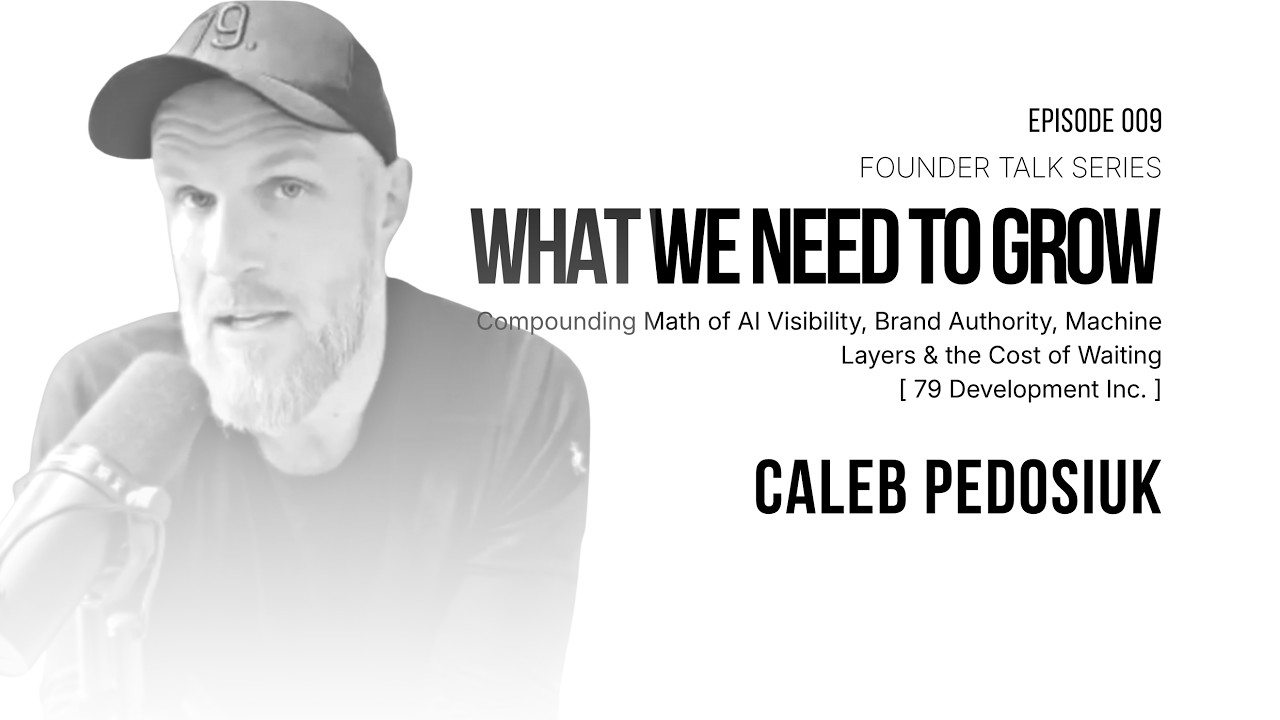
In this solo episode, Caleb Pedosiuk of 79 Development uses a rose of Sharon seed pod to explain why AI visibility compounds. A brand that plants meaningful content now, connected properly into its own digital infrastructure, gives AI systems something to read, index and reinforce, and every query it wins points to the next piece worth making. Waiting until the competitors arrive means paying more for less. The principle underneath it is the one 79 Development keeps coming back to: to be cited a year or five years from now, no matter how the models move, be deserving of the citation.
KEY TAKEAWAYS
- Visibility goes to the brands that deserve it. Forget the hacks, the shortcuts and the black hat tactics. "This time next year, there will be far more people in your space that are contending," and the lineup will be longer. The ones that get to the top are the ones with substance: "if you do solve a meaningful problem in the world and you're good at it, you have testimonials, you have proof, you have product market fit, there is no reason that you should not be surfacing in your market."
- Planting two seeds costs about the same as planting twenty. Right now the time it takes to put a seed in the ground and let it become a sapling is "the same amount of time and arguably same amount of resources" whether you plant two or twenty. Wait until the ocean turns from blue to red and it "will become far more expensive to get far less impact than if you start now."
- Write for the machine layer, not only the feed. Content that interrupts people in their feeds still has a place. But when someone pulls out a device, describes a problem and asks for a solution, "that is a different point of intersection," and reaching it takes more work up front so AI systems have "a greater level of confidence to believe that you actually are the right option."
- Every surfaced query carries the DNA of the next piece. Tools now show what people ask ChatGPT, Claude, Perplexity and Google's AI summaries word for word, and whether your brand or a competitor showed up. That query "has the DNA of possibility": an article, a post, a podcast, a conversation with an authority, all connected back to "the digital root structure" of where the brand calls home. One seed becomes a pod, the pod becomes the next season's seeds, and the compounding plays in your favour instead of against you.
FULL TRANSCRIPT
What We Need to Grow, Episode 009: Plant Two or Plant Twenty. A solo episode with Caleb Pedosiuk, co-founder of 79 Development. Cleaned for readability; the words are the speakers' own.
Caleb Pedosiuk: If you are considering growing anything this spring, this is probably one of my favourite things to grow. This is a rose of Sharon seed pod. The rose of Sharon is just such an incredible plant. I'll share an example of it with you right here. It looks like a hibiscus in many respects, but it grows as a tree, and it blooms for so much of the summer. We're located up in Canada, and this thing is just amazing. Many times you'll see vibrant pink, white, even purple hues in it. It's really incredible.
Caleb: As much as I love this plant, and I would encourage you, if you're thinking about planting something, to absolutely consider it, I want to connect it back to growing things in the digital space as well, because I think the parallels are very similar.
Caleb: First, this seed pod came from my late aunt, an incredible woman. She and her husband, my uncle, had planted a rose of Sharon tree in their yard, and it was big and beautiful. Decades ago my parents took some of the seeds, or the little shoots that pop up over the season, small tiny versions of the tree, and planted them a few hours away, where we lived. So we grew up with rose of Sharon trees growing in the backyard, and they're very, very fertile. For every flower, the seed pods open up and have multiple seeds within them, these fun little furry seeds.
Caleb: My mom suggested it. She said, "Hey, I see some of these shooting up. Why don't you take a couple of these little trees and come plant them?" So I did, and I had a couple extra, so I gave a couple to the neighbours and some friends. That would have been about two years ago. Their trees are doing well, our trees in the backyard are doing well, and this year we'll see some blossoms.
Caleb: But I've been thinking about a lot of the work we're doing right now in the digital space. There are real parallels between what goes on in the physical space and what goes on in the digital. One of them is specifically where we are focused, which is helping brands show up in AI search, so that when someone goes to ChatGPT or Claude or Perplexity or Google and starts asking, "Who's the best for this?" or "What are some great options for that?", your brand shows up.
Caleb: The reason I mention it is that if you want what you are doing to be surfacing a year from now, two years, three years, five years from now, you need to have a real reason for it. Forget all the noise about hacks and weird tactics and shortcuts or black hat practices to show up in AI search, the way SEO had black hat options. Forget the scammy stuff. This time next year, there will be far more people in your space that are contending, realizing the importance of being one of the brands that show up. The lineup is going to get longer, and everyone's going to want to be at the top.
Caleb: So who gets to be at the top? The ones that deserve it. The ones that have substance, that have value that fits the criteria of what people are searching for. More and more, this is who should be recommended. If you do solve a meaningful problem in the world and you're good at it, you have testimonials, you have proof, you have product market fit, there is no reason that you should not be surfacing in your market.
Caleb: The reason I bring up seeds is that right now there is a compounding effect of starting and persisting, versus those who are just waiting. They think that once they see more boats on the horizon, more competitors, when it moves from blue ocean to red ocean, then it's time to saddle up and start contending. By that point it will become far more expensive to get far less impact than if you start now.
Caleb: That's why the idea of seeds is so important. Right now, the time it takes to put a seed in the ground and let it sprout and become a little sapling is the same amount of time, and arguably the same amount of resources, if you have soil and sun and water, whether you plant two or you plant twenty. So right now is a really valuable time to picture the digital landscape of what you want your brand to be doing, take that territory, and find ways to take the seeds of your content, your messaging, the value you have, and start planting them immediately.
Caleb: Here's the angle I've not heard a lot of people talk about: producing content specifically for the machine layer. That's not to say you completely stop producing content for the human layer. There's good reason to still contend for content to surface in people's feeds, to pay attention to trends and have your team working on things that surface in trends and interrupt people as they're suggested in feeds. That's a great way to show up where human eyeballs are inadvertently coming across things they might be interested in.
Caleb: But when it comes time to solve an important problem, when someone actually pulls out their device, explains what the problem is and looks for a solution, that is a different point of intersection. To intersect at that point takes more work up front, to be indexed in a way that these AI systems read, so they have a greater level of confidence to believe that you actually are the right option, or one of the right options, to suggest.
Caleb: So think of it this way. This might be a little more technical, but I think it's pretty simple. Say there's one specific topic you decide is key to what you do, so you're going to talk about it. You produce a piece of meaningful content out of that, and you plant it. Once it has a place to live in the digital space, it has the potential to grow. If it's connected properly into the ecosystem of how your brand is set up, then as AI systems index it, it reinforces that message, that content, that value with your brand, to the point where it will affect what's cited and referenced for people searching for other content. In a way, it begins to grow.
Caleb: Within that, over time, if you're using tools that help you see what others are searching for, you can get more clues about what will come out of it. Depending on the kind of content you're creating, you get more clues within that category about other things you can produce and plant.
Caleb: One of the ways we do this is with tools that show exactly what people are searching on ChatGPT or Claude or Perplexity, or in Google with Gemini or Google's AI summary. We look in certain topics at what, word for word, people were searching for, and whether your brand showed up, or whether competitors showed up for it.
Caleb: Once you have that, it has the DNA of possibility in it. It has come from something in the real world. Someone has been looking for something. You can take a key out of that and realize, "Wow, someone is asking about this specific thing. We're going to produce a specific piece of content for that." Depending on what it is, it could be an article, a blog post, a social media post that gets repurposed. If it's a deeper topic, it could be a podcast where you break it down, an audio version of that podcast, or a video. It could be a conversation with someone who is a relevant authority in that space, whom you invite on to create that content. Then you pull the transcript, rework an article from it, turn it into a social media piece, and make sure all of it connects back to the digital root structure of where your brand calls home.
Caleb: All of that, I think, is a healthy way to find keys. As soon as you see a reason to produce content that relates to what people are actually searching for, take it and plant it now. Don't wait. Because every season, from one seed, you get to multiple pods. The next season, if you plant an array of those and repeat the process, you have the potential for compounding interest to play to your benefit as opposed to the opposite.
Caleb: So my suggestion: first of all, if you're gardening, it's May in Canada right now, so this is the perfect time to be planting. I would absolutely suggest planting a rose of Sharon tree, or trees. If you know someone who has one, get seed pods from it and consider starting it from scratch. And if you do, then season by season, as more seeds come up, intentionally take those seeds to the parts of your property where you want more of those trees and sow them, because they are absolutely gorgeous.
Caleb: And if you're producing content and looking to grow something online, find the content of the substance you want to be known for and get the essence of it. Use the tools. Do the due diligence to find out what those pieces are. Then reverse engineer it. Plant those seeds in the territory where your brand lives, so they grow and produce more seeds, and keep doing that.
Caleb: Over time, I'd look at it like this. The simplest way, if you want to be a brand that's showing up in AI search a year from now, two years from now, no matter how the models move, is to be deserving of it. Create the content. Build your infrastructure at the machine level, so that as the machines look, they see that you are an authority in the space, helping to solve meaningful problems for customers who are looking for the solution you offer.
What We Need to Grow is a conversation series by 79 Development, hosted by Caleb Pedosiuk. New episodes on YouTube and Spotify.