Farming Can't Change Until the Market Pays for It
For families who want to buy food straight from the people who raise it, for anyone starting a farm or homestead without the money to buy land, and for impact investors looking for a food-system founder who protects the mission.
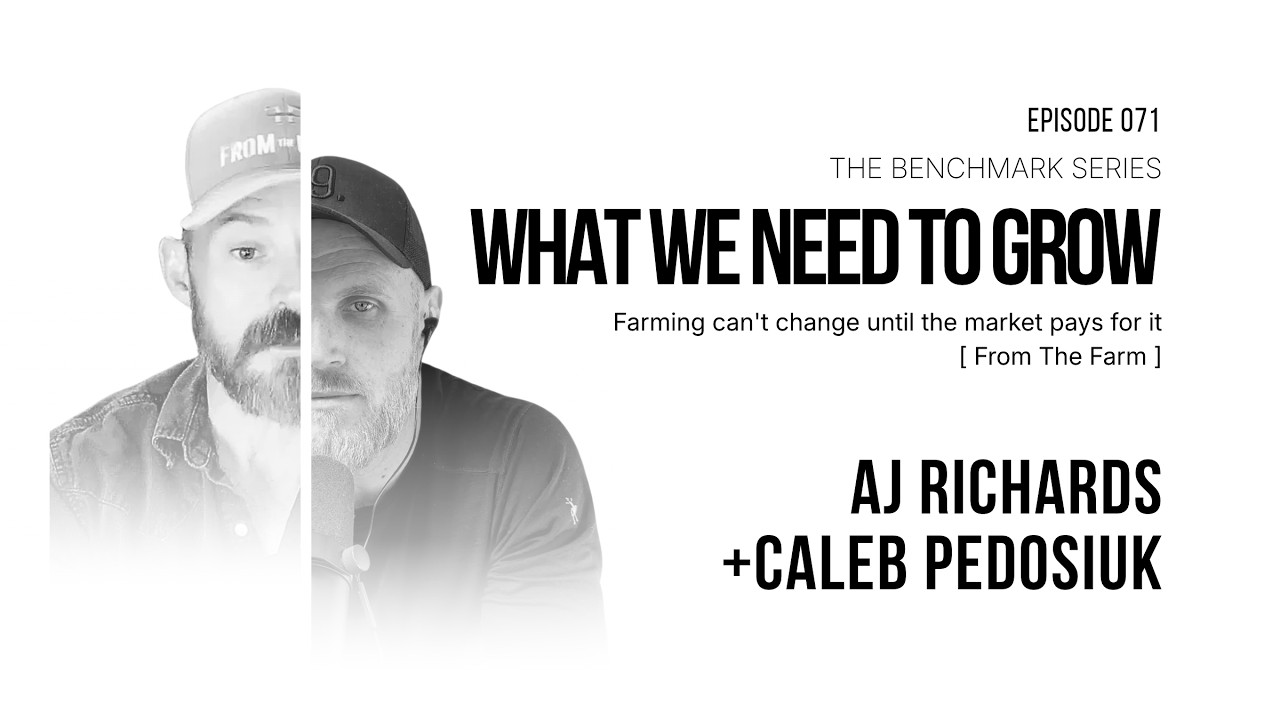
AJ Richards grew up the "city-slicker cousin" of a ranching family, and when he tried to bring regenerative ideas home to the ranch he learned that producers can't change how they farm until a market pays them for it. So he built From The Farm, which he calls the Airbnb of local food: buyers search by where they live, and every producer on it is verified, because the first thing a buyer wants to know is whether the farmer is real. He funded it through a community round rather than venture capital, and he has turned money down to keep the mission his. That is the argument 79 Development keeps returning to. Trust goes to the people who make themselves easy to check, and the founders who show their work are the ones people find and choose.
KEY TAKEAWAYS
- What he needs most is philanthropic capital, and he has turned money down to keep it that way. Asked what From The Farm needs most to grow, AJ didn't hedge: "It's philanthropic capital." He is "not willing to take capital from somebody whose sole purpose is the ROI, because we're disrupting a system," and says the testing and iteration are done: "we just need to scale it." He has already said no to money the company could use: "I would rather see this fail than see it succeed under somebody's thumb who wants to change our mission."
- Fix the market first. AJ came to regenerative ranching through Allan Savory and Alejandro Carrillo, and tried to bring those ideas to his family's desert ranch. What he learned is that "unless you fix the market first, you're not going to be able to reach the producers and have them do a transformation, because their first need is economic." COVID added the second reason: "the fragility of our food system because of centralization." From The Farm came out of both.
- Build the Airbnb of local food, and verify everyone on it. Buyers search fromthefarm.org by where they live or what they want, and see the producers nearby and the ones who can ship. Every producer is verified, because the first question a buyer has is whether the farmer is real: at the farmers market, "somebody's just peeling the sticker off from the grocery store and pretending it's something they grew." Some producers now have their meat tested for nutritional density, a measure the commodity market, which sells by the pound, leaves out. He says he spent three and a half years asking consumers and producers questions before any code was written.
- It starts at the soil. His chain runs from soil health to forage health to animal health to human health. Focus on the soil and "everything else is a natural downstream byproduct," including what a rancher actually sells: protein pounds per acre, and healthier herds that reproduce better. He explains the cooling you feel running through a park as evapotranspiration, "the grass is sweating," which on his figure is supposed to create 40% of local rain cycles.
- Raise from people who want a new system, not control. From The Farm's community round on Wefunder brought in "a little over $300,000" from people who "just wanted to see a new system be born." He chose it because the structure "doesn't have people controlling our board and our decisions," and because investors share in returns rather than taking equity. On air Caleb also notes From The Farm takes no commission on goods sold.
- Don't own the land. Lease it. For anyone trying to start farming, AJ's advice is to put the money a mortgage would eat into infrastructure and livestock instead. Many older landowners without heirs care less about the price than about knowing "the history of that land that their family worked" will continue. He speaks from his own homestead: buying outright means "it'll just take me longer to develop my farming operation."
- Change one thing at a time. For people who feel overwhelmed, he offers behavioural change science: "pick one item in your refrigerator, your pantry or your freezer. Just one." Learn where to source it and how farmers sell it, then add the next. A lot of what stops people, he says, is not knowing how to talk to a farmer, and once you've "flexed that muscle," you can always find another one.
FULL TRANSCRIPT
What We Need to Grow, Episode 071: Shake the Hand That Feeds You. A Founder Talk conversation with AJ Richards. Cleaned for readability; the words are the speakers' own.
A Conversation with AJ Richards, Founder and CEO of From The Farm
Caleb Pedosiuk: All right, AJ. I am so looking forward to this conversation. We're talking about local food systems, and specifically we're going to hear a little bit about what you're doing with From The Farm. It was probably about 2017 that my wife and I, I would say more me, through our local farmers market and some things that happened, had our eyes opened to the importance of a local food system. The difference between resellers at a farmers market, the ones that sort of masquerade, and the primary producers that actually have their hands in the soil and are tending to it.
We're up in Canada, northeast of Toronto, and with the climate up here I have so much respect for farmers. I don't mean this in an insulting way, but I was so ignorant about food before that. And I'm so grateful for so many organic, regenerative farmers that I now know and have huge respect for. So please, share a little bit about From The Farm, what you're working on, and let's go from there.
AJ Richards: Yeah, cool. Very similar to you, 2017, 2018. My family are five generations into the sixth of ranching in a desert environment. We call it the Arizona Strip, which is the north side of the Grand Canyon. They homesteaded there in 1916, so my cousins and uncles have been ranching there for generations.
I always wanted to be in ranching, but my mom married a guy from the city. He was a construction worker, so ranching wasn't what I grew up doing, but it was something I always wanted to get into myself. Then in 2017, 2018, I got turned on to regenerative agriculture, specifically what Allan Savory was doing in Africa, and other folks like Alejandro Carrillo in the Chihuahuan Desert. Since my family was ranching in the desert, I grew up knowing the challenge was local water cycles and forage. Drought was making it really hard to ranch.
So that's how I got into agriculture myself, learning about those technologies in regenerative agriculture and trying to share them with family. Ultimately what I recognized was that unless you fix the market first, you're not going to be able to reach the producers and have them do a transformation, because their first need is economic. Especially as the city-slicker cousin of the ranching family. What do I have to share? What do I know? Even though I was studying and watching and reading all these books about things they could do better.
So that was my first way into it. Then, when COVID hit, the supply chain became the concern: understanding the fragility of our food system because of centralization. The pivot to markets, and local markets, became even more important than just trying to help the economics of the producers. Localized food is the only way we can sustain life if there's a disruption. From The Farm was born from all of that experience.
Our vision is what we call the Airbnb of local food. You don't need an Airbnb in the town you live in, but if it were as easy to find your farmer or rancher as it is to find a place on Airbnb, we could solve a lot of problems on the market access side of the supply chain.
Caleb: Can you explain, at a level my kids could understand, the simplicity of how this works? There are farms on an app. You have this phrase, shake the hand...
AJ: Shake the hand that feeds you. Yep.
Caleb: Shake the hand that feeds you. How does From The Farm work?
AJ: You go to fromthefarm.org, you put in the area you live in or the product you're looking for, and our website shows you the producers closest to you, and beyond that the ones who can ship to you, so you can get the food you're looking for, based on the specifics of what you want. We've got producers now having their products tested, their meat tested for nutritional density. So if you're really focused on nutritional density, not just the weight of food. Because that's where the commodity market went: we're going to sell you a pound of beef for X amount of dollars. They completely leave out the nutritional value.
Our website is designed to simplify that, because that's something I learned from working with consumers. I spent three and a half years doing R&D before we even started coding, and that time was spent asking questions of both consumers and producers. I knew farmers and ranchers because it's where I grew up. But I also lived in Phoenix, Arizona for twelve years, and the average person has no clue where to start. It's paralysis by analysis.
You could go to Google and do all this searching, but then you have all these questions in your head. Is it true? Is this really a farmer or rancher? You alluded to that. You go to the farmers market, and somebody's just peeling the sticker off from the grocery store and pretending it's something they grew. So we verify and validate every producer that's on there, so that we can make it easier.
So you are shaking the hand that feeds you, in a sense, even if they have to ship it to you. You get to know them, you can follow them online, you can see their family practices, all the things you would like to know. I believe the human's most important need is food, but we have farmed that out to unknown corporate entities, when it should be the most important thing we put time and energy into understanding, because it's what moves this physical body through our lives. So we're trying to reconnect people to the importance of that.
Caleb: I think one of the markers people look at is grocery store shelves. A lot of preppers use them almost like a thermometer: how well are we doing, how full are the shelves? But as a thought exercise, let's assume we could snap our fingers and see a representation, percentage-wise, of the nutrient value of the food. Now take something that has five percent of the nutritional value it should, and shrink it on those shelves to see what that actually looks like.
I had no idea until talking to some of these farmers. I'd hear them obsess about soil, the microbial life, these forms of composting, and I'm like, what are you guys talking about? And then you understand. You might set two vegetables or two pounds of meat side by side, and they are not the same thing. At a glance they might seem to be, but they're not.
And the thought occurred to me that, if that's the case, it's not much of a stretch of the imagination... I don't know if I really want to say the word. God forbid we ever go through something like a famine, and I mean that sincerely.
AJ: So do I.
Caleb: I've heard stories and read things, and it's horrific, and there are parts of the world going through tragic things right now, so I don't want to pretend that isn't real. But so many people's diets are so decoupled from nutritional value that, in a way, they're famished of nutrients. They're eating and wondering what's going on. And downstream of that are so many issues.
AJ: The downstream is exactly it. They're relying on pharma now to keep them alive, because they are experiencing some level of famine. The body is starved of the nutrients it needs. A few years ago, the first step was supplementation. The supplement market is huge. I used to own a gym in Phoenix, Arizona, so I'm very familiar with that world. Everybody was supplementing what used to come naturally from the food they were eating, without really knowing it.
Then it's progressively gotten worse because of consolidation and mass production. Now you've got pharmaceuticals keeping you alive, and if you didn't take them, you'd probably stroke out early in life, because the nutritional density isn't there in your food. It's a lack of phytonutrients and essential and non-essential amino acids, and your omega-3 to omega-6 ratios are completely unbalanced.
Whereas the farmers who really understand the importance of soil health know how that leads to forage health, and forage health leads to animal health, and downstream, animal health leads to human health, for the consumers of that end product. And you can go even further downstream. Now you're talking about mental health. Your gut microbiome is your first brain. It sends the signals to your brain on whether your life is working or not. We can see evidence of these breakdowns from nutritional deficiencies across almost the whole human experience. It's all tied together, and most people don't fully understand that it starts at the soil. Our world exists around our soil health.
Caleb: It was interesting. I had an earlier episode with a gentleman named Bryan, in southern Ontario here in the province. They raise cattle. He made a comment so fast it went over my head, and I almost had to go back and get it later. He said, people think we raise cattle. We don't raise cattle, we grow grass. We cultivate grass, the meadow. We grow something that captures carbon from the atmosphere. We're basically harvesting sunshine. And it's harvested by these self-propelled machines, the cattle, that reproduce themselves every year. He said it so quickly and was on to the next thing, and I thought about it afterwards. It was so interesting. He's an old boy, but there was some major old wisdom there.
AJ: Yeah, that's a guy who gets it. And he said it so well because he lives it. If soil health is the focus, everything you do with your animals, the timing on the pasture, how you treat the soil, everything else is a natural downstream byproduct of the health of that one thing. Versus skipping the soil health side and the environmental health side, and only looking at the livestock. Then you're trying to figure out why the grass isn't growing like it used to, and the rain cycles broke, so the droughts come more frequently or last longer.
I heard someone in the regenerative space, I can't remember his name, I think it was Dr. Allen Williams or somebody like that, say that everybody's trying to engineer nature, but nature works as a whole. It doesn't work linearly. When you remove one piece of that whole, you've broken the natural cycle, and it starts with the soil.
So that's a guy who gets it. He's been doing it for a long time. And that was a big part of our mission early on: trying to help ranchers focus on the soil first, understand all the nuances that happen there, and everything else will be a byproduct, including the weight of the animal you're selling, because that's what matters to them. When they sell that animal, its weight is the sellable product. It's protein pounds per acre. If you focus on the soil, your protein pounds per acre go up, and your reproduction rates increase because the animals are healthier. That's more protein pounds per acre without needing certain things to keep them pregnant or to supplement the animals. It all comes from the soil. Go figure. That's how God designed this world to work, and it works when we put that first.
Caleb: I think they're on Instagram as the Carbon Cowboys, or something like that. I remember seeing them talk about the soil, these wild grasses that hold moisture in a desert-like environment. They go out first thing in the morning and they're soaked past their boots, up to their pants, with the dew. And the field over is a completely dried-out wasteland.
AJ: An easy way to describe that for the average person: say you're in the city, it's hot, you're out on a jog, and then you run through the park. All of a sudden the temperature drops. What's happening is the grass, the foliage, is doing what's called evapotranspiration. It's sweating. That's what's supposed to create 40% of our rain cycles, that local water cycle. The rest comes from ocean breezes and things like that. So if you've experienced running and suddenly going through a meadow and thinking, it's much cooler here, that's because the grass is sweating. It's putting moisture back into the atmosphere and recycling it.
Caleb: I know venture capital has its place in systems for different things, from what I understand. With From The Farm, you've drawn a line. You've seen how big systems will sometimes come in and, well-meaning or not, end up compromising something. So you've drawn a firm line: no venture capital. You also don't take a commission. You mentioned the Airbnb analogy, but in this case you're not taking a commission on goods sold. You're really just connecting people with farmers. And there was one thing I noticed, I'm trying to remember how it was described. Was there some tool you used for raising money, some financial vehicle? Something my research had surfaced.
AJ: Yeah, it was a crowdfund we did, a community round through Wefunder, early on. That brought in a little over $300,000 and helped us get started and kick it off. We did it that way because that mechanism doesn't have people controlling our board and our decisions. It's just people who believe in the vision and the mission of what we're trying to accomplish, who want to say, hey, I'll throw a little bit in. It's a return on investment. It's not an equity play. So if we succeed faster, their return is greater because they get it back faster. If it takes us longer, it's not so great. But most people who joined just wanted to see a new system be born. That's why they got in.
Caleb: What are you seeing for a new system? Buckminster Fuller, I don't even know much about him aside from the quote, but there's this idea that you don't defeat a system by resisting it. You defeat it by building a new system that makes the old one obsolete. Something to that effect.
I get this from the digital aura coming through your Instagram and other things, which is how we connected. There's this renaissance of people. Before, you'd see people working with their hands in the soil and it was viewed as bottom of the barrel, day labour, digging ditches. And now you see people who have come full circle. To have your hands in nutrient-rich soil is an immense treasure. To raise children like that, connected with the sun and the soil, cultivating life. There's a whole other perspective on coming back to it. So what are you seeing in terms of where things are headed?
AJ: Great question. I think the concept of retirement after World War II was designed by people in the corporate space to get people bought in: commit your whole life to us, and then you can retire and enjoy it later. It became very clear, a decade or more ago, that that was not the right way to live, and people started waking up to it. Like you, I see so many people whose life's mission now is to get on a small piece of land, put their hands in the dirt, and grow their own food for their family, and maybe extra for their neighbours. I think there's something inherently spiritual about that that people are rediscovering.
We can look at the mental health decline in society and see that the more disconnected from nature we become... we're not designed that way. There's a book called The 3-Day Effect that took former sex workers and combat veterans out into nature and measured their brain activity. After three days in nature, parts of their brain that were going dormant, that were causing depression, started lighting up again.
I know that for myself. We live on a small homestead here in Cody, Wyoming. I spend most of my day in front of a computer, but I find balance when I can get out, do manual physical labour, and put my hands in the dirt. More and more people are recognizing that life isn't necessarily about striving to become a millionaire. I think podcasts help too, when people go and talk to somebody dying in a hospital bed in their sixties, seventies or eighties, who has all this money, but their family is no longer with them and their health is failing. They'll tell you: I took the wrong path. I pursued wealth and acknowledgement over family and health. There's a saying that at some point, the thing that will matter to you the most, and nothing else will, is your health.
When you're that young person who thinks you have to hustle and that's joy... I'm 43 now, and I look back at the mentality I had at 20, and it is not the same. Wisdom comes through time, and I think that's what's happening. We're seeing a renaissance, or a regenescence, as my buddy likes to call it, in farming and homesteading in America. I don't know what it looks like in Canada, but post-COVID, one of the fastest-growing movements was people getting onto small homesteads and living this lifestyle.
Caleb: What is that saying? Health is a crown that only a sick person can see. Such an interesting idea.
I've also heard of something going on in Ontario, a high-speed rail project. I want to be really careful with my words here. Let's put it this way: a lot of neighbours in our area have signs out that are, let's say, really politely voicing the perspective that maybe this project hasn't been thought through that well. The idea for this project was well over, I think, $80 billion or so, and then they said, no, hold on, it's going to be $130 billion, to connect, I don't know, Montreal, Ottawa, Toronto, something like that.
But it's so much farmland, so many watersheds, the tiling of farms, so many backcountry roads that would just become dead ends. So much would be dug up for this. And a lot of farmers are just raising a hand and saying, has anyone talked to us about this? Before you put on paper that you're going to hire McKinsey or somebody, God bless them, to do an analysis, you need to talk to the people who have been stewarding this land for generations, and who stewarded it before that, and how it worked when it was disrupted in different ways.
You see that amount of disruption that could be coming through, and people looking at it and wondering whether this is actually what's needed. I think some people, well-meaning, look at big infrastructure builds on paper and say, if we do this, the trickle-down effect will raise the tide across the way. But is that actually what's going to happen with a rail project like that?
AJ: We have the same thing here: data centres, solar farms, wind farms. In some cases well-meaning. In most cases, I think, it's for the financial prosperity of a few. Fortunately, and I know this firsthand from working as a volunteer in Washington, DC with the Secretary of Agriculture to try to highlight some of these issues, that concern is getting a real seat at the table right now. We have country music star John Rich, who has a massive platform, whose job is to stop corporations from bulldozing farms for data centres and solar farms, because that land needs to stay in food production. So we're having some wins in areas like that in our country, where the rural people who usually don't have a voice are being heard.
Caleb: I've heard some people describe it almost like stairs going up. You've got that first step, and then it's up to stair seven to get onto a piece of land. You look at affordability and inflation. If you look at the equivalent value, what a week's wage was in gold, what a house would cost in gold, you see how much it's decoupled with fiat.
But looking specifically at people who have stewarded land, say they're boomers or older, and they don't want to cede their land to just whatever. They don't want to let it go. They understand the land in a different way. Are you seeing initiatives, like From The Farm, that connect want-to-be farmers in the younger generation with the older generation? Are there new ways of financing these things? I think of the home equity line of credit. At some point, someone came up with a HELOC and said, why don't you do this with this? Are there creative capital ways for someone to come in and say, look, we're open to succession planning. We still want to live here, and die here in our old age. How do you work it out in a way that isn't giving up ownership foolishly, or to someone who might get tired of it after a couple of years of realizing how challenging it can be?
AJ: I am seeing that, not necessarily on the financial mechanism side, because that's still a challenge. But what I am seeing is that the older generations who have stewarded that land for so long, and their ancestors did, especially if they don't have kids to pass it on to, know they're going to pass away. It's not about a financial reward. It's about knowing that the history of the land their family worked is going to continue.
So I tell people, don't think you have to own it. Lease it. You can lease the land and put all the money you would have put into a mortgage into infrastructure, or into developing your farm operation with livestock or whatever it happens to be. Just lease it for now, and as you're leasing the land you can start looking towards ownership. Or the folks on that land want to pass away there, and your responsibility is to help them stay there until that happens, and then it's handed over through some sort of transaction, but not nearly what it would cost to go and buy a place outright.
Because if you do that, and we did that where we're at, I've got far fewer resources to develop my homestead, because it's going into my mortgage. We'll get it figured out, it'll just take me longer to develop my farming operation because of that. So focus on leasing the land, or on finding somebody who has extra land that isn't being used. In our country, that owner can get an agricultural tax write-off because the land is being produced on. People are figuring out different arrangements like that. Or they'll rotate their cattle onto it for part of a season and then they're off, and they're managing it. Especially if you're in wildfire territory, you're managing the wildfire fuels with your livestock and working out a special deal, but you're not coming out of pocket with so much money to own it. So I tell people, and this isn't my idea, I've heard it from others and from mentors: don't own it, lease it. Start there.
Caleb: It's almost a whole different niche. If the times change, you've got to change and adapt, like any market in business. And what a great niche, if you know how to be agile like that. If you're cultivating herds, to be able to say, this is how we do it, and to mentor people using digital tools, here's how you could get started, and to keep it flexible. It seems like a win-win-win, in the sense that the person with the land doesn't have some odd tenant who may or may not be whatever. Interesting.
The other piece that came to mind when you were speaking, maybe not so much at the farming level: we're on a small piece of land, less than an acre. We've got a lot of gardens, built-in irrigation, raised beds, all that jazz. Some of it's permaculture, but a lot of it we do annually. And so much of our backyard is set up. Flagstone, a fireplace, the kids have their areas, each little area. And the next parts are things like a sauna, a place to chill out. We've got a bunkie back here that I work out of. A cold plunge, those sorts of things. How amazing would it be to have a natural swimming pool?
My wife and I do very digital, AI-driven work. But I have this picture in my mind of more and more people finding that, even on less than an acre, you can grow enough food that the flame hasn't gone out. You're still tending to it with simple things. The kids have their hands in the soil and are out there to play. You can sit by the fire under the stars. With the sauna, you get that full spectrum of heat and sweating, and then you get into the cold water. It's fully immersive. Where people have the ability to work, rest, cultivate, have their hands in the soil and grow food, it checks a lot of the boxes, almost the way certain things need to come together at the molecular level for molecular structures to be strong.
I picture that five or ten years from now there'll be such a resurgence of people who aren't saying, a couple of times a year we go off to a spa to do this. I think more landscape architecture, renovation and design will look at it and say, come on, if we're not doing this a few times a week, if this isn't part of our culture when we invite friends over, that's not how we're aging as we get older. We're just waiting to rectify problems later.
AJ: You're absolutely right. I'm in no hurry to go on a vacation. Our home is set up for what we'd be leaving to seek. When I lived in the city, I'd be looking to go somewhere like what we've created here. And my wife's cooking, with the fresh foods and ingredients we have, nobody can hold a candle to that anyway. We go to a five-star restaurant, and a lot of that is still coming from Sysco, the big food service distributor here in the US. Nobody's offering us anything outside our own homestead that we aren't already creating or producing for ourselves. If we travel, it's to see family. That's the missing component. But outside of family, our work, our rest, our relaxation, our recharge is here on the homestead we're developing.
Caleb: Man, you're speaking my language. We have four kids, and Sarah started doing this thing with sourdough where, if it wasn't fully ready, she'd make flatbreads. My word. Cast iron, some good salt, flatbreads. Sometimes we'll have them with some beef or whatever. It is so, so good. You break that bread and think, how is it that something so simple... You've got organic flour that doesn't have glyphosate and all that jazz in it, and you're eating food that sits so well, that the body processes so well. It's such a treasure. Literally breaking bread with others. What a gift.
AJ: That's right. And to that, for the folks listening who aren't there yet: behavioural change science. They can feel overwhelmed. If they're not doing any of this, it may be because they feel like they have to do it all. That is not where we started at all. Behavioural change science is picking one thing and committing to it for a few weeks until it becomes a habit. It's the opposite of New Year's resolutions, where you have a laundry list of all the things you want to do, and after a month you're not doing any of them.
So I tell people, when it comes to your food, pick one item in your refrigerator, your pantry or your freezer. Just one. Get really comfortable with where to source it and how to use it, and don't worry about anything else. Just do that one thing until you're like, okay, I'm good with this now. Then add the next thing, and you'll build momentum over time. If you do that over a year, you'll be surprised how far you've come, how much better you feel, how much healthier you and your family are. And you didn't overwhelm yourself by looking at everything in your refrigerator and pantry and saying, man, I don't know how to replace all this. Don't worry about that.
A lot of what stops people is that they don't know how to talk to a farmer about buying beef or chicken or pork or lamb or whatever it is. Paralysis by analysis. I'm overwhelmed, I don't want to sound foolish. So just pick the one item, do a little research on how farmers sell it, and build that muscle. That way, if the farmer runs out, you're not afraid to go find another one, because you've flexed that muscle enough to know how to have the conversation.
Caleb: AJ, thank you so much. I love asking this one last question of the guests who come on. If you had to pick one thing that you need most to grow right now. For some it's capital, some are looking to launch something new and trying to get the word out about it, for some it's a team factor. What would you say is the one thing From The Farm needs most right now?
AJ: It's philanthropic capital. And I say philanthropic because, as you identified, I'm not willing to take capital from somebody whose sole purpose is the ROI, because we're disrupting a system. There are people who have made plenty of money and are looking for somewhere to do good. If we can disrupt the food system the way we've designed it, and we've got plenty of years of testing and iteration to show that what we're doing works, we just need to scale it. So philanthropic capital is what we need most.
Caleb: Where would someone who's interested, whose values align, and who maybe has capital that could be allocated in that direction, go to understand more of what's going on? Do you have resources available? Should they reach out to you directly? What's the path?
AJ: I would have them contact me directly, and we get on a Zoom. I've said no to money that we could use, because I'm so committed that I would rather see this fail than see it succeed under somebody's thumb who wants to change our mission and our intention. So we get on a Zoom call, they ask every question they want, and then I send them the data they need to see afterwards.
Caleb: Okay. And they can find you through fromthefarm.org.
AJ: Yep. And just give them my email: aj@fromthefarm.org. Shoot me an email and we'll connect.
Caleb: Awesome. AJ, thank you so very much. Appreciate it.
AJ: Thanks, Caleb.
What We Need to Grow is a conversation series by 79 Development, hosted by Caleb Pedosiuk. New episodes on YouTube and Spotify.