How a Nonprofit Scales Without Relying on Donations
For nonprofit founders and executive directors weighing an earned-revenue line against a donation base, for anyone building training or education at scale in low-resource settings, and for operators who want a concrete review protocol before letting an AI tool touch work that reaches vulnerable people.
About Miriam Chickering
Miriam Chickering is a registered nurse with an MBA and the CEO of The Frank Foundation, the US charitable foundation whose platform NextGenU.org gives away free, competency-based health sciences education to health workers in low-resource countries. She is known for building emergency education at a speed the sector does not normally manage, including the first globally available online acute care COVID course, written by 49 volunteers over a single Easter weekend in the first year of the pandemic and in use in 49 countries within six months. She founded Nurses International in 2013 to mobilize nursing expertise globally, she is a member of the Forbes Business Council, and she is an authority on health workforce education, education delivery in conflict and outbreak settings, and the safe, locally reviewed use of AI in humanitarian programs.
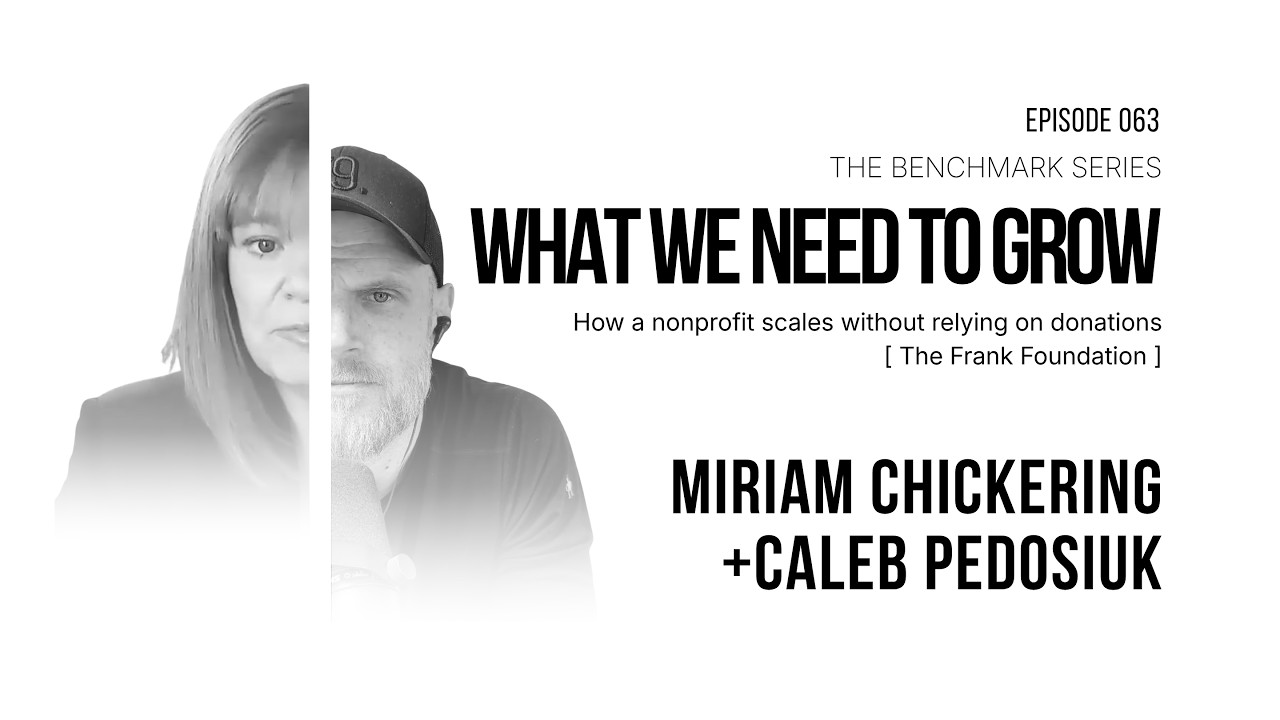
Miriam Chickering is a nurse with an MBA who runs The Frank Foundation and its free health sciences platform NextGenU.org, and who founded Nurses International in 2013. Her reframe is worth borrowing by anyone building authority in a technical field: when half a cohort fails the prerequisite, the defect is in the teaching, not the cohort. She applies it to her own sector by refusing the excuses available to a nonprofit, running hers on earned contracts rather than donations so that clients have to be served well enough to return, and taking outside advice on the strategic plan rather than writing it alone. On AI she holds a line that a lot of organizations claim and few operationalize: the model restructures and formats, subject matter experts create, and no tool ships until local reviewers have graded blinded outputs against a rubric. That is the shape of real authority in a field where everyone is asserting it, and it is why an honest account of the work is what makes an organization legible to the systems people now ask for answers.
KEY TAKEAWAYS
- A failure rate is a design defect, not a talent shortage. Her sharpest reframe arrives as an aside about a nursing prerequisite. "If you have a class of nursing students and they're taking organic chemistry, and 50% of them can't pass organic chemistry, that's a problem with the education, not the students." She extends it to the global health workforce shortage: part of the cause is simply that "we have terrible training for healthcare workers in so many areas." The joke she names, "watch one, do one, teach one," is not a pedagogy, and it only ever worked for the intuitive top fifth of a cohort. The tooling she is interested in is tooling that lets everyone else practise in an atmosphere where mistakes are safe and even encouraged.
- A nonprofit is a nonprofit business, and the vulnerable are the reason to raise the bar rather than lower it. Asked what she would tell someone with the heart to start one, she goes straight at the operating discipline. "You need to treat your nonprofit with the same care that you would treat a business that you had just had first-round funding." Controls on finances, a controller past a revenue threshold, separate accounting, outside advice on the strategic plan rather than a plan written alone at a desk. Her stated reason is not optics, it is standing: "The most vulnerable deserve the best that we can give them. That is a privilege. And along with that comes the responsibility." The Frank Foundation runs a hybrid model behind that, an investment portfolio covering part of the annual budget and the rest earned through contracts and services, and she argues the client discipline makes the mission work better. "We don't really take in donations. We take in clients, and that forces us to serve our clients well so we get repeat clients."
- The same AI tool is helpful in one context and harmful in another, so the unit of safety is the local review, not the model. She is direct about where AI sits in her production: "We use artificial intelligence to restructure, format, and make things beautiful, not create content from scratch." On air she describes eighty education products built for WHO during a recent Ebola outbreak in three weeks, AI-assisted with what she calls extreme amounts of human review by a wide range of subject matter experts. The selection method is the part worth copying. "We test multiple models, we blind the outputs, and then we have local reviewers grade the blinded outputs with a rubric, and then we use the tool that's best." Her warning is against the reverse habit, arriving with a tool and looking for somewhere to apply it. "You can have the same tool in different contexts, and in one context it's extremely helpful, and in another context it can actually be harmful. And it's the same artificial intelligence tool." Hence her rule: "Hyperlocalism is extremely important for safe use of artificial intelligence tools."
FULL TRANSCRIPT
What We Need to Grow, Episode 063: Not the Students. A Founder Talk conversation with Miriam Chickering, CEO of The Frank Foundation. Cleaned for readability; the words are the speakers' own.
Caleb Pedosiuk: Miriam, you are a registered nurse with an MBA who leads NextGenU.org, a nonprofit platform offering free accredited healthcare and science courses to professionals in every country. You also founded Nurses International in 2013 to mobilize nurses' expertise globally, giving a healthcare worker in a low-income country the same quality education as one in a wealthy one. So the growth question we may take a look at today has to do with platform scale. In some respects you are at a place that most nonprofits would dream of in terms of reach. You're giving away accredited healthcare education to anyone in any country for free. How does a platform like NextGenU get to that level, and what is that like? Tell us, by all means, introduce yourself and tell us a little bit about what's going on.
Miriam Chickering: Well, it's great to be here with you, Caleb. Thanks so much for that very kind introduction.
I think the key to achieving scale like this is our framework, which is called Listen, Learn, Serve, Share. When you are very serious about listening to what people need, and have the courage to move in that direction, good things happen.
So I can give you an example. You're probably sick of talking about the COVID pandemic, but back when COVID was raging in New York City and huge trucks were being filled with bodies and Mount Sinai had a hospital tent outside of its ER, we had volunteers who were providers in that ER. There were so many nurses and docs all over the country and the world who were just overwhelmed. They would go to work, work a 12-hour shift, be off for one day, come back, and every patient they took care of, the prior shift had died.
It was about Easter, Easter weekend of the first year of the pandemic, and the guidance was changing very fast. We were looking online, and there were no courses online at all for acute care providers. All of our physicians and nurses were in acute care. So what we decided is that over Easter weekend we would work the entire weekend and put out the very first globally available online acute care COVID course.
And we did. There were 49 of us. We worked all weekend over Easter, and we put out the very first course. We could not advertise it, because there was so much misinformation and there were so many filters. We have a Google Ad grant that normally we would use to advertise it. Even without being able to advertise it, within six months it was being used in 49 countries.
I was talking with some of the nurse practitioners who helped create that course this last weekend, and I said, I was so scared you guys were all going to get PTSD if we didn't give you an outlet and let you do something that would be effective in the world. And she said, well, I didn't get PTSD. So I was really happy that we were able to provide an outlet for these providers and help them be effective at scale. And at the same time, we were able to train so many providers all over the world because of that. It was a great use of an Easter weekend. Probably my best Easter weekend. We didn't go to church that weekend, because it was in the middle of the pandemic, but we did get that COVID course out.
So we listened to the people who were right in front of us, and we spent a lot of time learning about their experiences. Then we identified a need, we served by meeting that need, and then we shared the outputs. So it wasn't just for those providers' hospitals, it was a global provision. We've used that method over and over and over again, and every time we use it, we get those kinds of results.
Caleb: So what is the response coming back from some of these countries? You're in every nation in the world, which is wild. Completely different languages, culture, time zones. The challenges from one place to the next are completely different. It's not a rinse and repeat, one-size-fits-all model. I don't even know how you begin to process something at that level. Do you begin with the lowest common denominator, the smallest building block, and then try to build from there?
Miriam: We're so much more alike than we are different. The human body is the human body, and in healthcare we deal in math, we deal in science, and those things don't change. It doesn't matter if you're in North Korea or if you're in the United States, the body is the human body. So first of all, we look at our commonality, at what we have in common and what we can share that does translate.
Then most of what we need to do is just repackaging. For example, in the COVID course, we had contacts in Pakistan who wanted to use that course, but not with acute care providers. They wanted to use the principles of it with firefighters, with first responders, with nurses who were taking care of children in children's homes. So we took the core principles and restructured it to be appropriate for that setting. We did that in concert with people on the ground, and it was their package. They co-created it. So the main thing is working with people who are local, hyperlocal, that you trust, and co-creating with them.
Caleb: It's interesting to think of the role that technology plays in this. The fact that something can be rolled out to all nations of the world on its own is remarkable. One of the conversations I had earlier this week was with a gentleman who works in VR. They develop immersive experiences to train firefighters, which you just mentioned, firefighters and search and rescue teams. They use spatial mapping, where an area can be spatially mapped, and then they can introduce different scenarios and characters. There are now even suits that control temperature. Some of the work being done with VR can mimic gunshots in the suits that get worn. It's remarkable to see how education is becoming so advanced in terms of helping people experience, in an immersive way, things they need to learn.
So you're right on the edge of that technology rolling out to the nations. What are you seeing in terms of how AI or other advancements are being used to help people understand concepts quicker?
Miriam: If you have a class of nursing students and they're taking organic chemistry, and 50% of them can't pass organic chemistry, that's a problem with the education, not the students.
So I think the advanced tools that we have now allow us to teach concepts in a way where the majority of people can understand them. And then the VR, the clinical interactions, the interactions where people are able to practise their judgment, that allows more people to participate, because you're not having to target the top 20% of students who can practise because they're intuitive and they can get things right the first time. Back when I went to nursing school, you didn't get a lot of chances. If you messed it up one time or two times, that was it. So allowing students to practise over and over again in a nonjudgmental atmosphere, where they can make mistakes, where it's safe for them to make mistakes, and mistakes are even encouraged, is extremely helpful.
We have a massive healthcare worker shortage, and there are many reasons for that, but some of the reasons are that we have terrible training for healthcare workers in so many areas. There's a joke in nursing and medicine, which is watch one, do one, teach one. And that's just not realistic for the majority of the population to be able to perform at that level.
Caleb: Two conversations this week. One was with a physiotherapist turned clinic owner. She has a couple of locations now, deals with pelvic floor, serves a lot of women, huge demand, but has had to become an operator. We were talking about that in the healthcare system in Canada. And then yesterday, a doctor in British Columbia who has gone from being a doctor to opening a clinic to having 35 clinics. She was talking about this very subject of education. A lot of Canada's healthcare system requires a lot of doctors, and at one point there were more doctors in training from Canada who had left Canada, gone to train abroad and would look to try to return than there were actually studying in Canada. So the system, even at this level, is recognizing the importance of it.
That's not a criticism or a knock at any of the universities. I think even the universities are recognizing, as you said, that if 50% of people are not passing organic chemistry, maybe we should look at the approach. Likewise, if the amount of demand is not being met by the pipeline, in any aspect of business, any industry, you need to address that. So I think it's beautiful to see so many people interested in healthcare. I love that there are people who want to have such high standards. Finding a way to work on both of those, to find the path that works, is really key.
Miriam: Couldn't agree more.
Caleb: Maybe to shift gears a little bit, this is something I'm curious about. I remember growing up with parents who were very generous, who loved to support other causes. My dad, and my mom, they always had such a heart. They never would splurge on themselves. I never saw that. But I would see them be generous when there was a need, something presented that they would care for, whether it's locally or abroad. I would see my dad, who was quite often very frugal, very focused, just light right up. It was so beautiful. So I would see them support many different nonprofits.
And here's the thing I've noticed. Nonprofits are really interesting. People look and see a need where they want to help. For some people, especially entrepreneurs, they'll go and say, my heart's moved, I can do something, I want to do that, and a nonprofit is started. If you're in the for-profit space and your business is maybe not successful, statistically a lot of people start a business and don't necessarily succeed with it, or it's mediocre, sometimes it's really successful, people look and go, you're in business, you're figuring it out. In the nonprofit space, if you're not successful, or you're mediocre, there is a lot of scrutiny. And I think for good reason.
This is the paradox to me. When there are financial donations, the level of excellence should be really high. But at the same time, I also recognize that I see so many problems that humanity is ignoring. And then when you see a group of people who step out and are willing to work in the nonprofit space, or start a nonprofit, which can so often be taxing, draining, hard on the people, often thankless or behind the scenes, depending on the problem you're working with and the people you're serving, it can be so hard. And on top of it, the bar is so high to avoid, importantly, things like misuse of funds or misallocation of capital or resources.
So it's a paradox to me. I wonder if you would have any advice for a young person, or someone who might hear this, who has a heart to want to do something, make a positive impact in the world. Any encouragement or wisdom you could share?
Miriam: I think the most important thing, if you want to do nonprofit work, is that a nonprofit is a nonprofit business.
In this work, we represent very vulnerable populations. The most vulnerable deserve the best that we can give them. So when I do a strategic plan, I'm not just sitting at my desk doing a strategic plan, I'm getting advice from Deloitte on my strategic plan. I'm not just trying to sift through my 990 with ChatGPT helping me, I'm getting the best firm in the country for private foundations.
You need to treat your nonprofit with the same care that you would treat a business that you had just had first-round funding. With that same care, you need to have controls on your finances. You need a controller once you're over a certain amount of revenue. You need to have your accounting separate. Just everything that you would do as a CEO of a business that you didn't own, all the care that you would put in, you need to put in that same level of care for a nonprofit, and more. You're serving the most vulnerable. That is a privilege. And along with that comes the responsibility.
One thing that we do at the Frank Foundation that I think is super helpful is that we have a hybrid revenue stream model. We have an investment portfolio that funds a percentage of our yearly budget, but the rest of it is contracts and services. I think that really keeps us on our toes, because we're not just taking in donations. We don't really take in donations. We take in clients, and that forces us to serve our clients well so we get repeat clients. Then the same principles that serve us well for our clients serve us well for our nonprofit stakeholders.
I don't think that model's necessarily for everyone. If you're feeding kids, you don't necessarily have time to go out and open a service line or a business unit. But for us in the education sector, we certainly can. I think it's tremendously helpful for every single person on our team to serve paying clients. It makes us better overall. But like I said, I don't see that as a one-stop shop. I think it's a good answer for nonprofits in the education and health sectors.
Caleb: Can you share, for someone who's not familiar with the Frank Foundation, a little bit more about what that model would be? I think a lot of people have a for-profit, maybe startup, maybe venture capital mindset. When you say we have clients, would that be a family office, or a corporate, a company who says, we're looking for ways we can create impact, ways we can give back, we want to partner with an organization we are aligned with, and they have allocated a certain allotment per year, and they want to steward that and report back to their board or their shareholders for their impact? Is that an accurate description of what a client would be for the Frank Foundation?
Miriam: No. Our clients would be a university in the United States that wants us to help them facilitate a program, or a UN agency that needs emergency education materials for an outbreak. Or it might be an NGO that has a big grant and they're subcontracting to us to do the education component of that grant.
Caleb: So it is a practical service, or set of services, projects that fit within the umbrella of the vision of what you do well, what you are experts at, and is aligned with the impact that is the purpose of the organization. And it potentially becomes more effective for other universities, agencies, organizations that recognize the need, want to be effective in an area, see that you are experts in this, and engage or subcontract with you to help them fulfill that.
Miriam: Yes. And then most of the time they allow us to make whatever materials they contract us to create available globally. Not always, but often. And that's actually a pull. They want to work with us in part because they know that whatever we create together is going to have a larger impact than the near-term project they're working on.
Caleb: We had spoken briefly about AI and how things are shifting. Is there anything you see that you're excited about, or that you have noticed has brought real advancement or breakthrough, or helped to speed up some of the work you're doing?
Miriam: Oh, definitely. One example: we just created 80 education products for WHO for the recent Ebola outbreak. It took us three weeks. Those were AI-assisted, but with extreme amounts of human review with a wide variety of subject matter experts. We use artificial intelligence to restructure, format, and make things beautiful, not create content from scratch.
Another example. Creating a set of science textbooks for kindergarten through 6th grade for a country, or primary school, is generally $3 to $6 million. We can do it for $100,000, and we think we can decrease that by 50% and do it for $50,000 per country. Again, a large group of subject matter experts is involved in that process.
But I think the most important thing to keep in mind for artificial intelligence, when you're considering whether it is appropriate to use in this situation, is to not just think, okay, I have this tool and I'm going to use this tool in whatever situation I'm in. You have to really look at the people on the ground and ask them, how will this tool help you become better at your job? Will this tool cause harm? You can have the same tool in different contexts, and in one context it's extremely helpful, and in another context it can actually be harmful. And it's the same artificial intelligence tool.
So focusing on that contextualization is really very important, and always staying in a co-creation mindset, where you're co-creating with that client, with that stakeholder on the ground. Hyperlocalism is extremely important for safe use of artificial intelligence tools.
Caleb: I'm curious to know how tool selection works for that. If I was to guess, I would assume it would depend on the stakeholders you are engaging with, who may be subject matter experts in an area you're working with, to get a sense from them whether they're using local models or a specific model that they've trained based on some of their expertise. I'm assuming it would probably be across an array of options.
Miriam: Yes. So what we do is we test multiple models, we blind the outputs, and then we have local reviewers grade the blinded outputs with a rubric, and then we use the tool that's best. We are tooling where LLM agnostic, but we normally stick the LLM inside something else that creates a lot of guardrails and guides the product development.
Caleb: Very cool. Well, Miriam, I love asking as a final question what it is that each guest feels they need most to grow right now. For some it could be raising a seed round, a series. For others it could be rollout of a new product. What would you say would be the one thing you need most to grow right now?
Miriam: We've been using artificial intelligence to improve our productivity, but we're not using artificial intelligence as a core of our operating systems yet. There are a couple of tools that we're building now that are at the core of our business that will switch us from AI as productivity tools to AI as the core of our operating system. I think it's going to take us about 12 months to get those tools in place, and it's going to change things very significantly for us. So I'm really, really excited to see those things come into place, and then see the world benefit from that.
Caleb: Very cool. Miriam, thank you so much for the work that you do and for answering some of the questions today.
Miriam: It's my pleasure. Thank you.
What We Need to Grow is a conversation series by 79 Development, hosted by Caleb Pedosiuk. New episodes on YouTube and Spotify.