How a Ramen Shop Became a North American Grocery Brand
For restaurant owners eyeing retail, food and CPG founders, and operators deciding which parts of a craft survive at volume.
About Jared Ferrall
Jared Ferrall is the co-founder and Chief Culinary Officer of Crafty Ramen, the Guelph, Ontario company he started in 2017 with his wife, Miki, known for taking a scratch-made ramen shop into a frozen, heat-and-eat line sold through major grocery chains across Canada and the United States. A Michelin-trained chef with more than a decade in fine dining, including Gordon Ramsay's kitchens and work as a private chef on a luxury yacht, he trained at the Yamato ramen school in Japan before opening the first shop. Crafty Ramen was named to the Globe and Mail's Canada's Top Growing Companies in 2022 and 2023 and won the Guelph Chamber of Commerce Innovation Award in 2023.
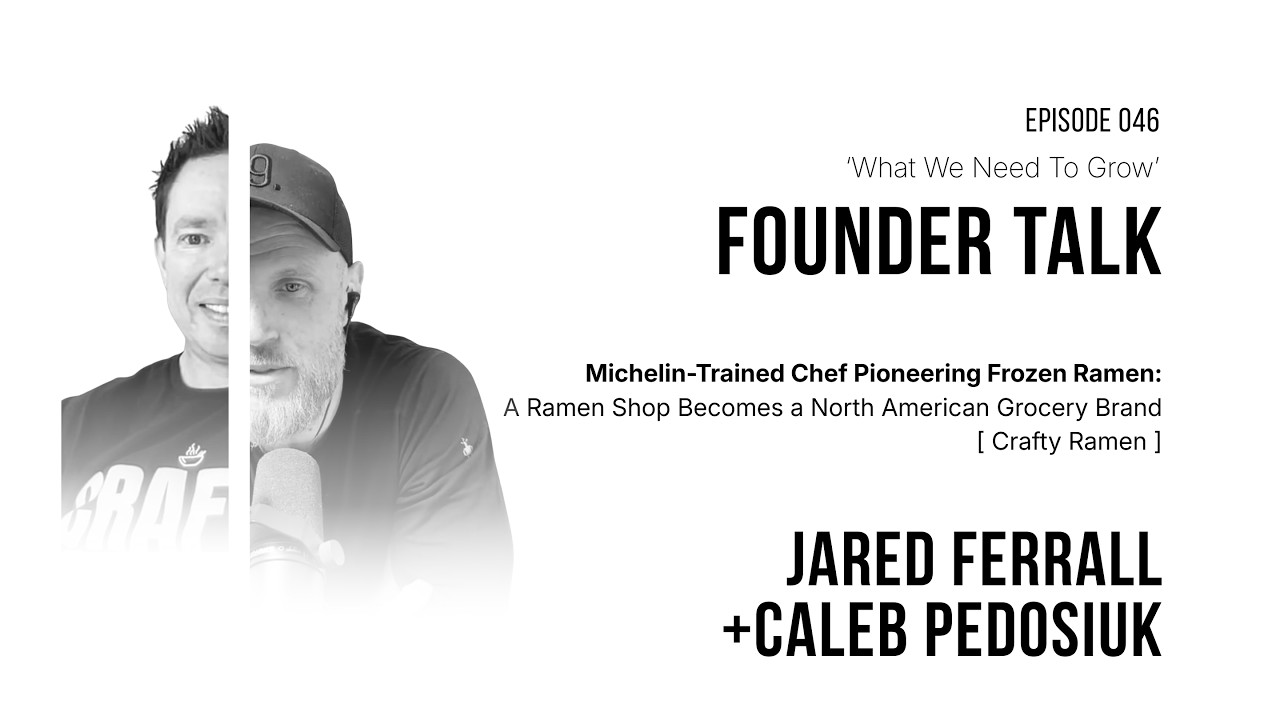
Jared Ferrall spent about ten years cooking in Michelin-starred kitchens and as a private chef on a luxury yacht, and is blunt about who that was for: "I was cooking food for the elites." Then he and his wife Miki trained at a ramen school in Japan, came home to Guelph, and pointed the whole credential at the opposite end of the market. Crafty Ramen is now a CPG company with frozen bowls at Sobeys, Loblaws, Rabba, Colemans and Walmart across Canada and the United States, and the interesting part is how exact he is about the translation. The fine dining method survives, the scratch-made components survive, and one thing does not: green onions at volume need equipment "we just can't afford," so a supplier does it, because "it's the same philosophy, the same mentalities, but you've got to align it to the product that you're producing." He will not oversell the result either: "I'm not going for a Michelin-star experience in your freezer." The decisions are the same shape. A ramen kit in a cardboard box, invented at a bar four months after their second restaurant opened into a shutdown. An e-commerce business he killed the afternoon a delivery app put his own product in his hands in fifteen minutes: "our e-commerce is dead." Four restaurants closed down to one, because "CPG is a beast." A vegan bowl he personally believed in, pulled because it could not "earn its space on shelf. It's just a sad fact." And asked what he needs most, a working capital figure rather than a vision. That is the throughline 79 Development keeps coming back to. Authority is not the credential, it is the honest account of what you did with it, and that account is what makes a brand legible to buyers and to the systems now answering on their behalf.
KEY TAKEAWAYS
- He left the 0.001% on purpose, and he is blunt about who he was cooking for. The choice the whole company rests on, and he does not soften it. "The reason I chose that path over the high-end sort of fine dining path, I did that for like ten years, right? I was a private chef at super high-end Michelin-star restaurants, and then I was a private chef on a luxury yacht. We're talking like the 0.001% type. I spent most of like ten years of my career just cooking for, I was cooking food for the elites." What he wanted instead was a place rather than a clientele: "to ultimately put down some roots. And when we did that, we wanted to become part of a community and we wanted to provide like comfort food for everybody."
- The fine dining discipline survived the move, with one concession he names out loud. He keeps the method and is honest about where it breaks. In fine dining "you make everything from absolute scratch, to butchering, to even sometimes growing the food yourself. We wanted to do that, but with ramen," which is why they made every single component themselves. But at CPG volume, "processing the volume of them at scale that we would need would require equipment that honestly we just can't afford," so green onions come from suppliers. His formulation of the trade is the most transferable thing in the episode: "it's the same philosophy, the same mentalities, but you've got to align it to the product that you're producing." And he draws the line without apology. "I'm not going for a Michelin-star experience in your freezer. I'm going for something that you're going to eat and be like, God, that was my, I look at the ingredient deck and I feel good about what I've ate, and it actually makes me feel good."
- The pivot that became the business started with a box and a guess. They opened a second restaurant in Kitchener four months before the shutdown. "Me and Khalil, our CEO now and our business partner, were sitting at the bar and literally just looked at each other and said, what are we going to do? And that's when we came up with the idea. We said, well, all these other people are making like pizza kits and burger kits and all these other meal kits. Can we do a ramen kit? So let's give it a go. So that's what we did. We literally went out and bought a box and bought a bunch of little containers and put all of our ingredients in that box and we launched them online." It worked immediately: "they were selling out literally within minutes. As soon as we put them up there, three times a week they'd be gone."
- E-commerce died in fifteen minutes at a trade show, and he killed it the same day. The sharpest decision story in the conversation. At a trade show they realised they had brought demo food but no actual retail product to show. "Khalil was just like, oh, well, why don't we jump on Instacart and see if we can get something delivered to us? And literally we had one of each of our products in our hands from Instacart within fifteen minutes. And we all looked at each other and we said, our e-commerce is dead." The reasoning is immediate and unsentimental: "why would anybody want to pay all that extra cost for us to deliver to them with dry ice, when they can literally get it within fifteen minutes anytime they want it from Instacart? We're putting our effort into the wrong spot here." The same logic closed the restaurants down to one. "CPG is a beast. It's a whole other business. And we realized that if we were going to do that and we were going to be successful at it, we need to focus on doing that."
- Coming back from the biggest show in the category with nothing but yeses, and having to say no. On Expo West, which he calls the Super Bowl of CPG: "we literally came back from them with no nos. Every single grocery store we spoke to said yes and we had to say no to them. We were at the, we had the privilege of picking." The goal behind it is stated as a number rather than a mood. "Our BHAG, big hairy audacious goal, is to become a household name for ramen across North America. I want to be in twenty thousand grocery stores across North America."
- The product he pulled, and the fact he refuses to dress up. The moment he argues against his own preference, which is why it lands. They had built vegetarian and vegan bowls into the restaurant "from day one" and carried them into the kits and the frozen line. "Unfortunately, there's not enough demand for a vegetarian or vegan ramen to earn its space on shelf. It's just a sad fact. There's just, it's a very small part of the population that goes for that, and they don't hold their space." The vegan bowl was replaced with a birria ramen in the US. He still offers to feed a vegan a bowl that will change their mind, which is the whole character of the thing.
- What he needs is cash, and he is specific enough that you can see the shape of it. The standing closing question, answered with a working-capital figure rather than a vision. "We've just done all the load-ins within the US, so we've got like two million dollars worth of product either sitting in warehouses or on shelves that we're waiting to get paid for. That's a lot of money for a small CPG startup." What it would buy is concrete: more ads, more inventory, more shelves, and a warehouse extension in Orangeville for a spiral freezer. "So everything takes cash. If you want to grow, you're going to need money to do so. We can do it in a more sustainable way like we're doing it now, but if we wanted to put some rocket fuel on this and throw some cash at it, we could grow a lot faster."
FULL TRANSCRIPT
What We Need to Grow, Episode 046: Comfort Food for Everybody. A Founder Talk conversation with Jared Ferrall, Co-Founder and Chief Culinary Officer of Crafty Ramen. Cleaned for readability; the words are the speakers' own.
Caleb Pedosiuk: Okay, so Jared, I have a confession to make. I don't usually read people's intros, but I really want to read this because I don't want to miss it and I don't want to jumble it. So feel free to correct, but this is what our AI research is pulling up. So Jared, you co-founded Crafty Ramen in Guelph, 2017, with your wife Miki, after you trained together at the Yamato School of Ramen in Japan. You bring a Michelin background from Gordon Ramsay's kitchens, and what started as a neighbourhood ramen shop is now a dual-model business, three-plus brick-and-mortar locations.
Jared Ferrall: Two, just one now. Sorry, we've pulled the restaurants into just the one to focus on CPG.
Caleb: Okay, cool. So one brick-and-mortar location plus a ramen factory producing, two ramen factories, okay, two plants producing a heat-and-eat frozen line, stocked nationally at Sobeys, Loblaws, Rabba and Colemans, named to Canada's Top Growing Companies twice.
Jared: Two, two plants, yep.
Caleb: And so here's the sort of question. First of all, I've had your ramen and it is phenomenal. I wasn't even a, I didn't even know that I was a fan of ramen until I had Crafty Ramen. I'm not joking. The broth is just unreal.
Most chefs with your pedigree and background typically, and I mean, I'm not an expert in the industry, but from what I understand, they aim for a higher concept restaurant. You're interested in the quality of food and that usually drives to more of a niche, experience-driven thing. And you've kind of gone in the other direction, where you've been like, hey, you have this high respect for food and flavour, which I can attest to, but you're now saying, by the way, you can heat and have this experience at home or wherever. Take it camping with you. Take it wherever you want.
Jared: Yeah, well, the reason I chose that path over the high-end sort of fine dining path, I did that for like ten years, right? I was a private chef at super high-end Michelin-star restaurants, and then I was a private chef on a luxury yacht. We're talking like the 0.001% type. I spent most of like ten years of my career just cooking for, I was cooking food for the elites. To ultimately put down some roots. And when we did that, we wanted to become part of a community and we wanted to provide like comfort food for everybody.
So that's it. It was just a natural choice for us. And ramen was so great with it because there's five elements to a bowl of ramen. And with all my background in fine dining, and obviously in fine dining you make everything from absolute scratch, to butchering, to even sometimes growing the food yourself. We wanted to do that, but with ramen. So we travelled around the world as we were planning this restaurant out. And then we did a top-to-bottom tour of Japan, finishing that off with two weeks at the Yamato Ramen School before coming back here and bringing our own noodle machine over and making ramen. Making every single component from scratch in order to make a truly Canadian or North American bowl of ramen.
Caleb: So what has that been like? I mean, if we're talking 2017, you opened it, you got a couple of years of traction, and then the world shuts down. So you've got 2020, you've got restaurants, so many of them on a lifeline trying to survive, trying to switch models to figure out, can we even get food into people's hands? Certainly food is in demand, people not wanting to go out, there's a demand for delivery, but then also a lot of restaurants trying to figure out, can we survive this?
Jared: Yeah, and that's how it was for us. So we literally opened our second restaurant. The first restaurant opened up with huge success, literally had people lined up around the block to get in on the first day and days after that. We couldn't make the food fast enough. So it was fantastic. We partnered with another local restaurateur and opened up our second restaurant in Kitchener. We opened that four months before the pandemic shut us down. So there we were, just starting to figure stuff out in the restaurant, getting the P&L in line and just basically figuring out how our new restaurant worked. And we got the announcement that we would have to close our dining rooms and ultimately close the restaurant.
So me and Khalil, our CEO now and our business partner, were sitting at the bar and literally just looked at each other and said, what are we going to do? And that's when we came up with the idea. We said, well, all these other people are making like pizza kits and burger kits and all these other meal kits. Can we do a ramen kit? So let's give it a go.
So that's what we did. We literally went out and bought a box and bought a bunch of little containers and put all of our ingredients in that box and we launched them online. And again, to just like viral success. They were selling out literally within minutes. As soon as we put them up there, three times a week they'd be gone. So we're like, okay, we're onto something here. People want this. The restaurants were still just ticking away at this point doing takeout, and we were getting people from all over the world reaching out to us asking if we could ship these. And we said, well, let's try. So we found a local last mile courier service, and we started to buy insulated containers and we got a box made and we started an online subscription service.
Caleb: How is that going?
Jared: Well, that was a while ago. We ran that for about two years with the kits themselves. So the first thing we did was we converted the fresh kit, because there was just no shelf life on it. We converted that to a frozen kit, because we were getting all these grocery stores and other people, even other e-commerce platforms, reaching out to us wanting to sell them. Well, you can't really sell a fresh kit very far, right? It just doesn't have the shelf life. So we converted to a frozen kit, and that went well as well.
But as COVID was winding down and people were going back out into the world, they weren't looking for experiences as much as they were through COVID. So by this point we had brought on Adam, who's our VP of sales. And he had spent about eleven years at Nestlé in the frozen food business, and we had already seen this puck coming out of Japan. We didn't invent the puck. We saw firms in Japan making these things, and he kind of said, hey, can we do that? Can we give that a try? So we said sure. We got some molds. We made a bunch up. They worked out really well. So we took that to our first trade show, and the grocery stores were just like, we love this. And we heard just yes, yes, yes. So that was before we'd even actually really made one. We were there selling it at trade shows and then left that trade show and just got to work figuring out how to produce them at scale.
Caleb: So what does your current primary energy go towards? You've got this background, a love for food, for creativity, for flavour, for service. Probably part of that experience is seeing people reacting to what you've prepared. The thought has occurred to me before that the best form of art is edible art, in a way, in terms of experiencing it. Certainly a painting is going to endure, but you get to see it, smell it, feel it, taste it. Whereas a lot of others you can't. Do you find that you have an outlet for a lot of that creativity? Or do you find a lot of it right now is like CEO mode, building mode, operations?
Jared: So I'm not the CEO. I'm our Chief Culinary Officer, so I can focus on stuff like the food. So where all my energy goes is into solving problems. How do we produce? How do we maintain our quality, but produce at the volumes necessary to make a profitable CPG company? And I've also got a building background. So before I became a chef I went to school for construction, and I did a lot of labouring and stuff when I was younger. I'm kind of a handyman, so that's where my focus is. It's on culinary R&D, equipment and process R&D improvements. So I'm both problem solving and directing and cheering on our production teams. And then developing future products is where I spend my time, really. And it is rewarding because I love to solve problems.
Caleb: Now I see five boxes, I think, behind you. Five or six. Is that the extent of the line that you currently have?
Jared: So right now we've got about sixteen products. There's a couple extra. So up here you'll see these are the future five, we'll call them. This is what we've just launched in the US, and what we're bringing back to Canada, if you will, through the fall. Because we had a couple of other ones. We had a couple of vegetarian ones. We've always been a very inclusive restaurant. We wanted to make sure we had a lot of vegetarian stuff on our menu in our restaurant from day one, and we still have it there. So we brought those products with us when we started making kits and then frozen products. Unfortunately, there's not enough demand for a vegetarian or vegan ramen to earn its space on shelf. It's just a sad fact. There's just, it's a very small part of the population that goes for that, and they don't hold their space. So we've replaced the vegan one with a birria ramen that's launched in the US, and then these are the other four that are going to come back to us.
Caleb: So how is that going? Is one of your plants in the US and one in Canada then?
Jared: Nope, both in Canada. One in Waterloo and one in Orangeville. So they work as sister plants. One of them makes the food and the other one assembles it, packages it, and ships it.
Caleb: I've had a couple of conversations with some farmer friends that grow and have great relationships with different restaurants. Actually, back in the day there was Actinolite, I think, is the restaurant. Am I pronouncing that right? Somewhere in maybe Ossington. I got to film this really interesting conversation between an organic farmer friend in the Millbrook area, and the owner chef, and they sat down and it was remarkable. Just two of them, a farmer and an owner chef talking, and man, I was so ignorant of so many of the things they were talking about. He's talking about getting things in season and this calendar he has for Ontario, and really working with the farmer to understand, when is celeriac at its peak? When are your carrots, once they've been stored, when is the sugar content at its best? He talked about a February carrot and I'm trying to understand the sugar. And it was just so interesting to hear him talking about freeze-drying things and building powders, and everything from capturing it at the peak.
First of all, engaging the right farmer with the right terroir, the soil, everything, to say, no, this is what I want planted in this region. I'm going to harvest it at this time based on what you're saying. I want enough of it for the year, we're going to freeze dry part of it. And he went through tinctures of stuff, and I'm listening. And then he's like, I've got this pantry of like time capsule flavours. And I'm tracking in that. It was something where maybe I was being inoculated to it, because years later I just couldn't get that out of my head. We have a freeze dryer, my wife and I, for our own garden. Not near the level of what's going on there. But it's interesting to me to hear that level of discussion, and I'm curious to know about ingredients.
I do understand food systems are international in our current form, which is a gift, very grateful for it. And I do understand that a local food system everywhere on the earth is important to have, whether it's seafood or tropical fruit, so you're not so dependent, God forbid there's trade wars or worse conflicts. But how are you finding the ingredients? You're shipping internationally. What does that equation look like when you're sourcing the actual ingredients?
Jared: Well, unfortunately, the type of restaurant you're describing and what he was doing, that's the background I come from. So I have absolute mad respect for what he does, that curiosity, that desire to find the absolute best. What is the right product to use? That's what good chefs do, right? They take anything and they figure out, how do I maximize this product?
And I would love it, since we take the same concept for what we do, but we just have to serve it differently. Processing vegetables and stuff like that at scale, with something like green onions, for instance, processing the volume of them at scale that we would need would require equipment that honestly we just can't afford. So that's something that we've found a couple of really great suppliers for, that produce a pre-sliced green onion. I've got a green onion that I stand behind and it's fantastic flavour. It's all IQF, comes out super fresh flavoured. So it's the same philosophy, the same mentalities, but you've got to align it to the product that you're producing. Like, we're making a restaurant-quality bowl of frozen ramen.
Comfort food. It's supposed to be great value, great comforting. That's what we're going for. I'm not going for a Michelin-star experience in your freezer. I'm going for something that you're going to eat and be like, God, that was my, I look at the ingredient deck and I feel good about what I've ate, and it actually makes me feel good. That's what we're going for. Not trying to impress people with, oh, I picked this shiso from my garden this morning and I'm going to wrap this blue cheese in it, and this is a couple of slices of this organic green apple that we get from John down the road. I love all that, that's fantastic. And there's a definite place for that, but the CPG freezer aisle is not necessarily, I think, that place.
Caleb: Well, first of all, I can't think of an episode we've done or a conversation I've had where I've said this, because it's unique. Everything you've said about your product is an accurate description of what it's like. So first of all, I was vegan back in the day. I went to a ramen spot to have lunch with a friend in Toronto and I was underwhelmed, to say the least. And I don't remember where the spot was, and I remember after the fact leaving there being like, I don't know if I had the full experience here.
Jared: So please, get it. I know you're way on the other side of Toronto from me, but come down for a bowl in Guelph. I'll give you a vegan bowl of ramen that will rock your socks off, okay? That's an open invitation.
Caleb: Well, thank you. I'm not vegan, haven't been for probably about ten years, but okay.
Jared: Honestly, you'll eat this even as a non-vegan now. I eat our Mapo Tofu, which is one of our frozen products right now. You don't need meat in it. It is such a satisfying bowl. Yeah, it's really good.
Caleb: I just want to say that the chicken that you guys have made, and you probably have different versions of it, I was just blown away. My wife making it, I still remember, I think it was 2021, there was some service that we had bought it through, but just discovering it early on, we were blown away. And anytime she made it, when it was like, oh, we're going to have this, it came with this big puck, the frozen piece. I just remember that feeling. You describe it well. It's a warm feeling. It's comforting. It's like, it's not like a date, but it's an experience. It's something almost sad to know, oh, it is now no longer in the freezer. We have eaten it. That's a great thing to have. That's your ideal thing. So I actually think your description of it works well. Do you find the subscription model has worked well?
Jared: No, because we shut it down. It worked for us. I mean, I'm not saying that it doesn't work well. Shipping frozen food is extremely expensive. And very, very complicated, because you need dry ice for one, and dry ice is one of the most perishable things we had. We just found it was really, really tough to make any kind of profit out of it. So it was a really great way for us to get our name out there. With the kits originally, it was better. And again, through COVID it was a little bit easier and it made sense. But then as COVID dropped off we just started to look at it and we were like, this doesn't make sense.
And the big turning point for us was, we were at a big trade show, and we were demoing after this conference, and we realized that we didn't bring any of the actual pucks to show anybody. And we were like, oh no, what are we going to do? We had all the demo stuff so they could taste it, but we didn't have anything to show. So Khalil was just like, oh, well, why don't we jump on Instacart and see if we can get something delivered to us from Instacart? We're like, okay, that works. So he gets on there and literally we had one of each of our products in our hands from Instacart within fifteen minutes.
And we all looked at each other and we said, our e-commerce is dead. Because this Instacart driver had gone and picked it up from Walmart. We were in Walmart, I think, and in every major populace. So we were like, why would anybody want to pay all that extra cost for us to deliver to them with dry ice, when they can literally get it within fifteen minutes anytime they want it from Instacart? We're putting our effort into the wrong spot here. So we actually shut down the e-commerce and we've just focused on, and that's like I was saying earlier about bringing it back into just one restaurant. Because we're like, if we want to do something, CPG is a beast. It's a whole other business. It's a very complicated business. And we realized that if we were going to do that and we were going to be successful at it, we need to focus on doing that.
Caleb: So all of the Walmart...
Jared: It's not even Walmart. It's anywhere. They'll pick it up from Sobeys, they'll pick it up from Loblaws, they'll pick it up, like Instacart just uses the grocery stores as their network. And actually Uber and DoorDash do it now as well. Before we were in grocery stores, it made sense. But now that we're in, not every grocery store in Canada, but a vast majority of them, and now in North America as well, all across the US you can get our product.
Because even when we went down there, we were like, do we want to restart e-commerce? It did us well for that first launch, because you can really leverage social media, right? And email and stuff like that, through e-commerce. So we looked at that and we thought, okay, is that what we want to do? But then when we went to Expo West, which is the big CPG show, they call it the Super Bowl of it, so we went there in March this year and we literally came back from them with no nos. Every single grocery store we spoke to said yes and we had to say no to them. We were at, we had the privilege of picking. And we're in all the ones that we initially wanted to take, and we're just sort of figuring out where our baseline is and seeing which new ones we can take on. There's no point in launching e-commerce, because we're already in the position where right now, if you want to get a bowl, obviously there's areas that are in the wilderness that you wouldn't get a bowl there, but across populated North America you can get it from Instacart and be there.
Caleb: And what's the grocery store, is it Erewhon or something like that? That's kind of their higher end, sort of niche. What has adoption been like for higher end grocery stores?
Jared: Erewhon, yep. So we're not in Erewhon yet. It's not one that we've really chased. I mean, they've only got a couple of them. But we are in a lot of independents. Some really great independent grocery stores have taken us on. Certainly Summerhill here in Canada has always been a big supporter of ours. They're like a really high-end grocery store too. And that's where everybody wants to get in there and hopes that Justin Bieber's going to go walking in and pick up your product and do a video on it or something like that.
Caleb: Well, it's interesting to me that you've actually accomplished the goal of bringing this premium experience to the masses, and the fact that you're in those stores, that to me is the gold standard. The fact that you can be in so many Walmarts, so many grocery stores, and not just across Canada, but across North America. So what's next? Do you have a new next chapter of this that you're working on, that you're starting to cast vision for?
Jared: Well, we're not finished what we're doing. We're still growing through. Our BHAG, big hairy audacious goal, is to become a household name for ramen across North America. Not obviously, we're not going to be Mr. Noodles and Nissin and stuff like that. We just want to be up there with those guys. We want to bring more people to the front, realize that you can get grown-up ramen that's convenient as well as being nutritious, and at the very least not bad for you. So we still want to continue that play. I want to be in twenty thousand grocery stores across North America. And then we want to expand internationally as well. When we were at Expo West, we had people come from Hong Kong to sell our product, Dubai. So there's still a lot to do here in growing this CPG brand. So the future is to just keep going.
Caleb: So the last question I'd like to ask is, what do you feel you need most to grow right now? I know for some people they're like, hey, we're raising a round. Others, it's more awareness. Others, it's team, expanding team, having the right people, or new locations.
Jared: We always need, we've just done all the load-ins within the US, so we've got like two million dollars worth of product either sitting in warehouses or on shelves that we're waiting to get paid for. That's a lot of money for a small CPG startup. Cash. We would be able to run more ads. We would be able to produce more inventory and go out and get more shelves. We've got plans to put an extension on our Orangeville facility in order to put a spiral freezer in. It takes cash. So everything takes cash. If you want to grow, you're going to need money to do so. We can do it in a more sustainable way like we're doing it now, but if we wanted to put some rocket fuel on this and throw some cash at it, we could grow a lot faster.
Caleb: Very cool. Well, Jared, thank you so much both for your gift to humanity. I mean that. And really taking your gift and making it accessible.
Jared: Thank you.
What We Need to Grow is a conversation series by 79 Development, hosted by Caleb Pedosiuk. New episodes on YouTube and Spotify.