How Allied Health Providers Build a Private Practice
For physiotherapists, massage therapists, osteopaths and other allied health practitioners building a private practice, for clinic owners hiring into waitlists, and for anyone whose business has a radius in a subject that does not.
About Andrea Plitz
Andrea Plitz is a co-founder of Bloom Integrative Health & Movement Centre, an interdisciplinary clinic with locations in central Ottawa and in Stittsville, and an orthopaedic and pelvic floor physiotherapist who has worked in pelvic and women's health for sixteen years. She is known for building a clinic around complex, chronic pelvic conditions and for pairing physiotherapy with naturopathic medicine, mental health care and manual therapy under one roof rather than treating the pelvis in isolation. She is also a registered yoga teacher, and she mentors pelvic health physiotherapists through the stretch of training that sits between a physiotherapy degree and confident clinical practice.
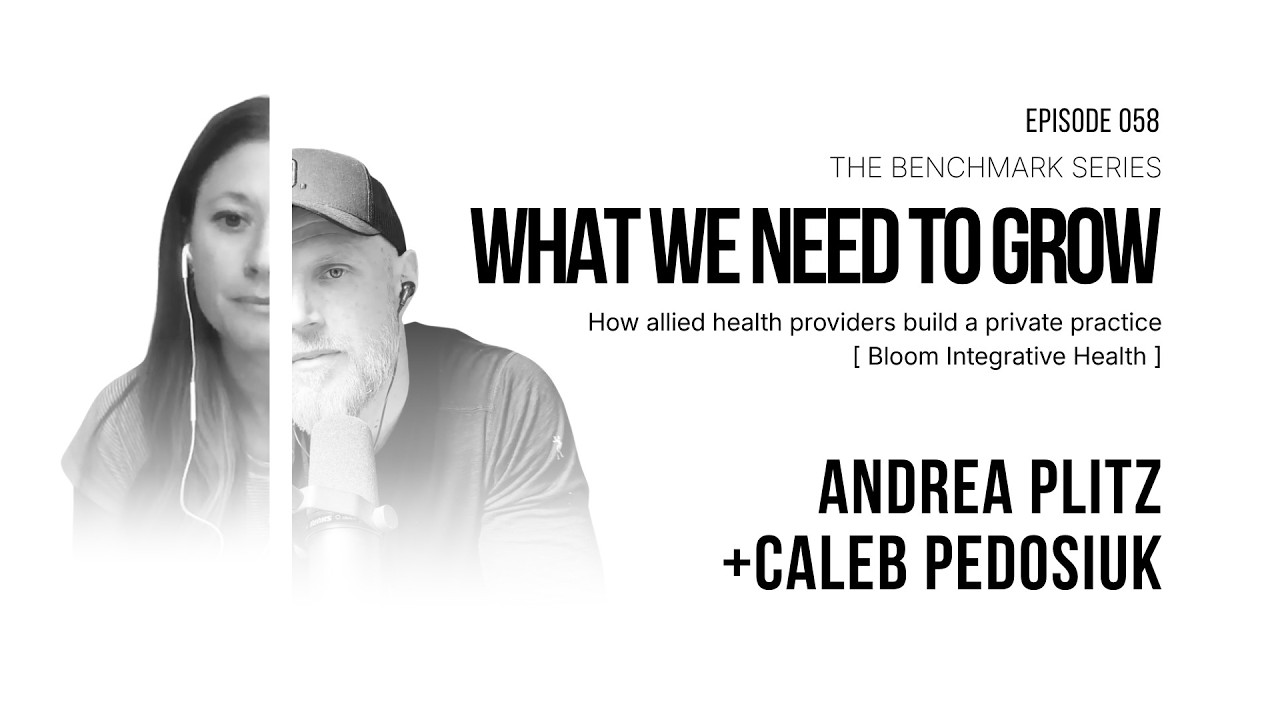
Andrea Plitz co-founded Bloom Integrative Health & Movement Centre because treating the pelvis in isolation, as an independent provider inside someone else's clinic, could not do what she wanted done. Sixteen years into pelvic and women's health physiotherapy, her account of growth is the useful one for anyone selling expertise into a community. The clinical credential does not come with a practice, and "building their clinical practice, learning how to network and engaging with the community, get their faces out there" is, in her words, "the most challenging part of private practice healthcare." What works is not a campaign. It is one-on-one relationships with the doulas, midwives, psychotherapists and chiropractors who already see the same patients, built over multiple engagements rather than a single meeting, and a website that is actually findable rather than merely live: "just because you have a website doesn't mean that people are finding it." That is the throughline 79 Development keeps coming back to. Her own sharpest line is about what happens next, when a patient takes a personal recommendation and asks a language model "to corroborate that personal review." Whatever record of the work exists is what answers.
KEY TAKEAWAYS
- Asked what she needs most to grow, she said practitioners, and then named the roles on the record. The Stittsville clinic is growing faster than it can be staffed. "It's growing fast. We have significant waitlists for many different disciplines, and it's just health providers are hard to come by these days because everyone wants them." Registered massage therapy is the acute one: "Our current massage therapist has a 61-person waitlist. No joke." Pelvic floor physiotherapists, also an ongoing waitlist, with one partner and full-time physio on maternity leave. Osteopathy, where there is more capacity than there are hands. A women's health focus is preferred and not required: "If you don't have women's health, that's okay. We can mentor, you can get other courses, all good."
- The hardest part of private-practice healthcare is not the clinical work, and it is not taught. "When I was in school for physio, we didn't even talk about public versus private system healthcare." Most physiotherapy in Ontario is privately paid, with OHIP coverage rare and narrow. "I find that's the piece that a lot of healthcare professionals in the allied health realm really have a hard time with, is that building their clinical practice, learning how to network and engaging with the community, get their faces out there and really build that presence in the community. It's definitely something that's the most challenging part of private practice healthcare."
- The lever that actually works is other practitioners, built slowly and in person. Not a campaign. Mental health professionals who work with sexual pain and trauma, doulas and midwives who see the same prenatal clients, chiropractors, massage, osteopathy, acupuncture. "It's really important to make those one-on-one connections in your community to know who's there, how do they treat. What do they love to see? How can you work and coordinate together?" And the part most people skip: "It's not just a one-time meeting. It's building that relationship with that other allied health provider over time with multiple engagements that makes it meaningful and relevant. That's probably the best one in my experience in order to get ongoing referrals." The outreach itself is unglamorous, a plain email: "I'm curious about your practice. Could we meet and just learn about each other and how we might help mutual clients?"
- A website is not findability, and she says so plainly. "You have to have a basic online presence these days, whether that's a website that is SEO optimized. That's a big one. Like, just because you have a website doesn't mean that people are finding it." The rest of her list is where attention actually is: active engagement in local community pages, including the mom groups where people ask for a provider by name, where you can recommend yourself and, she adds, somebody closer to them.
- The demand side changed under her, and the business did not follow it. Sixteen years ago the work was free workshops and basic education. "No one had really heard about pelvic health too much, especially pelvic physio." Now people arrive already informed, and earlier: prenatal, during pregnancy, even before trying to conceive. The reason is social, not clinical. "We're seeing now more and more just that communication, that social storytelling and sharing where it's less of a taboo to talk about." What has not changed is the lag before someone speaks up: "Because the pelvis is an area of such diverse and intimate parts, what we see happen is that a lot of times people will live with symptoms for a long time before they talk about it."
- The clinic has a radius and the subject does not. That mismatch is the whole strategic problem of a geographically bound practice whose topic is national. Her answer so far is to diversify the education rather than the footprint: a YouTube channel of health education videos, her business partner's podcast, blog posts kept current on the topics patients actually ask about, Instagram. She is clear-eyed about the limits of the online version, too. The workshops moved online after COVID, and "people are pretty online fatigued these days."
- Her read on the system is that siloed care is the thing that has to break. "Our health system is crumbling and decentralizing. But I really think that that interdisciplinary approach that you just mentioned is the key to improved healthcare for all. Too much in the past has been too siloed and too focused on the acute care system." In practice that means she is already triaging well beyond her own scope, sorting what belongs to physiotherapy from what belongs to naturopathic medicine, psychotherapy, or back to a family doctor, and she names the hole in her own training again: allied health professionals are taught the public hospital map, not how to navigate the whole public and private system on a patient's behalf.
- The mentorship she offers exists to shorten a path she had to meander. Physiotherapy school gives you orthopaedics and neuro; pelvic health training gives you the foundations; nothing joins them. "Bridging that gap between your existing knowledge and skillset and your pelvic health knowledge and skillset takes a little bit of time and energy. It's a meandering path, at least it was for me, over many years, many different courses trying to tie things together. And so I like to help people expedite that, so they can be more confident in their clinical application of what they're learning, as well as then transferring them to optimizing client outcomes a little bit faster." She is deliberate about what she is not building: the credentialing organizations already exist and do it well, "so I don't feel like I need to go that route."
- On testimonials in an intimate specialty, the patients self-regulate better than a policy would. "We have amazing clients who leave us amazing Google reviews. But we don't prompt them, and they just tend to write however much they're comfortable with, making it a little more vague as far as not adding those intimate details of their care." For anything the clinic writes itself, the rule is explicit: anonymous, non-identifying, mindful of what is shared and how.
- And on being found by a machine, she got there on her own. Caleb's point was that people increasingly reach for a trusted model the way they used to reach for a neighbour's recommendation. Her amendment is the sharper version of it: "Or if you develop that research and ask your trusted tool and language model to corroborate that personal review." That is the mid-funnel moment, a named provider checked against whatever record of them exists, and it is the most powerful argument there is for being legible to these systems.
FULL TRANSCRIPT
What We Need to Grow, Episode 058: The Most Challenging Part. A Founder Talk conversation with Andrea Plitz, co-founder and physiotherapist at Bloom Integrative Health & Movement Centre. Cleaned for readability; the words are the speakers' own.
Caleb Pedosiuk: All right, Andrea, today we're talking about what you have built with Bloom. I think it's interesting because you come from a background doing physiotherapy work, and yet you haven't just stayed with one location serving. First of all, you didn't take the path of operating in an existing clinic. You created your own clinic, and now, having seen the need and to be able to serve a wider group of people, you've actually expanded it. So you have multiple locations. I would love it if you can share a little bit about what it is that you are building, and how it is that you came to the decision to actually move into more of a builder operator role, as opposed to just functioning as someone who's caring one-on-one with your clients.
Andrea Plitz: I've been a physiotherapist for 16 years, working in pelvic and women's health from the get-go. It definitely wasn't what I thought my path would be when I was in physio school. I did work in other clinics as an independent provider, but I really felt the need to build a space that was, one, really focused on women's and pelvic health concerns, and also that was interdisciplinary, so that we were able to more holistically serve the people that were coming in.
So we founded Bloom with one of my co-founders, in Ottawa and Stittsville. Personally, clinically, over the years I've been focusing a bit more on complex conditions. Obviously starting with traditional pelvic health as the starting point, so pre- and postnatal and menopause and all those important aspects of the lifespan. But for me, I'm really finding interest in complex conditions that are more chronic, and that really intersects with pelvic health.
And so that just opened up the need to work more collaboratively with allied health providers. Naturopathic medicine, for example: they have a really nuanced and grayscale look at health from a medical side. But then even mental health providers, other manual practitioners like massage and osteo, acupuncturists, and all those more allied health providers.
Caleb: A question with that pelvic floor work. I know from my wife Sarah, and just learning a little bit about it, from what I understand it hasn't always been as mainstream in terms of understanding as it is today. So from your journey, what are you seeing? A lot of people get their information online, or are exposed to information through how social media has evolved over the last decade, from being more social to more interest and attention optimized, serving up content that would potentially fit a demographic. So have you found people have been seeking your clinic out with questions specifically about these things, rather than you necessarily having to educate them on it?
Andrea: Definitely. Initially, 16 years ago, no one had really heard about pelvic health too much, especially pelvic physio and what we can treat. We were doing free workshops all the time and just educating the public about it.
Now we're definitely seeing more people coming in, especially prenatal, saying: I heard pelvic physio is important to do not only postpartum, but especially preventatively, even maybe before trying to conceive, as well as during pregnancy and then post. A lot more social awareness and education out there on the importance of this part of our body, how connected it is to our daily life and living. So it's not just pregnancy related. It's bladder, bowel, sexual and reproductive health. It's musculoskeletal health that connects through the pelvis, which connects whole body, head to toe.
And because the pelvis is an area of such diverse and intimate parts, what we see happen is that a lot of times people will live with symptoms for a long time before they talk about it, whether that's with a health provider or socially with their friends or family. But we're seeing now more and more just that communication, that social storytelling and sharing, where it's less of a taboo to talk about.
Caleb: So you're doing workshops, and it's interesting to me because your business has a radius to it. It's geographically based, but the topic is not at all restricted to a region. So I'm curious to know, did you do the workshops digitally, or were you doing them in person?
Andrea: Back in the day, 16 years ago, they were definitely in person. Since COVID we've done a lot more online, although people are pretty online fatigued these days. But that's where we really try to diversify our education and our health literacy. So we have a YouTube channel that has a lot of health education videos, especially on pelvic and women's health. My business partner has a podcast, and she does a lot of health education on that as well.
We have our blog posts that we try to keep up to date and on topics relevant and important to people that are coming in, as well as people we get questions from. So we're trying to hit all of those different channels, obviously Instagram and those social media sites too. We just try to diversify how we're getting the word out there.
Caleb: So in moving from a clinician or a technician, to a business owner, to an operator, and then to multiple locations, have you found the sweet spot of what you're interested in serving? Or have you noticed that there are people raising their hand further out in Ontario, or in other provinces or beyond, saying: hey Andrea, can you help guide our process, we would like to add this as a capability or open a clinic like this? Have you found that demand has been pulling on your experience or the brand, to be able to further serve a broader audience?
Andrea: Not directly that way. But we have lots of medically professional collaborations in the Ottawa area. Ottawa Hospital urogyn, we have a good connection with them, a partnership with them that we're trying to enhance and build out, and create more of a public-private partnership in that way.
I have been interested, and I'd love to look at supporting pelvic health in rural Canada and rural communities, just because they don't have a lot of pelvic health providers there. I mean, healthcare providers there in general, but especially pelvic health. But in the realms of daily life and all the things I'm going through, this hasn't been top priority.
It's not an area of the business that I personally have expanded on. We just opened the Stittsville clinic, our second clinic, about 2 years ago. So we're still in the growth phase of that. Our focus has really been on trying to expand and build that team, while keeping our Ottawa clinic humming along.
Caleb: Do you find in that process that you're inclined to enjoy the training aspect of it? In the sense that you have this secondary clinic, is it something that you would potentially, much like creating educational content around the subject on the YouTube or the podcast, could you be educating people into saying: hey, you're in rural Ontario, if you were curious about what a path might look like, it would look like A, B, C, maybe finding an in-person location for training, and then B, finding your community?
Andrea: I personally really love mentorship, with especially pelvic physios, that's my discipline. And so I do offer virtual and in-person mentorship and training, but they do have to have started their first few levels and credentialing to get their pelvic health capacities.
There's some really great pelvic health educational organizations already, especially in Ontario, but in Canada, that their sole focus is the education of our discipline, to be able to perform those treatments and assessments. So I don't feel like I need to go that route. But I do like helping people who are navigating their journey in pelvic health, because I find a lot of what happens is we have this foundational knowledge coming out of physio school, orthopedics and neuro and all those bits, and then we get this pelvic health foundational training, which is important. But then bridging that gap between your existing knowledge and skillset and your pelvic health knowledge and skillset takes a little bit of time and energy.
It's a meandering path, at least it was for me, over many years, many different courses trying to tie things together. And so I like to help people expedite that, so they can be more confident in their clinical application of what they're learning, as well as then transferring them to optimizing client outcomes a little bit faster.
Caleb: So you mentioned that gap. To me, I don't have a physio or pelvic floor background, that's not what I do, but my world is dealing with businesses regularly. A lot of the work that we do is helping to take a product, a service, a problem that someone solves, and connect it with people that have that problem. And so the gap, I do know how much, like you were saying, time and energy, you're constantly learning to understand how do we do this effectively. And I wonder, when you have someone who has gone through a process, they have some education, they're on their learning journey, they're maybe practicing, they're in a mentorship capacity with yourself, do you find you're also able to help them with the gap of understanding how to operate, and build a client list of who they would serve?
Andrea: That's a big one. And I find that when I was in school for physio, we didn't even talk about public versus private system healthcare. As a pelvic physio, most physiotherapy that you go into is private paid, and there's very rarely OHIP covered physio. And if there is, it's for post-op, or very specific criteria that you have to meet in order to qualify: under 19, over 65, all those different types of things.
And so I find that's the piece that a lot of healthcare professionals in the allied health realm really have a hard time with, is that building their clinical practice, learning how to network and engaging with the community, get their faces out there and really build that presence in the community, so that people engage with them coming for treatment and all those things. It's something that we're working on with our team, but it's definitely something that's the most challenging part of private practice healthcare.
Caleb: What would be some of the levers that you have? You mentioned networking as one of them. What are some of the tactics that you have seen to be effective to be able to help, let's say, a fledgling or a new clinic create awareness about what it is that's being offered?
Andrea: You have to have a basic online presence these days, whether that's a website that is SEO optimized. That's a big one. Like, just because you have a website doesn't mean that people are finding it.
Some active online engagement through some means, whether that's being active in the local Facebook community page, where there's lots of mom community pages where they're asking for health providers for this, this, and that. And you can go in and recommend yourself, and maybe somebody else who's a little closer to them.
I find connecting with other allied healthcare professionals who work with the same population as you do is really important. So I go and meet frequently with other mental health professionals who work with sexual pain and trauma clients, doulas and midwives who see their pre- and postnatal clients, and they know that pelvic physio is of value. Chiropractors and all the different allied health people.
It's really important to make those one-on-one connections in your community, to know who's there, how do they treat. What do they love to see? How can you work and coordinate together and collaborate together to help the person who comes in to see you? That's probably the best one in my experience in order to get ongoing referrals. And it's not just a one-time meeting. It's building that relationship with that other allied health provider over time, with multiple engagements, that makes it meaningful and relevant.
Caleb: I think it's interesting, the sort of backdrop of the era that we're in has all this dialogue around AI, robotics. So much of that ecosystem is really being woven throughout our society, and a lot of the tactics or activity that business conducts itself in is on the digital side of things. And you mentioned digital fatigue, that a lot of people feel this sense of wanting the oscillating wave to maybe move back in a different direction. And I'm curious to know, making those in-person connections face-to-face, so they get a sense of who you are, do you mind sharing a little bit about what that is like? Is it something that you coordinate in advance, you have a digital component to that, whether it's outreach, and then do they say, hey, happy to see you? Or is it something more ad hoc? I would be curious to know how you approach it.
Andrea: For the one-on-ones with other allied healthcare providers, it's really just an email reach out and an interest: I'm curious about your practice. Could we meet and just learn about each other and how we might help mutual clients?
When it comes to community events, we do community pop-ups that are donation-based or pay what you can. So we're also trying to work with that accessibility piece, that private healthcare is quite privileged. We've done some collaborations where we host a teen health night at a storefront. And so then it's a combination of education for the customers coming in, as well as a mini movement practice that's a little more physio movement based, obviously. And that's definitely preplanned and organized and all those things.
And then there's a little bit more ad hoc, sort of happenstance meetings with other allied healthcare professionals at different local events. So the CLIMAX Conference is one that's coming up at the end of October in Ottawa. A lot of our urogyns are going to be there that we have good relationships with. We have a booth there, and that's another great place to do some marketing. Local BIA events and networking events, health fairs, and those types of things I find are all really valuable in not only connecting with the community and possible future clients, but also with the allied health who are serving the same population.
Caleb: How do you approach testimonials? I think for people, they first hear about something, it's sort of top of mind for them, and they're like, oh, there's something here. Maybe it would relate to me, maybe it doesn't. But when you start to hear or you read or you see someone sharing their story of, hey, this is actually my experience with it, and when that resonates more clearly, that is such a strong piece of the path for someone. But with the subject matter, because aspects of this is very personal, how do you approach testimonials? Do you find people are willing to share?
Andrea: Surprisingly, yes. We have amazing clients who leave us amazing Google reviews. We don't prompt them, but they just tend to write however much they're comfortable with, making it a little more vague as far as not adding those intimate details of their care. So we haven't really had too much of an issue with that.
And just thinking about putting out a blog post or some more content around some other aspects of care, we would just really take a really mindful look at how we're sharing that information. So making sure that's anonymous and there's non-identifying information in there for people. But I think it is important, because it is such a personal thing. I mean, health is personal, and especially pelvic health, that we need to be mindful of what we're sharing and how we're sharing it. But it doesn't seem to be an issue thus far, thankfully.
Caleb: As you were saying that, it made me think it would be interesting if, I don't know, 5 years out or whenever, that there was more of a norm where each healthcare practitioner, each GP, has this circle around them, like these seats around them, 5, 6 people. And for each one, hey, who do you have in your network that fills that role? And then the default for practitioners in various places is, who do I have? And actually the onus is to actively find out: okay, I understand that this is a gap, or this is a need for a certain portion of the people I'll come across, who do I know to be able to serve that?
Andrea: Absolutely. I really think that, I mean, our health system, we're very lucky and fortunate in Canada relative to other parts of the world, but our health system is crumbling and decentralizing. But I really think that that interdisciplinary approach that you just mentioned is the key to improved healthcare for all.
Too much in the past has been too siloed and too focused on the acute care system, the public system. Which, I get, healthcare is expensive and we need that to clear acute medical emergencies. But I think we really need that holistic, multidisciplinary approach.
Caleb: I had a really fascinating conversation, I think on Monday. It was recorded, so it'll go live. It's a gentleman whose partner came out of the healthcare system, specifically on the diagnosing side, doctors diagnosing. So he understands that whole practice, the methodologies in there, and they were just so aware of this gap, because so many times, and then he gets into some of the statistics about misdiagnoses for different things and how much a doctor has to hold mentally and process, and then they're essentially triaging information in their mind as they're trying to understand.
But he talked about the value of creating personalized LLMs that each person has access to. They have a process that is fairly extensive, I think it's about 45 minutes, where they're asking you at length certain aspects of your health just to onboard. But then from there, you can interact with it as different things are coming up. And part of the goal was to recognize that people are predisposed to different things genetically, different foods, the way that some people can eat a diet and they're fine and others, it results in kidney stones or other things. Once you recognize these patterns, that information as a whole can be very valuable, either for the person making decisions or when they go to see their physician. And they have this summary where it summarizes in doctor speak exactly, hey, these are some things that you might want to consider looking at.
But with the pelvic floor aspect of things, it would be interesting to be able to have something like that connect directly to say: one thing you might want to do is have a conversation with a pelvic floor practitioner in your area, here's two of them, here's a couple options.
Andrea: I think the medical system is getting better at referring to allied health, and especially pelvic physio, it's a lot more well-known. But that is what we see in our health team, whether they're coming in to see me or naturopathic medicine, is that they're coming in with a multitude of symptoms, whether it's a pelvic floor complaint or chronic pain, anxiety, GI issues.
And so we are capturing this information as well, and trying to put all those pieces together of how much of this may be influencing the pieces that I can help with, and the tools that I have in my toolbox, and what needs a referral out back to their GP. Is there something that's yellow or red flaggy? Or have they been to their GP, done all the tests, they're quote unquote normal, but yet they're still having symptoms and lack of quality of life? And so in which case, then, is that a referral to naturopathic medicine, where they can be really nuanced about it, look at other lifestyle medicine pieces? Or do they need to go to mental health support and psychotherapy, because that's the bigger piece of the puzzle at this moment in time?
So I think that all allied healthcare professionals have the capacity to take in that health picture, the whole health picture, and really triage, do what they can within their scope, and then access the rest of allied healthcare. It's just that we don't have a lot of training on that in physio school, allied health for sure. But again, more public system focused, as far as, if you're in a hospital, these are the people. Not the big wide world of healthcare, public and private. How do we navigate the system as a private health provider? How do we get up the ladder and navigate that system on the public side, especially if their primary care provider isn't willing or able to take the necessary steps to get them to the next phase? So it's interesting. Definitely a lot of opportunity to help with that interdisciplinary communication and collaboration.
Caleb: And hopefully to simplify it for people, much like people are picking a restaurant or picking a tool for something. They'll be able to ask, because more and more, the data shows that once people have a language model that they trust or that they like, they lean into that thing. It is very much a trusted companion. I don't mean, in some weird way, to replace human connection, but I think that more and more people are looking and saying, hey, if I'm going to look for a roofer, I'm probably going to reach for the tool that I trust, as opposed to trusting my neighbour's recommendation. Maybe unless you really like the roof.
Andrea: Right. Or if you develop that research and ask your trusted tool and language model to corroborate that personal review.
Caleb: True. In fact, mid-funnel, as we would call it in that case, because you're then taking the product, the service, the company, and putting it into the search, which is much higher intent. Mid-funnel is actually probably the most powerful use case and argument for strengthening visibility. So I 100% agree.
So last question I'd like to ask is, if you had to pick one thing, what would you say that you need the most to grow right now? And I know for some companies it's, hey, we're raising money. Others are, hey, we're launching a new product, we want to get word out, so trying to get people to try it. What would you say is the one thing?
Andrea: I think right now, at this moment in time, is allied healthcare providers for our Stittsville location. It's growing fast. We have significant waitlists for many different disciplines, and it's just, health providers are hard to come by these days, because everyone wants them. So if you know anybody who wants to come and work with us in Stittsville, send me an email.
Caleb: So can you name those actual roles, for the sake of the transcript?
Andrea: Sure. Registered massage therapy, absolute need. Our current massage therapist has a 61-person waitlist. No joke. And ideally they would have pre- and postnatal massage, more women's health focused. All of our providers have a women's health focus. If you don't have women's health, that's okay. We can mentor, you can get other courses, all good.
Pelvic floor physios, again, ongoing waitlist. One of our partners and full-time physios went off on a mat leave. One of the pros and cons of being a fully female-run and staffed organization is that there's lots of ups and downs in our staffing.
And we have osteopathy, but there's definitely more capacity and space for that. We're open.
Caleb: Very cool, Andrea. Thank you so much. And I'm excited to, I say sometimes I'm excited to see where things go, but realistically, we as human beings see like a shimmer from a distance. I think a more accurate thing would be to say, and I mean this genuinely with the number of people I speak with, I'm encouraged at the thought of what you're doing continuing to expand and prosper. Because the result of that are people who feel more comfortable in their body, that recognize that maybe some things that they thought were just wrong with them are actually, they're able to actually move. And so they have a whole different aspect of their life that opens up because of it, which is a really beautiful thing.
Andrea: Yeah, love that. Thank you.
What We Need to Grow is a conversation series by 79 Development, hosted by Caleb Pedosiuk. New episodes on YouTube and Spotify.