How Bitcoin Fits Into Generational Wealth Planning
For bitcoin and digital asset holders, financial educators, and families planning wealth that has to survive a generation.
About Brandon Karpeles
Brandon Karpeles is the CEO of Sovreign, a bitcoin-only consulting firm handling education, treasury strategy and white-glove self-custody onboarding for individuals, families and businesses. He spent roughly twenty years in traditional finance specializing in distressed assets and restructuring, and holds the Certified Insolvency and Restructuring Advisor designation. He hosts The Becoming Sovereign Podcast, and brings restructuring-grade discipline to a field dominated by hype and poor custody practice.
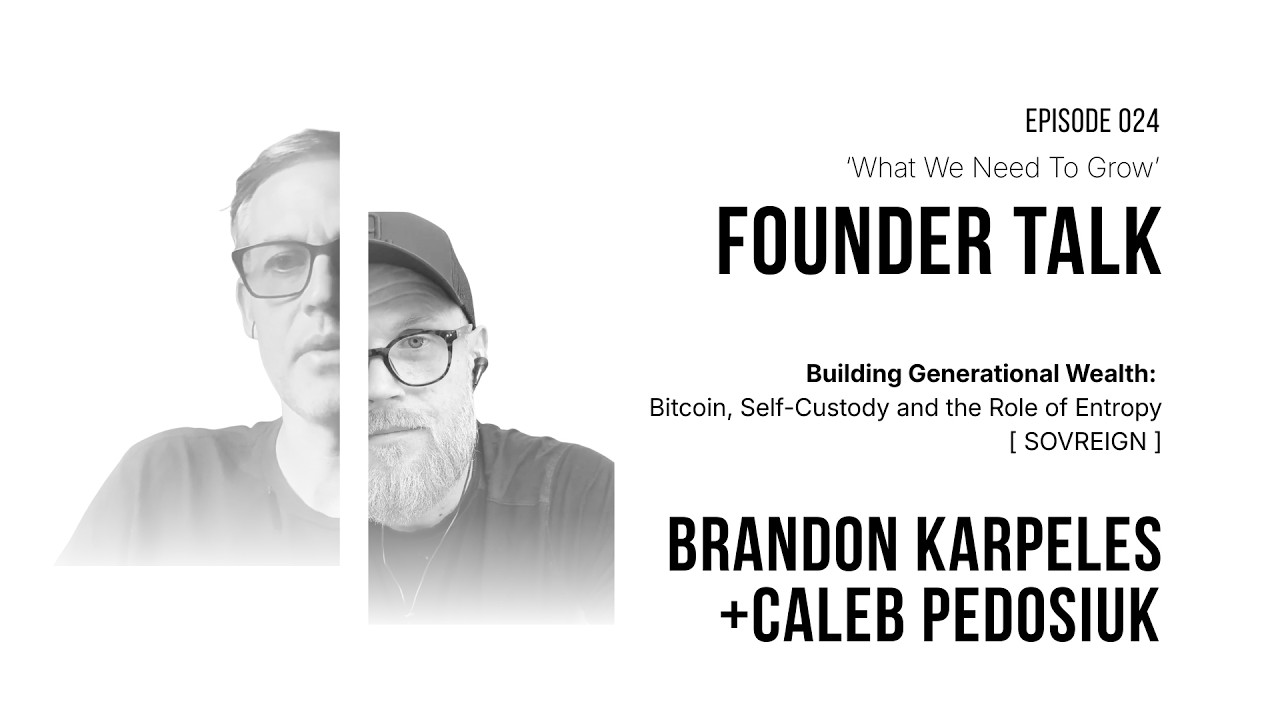
Brandon Karpeles left corporate distressed-asset work for Bitcoin and now runs Sovreign, a Bitcoin advisory firm doing education, retail self-custody, and multi-signature and inheritance planning for family offices. This conversation was recorded five days into the largest hardware wallet exploit in Bitcoin's history, and what makes it worth listening to is that Brandon does not position himself outside the failure. He watched prominent people in the space trust the same device, took that as confidence, and was only protected because he happened to generate his own entropy with dice. His conclusion generalizes well past Bitcoin. A recommendation from people you respect is not documented evidence, and open code that anyone can verify beats a reputation nobody has checked. That is the throughline 79 Development keeps coming back to. Authority is earned by doing work worth talking about and being able to show your work, and a verifiable account of that work is what makes a brand understood, trusted, and findable by the systems people now ask for answers.
KEY TAKEAWAYS
- "Always be skeptical. Don't just trust what other people are doing around you or saying around you." Brandon is unusually honest about his own exposure. He watched prominent people in the space swear by the Coldcard, watched them put funds on it, and took that as confidence. He generated his own entropy anyway, with dice, and that is the only reason he was never at risk. His conclusion is not that the crowd was malicious, it is that groupthink is not evidence. Make sure you have some actual documented evidence of what is going on, not that so and so recommended it to me.
- Nobody is taught what money is. He went through college and never encountered Austrian economics once, reading Hayek and Bastiat on his own. Sovreign's education curriculum is tiered like a school career, starting at K through two with opening an app on a phone, and building through cryptography to how mining works, down to hashes and nonces and elliptical cryptography by high school. Everything runs on Bitcoin's testnet rather than mainnet, deliberately, because introducing real money into a classroom creates legal problems no good intention survives. When Caleb pushed on where it stops being theory, Brandon's answer was that the point of the training is the moment a student says: okay, now I understand this, what am I going to go build with it.
- The quantum threat is not the one people think it is, and it is not the one that just happened. Brandon separates the two clearly. Quantum computing would break the cryptography itself. What actually happened with the Coldcard was far more ordinary, and worse: bad code, found by agents that have become very good at finding bugs. Mining is not the vulnerable surface, because a quantum machine can only hash about as fast as anything else. The exposed surface is seed phrases. And the failure was at the one place a failure is unrecoverable. Everything to the right of generating entropy is almost irrelevant if you cannot get that first thing correct.
FULL TRANSCRIPT
What We Need to Grow, Episode 024: Building Generational Wealth. A Founder Talk conversation with Brandon Karpeles, CEO of Sovreign. Cleaned for readability; the words are the speakers' own.
Caleb Pedosiuk: All right, Brandon. Sovreign, your company's name, is one of my favorite words right now. It's a term I hear coming up a number of times. I've got friends working in the farming community, people in finance, people looking at understanding land and community and whatnot. I think it's such an interesting concept to really consider. You are specifically helping people in the Bitcoin space, and with just what's happened in the last week alone, it's been fascinating to see how more and more people are trying to understand the importance of security, and making sure that wherever your funds are, wherever your resources are, things are secure. This past week, Bitcoin was in the news for it. So if you don't mind taking a second to share yourself, your company, the problem it is that you guys solve, and then let's get into it.
Brandon Karpeles: We're Sovreign, spelled a little differently than the actual word sovereign. It was a play on words from the founder, with Sov being store of value, like Bitcoin, and reign being the king. So it's like the king of store of value, and that's how the name came to be. It is a little confusing sometimes for people, so I do admit it was our founder's choice and I think we've made the best of it. But just to clear up any confusion over that.
What we help do is, we have three different verticals. We have an education vertical, we have a family office and high net worth individual vertical, and we have a retail vertical. In the education one we have a curriculum, just like a school course if you will, but it's very hands-on in integrating actual use of the network on the test network, getting people familiar with actually using the network and understanding the concepts behind it.
The retail facing portion is more just smaller, quick help. Help get set up with a hardware wallet, help running a node, get your coins off an exchange and into your own custody. And then family office and high net worth is much deeper, much more robust setups. Multi-signature, multiple keys, multiple parties, and along with that some long-term planning, like inheritance planning and estate planning. So those are the three different offerings we have, and depending on where you fall on that spectrum, we can help you out with any of those needs.
Caleb: For someone that maybe isn't that familiar with the space, you offer basically any financial service that exists in the fiat system. There is some version of an alternative that has its foundation in the Bitcoin space. Not that you guys necessarily are involved in all of them, but if I understand correctly, the ecosystem in Bitcoin has so evolved that there are options far beyond what most people, even people who understand the concept of Bitcoin as a store of value and a medium of exchange, may not understand how advanced some of this has become.
Brandon: Absolutely. And for the stuff we can't do ourselves, we have a very rich partner network. I mean, it's beyond just a partner network. It's people we know, people that we refer our friends and family to as well for different services. So something like estate planning, we'll help you map it out, we'll help you come up with what you want to do, but when it comes to actually documenting it, getting the trusts filed, all of that kind of stuff, we'll turn you over to someone else to handle that.
If you can think of a product, an HSA, a 401k, if there's a financial product out there, it exists in Bitcoin. Even something like setting up your wallet, that's the equivalent of opening a bank account for the Bitcoin ecosphere, except you actually own your money and control your money, not the bank. Every aspect of the financial world can be mirrored onto something that we will help you do in the Bitcoin world, or get you to the right person to help with that. There's insurance products, there's life insurance, there's actual insurance of your Bitcoin. So the ecosystem is really growing, and there will be more and more products out there. But yes, there is an entire parallel system being built on top of Bitcoin.
Caleb: You mentioned education. You have some training that exists. Can you give an idea, if we use kindergarten through to university, where would you say your education currently sits? For example, the very fundamentals of almost like setting up a bank account, through to understanding how to move some of that, through to where maybe you have a roadmap of where you see this going?
Brandon: Our education program specifically, we have it tiered out. So ideally, the program is you start in K through two and you go your whole elementary career, for lack of a better term, just progressing along the way. You start with basic concepts, simple things, just understanding the concepts of opening an app on your phone, which is something anyone can do, and then understanding the ideas of math and cryptography and things like that. All the way to, by the time you're heading into high school or in high school, you're learning how mining works, down to the hashes and the nonces that are being created and how that's done through elliptical cryptography.
The ideal course is just learning more and more as you go through. Finance was something that was never taught in school at all. Personal finance. Or maybe, if you got a finance degree, all you were learning about was bonds and corporate accounting. But in terms of actually understanding money, understanding the monetary system, understanding what money is, that's the big unlock. No one knows what money is. No one knows how money works. No one knows how it's created, et cetera.
The idea would be that you get this full education about Bitcoin and about money as you progress through, just like you do in math. You go from first grade math to second grade to third grade, all the way up to calculus. The same thing with money and Bitcoin and how the ecosystem works can be applied to an education program going through. And if you aren't starting in kindergarten, if you happen to be in sixth grade and this is when your school is going to implement a program and start teaching about this, then you pick up from there and go forward and start at a more advanced level, being able to understand more advanced concepts.
Ultimately the goal at Sovreign would be to start educating these kids as soon as we can, and then watch them spend their entire elementary years and into high school learning about this and progressing as they go, interacting with the network, being able to use tools like AI to help them along the way and interact with the network and set things up for them. That's the vision from the education side.
Caleb: It's interesting. As you were saying that, it made me wonder if there would be an interesting sweet spot. The Bitcoin ecosystem as a whole benefits from those who participate in it. The essence of believing in something is your participation in it, much like people talk about voting with your dollars. Voting through use, either store of value or actually using and trading in Bitcoin as something that you come back to.
But as you were talking, it made me wonder if there would be an interesting little niche where you could have young kids at different ages that are learning in this process, and at every stage, for them to teach. Almost like kids are creating content about whatever and posting it online, Minecraft videos, toy tutorials. If you had kids in their own words at different stages teaching a principle that would be understood by others at that age, and if you could earn Bitcoin in that process. So part of it is, if you're in a process of learning, and as you're learning you're saying, hey, if you wanted to help explain this to others, help them understand that, and you do that, there's a way to earn in that process, so that their actual wallet, they do see that wallet move. They do see that ability for it to actually grow. That would be interesting, rather than a lot of the time with learning you see kids doing some project that's detached from reality and it just feels like, what is the purpose of it?
Brandon: Absolutely. I don't disagree with you. And it's a fine line, right? Because you really do want this to be educational, and the minute you start introducing financial incentives into schools, you run into all sorts of issues. So maybe that's something that we could work with the students on, but it would be an initiative of their own, completely outside of the school. Something they would do, maybe offering this education or teaching to someone outside of the classroom, maybe not even at the school, somewhere else, and then say, yes, as I am helping do this, I have made the choice as an individual to monetize this. We do everything in testnet and nothing's done on mainnet, and we just have to do that because, unfortunately, using actual money in schools and education programs, you run into all sorts of bad legal stuff, even if you're very well intentioned and truly do mean it as an education experience only.
Caleb: Fair enough. Well, I look at so many things that seem nutrient deficient, that seem absent of value, that culturally take on. Have you seen the Tuttle Twins episodes?
Brandon: Of course. Well, I haven't seen as many of the episodes, but we have all the books, so we're just starting to read them to my 18 month old. I've seen plenty of the clips. I watched the Bitcoin one, of course. I'm not fully familiar with the full pantheon just because my kid's not quite that age yet, but we have all the books.
Caleb: Our seven-year-old absolutely loves them, but so do the 13 and 15 year olds. I mean, it's so well done. And it's interesting to see these subjects being approached and talked about. The one thing I think is interesting is that, much like the Simpsons or other cartoons that came out decades ago, they did not come in tiptoeing about subjects. They would just put it out there from a comedic standpoint. React however you want. If it's offensive to some group, that's fine. This episode might be offensive to that group. It seems like they're just having fun. I get that feel from the Tuttle Twins. But they're speaking about subjects, and they discuss history and concepts from other thinkers and leaders, economists, philosophers, explaining this in a way that reaches other kids, using video games or other ways to look at these things. Which is different.
Brandon: I absolutely love it. And again, it's just one of those things. As I was mentioning earlier, you never get taught about personal finance or banking or money creation, or money, period, at all. And you also never learn about Austrian economics. I went through college and I didn't learn about Austrian economics in school one time. I read some Hayek and some Bastiat kind of on my own, but I was never exposed to that school of thinking. So even just being exposed to this and thinking, okay, now I can make my own decisions.
It seems like that's something they won't even entertain in the education system these days as well. That's why you're seeing places like charter schools, private schools, proprietary schools, something like Alpha School that's just doing something completely different. You're seeing students thrive and excel getting outside of the box of the traditional education system, because you're just so kneecapped within that system. And forget all the ideology and other things, I'm not even talking about that. I'm just talking about a simple curriculum you're forced into, and such rigid rote recitation, not actually expanding your mind or learning how to think. Just memorizing stuff and not really absorbing or retaining anything, in such a limited scope of subjects and topics.
Caleb: We have homeschooled since 2020. That was a bit of a catalyst for us when things started to shift. And I agree with you, there are multiple categories you can have this discussion in. A lot of people feel like things are caught up in ideologies, which is certainly a discussion, and it is very polarizing. But if you just strictly look at the purpose of school, and you align on the goal being to prepare them to function harmoniously in society, contributing to society, and ideally to prosper, so that they too can have safe, loving, constructive households that can then contribute to society and to their community and grow up in a loving, constructive way, and then to continue that. And then to look at the picture of where we're at technologically, economically, socioeconomically, culturally, and say, are these things aligned? Where would we grade them?
If we took a grading report and we sat down the educators and just said, hey, much like good teachers in a loving, caring, compassionate, empathetic way sit down and say, this is a way we think we can improve. It would be interesting to sit down and say, hey, these are some ways that I think you can improve. Our lens for the last few years has been from privately educating them in a homeschooling environment. And certainly the moment you talked about these educational programs, it made me wonder, could my seven-year-old pick up on some of this stuff? Could my 13 year old, 15 year old? And then the immediate question after that is, how does it become real? Not theory. Where does it actually get traction? Where does the lemonade stand happen?
Brandon: That's absolutely the goal. The goal is to get that training, get that experience. And Bitcoin, for those not familiar, there's mainnet, which is the actual Bitcoin network, which is where all the transactions happen and Bitcoins are moved around. And then there's something called testnet, which is basically a play version of that. It functions exactly the same way as the Bitcoin network, it just doesn't have the monetary aspects of it. So you can move coins around, you can do the mining, you can mine a block, you can do all these different things. It was initially designed to help developers test things out before they put them into practice in real life, and that's still the purpose to this day.
But it also works great as an education tool, because you can learn about the network, see how it all works functionally. You won't really know that it's any different than using the actual Bitcoin network, other than if you try to send those coins to someone as payment it's not going to work, or send it to an exchange and they're not going to recognize your coins. What that does is it allows the training of kids, or adults, or anyone, to learn about the network, figure out how it works, and then say, okay, now I understand this. I see what can be built here. What am I going to go do with this information? What am I going to go build on my own?
Caleb: This past week in the news, Coldcard had, and I'll explain it how I understand it, Coldcard had a breach where the way that they had set their seed phrases, and maybe some of this is a little bit technical, they had used a predictable pattern, enough that it was able to be brute forced. Those passwords were able to be guessed, and as a result something like 100 million or so was taken. So I'm curious to know if you have any insight into what the community has learned because of that, or whether there were things to have been avoided to begin with.
Brandon: Man, there's so much here. This has been consuming my life the last five days. I've had friends and family that were on Coldcards that needed to be immediately moved and get into a better setup.
At the end of the day, the Coldcard was using a random number generator to generate seed phrases, and it wasn't generating enough entropy. You're supposed to have a minimum of 128 bits of entropy to have a properly secured Bitcoin address. That's the 12 words, if you're familiar with seed phrases, and then 256 bits of entropy is the 24 word phrase. So wallets should be generating either 128 or 256 bits of entropy. Their newer models were around 70 bits of entropy. And so to your point, yes, people are brute force attacking this. Without getting too technical, they're effectively guessing wallet addresses from a smaller pool, because if you don't use enough entropy it reduces the pool of options that could be picked, and therefore you can find those addresses.
So one, the lesson is that self custody you need to take very, very seriously. It's not just something where it's like, hey, I'm going to figure this out in a half hour and get my coins into my own custody. Have a plan, figure out what you're going to do, understand what you're doing, really understand the responsibility that comes with it.
And two, that generating your own entropy is really important. By generating your own entropy, I mean that 128 bits or 256 bits we were talking about earlier. On the Coldcard, if you did 50 dice rolls, that gave you 128 bits of entropy. If you did 100 dice rolls, that gave you 256 bits of entropy. And anyone who used that feature on the Coldcard was fine. Fortunately for myself, I have a bunch of Coldcards, but I did do the dice rolls on there, I generated my own entropy, and so I was never at risk of any of this. That being said, I've completely rethought my setup and I'm changing a lot. But at the end of the day, if you can generate your own entropy, do it. That's the only way to be 100 percent certain that you're good. Otherwise you're relying on the wallet manufacturer.
Now there's the other side of this, which is that now there's so much scrutiny on all of this that the open source wallet providers are being verified right now, and it appears that Coldcard was the only one with a vulnerability. But again, you're still relying on the hardware manufacturer. You also have supply chain issues. Maybe one of the Trezors, a very popular wallet, if their supply chain gets compromised, now potentially you have an issue with that wallet. So thinking about using multiple wallets in multi-signature addresses, so that you need multiple devices to sign one transaction, means that if there's a failure of one hardware provider, at least your other hardware providers provide some security there.
The main lessons are that open sourcing your code is really, really important, so that everyone can verify it, so that you can get eyeballs on it. Not just for your customers, but as a business owner, because you want people looking at it and you may have missed a bug. That's what happened, supposedly, in the Coldcard case: bugs were missed by the people internally reviewing. So having open source software that people can review, and having bounty programs as well, is a good idea, because then it incentivizes people to look at it.
And then generate your own entropy. There are some tools out there to help you do that, so to the extent you can do that, do that. But I think the overarching philosophical takeaway from everything is about trusting a single source, or groupthink about something. And listen, hand up, I was guilty. I saw very prominent people in the space using this wallet, swore by the wallet, watched them put funds on there, and it gave me a sense of confidence about it. I just said, well, this one wallet's good enough for me. Thank God I did generate my own entropy, but I could have just as easily used the wallet, turned it on and accepted the passphrase they gave me.
So always be skeptical. Do research about the products you're buying. Make sure that the code has been verified. And don't just trust what other people are doing around you or saying around you. Make sure that you have some actual documented evidence of what's going on, and that you're not just going, hey, so and so recommended this to me, I'm going to do it. I think that was a big takeaway from all of this. Sorry, I went for a long time. I could go for much, much longer. There are just so many layers and different things to this.
Caleb: I don't know this to the level that you're speaking about, and I appreciate what you're explaining. For other wallets, like Ledger, or Trezor, is there a similar challenge, not from this breach, but right now? Or is that one of the questions or problems to be solved with quantum computing, that some additional level of safeguarding would be needed as the hardware for computers enters a different era?
Brandon: I think there are two separate things here. One, Kimi K3 came out last week, and we've entered a new era of the ability of agents or AI to find bugs in things. So we're not even at quantum computing. Personally, I don't even think we're close to quantum computing. We're just getting really powerful agents that can find bugs. When you talk about quantum computing, the risk there is that you break the cryptography, that the computer becomes so good that it can perform those ten quadrillion gazillion calculations itself. What happened now was it just found bad code.
So the finding bad code issue is absolutely something out there that hardware and software manufacturers are going to have to reckon with. There are going to be many more bugs found and exploited, and you are going to have to have increased security on that front. Lots of people are working through that right now, trying to find different bugs. It's been reported that there are no issues with the actual entropy and the cryptography on any of the other hardware wallets.
So unfortunately, this Coldcard thing. Could you have a bug on another wallet? Sure. Maybe it discloses privacy or it mixes up a send address, something like that. But the problem with the Coldcard one was that it was the most important thing, generating enough entropy for your seed. That is the entire value proposition of the elliptical curve in Bitcoin, that you can hold your own keys in these 12 or 24 words, because the entropy is sufficient that no one can ever guess your password. The level of the failure on the Coldcard was the most important thing. Everything to the right of generating entropy is almost irrelevant if you can't get that first thing correct. That's what was so catastrophic about this.
And then the quantum issue is, again, in the future. Are we going to have to consider it? Yes. People are working on things. It may never happen, but if it does, then yes, there are going to have to be alternatives. Different math, different levels of security, or options introduced. And I'm going to be perfectly honest, all of that stuff's way above my pay grade. There's a very small subsect of people that even understand all of the elements involved. But they are working on solutions, and there actually is a break glass in case of emergency solution out there. If we really woke up tomorrow and there was a quantum computer, there is a solution. It wouldn't be perfect, it'd be messy, the network would be jammed, it would be very slow, but there is an option in a worst case scenario if that were to happen. And there are people working to make that option better and better. But that's something that I think is much farther down the road.
Caleb: Going back to my, I don't even know if I would say grade six understanding, but in solving the block, all the computers on the network are looking to solve the block, right? And then one wins it. Is the challenge with a quantum computer that it could constantly be the one that solves the block, and or that it has the ability to rewrite aspects of a ledger?
Brandon: The issue with hashing, that's not something a quantum computer can solve, because it can only hash as fast as the other computer. The mining won't be an issue at all. What's going to be an issue is exactly what just happened, in theory. Your seed phrases will get compromised, because the computer is so powerful that it can do those calculations that today require the energy of eight trillion suns and ten trillion years to find an address. In theory that will be able to be done by a computer. So the mining's not the issue. It's the seed phrases being uncovered.
Caleb: Okay. From what I understand, the problem you guys help solve is everything from the youngest age of people learning about this tool, being educated, through to family offices that want to take this seriously and have a lot in that equation that they need to handle properly. So in terms of who it is that you're signaling to, how do people come into your ecosystem at different levels? Are there specific people that you're looking for, and if so, what action should they be taking?
Brandon: The reality is that to date it's really just been us leveraging our personal networks and doing good old-fashioned business development, trying to get out there. So we've basically been limited by the extent of the people we know. We are currently working on coming up with the campaign to get our name out there, to do a lot more and make our services better known.
For someone like a family office, or just a high net worth individual who's on their own, we'll sit down with them, talk with them, figure out what their needs are, what's important to them. How educated are they about Bitcoin so far? Do they want to learn more? Do they want to just start with a little, or have they done a lot of research and want to put a bigger portion in, they just don't know how to do it? So we'll sit down with them, go through that assessment and figure out what's best for them. But at the end of the day, we're really just trying to help them introduce Bitcoin into their portfolio, their inheritance planning, their legacy, and their overall picture of wealth.
Caleb: For more information and resources, are you guys active on LinkedIn, X, anything specifically that you would direct people to?
Brandon: Absolutely. Our X account is @SovreignBTC. And then you can just find Sovreign on LinkedIn as well. And then personally, Brandon Karpeles, the CEO of Sovreign, you can come find me personally and reach out as well. And as I tell everyone, the best way to do it is just go to the website and do the contact us and shoot us an email, because then there's a bunch of us all looking at it at once and we'll get back to you ASAP.
What We Need to Grow is a conversation series by 79 Development, hosted by Caleb Pedosiuk. New episodes on YouTube and Spotify.