How Lawyers and Accountants Win Clients When Work Is a Commodity
For partners at law, accounting, engineering and consulting firms, and technical professionals who were never taught how to win clients.
About Hilary Fordwich
Hilary Fordwich is the president and founder of Strelmark, a Washington, D.C. business development firm she founded in 2002 to help professional service firms gain and retain clients. She is known for teaching lawyers, accountants, engineers and other technical professionals how to differentiate work that is otherwise a commodity, through keynotes, boot camps and executive coaching. Before founding Strelmark she spent more than a decade as head of global business development at KPMG, working in its Manhattan, Long Island, Washington and Amsterdam offices, and she is a regular broadcast commentator on economics, politics and the British royal family, including on GB News and Newsmax.
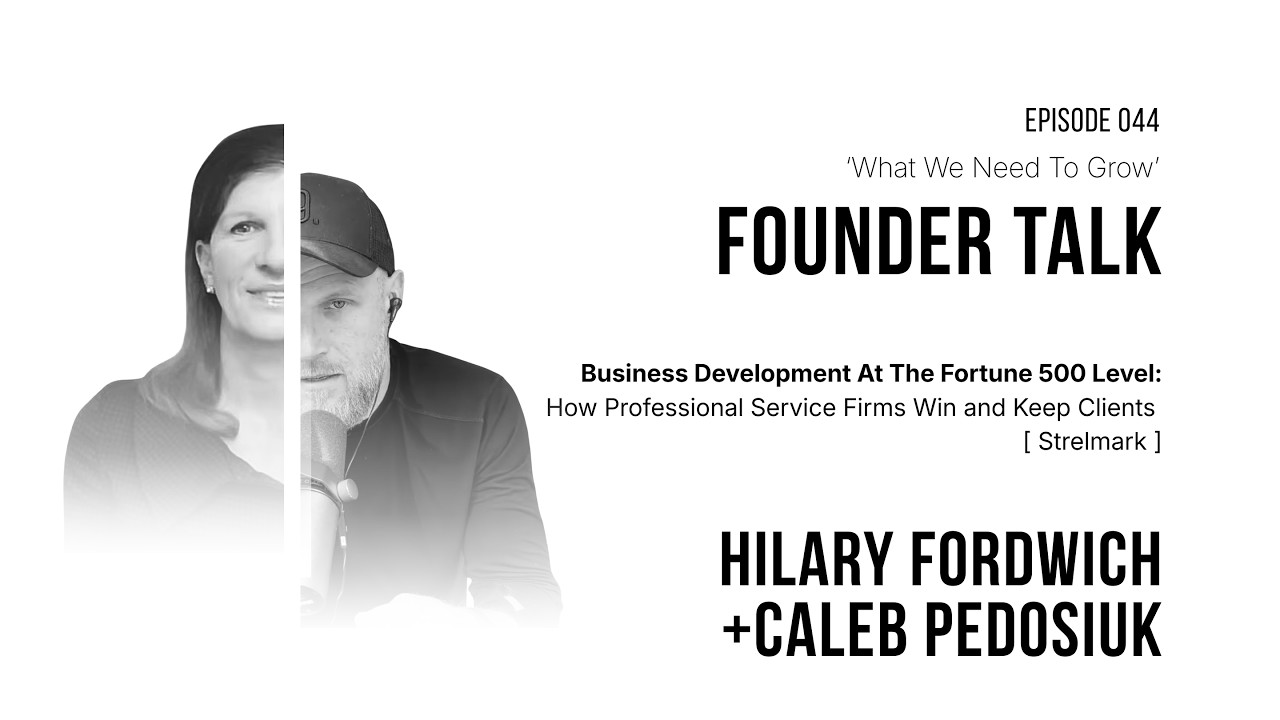
Hilary Fordwich is the president and founder of Strelmark, a Washington, D.C. business development firm, and spent more than a decade as head of global business development at KPMG. Her argument is aimed at lawyers, accountants, engineers, architects and technologists, and it starts with an admission most of them resist: the technical work is a commodity. An audit is an audit. What decides who gets chosen is everything else, which no professional school teaches, and her framework for it rests on being wanted rather than just needed. The people who rise to lead their firms, in her experience, are the ones strong on the human side, and the rest can learn it. She is equally direct that the same keynote delivered over Zoom produced no business at all, while the in-person version leaves a line of people waiting. That is the throughline 79 Development keeps coming back to. Authority is earned by building things worth talking about, and an honest account of that work is what makes a brand understood, trusted, and findable by the systems people now ask for answers.
KEY TAKEAWAYS
- Nobody teaches the part that decides success. "No law school, no accounting firm, no university, no higher education in America or anywhere in the world teaches how to gain and retain clients." A new lawyer knows the law, "but there are thousands of other lawyers. Why would you go to that lawyer versus the other one? So the key is differentiation."
- Be wanted, not just needed. Her framework is built on the difference. Every business needs an accountant and at some point a lawyer, so need is table stakes. "You need to be wanted, not just needed, for your brilliant technical skill." The framework has three pillars of want and five ways to achieve it, and in years of asking audiences what it misses, she says no one has named anything outside it.
- Admit that the technical work is a commodity. "Lawyers don't want to admit this. Neither do accountants or engineers or architects. They don't really want to have to admit that what they deliver is a commodity. An audit is a commodity. Tax returns are a commodity. Legal work is a commodity." She cites the Carnegie Institute of Technology finding that technical expertise accounts for only 15% of success, leaving 85% to everything else, and that 85% is what she teaches.
- The people who rise have it by instinct. The ones who become managing partners and practice leads are the ones good at the people side, not only the technical. She points to a former KPMG chairman she knew as a young manager: "I could tell you right the first time I met him, he has something." Her work is to teach that to left-brain professionals who do not have it by intuition.
- Business golf is not competitive golf. A client told her he spent thousands entertaining prospects on the course and never won a piece of business. She played a round with him, and "he was not doing anything right in terms of developing the right kind of relationship on the golf course." Different tactics from a networking event or a meeting. Fixed, his guests walked off wanting to do business with him. "It comes down to what you do, and also, on the golf course as in life, what you don't do."
- The same keynote on Zoom produced nothing. In person, a keynote leaves a line of 20 or 30 people waiting to talk to her. Delivered remotely during the pandemic, "same content, same me, not one piece of business." Video is excellent one on one and for audiences watching later, she says, but not for building business at a conference.
- The principles are the same, the prescription is not. Her analogy is diet: no diet tells you to eat more ice cream and sit on the couch, so in one sense they are all the same, yet a diet only works when it is built around your sport, your food, your family and your life. The want framework is universal human truths, tailored to a firm's profession, geography, people and competitors.
FULL TRANSCRIPT
What We Need to Grow, Episode 044: Wanted, Not Just Needed. A Founder Talk conversation with Hilary Fordwich, President and Founder of Strelmark. Cleaned for readability; the words are the speakers' own.
Caleb Pedosiuk: All right, Hilary. Let's see: 2002, your firm Strelmark was started. One of the things I think is so neat is that you ran business development at KPMG for a decade, international business development, from what I understand. And you're sitting in this space now where you're consulting on law, accounting and more. Can you share a little about your firm, what you're doing now, and the niche, as I understood it from our first conversation, of helping on the business development front?
Hilary Fordwich: Yes, absolutely, Caleb. Thank you for having me. You're right, I was at KPMG over 14 years, and I was locally, nationally and then internationally heading global business development there, and then I was headhunted out to another global systems integration firm. So a lot of global, national and local experience. What was consistent across all of those experiences, and what I brought to my company now, is that I observed that technically brilliant, left-brain people, so lawyers, accountants, architects, engineers, government contractors, tech, and of course at KPMG they were all accountants and auditors and tax, were never taught. They're not taught in school. No law firm, no law school, no accounting firm, no university, no higher education in America or anywhere in the world teaches, and this is my tagline, how to gain and retain clients.
People graduate from law school and think, great, I've got a law degree, I know the law, now I'm going to be a great, very successful lawyer. No, there are thousands of other lawyers. Why would you go to that lawyer versus the other one? So the key is differentiation. How do you differentiate your services from your competitor's? Same thing with accountants, engineers, architects, anybody in any technical field. That's what they have to know how to do.
Caleb: So what is the bridge? Is there a process you take them through, first of all to understand the gap? Can you walk through a little of what that process is like?
Hilary: Yes, absolutely. And excuse me, I've been talking a lot this morning on other podcasts across the globe. It's the difference between need and want. I have a want framework: why would you be wanted? You need an accountant for your firm, Caleb, and so does everybody listening who has a business. At some juncture you need a lawyer. You definitely need an accountant. You need certain services. So for any service, even technology, even AI, AI has to differentiate itself. How do you make yourself wanted? There are three pillars to want, and five ways to achieve it. I've been delivering this for many years, and I ask every audience: is there anything I've missed, anything I haven't covered, anything you think is different? Interestingly, no one in any of those audiences has ever come up with anything outside the framework. So it's a want framework. You need to be wanted, not just needed, for your brilliant technical skill.
Caleb: Let's say a leading accounting firm, with something that seems very objective and numbers-driven: what's the ROI, where's the practical value? How would they move the needle on the want side, because it is technical, it is objective? Would they be evaluating all the quantifiable ways their firm brings a financial advantage? Or are you suggesting there's a layer outside that, something more intuitive or more human?
Hilary: Well, it's a great question, because it's the crux of this huge issue, and it's the dilemma they always face. Is it subjective? Is it objective? The reason the want framework works is that there are certain universal human truths, and those are what you can leverage to be wanted over your competition.
Lawyers don't want to admit this. Neither do accountants or engineers or architects or anybody technical. They don't really want to admit that what they deliver is a commodity. An audit is a commodity. Tax returns are a commodity. Legal work is a commodity. It is technically very similar. And this actually comes from the Carnegie Institute of Technology: the percentage of your technical expertise that determines your success is only 15%, one-five, 15. So 85% of your success is everything other than your technical capability. What is that? That's what I teach on and talk on. That 85% is making people want you, and it's exactly, to your point, differentiating what is otherwise a commodity. But people have to be taught this, because it doesn't come intuitively. It's not taught in schools or anywhere else. They graduate all these students and don't give them one single skill for how to succeed at gaining and retaining clients.
Caleb: So where would you see someone doing this well currently, whether it's a personal brand or a company or a firm? If you had to pick an example, even a hypothetical one.
Hilary: Oh, I can give you real examples, actually. You can always tell the people who intuitively have a je ne sais quoi, who get the instinct of it. Maybe they've read a lot about business development, maybe they've learned a lot, or maybe they've been through one of my programs. I've had phenomenal testimonials, like, if I'd had this session 30 years ago, I could have made a lot more money. One high producer at a financial services firm said he'd been sent to an eight-hour high-producer session in New York, and two hours with Hilary was different.
But the people who know what to do, Caleb, are the people who rise to the top of their profession. They're the most successful. They often become the managing partner. They often become practice leads, because they're very good at the people side, not just the technical skills. I used to point to the former chairman of KPMG, John Veihmeyer, whom I knew well. I knew him when he was a young manager, and I could tell you, right from the first time I met him, he had something. He was technically brilliant, but they were all technically brilliant. He had these human engineering skills that aren't taught, which a lot of people do have inherently. The issue is that when someone is in a very technical, left-brain profession, lawyers, accountants, architects, engineers, government contractors, and everybody in technology, and they're brilliant on the left-brain side, they don't necessarily have the intuition and the human engineering skills required for that 85% of success on the right side of the brain.
Caleb: From our initial conversation, and some of what I looked at in your work, there's this component of golf that weaves through what you do. Let me use it as an analogy. Say there's a charity golf tournament, a networking or association event, with a number of teams out there, and everyone is equally technically capable. Their skill is perfect. If I understand you correctly, and let's pretend everyone shot the exact same score, that's the level playing field technically. What you're suggesting is that the conversations happening on the cart, off the cart, around the ball, around the hole, those interactions are actually more of the equation. If 15% is technical, per the Carnegie Institute, then what happens on that golf course is mostly interpersonal. Is that an accurate way to look at it?
Hilary: Well, you're bringing in, which is really kind of you, that I also do a lot of business golf. And yes, business golf isn't competitive golf. Right now the Presidents Cup is going on, and your audience may know the other majors, the Masters, the US Open, the Open, the PGA Championship. That's competitive golf, and it's completely different. The players aren't having conversations. They're not there to network. But to your question, when you attend a charitable golf event, or a chamber or association event, or you just go out and golf with people on a weekend like I do, or you entertain people for business golf like I do, it's not just your raw score, assuming, per your great analogy, everybody shot the same score. It's the difference in how you walk off the golf course with them wanting to do business with you. I've developed most of my business from being on the golf course, either from serendipity, being teed up with the right people, or from interacting with them and inviting people.
Somebody once came to me, knowing that I talk about business golf, and said: Hilary, I'm spending thousands of dollars a year entertaining people, and I never get any business on the golf course. What do I need to do? This stuff doesn't work. So I said, let's go out and golf and we can talk about it. When I observed him on the golf course, and somebody once said to me, Hilary, you have the ability to tell someone their baby's really ugly and they'll still hug you afterwards, so I had to be very careful, because I didn't want to insult him or be rude, but he was not doing anything right in terms of developing the right kind of relationship on the golf course. It's not the same as going to a networking event, a business event or a business meeting. Different tactics, different techniques.
I was able to totally rectify that: have him stop doing all the things that were rather annoying, which most people consider somewhat rude, and give him the tactics and techniques that would ingratiate him. In a nutshell, when he left the golf course with those prospects, they wanted to do business with him, not just enjoy the money he spent hosting them. So yes, it comes down to what you do, and also, on the golf course as in life, what you don't do.
Caleb: With the work you're doing currently, what are the different avenues for these trainings? Is there a one-on-one component, coaching or consulting? A group component? Larger-format events where you're training an entire room, a seminar or keynote?
Hilary: Yes, yes, yes, to all of the above. To give you concrete examples, global firms have brought me in and given me just one opportunity, a keynote, and luckily, 100% of the time, they've then wanted me to work further with their people. So they'll break it down into groups. Smaller companies might have me in for group sessions: one initial session on the principles of the want framework, and a second, far more interactive session working on the specific issues within their firm. And I do one-on-one coaching, usually for more senior executives, because obviously companies invest in them. The group sessions are usually for younger professionals. I've delivered all of the above for over 20 years now, for professional service firms across the globe.
Caleb: There's a spectrum of things you can speak to. What would be one of your favourite areas or keynotes? Is there a specific angle you really shine in?
Hilary: I've been asked to speak in so many different arenas, Caleb, and on so many subjects. In terms of what I like most, fundamentally, I absolutely love what I do. Why? Because I'm making a difference in people's lives. We all need money. We have bills and mortgages and living costs. But what really rocks my soul is making a difference in people's lives. I can almost tear up saying this: I had a managing partner of a law firm I worked with over 20 years ago tell me that for all the years he led that firm, he had my want framework on the back of his door, and he'd walk through it on every single call. I mentioned the testimonial from someone who said he'd have made more money if he'd had this 30 years ago. I have testimonials from every industry. I'll bump into somebody who was a young person then, and they still use my principles. People reach out on LinkedIn and say they still treasure what I taught them. So overall, that's what I love about what I do.
In terms of the actual keynotes, it's always the want framework, but tailored for different things. I've been asked to speak on work-life balance and stress management. I've spoken to a lot of women's initiatives, on being a successful woman in what's still a predominantly male world. And though I haven't done a lot of it, my personal passion is longevity and wellness, and I've been asked a couple of times to speak on that. I'm not technically qualified, I just, not to be too modest, personify it. I've never been sick, never been ill, had three totally healthy children, and I really relish a healthy lifestyle. No one raises their hand and says, I'd rather be sicker, I'd rather die younger. Every day in America, 12,000 Americans retire, and not one of them has ever said, I'd rather be sicker and die younger, please. So there's something there, and that's a space I'd love to get into more, and link up with business goals: longevity and health with the same principles. What do you want?
Caleb: I'm thinking about some of these larger organizations you've been comfortable walking into, KPMG and other international firms. We're in 2026. Since 2020 a lot of things shifted: video calls, large remote groups. Are you finding there's appetite or demand for someone like yourself to address an international audience beyond the room at an in-person conference? Are you doing keynotes over Zoom or Teams?
Hilary: Well, I will say I've been asked to do that, yes. And I remember during COVID how I determined it was far less successful in terms of actually developing business, from my business perspective. Anytime I've ever delivered a keynote in person, there's a line of people in front of me afterwards, 20, 30 people. Over Zoom, I will be honest, I didn't get one piece of business. Same content, same me, not one piece of business from that. So I think Zoom, and the internet as we're doing now, is absolutely fantastic when you're doing something one-on-one like we are, and when people want to watch it and choose to watch it later. But for conferences and group events, there isn't anything like being in person. Not because of the content I deliver, because it was the same slides, the same me. I'm not able to walk around, and you don't want me pacing around the room here. But people just don't reach out in the same way, and I'm not in control of that, and I don't know why.
What I do love about modern technology is that you and I met like this, and you're not here in Washington, D.C., you're somewhere else, and we're able to have exactly the same conversation as if you'd flown in to meet with me or I'd flown to meet with you. And I did a big podcast in the UK this morning. I couldn't fly into the UK and back for that except for thousands and thousands of dollars and a lot of time. So it has its pros and its cons, and I'm not in control of the cons, so don't ask me why they happen.
Caleb: It's interesting how interconnected things are, how quickly we move from stream to stream. Even meetings today, it's almost like we're teleporting from one point of the continent or the globe to another, which is very different than before. So given the strengths of it, if we're not in control of the weaknesses, what could we be doing with it? Where can people learn from you if they want to glean some of this digitally? From what I understand you're a regular in the media, often asked to share your voice and perspective on different subjects across different networks. What's the best way for people to get some of the signal you're sending?
Hilary: Well, thank you. My business principles aren't really as much on the networks, because the networks want me to talk about economics, which I'll be doing this afternoon, naturally, in terms of what's going on in the political sphere. I talk about economics and business, and I also talk about politics and the British royals, so I'm on different networks live. I'm a regular on GB News. I'm a regular on Newsmax. I'm a regular on Sky News Australia. I do post some of the videos on my YouTube channel, but it comes down to my bandwidth and time, and whether I get the clips and they're timely. So I don't really have much material out there on the want framework, because basically that's what companies retain me and hire me for, and I go through those principles.
And while the principles of the framework are the same, the analogy I always give, Caleb, is that for every company it's tailored and it's different. The best analogy I have is a diet. Everybody listening: if you wanted to lose weight, there's no diet that's going to say eat more ice cream and bonbons and candy and sit on the couch. No diet's going to tell you that. So you could say, well, all diets are the same. I always say the principles of a diet are the same, but to be effective, they should be extremely different. If I were to design a nutritional lifestyle diet for you, it would be very different from someone else's. What's your favourite sport? What foods do you enjoy? What's your lifestyle? You have children, other people don't. In the same way, human relationship truths are tailored to a different company, the part of the world it's in, the employees it has, the profession it's in, and the competitors it has. There are so many variables that make it very different.
And I mentioned international. Your audience can probably tell from my accent that I'm English-born American, so I have a very transatlantic, across-the-pond view, and I do a lot of international training as well. I was married to a Dutchman and lived in Holland for three years, so I speak Dutch, Spanish and French, I always say like a five-year-old child, and most importantly, a restaurant menu. But it does enable me to deliver international training. I spent a lot of time in Spain as a child, and in global development we had a global development centre in Manila, so I spent a lot of time in Hong Kong and Manila, with Asian culture, European cultures, American culture. So I feel international training has a lot of components: the differences between nations, how nations view each other, and the best ways to get along, trade and train.
Caleb: My last question for you would be whether you've considered writing a book, or have something people could get in their hands. If you could speak to that, to let people know.
Hilary: Well, yes, I've considered writing a book. I actually have lots of content, so much content, ready. But I don't do anything unless I can do an A version of it, and I need a team behind me, because I've never published before. So I wouldn't do it unless I really had the proper machine around me. Today's world is an AI world. I would want to work with a company that had the AI to promote it and leverage it, and the proper kind of publishing. One publishing company did approach me, but they wanted a fortune upfront, and I've been burned many times, so I'm very leery about that. I have to be very careful about the way I go ahead.
Caleb: Well, Hilary, thank you so much for the time and for everything you shared today. Really appreciate it.
Hilary: Thank you, Caleb.
What We Need to Grow is a conversation series by 79 Development, hosted by Caleb Pedosiuk. New episodes on YouTube and Spotify.