How to Choose the Right Technology Before You Build a Farm
For founders deciding between a consultant, a software tool and a channel partner, operators whose category is sold to them by the people who make the equipment, and anyone who wants to understand why answering a category's questions in public for ten years beats chasing its buyers.
About Henry Gordon-Smith
Henry Gordon-Smith is the founder and CEO of Agritecture, the advisory and technology firm that plans greenhouse, vertical and urban farms for entrepreneurs, governments, investors, architecture firms and corporates in more than 45 countries. He is known for starting it as a blog in 2011, while studying political science and international relations at the University of British Columbia, and turning a decade of answering his category's questions in public into both a consultancy and the Agritecture Designer farm-planning platform. He co-founded the Association for Vertical Farming in 2013, holds an M.S. in Sustainability Management from Columbia University, and is a lecturer in Sustainability Management at Columbia's School of Professional Studies.
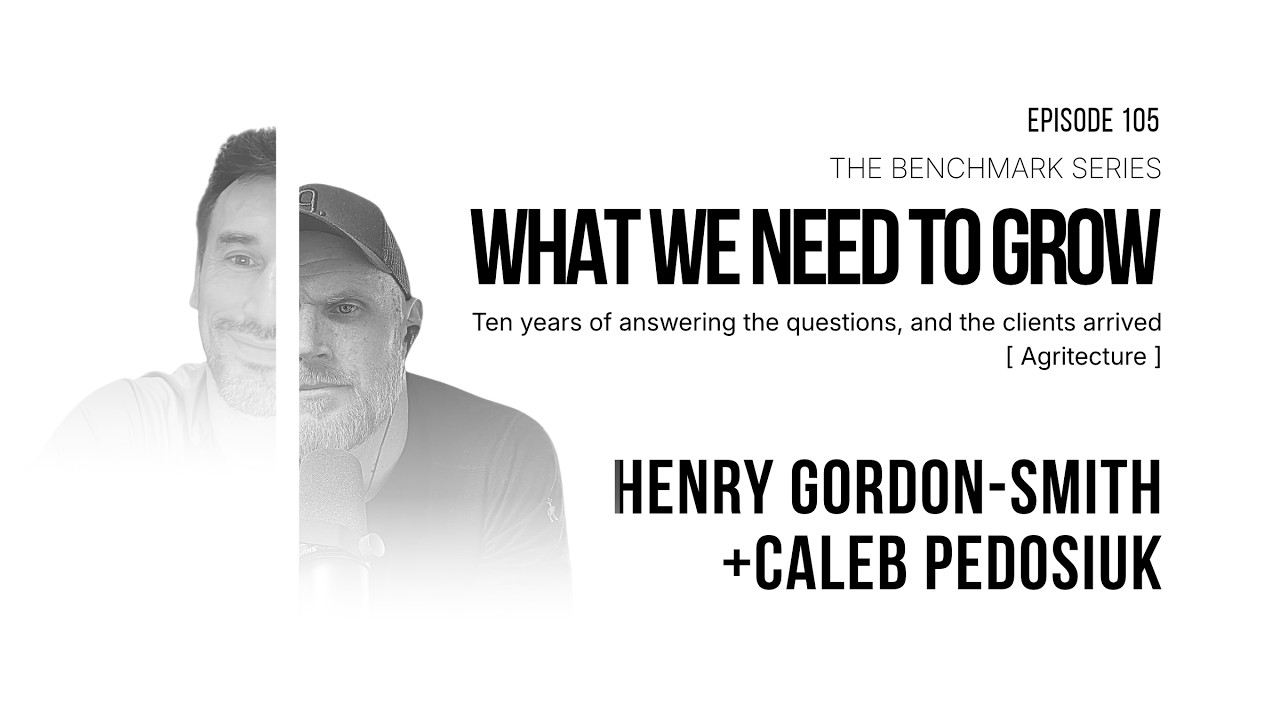
Henry Gordon-Smith is the founder and CEO of Agritecture, and the way he describes how the firm gets its clients is the clearest statement of this show's own argument that any guest has given: they call themselves a garden, and they attract more than they chase. The mechanism is not a campaign. They answered their category's questions in public for ten years, the people looking for those answers became a community, and the community sent the referrals and became the clients. The content was a by-product of doing the work, which is why it reads as credible rather than as marketing. That is exactly what the machine layer now rewards. An engine asked whether to build a greenhouse or a vertical farm looks for the source that has answered that question consistently and in detail, and finds the one that has been doing it for a decade. His discipline about what he will not claim is part of the same thing: he warns against being naive about technology, and he tells farmers to choose the right tech rather than the newest. A brand that only says what it can stand behind is one that gets explained accurately when someone asks a machine about it. The work is not louder marketing, it is being findable by the people already looking.
KEY TAKEAWAYS
- "We call ourselves a garden. We attract more than we chase." This is the sentence the episode is built on and it is a complete content strategy stated in nine words. He is explicit that it has been a double-edged sword, and he is equally explicit about what makes it work, which is duration rather than volume: "I pride myself on the fact that we've been an organization that has been answering these questions for 10 years, and our clients could be entrepreneurs planning their first farm." The mechanism he describes is the one 79 Development argues for constantly, arrived at independently and a decade before the machine layer existed to reward it. The community "learns from us and is growing with us," they "either send us referrals or they become our clients," and the by-product is the asset: "the content that we produce in that process becomes useful to groups that are looking for information."
- The operating idea is that the equipment salesman should not be designing the farm. His account of how farm decisions actually get made is the most transferable thing in the conversation, and it indicts a process nobody thinks to question: a farmer with a problem goes to the person who sells him seed, asks about a greenhouse, "and then that guy is going to sell a greenhouse, is going to get a commission for it." His objection is not corruption, it is sequence: "it's sort of this middleman process that's based on a bias of selling equipment. And I think it also misses the role of design." The alternative is design thinking, which he reduces to something a founder in any industry can use tomorrow: "I'm going to list all the problems I have and define the biggest problem. Then after that, I'm going to list all the possible solutions and select the most optimal solution. And that's literally just two triangles of problems and solutions in its simplest form." The three principles he says the firm runs on are design thinking, interdisciplinary teams, and a global rather than local evidence base, and he names what the farmer and the distributor are both missing: all three.
- He is openly sceptical about technology in his own category, which is the position that makes the rest of it credible. "We don't want to be too naive about how technology can solve their problems. One of the things I talk about in my company and with our work and with my students is you really want to choose the right tech. So we want to not be too obsessed with that." The example he gives against himself is Northern Virginia, where farmers are under land-value pressure and the answer is not AI at all: a local label, Prince William Grown in his telling, backed by county-supported farmers markets, plus shared infrastructure like an incubator for new farmers, plus agritourism so the land earns without selling. Where technology does belong, he is specific: Czech hop farmers facing drought volatility got an app pulling satellite, weather station, soil and plant health data so they could decide when to water and when to fertilize.
- And the version of AI he is most excited about is unglamorous and it has a human in it. He describes an AI agronomist in Malawi that farmers reach over WhatsApp, where "a human agronomist will come in just to confirm that it's accurate and have a final chat," which is how one team serves many more farmers. He is equally taken with the opposite end of the stack: a German engineer and his Mexican architect wife who inherited her family's greenhouse and could not afford the incumbent control systems, so "they're doing it with Raspberry Pis. They're creating their own systems. They're creating their own apps. They're vibecoding. They're building it all for themselves." His conclusion about what that independence means is the line to keep: "farmers always hustle. Now that they can build their own things and control them, that gives them a lot of independence."
- The frame he offers for the whole sector is a replacement for the usual two metrics. Caleb raises the regenerative argument that yield and profit are not the only KPIs, and Henry answers it structurally rather than ideologically: "the systems that these farmers based their work on, the soil, the climate, the rain, the market conditions, the labor conditions, all of those are at threat. All of them. So the name of the game is, how can you stabilize? How can you plan for the future?" Then the reframe: "moving beyond the KPIs you mentioned of just productivity and profit, it's about resilience. It's about adaptation. This is what most farmers are really thinking about these days. They just want to have clarity so they can continue."
- The business is mid-pivot and he says so plainly, which is rare on this show. Consulting does not scale, so the knowledge went into software, and now the software is being narrowed on purpose: instead of near-infinite modelling options, templates and digital twins for the few methods that are actually viable in a given place, "specifically in Ontario, these are the most viable farming methods." The reason is funders. He cites $750 million allocated in Canada to grow more food domestically, says he ran a webinar on it that morning, and the opportunity he sees is narrowing what gets proposed so more of it succeeds: "they have to get the business plans approved, and we can help a lot of the entrepreneurs by narrowing down what's most likely to succeed." He frames all of it as service to one stated mission, "to help humanity adapt to climate change through smarter agriculture. We have a bold mission."
- And the personal turn at the end is the human moment of the episode. He is forty, has been a nomad "literally every other week I'm in a different place," grew up in Hong Kong and Tokyo, holds three citizenships, and is leaving New York in December for family land in the Czech Republic: "I want to get back to my roots. I want to do some of that slow grounding work, but I want to bring tech into it too." He names what he wants to try, agrivoltaics and synecoculture, and then says the thing that explains his whole trajectory: "everybody in their lives at some point can crave that, if they've gone a little bit too global and detached from home."
FULL TRANSCRIPT
What We Need to Grow, Episode 105: We Attract More Than We Chase. A Founder Talk conversation with Henry Gordon-Smith, founder and CEO of Agritecture. Cleaned for readability; the words are the speakers' own.
Caleb Pedosiuk: All right, Henry, I'm stoked for this conversation. I don't always do an intro, but I'm going to try to touch on a couple of things here. So first of all, your website is agritecture.com. You started Agritecture as a blog in 2011, co-founded the Association for Vertical Farming in 2013, built the company into a consultancy that's advised on hundreds of urban agriculture projects across a dozen countries. You've also been publicly blunt that pure consulting doesn't scale exponentially, and pointed to setbacks like the AeroFarms SPAC failure and AppHarvest stock drops, signs of a vertical farming sector hitting a trough of disillusionment, which makes you a credible voice on both the promise and the real limits of this category.
A little bit of myself, my background. A few years ago, 2018, myself and my wife, we were just sort of tapped by a local farmer who was a primary producer, regenerative agriculture, organic farmer, who was saying, hey, there's this whole thing going on with resellers. And I had no idea what this was. So the industrial food comes in, they get it from the food terminal about an hour and a half from here in Toronto, peel the stickers off, make it look like something else. And actually there was a big exposé that went national here where they basically blew the lid off it, saying, hey, you cannot do this. You will cannibalize your local food system if you try to pretend that that green pepper grown in Chile that you can sell for 25 cents is the same as what this guy's been stewarding for years. So we got to come alongside some farmers and I really felt like our eyes were opened to some degree. I have a whole different appreciation for soil complexity, what's going on at the microbial level, more than I understand. But I would absolutely love to hear you share a little bit about Agritecture and your vision of what you're building right now.
Henry Gordon-Smith: Yeah, thanks, Caleb, for that introduction. Appreciate it. Agritecture, as you sort of noted, is really focused on global food systems, but we focus a lot on local agriculture and how technology can make the food system more resilient. And so what I'm really passionate about is the fact that the food system is such a massive contributor to climate change, but it's also severely affected by climate change. And as a result, it's hugely critical that we invest in it, for so many reasons.
And I get really excited about the challenge, because it's different in each place. You mentioned one case from Toronto, but you could think of a million different places in the world, and the context is different. Smallholders in Africa and India and the challenges they face from their ability to access technology, and yet combined, they feed such a significant population of the world. And then you could go to large-scale producers of wheat and corn, and what they're facing and how they engage with the government on lobbying and benefits and the crop insurance they need. And then you could go to people trying to start farms in cities who are passionate about growing local food. And for Agritecture, the reason I started it was because I was interested in all those different dimensions of the food system, and bringing that complexity to the world in a way that they could digest.
So that came in the format of blogs. Eventually that became workshops and structured methodologies for planning these farms, and then it became a consulting practice. And now it's a software solution where we have a farm planning software, where we're bringing this data and democratizing it as much as possible, so that this gap between what we need to do and what we can do starts to get filled by entrepreneurs, governments, investors, to start to grow the food system in what we would call climate-smart agriculture, which is basically more productive, more resilient to climate change, and mitigates some of the damage from climate change. So carbon sequestration or carbon reduction.
Caleb: So is there a specific avatar or target persona that you're speaking to, or a couple of them? Or are you just like a gravitational center point that anyone who's remotely concerned about these things can come and learn or be empowered?
Henry: Yeah, it's been a bit of a double-edged sword, starting from a content and brand and community perspective, because we call ourselves a garden. So we have these gardens in our business strategy, and we attract more than we chase. And so we have this community that learns from us and is growing with us. And sometimes we meet in person, and they either send us referrals or they become our clients. And the content that we produce in that process becomes useful to groups that are looking for information.
So I pride myself on the fact that we've been an organization that has been answering these questions for ten years. And our clients could be entrepreneurs planning their first farm. It could be a government who's trying to develop a policy to incentivize and improve agriculture. It could be an investor who wants to do due diligence on a technology or a farm. It could be an architecture firm that's planning a building or a city and needs to plan the food system. Or it could be a large corporate that's looking for a strategy related to a new technology they have. All those five are our main client categories over the last decade.
Caleb: So how did you get into this? What was your path? Pre-2011, what was going on in your world?
Henry: I was studying political science and international relations at the University of British Columbia. I hear you're in Canada, so go Canada. And I got interested, based on this visiting professor, in water wars. Do you know what water wars are?
Caleb: Not the water guns, right? Not water balloons.
Henry: That's pretty good. No, water wars are basically political and actual kinetic battles over water historically. So these are literally countries fighting over water. Think about the US cutting off water on the Rio Grande and farmers in Mexico suffer. Think about India and Pakistan fighting over water on their borders. It doesn't often go in the news, but this is a whole discipline as part of environmental security, which includes water security and food security. And those fit under the landscape of international relations and political science more broadly.
So this just struck me. I saw this and I saw the future. I remember hearing him speak and I could just see the next 20 years. And I could see these problems coming and I could see that they were underinvested in, under-understood, misunderstood, and just underdeveloped. And I just got really excited about it.
Now, I was also a blogger for my university and the Royal Bank of Canada at the time. So before Instagram, before blogging took off, I had a lot of experience blogging in the early days. So I was very comfortable to share my voice. I started three blogs about different sustainability topics, one focused on water, which was my first one, another one focused on new concepts for cities, and the third one was architecture. And my objective was to test which one of those I loved more and which one of those the audience loved more, because I knew I wanted to get into this overarching environmental security question.
So the blog was a pathway for me to explore my ideas and to understand how people respond to that, to define the gap more clearly. And I never imagined I would become a consultancy. I thought at best I would know the direction I wanted to go in and I would find a job, or it would help me get a job. It was really just a passion project.
Caleb: Nice. Agritecture. How would you define it? It sounds like you've got agriculture, we've got architecture. Are we architecting the agricultural system? Is there a specific definition that you have for it?
Henry: Yeah, I call it just the art, science, and business of agriculture. But as the name implies, it's about architecture and agriculture. If we think about farming traditionally and how farming develops, let's say a farm exists and it has a problem. It's probably going to go to its local distributor of its seeds and say, hey, I'm thinking about a greenhouse, can you recommend something? And then that guy is going to sell a greenhouse, is going to get a commission for it. And there's nothing necessarily absolutely wrong with that process if you look at it just superficially. The greenhouse gets built, the farmer works, everybody wins. But it's sort of this middleman process that's based on a bias of selling equipment. And I think it also misses the role of design. It misses the role of design thinking, which is what architects, among many other things, practice.
And so design thinking is really about saying, okay, I'm the farmer and I think I have a problem with, let's say, seasonality. So I'm considering a greenhouse. Before I choose a greenhouse, I'm going to list all the problems I have and define the biggest problem. Then after that, I'm going to list all the possible solutions and select the most optimal solution. And that's literally just two triangles of problems and solutions in its simplest form. But there's a whole methodology behind it. And that process doesn't typically happen, from my observation. It wasn't happening in agriculture.
Now, when you bring the farm closer to the city, there are things that change. You're now supplying more urban residents. You're branding the product. You might even be in the city where you have to embed into a rooftop, or you might have to put it on the ground, and there's shade. You might have zoning. You have all these other constraints that the rural farm didn't have, where I thought the design thinking exercise mattered more. So it came from the concept of designing farms. Designed to grow was one of our early taglines. It was really about bringing design thinking to agriculture, and it was focused on urban agriculture at the beginning, which is what I was really into. The idea that cities could be part of this buffer for water and food security by growing some of their own food, and how would that work? What works and what doesn't, and who's doing it, and where can I learn more about it?
And then, like I said, that evolved into workshops where I actually went to cities and I recruited 30 people, basically three teams of six to ten, which were diverse. They were architects, growers, marketing professionals, entrepreneurs. So again, the diverse interdisciplinary minds plus the methodology. While I was executing the workshops, I didn't know I was building a consultancy. I was just building what I was trying to do to solve the problem of how we would get people together.
So I think good architecture firms work in an interdisciplinary manner. They practice design thinking, and we do both of those things. And the other thing I wanted to do that was important was bring a global landscape to this. I really wanted this to be a global company from the beginning. I'm a bit of a global citizen with three citizenships, and I grew up around the world, so I have sort of that lens. So those are really three principles of how we run the business and how we do our work. Because even on a global stage, you can bring global solutions, things that have worked in other markets, other climates. They can go through the methodology and then be applied to a local condition. And if you go back to that farmer and that distributor, they don't have that global landscape, they don't have that interdisciplinary approach, and they also don't have the design thinking approach either.
Caleb: So I know from one region to the next, one growing zone to the next, like you mentioned at the beginning, what they're facing in Africa or Pakistan is different than Iowa. Do you, in this process, find you're looking to source or decentralize and give a central place for decentralized knowledge, or tools, or know-how, that would relate to different regions having more resiliency?
Henry: Yeah, so I mean, look, as we've worked in over 45 countries and I've seen some of the differences, you also see some repetition. So someone comes to me and they say, okay, I'm planning a farm and I want to do it this way. And I'm like, hmm, I've done that before. I know that won't work. I know this will work. And you start to hear these over and over again.
And so when COVID hit, we got together and we said, you know what, let's build a farm planning software where we put our knowledge, our methodology, our experience, and make it digital. So that some of those clients that are just exploring ideas or want to test things out first, or maybe have smaller budgets than our consulting makes sense for, we still want to serve our mission, which is to help humanity adapt to climate change through smarter agriculture. We have a bold mission.
And so software allowed us to bring that all into a place that people could explore those things no matter where you are, and it's customizable. So if you're in India, if you're in Africa, if you're in Canada, you can update the pricing in there based on your local conditions. So you're doing that work to optimize it to your conditions, or automatically it would bring in the climate data and some of the market data, for example. So that was the vision, and we did that for a few years.
And now we are working on a next step, which is instead of making it infinite options like you have in the software, or semi-infinite where you can model all these different ones, we want to templatize them. So we want to be like, okay, specifically in Ontario, these are the most viable farming methods for farmers to consider. And let's give them choice. Again, practice the design thinking, give them options. Let's actually narrow it down to a shortlist and make digital twins or digital templates that farmers can interact with to speed up the process.
Now, the reason we're doing that is because we want to actually work more with funders. Canada, for example, has $750 million allocated that they are distributing to grow more food locally in Canada. I just did a webinar this morning about that. And so they have to distribute that. They have to get that all out. They have to get the business plans approved. And we can help a lot of the entrepreneurs by narrowing down what's most likely to succeed. And we can actually make it digital and more accessible.
So that's where we're moving forward: a journey of still doing that high-level premium consulting, high-touch consulting, but then also trying to achieve our mission by democratizing and simplifying the knowledge that we've gained so that others can access that. And so we can get more of these farms planned and built and funded, ideally.
Caleb: On your website, I think you have projects, or portfolio, and then projects, and then farm design. I see you've got Sky Vegetables in the Bronx, Urban Oasis. You've got some vertical indoor farming, it looks like, in Sweden, the Philippines, Saudi Arabia, Toronto. Some look like they're at a point of design, the design stage. Some look like they've actually manifested into reality.
One of the things I noticed in the brief bit of time we had working with farmers was how much time they have, how hardworking they are, how stretched they often are. Most of them are not funded at all. They're bootstrapped. And to get them, often they don't have the luxury of being able to take on additional things, like investing time into a farmer's market or into marketing activities to increase awareness, or to create demand collectively and actually increase the slice of the pie that the local food system currently serves, compared to what the major food distributors or grocery store chains hold. And I've kind of wondered, how do you involve them? How do you leverage some of these tools with AI, certainly in the last few years, to be able to source more of the knowledge and then help them access knowledge that may be relevant for them? It sounds like some of what your platform is doing looks to facilitate some of that.
Henry: Yeah, we definitely do some of that. There's a community element to it. We've got our office hours where farmers connect with each other and they learn. We have knowledge we share with them. One of the things we do is a census of operators. So we actually produce a report where we survey them about what they're growing, what they're doing, and then we make that accessible to the community and the public.
But I think, to be totally honest, there's so much variety, so much diversity in the food system, that we have to talk really specifically about the specific problems. And Agritecture alone, unfortunately, we can't solve all of them. Much of our focus, as you saw from the website, is on a lot of high-tech farms that we've designed. Our software itself leans more towards greenhouses and vertical farming, hydroponic systems. Our consulting work has gotten broader, where we do regional food systems and some rural food systems. And I'm really excited about that, because it's a much bigger physical scale as far as the land masses that you have to cover. And the farmers are facing a lot of those challenges that you look at.
And I think it really is a case-by-case basis. Technology can play a certain role, but if you look at a lot of rural environments and communities, there still is quite a bit of a divide as far as how we use technology versus cities. And there's also a big divide between the global North and the global South from a development perspective. So we don't want to be too naive about how technology can solve their problems.
And I think one of the things I talk about in my company and with our work and with my students, I also lecture on this topic, is you really want to choose the right tech. So we want to not be too obsessed with that. And again, that's where that process comes in.
Just to give you an example, some of the farms in rural communities in the US, like we're working in Northern Virginia right now, there's so much urban development that those farmers are getting so much pressure on their land. And their land value's going up, and they're like, well, why am I going to keep it? I'll just sell it. And that's a problem for us. It's a problem for the country when the farmers are not willing to keep their land. And so in that case, it's not as much about AI and technology. It's more about things like, let's create a label for them, called Prince William Grown in this case, that's going to help them get additional value in the farmers markets that the county is supporting, that encourages residents to support the local economy. We know that investments into our local food systems stay in the local economy and have many, many benefits. In fact, one study showed that it's a 7x ROI. So you get seven times the return on a dollar to the local system when you invest in agriculture with that dollar.
There are other things though. There are shared resources, like an incubator so that new farmers can get started. And that can bring some of the young blood into the rural food system, where the average age of the US farmer, I think, is about 58, approaching 60. So we need to also have that as a part of it. And so in that case, there is a role for technology to come in, but not so much AI, although there may be some AI elements to that with satellite data or IoT.
Other parts of it are agritourism. Agritourism, when you're close to the city, you can actually turn the farms or parts of the farms into activities, for weddings, for events, for Airbnb hosting. And this is another way the farmers can make more money off the land besides just selling food product, and they can stay in farming. So there's a lot. It's super complicated, depends on the crop.
In the case of the Czech Republic, just to give you a different example in rural agriculture, we worked with hop farmers for beer, and this is a very traditional product in the Czech Republic. They've had a lot of droughts, and so they're kind of abandoning their farms because they have volatility. And so in that case, we did work on AI, and we worked on an app for them that brought in satellite data, weather station data, soil data, and these measurements on the plants themselves for their health. And so the farmers were getting data to their app that then allows them to make decisions about when to water, when to fertilize, and manage their resources more effectively.
And there's just a multitude of these challenges and opportunities globally, which is why we get so excited about agriculture, because it's really an endless, massive challenge. The world's largest employer. It's something that we all depend upon and it's under extreme amounts of pressure.
Caleb: Oh man, there are so many important points that you hit there. One of the questions I'm curious about is the open source model for AI and running locally on local hardware. And I'm not an expert in this, so I probably have some blind spots in attempting to explain it, and I mean no disrespect to cash crop farming, a lot of which goes into other products, plastics and fibers and fuel and whatnot. In fact, I think there's a lot of engineering that's gone into optimizing those machines, and even genetically modifying a lot of that stuff, that if your KPIs that you care about are yield and profit, they're astronomically successful. But I also understand some of the argument from regenerative agriculture that looks and says, hey, those aren't the only two KPIs. There's an entire ecosystem that is not winning at all on those KPIs. So I understand that there are two parts to that conversation, and I'm not at all the moderator for that.
But the reason why I bring it up is, from what I understand, big agriculture has access to big data that's really important for some of these really large farms. We're talking where there are hundreds of acres or thousands of acres, and it can get really expensive. And I'm curious to know, in a lot of the work you're doing, you mentioned AI, but is there a movement, or are there tools or resources, to help more at a grassroots level, to get people using Raspberry Pis, local storage, whether it's some kind of open-source model that's being trained on farm data, agricultural best practices, that maybe isn't just connected to the behemoths, the large big data systems?
Henry: Yeah, so a couple questions there, but I'm going to focus on the tech one versus the regen one, though we can talk about regenerative agriculture.
I was in Mexico recently, and in Mexico there are a lot of greenhouses that supply US crops, tomatoes, basically. And so there are just 40,000 hectares of these greenhouses. And these greenhouses are relatively low-tech greenhouses. They're not super controlled, not roboticized, not automated. They've got low-cost labor. And I was visiting this couple, and the man was German, the wife was Mexican. She had inherited the greenhouse, and they left Europe and moved back to take over the family business. And this is a story that's happening across agriculture. And he's an engineer and she's an architect, and they brought together their knowledge to freshen up the approach to the farm.
And there are a lot of incumbent suppliers of technology for data, for control, some of the ones that are supplying those big farms that you mentioned, that are not really accessible or affordable for small farmers. And so yeah, they're doing it with Raspberry Pis. They're creating their own systems. They're creating their own apps. They're vibecoding. They're building it all for themselves. That's what's really beautiful in many ways about the open source and the democratization of this hardware and software and knowledge. You're having people who, I mean, farmers always hustle on the farm, and they're doing incredible amounts of physical labor and intellectual labor to constantly adapt to changing conditions. And so now that they can build their own things and control them, that gives them a lot of independence. I think that's definitely really exciting.
And you see that happening also in places like India. You see it happening in many different parts of Africa as well. They've got this in Malawi. They have this really awesome AI agronomist that also has a human team. And so you can just WhatsApp with this agronomist about the issues you're facing, and then a human agronomist will come in just to confirm that it's accurate and have a final chat. And then we'll go on to the next one, thereby serving many more customers.
So there really is a revolution happening, I would say, as far as technology and data and AI and access. I think it's slower to reach farmers because of some of the connectivity and digital literacy. But it's happening, and it will continue. And I think that's a very exciting future for a number of reasons, but it's also something that's absolutely required. These farmers have so much volatility.
You have to keep in mind that the systems that these farmers based their work on, the soil, the climate, the rain, the market conditions, the labor conditions, all of those are at threat. All of them. So they're all volatile now. And so the name of the game is, how can you stabilize? How can you plan for the future? And so moving beyond the KPIs you mentioned of just productivity and profit, it's about resilience. It's about adaptation. This is what most farmers are really thinking about these days. They just want to have clarity so they can continue.
Caleb: I heard someone recently highlighting that the next tsunami of AI value is probably in physical AI, where there are these niche startups that are using tools to monitor the physical world, understand the visual field of view, audible, tactile, interactive, and basically understanding more nuance in those niche applications. And how attractive that may be at the enterprise level, to be acquiring these smaller startups, because they have the larger infrastructure, whether with robotics or consolidation of data.
But it's really made me wonder, even in my own thinking. I've got a little 3D printed tool, or toy, or fidget, whatever, that I sit with. But it's really made me wonder, at 45, how much my thinking has shifted and adjusted with AI over the last couple of years. And now looking at the hardware space, it's funny, the physical world, I cannot shake this idea of, almost like left and right, like being ambidextrous or being bilingual, the ability to be proficient in the online digital space and the offline organic, literally touch grass. We say it as a figure of speech, but it's literally like, go ground yourself, get out there, feel the sunshine, get in the cold water.
Henry: I totally hear you. I mean, I think it resonates for me, and some of these young people, again, moving to the countryside. I've been living in big cities. I grew up in Hong Kong, Tokyo. I've been traveling for my work. I've been in New York on and off for a decade, working in the middle of just big cities. And so I've become a little bit detached from grounding, because I'm kind of a nomad. I'm literally every other week in a different place, and that's been very exciting. But I'm 40 now, and I'm moving to Europe in December because I want to get back to my roots. We have land in the Czech Republic. I want to work on it. I want to do some of that slow grounding work, but I want to bring tech into it too.
I want to do an agrivoltaic setup. I want to do something called augmented ecosystems and synecoculture that I learned about in Japan. And I want to create new content that's not based on what's happening in the global world of urban ag alone. I want to bring things from, and there are a couple of influencers that do this already, but I want to bring my style of these things to, this is what it's like to inherit family land, take it over, and bring it to life with the fresh learnings that I've benefited from. And I'm looking forward to that.
I think everybody in their lives at some point can crave that, if they've gone a little bit too global and detached from home. And so I think what you said really resonates with me, and these technologies allow us to make our homes into these makerspaces. I remember years ago, because I think about the future a lot, I was imagining that the future kitchens are going to be more like these bio garages, where you're growing your own personalized nutrition methods, and you'd have vertical farms in there, and you'd have mushrooms, and you have all this stuff, because the world will become so much more scarce that there'll be a need for the technologies and the skills. And an expansion of the kitchen to not just a place where you keep things refrigerated, to where you actually kind of have to grow things. It's like a pharmacy, for lack of a better word. And I would sketch these things out. There are a lot of things that will happen in different ways in different parts of the world, but I think what you said resonated with me, Caleb. I'll just put it that way.
Caleb: It's funny, a couple of years back we built in the backyard here. We're on under an acre, but we put in probably like 750 square feet of gardens, and I put in irrigation, and figured out weed cover, and built some raised beds and stuff like that. And of course you make all your mistakes, but it's still going, we're about seven years in. But we built a Johnson-Su bioreactor, which was very simple to build, and I was blown away. For anyone really curious, you should check it out, a Johnson-Su bioreactor. Basically you can take any organic matter. We just do leaves because we have so many maple trees, but you could use full-on horse manure, like full ripe whatever. And the way that you build it, in a static environment without having to turn it, it will break down within 365 days, within one year, to be this incredibly microbially complex soil that you could then turn into teas or other things.
Henry: Yeah, they can use it for fertilizer across the site and all that. And there are all these open-source solutions. You can find instructions to build a vertical farm. You can find instructions to build those things. You can find all this out there. And so I think it's a really important skill, to actually learn those things. I feel like I've gotten a bit detached from that. I've worked on some farms, but it's been a while. And so I'm looking forward to returning to the land and bringing that knowledge with me. So you've inspired me a little bit, Caleb.
Caleb: Well, another really good friend of mine, Josh, his farm is called Carrot Top Organics. They're in this region. This guy is brilliant. We eat the beets, the cabbages, the Brussels sprouts, totally organic, regenerative. But he explained to me, he's like, if you get your soil really right, nutrient dense, the durability, his food will just last for so long in the fridge, and how durable it is against pests and other things. But I've watched him for about five years or so build his farm and just build soil for the first, he's mapping it out, he's like, yeah, that bed will be ready in like two years, that one over there. This year he put in a frisbee golf course through the wooded areas around the pond. He's done so many things. And it's wild to me that he's had others come that do seeds, heirloom seeds, others with flowers, and he's really been trying to welcome others in to participate. So it's been really neat to see a farm also become an ecosystem for humans, for culture, for different aspects of it, which is really beautiful.
Henry: I mean, I think it's such a fulfilling thing to work in agriculture. It's a privilege. It's very challenging. But yeah, getting to the point where you can share that with other people, as he is doing, is certainly something I aspire to. And I'm already trying to do it digitally, or with our workshops, or with our work, but I think I want to do it at more of my community level in the future in the Czech Republic. And encourage other people to.
Caleb: Very cool. So you started off blogging, like 15 or 20 years ago. You mentioned three things and I didn't catch them, the three areas of focus. Could you list those again, maybe slower, for someone like myself to catch them? But also, where can people track and follow your journey as you're blogging about it or producing content about it?
Henry: Yeah, I think the three things I was talking about was climate-smart agriculture, which is an overarching term for what we would want for the future. And it includes regenerative agriculture, it includes high-tech solutions, it includes all these, but it sort of says, we would want to have a future where agriculture is more productive, where it's more resilient to climate change, and it can mitigate some of the damages of CO2 and greenhouse gases.
So regenerative agriculture, for example, makes the farming system much more resilient. Some things you described: the plants are hardier, less erosion, better water retention. It also mitigates climate change, because when you practice no-till and various practices, it sequesters that carbon. Productivity might be slowed at the beginning, but the idea, like your colleague said, is that in the end that productivity will go up. That's just a lens to look at the food system. There are other lenses you could look at as well, but that's one I like, because it's quite a bit of an umbrella and it has various mechanisms for looking at it.
But me, I'm easy to find. I am @theagritecht on Instagram. The agritect, like the architect but agri. And I do farm tours all around the world. I feature events and news. I'm also on LinkedIn, Henry Gordon-Smith. I have a weekly newsletter that I write about the food system, very easy to find. And agritecture.com is where you can find everything else. But that's it. I'd love to hear from you.
Caleb: Awesome. Henry, thank you so much.
Henry: Thanks, Caleb.
What We Need to Grow is a conversation series by 79 Development, hosted by Caleb Pedosiuk. New episodes on YouTube and Spotify.