How to Keep Human Agency as AI Takes Over Your Work
For founders, operators and leaders deciding how much of their thinking to hand to AI.
About Dr. K
Dr. K is the founder of Attention Inc., an early-stage venture focused on the human side of the AI equation, known for the argument that AI is not a tool humans use but a land humans inhabit, and for building a three-app ecosystem that helps people identify and keep the expertise and judgment they would otherwise offload to AI systems. She holds a PhD in bioethics from the University of Southern California, where her dissertation examined ethical issues in genetic enhancement research through the lenses of Aristotle and Francis Bacon, and she worked alongside Francis Collins during the Human Genome Project. She taught for more than twenty years at Biola University and Talbot, spent thirteen years in international disability ministry with Joni and Friends, and served as an intelligence analyst across four agencies under the Office of the Director of National Intelligence, where she handled pandemic contact tracing for all eighteen intelligence agencies and worked with the Pentagon and the CIA on AIM, the ODNI strategy for Augmenting Intelligence using Machines. She works under a pseudonym as a former intelligence officer.
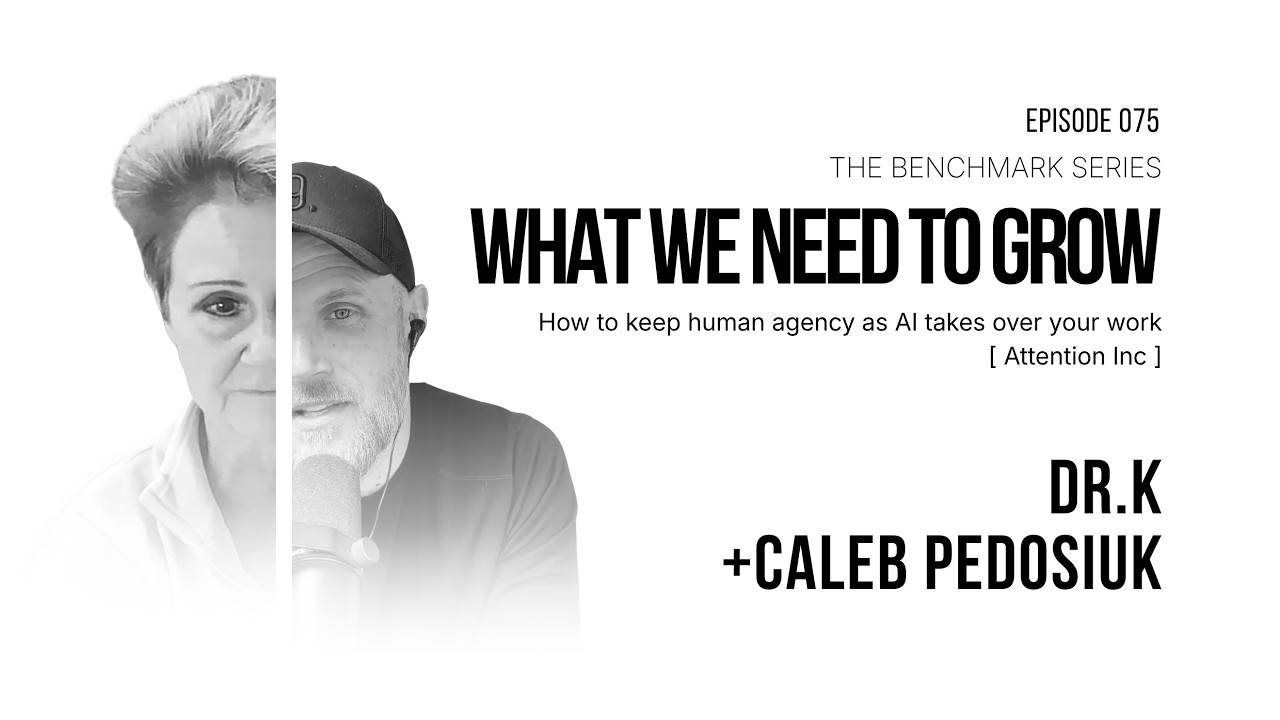
Most people treat AI as a tool they pick up. Dr. K, founder of Attention Inc, argues it is a land we now live in, and that its values were shaped by one city. A bioethicist who worked alongside Francis Collins on the Human Genome Project and later served as an intelligence analyst across four agencies, she explains the wisdom gap between how fast the technology compounds and how well people can respond, and the gradual disempowerment that follows when the only human left in the loop is pressing an approval button. Her sharpest observation: people asking what sound like career questions are really asking whether they still matter. Her three apps answer in order, mirror, then compass, then window. That is the argument 79 Development keeps returning to. The brands that get understood, trusted and found are the ones that can name the prevailing frame in their field and say plainly what they believe instead.
KEY TAKEAWAYS
- AI is not a tool humans use, it is a land humans inhabit. This is the line the whole episode turns on, and she states it as her mission rather than as a metaphor. "AI is not so much a tool that humans use, it's a land we inhabit. We live there, we work there." The consequence she draws is that the question changes shape. A tool is something you evaluate for fitness. A land is something whose authorities, culture and gatekeepers you have to understand before you can live well in it, and she is blunt about who sets those terms: the values of that land are "shaped by one city, Silicon Valley."
- The wisdom gap, and why it is a gap rather than a lag. She takes the term from the Center for Humane Technology and says she has "interrogated" it from a theological angle. Her version is two curves moving apart. "The exponential complexity of this technology coming out, it's like this upward curve, and that's coupled with the downward curve of how humans and institutions waning ability to respond to it." What fills the space between them is not ignorance but feeling: "all kinds of anxiety and uncertainty and fear about where things are going."
- Gradual disempowerment is the mechanism, and the approval button is the image. She names the technical term, which matches the 2025 Gradual Disempowerment paper, and then makes it concrete at the level of an org chart. "If within global systems humans begin to lose influence, and you have all these agentic flows and agentic swarms and sort of little agentic organizations within larger organizations, and they continue to take over these workflows, and all you have is a human that will press the approval button but may not have any transparency or visibility on what's actually going on, well then the influence of humans diminishes." Her question is the one nobody is contractually obliged to answer: "What's to guarantee that there's going to be any long-term human benefit from systems that are now run by agentic AI?"
- The career question is almost never the real question. This is the most quotable passage on the tape and the clearest payoff of her twenty years of teaching. She says that across Gen Z and Gen Alpha, and other generations too, people are "walking into churches, into small groups, and into counseling offices asking questions that sound like career questions, but they're really questions about whether they still matter." She reports the same thing from university research she is running with her alma mater: students telling her "I've been depending on these models and agents too much, and sometimes I just feel like I don't have confidence to think about things anymore." She also cites Tim Wu's 2018 essay The Tyranny of Convenience and argues the tyranny is now "scaling up."
- Three apps, three questions, in a deliberate order: mirror, then compass, then window. The ecosystem is her answer rather than her product pitch, and she walks it in sequence. Prompt literacy asks "might you be giving away too much to AI," runs nine scenarios and returns an evaluation. Unmuted asks "what exactly is my expertise and how do I contribute," invites the user "to be curious about themselves, because there's much, much more to you as a human than the task you do at work," and ends in what she calls a transferability map of tacit and institutional knowledge. Faithful Presence asks "where should humans and AI live and work together." Her framing of the order is domestic and exact: "we look in the mirror first before we look out the window."
FULL TRANSCRIPT
What We Need to Grow, Episode 075: A Land, Not a Tool. A Founder Talk conversation with Dr. K. Cleaned for readability; the words are the speakers' own.
Cleaned and publish-ready. The on-record cut only, 9:37 to 35:09 of Granola capture `7035fd82-fdad-4db4-b584-e8a641d5a7cc`. Pre-roll and the post-sign-off tail are excluded in full, per §2 and the boundaries above.
Caleb: All right, Dr. K, I'm not doing a big intro. Intelligence background though, four different agencies that you were with, and now you're doing some interesting stuff in AI. I don't know how much of it you want to touch on from your background, but know that you're quite qualified. You've been paying attention to a lot of stuff in this space for some time, longer than a lot of people knew it past any sci-fi films, probably. But by all means, please introduce yourself and let's share a bit about what you're working on.
Dr. K: Yeah. So in the AI space, if I could just back up for one minute and talk about my journey into emerging technologies, which was in medicine first. My PhD is from the University of Southern California, and it's in bioethics. I had an opportunity to focus more on applied ethics, and that took me on the journey with what was then a really cutting-edge emerging technology, which was the Human Genome Project and mapping the entire human genome. So I wrote my dissertation at that time on ethical issues in genetic enhancement research, which was really cutting edge, and I looked at it through the lens of Aristotle and Francis Bacon. Classical philosophy and modern philosophy. I worked with Francis Collins during the Human Genome Project, when that was completed in the early 2000s. That's where I started my journey in emerging technology.
I was a professor for over twenty years at Biola University and Talbot. And then I worked in tandem with Joni and Friends. I worked in international disability ministry for thirteen years, and that certainly has impacted a lot about how I think about what it means to be human, and that wraps into the work I'm doing now with my own company.
It was from Joni and Friends that I was actually recruited. Being a Southern California girl, I was recruited to the intelligence community and moved out here to Washington. I served in four agencies. I was responsible for all the contact tracing for all of our employees in the eighteen intelligence agencies, and that was a huge job. It was an incredible job. But part of my portfolio had to do with working on artificial intelligence, actually old-school machine learning, back in 2015. I worked closely with the Pentagon and the CIA and many other agencies on an unclassified program called AIM, Augmenting Intelligence using Machines. So we did a lot of work along those lines.
And I just realized, being a Jesus follower, having done that for six and a half years, that when it came to artificial intelligence, things were changing. Especially after 2017, when a paper was published, Attention Is All You Need, which was the development of the transformer architecture, which is where we have the chat interface now. I did sense that back in 2022, 2023, when ChatGPT and GPT-4 were released, that there was going to be quite a few changes coming to society writ large, globally.
And so I thought that the Lord was calling me back into ministry. I went back to Joni and Friends, and then I went into AI consulting, and that led me, just in looking at the trajectory of AI, to center on something that I think is a kingdom focus again, of focusing on the human side of the AI equation. If you look across the spectrum of AI, there's a lot of focus on the technology, and rightly so, and how it's embedded and operationalized. And it was always my question: well, what happens to the human in this scenario? All the attention is on the technology, and I wanted to shift the attention to the human. So, Attention Inc. And the right kind of attention changes everything. It's a play off that 2017 paper. Attention is all we need, the right kind of attention.
The Lord always focuses on his image bearers. Hence, that's where Attention Inc. comes from. And so if you think about it more broadly, I really want to talk about what happens to the human, the human side of the AI equation, when we start sharing our cognitive space, which we do now, with some of the most intelligent technology that we've ever created. In some sense we are no match for much of what they can do now, and this is the worst this technology will ever be. So to focus on this human side is to really help humans, I think, and institutions, to value and to keep their agency, their cognitive wherewithal, if you will, and not cognitively offload all of their critical thinking to AI. There is a temptation to do that. It's to draw that attention back to agency, back to human agency and influence within systems. So that's what I'm doing.
Caleb: Very cool. You know, I saw a video yesterday. Some creator, I think classically known for viral content, has had a very strong presence, a strong brand, from before we started seeing a lot of generative AI, certainly the language models, but he has ridden that wave as well. And the creative of it was pretty janky, almost like you would see a card a teenager made for someone. You could tell intention went into it. It was original. It was not trying to look like anything else. And it worked.
But his whole thing with it was for the creators that are strictly using AI to write their content, produce their content, roll out their content. He said, you might feel like you have an edge right now, but more than anything else, you have outsourced your work, you've outsourced your thinking, you've outsourced your creativity and imagination. You're essentially a puppet for how the machines are already being conditioned. So you put a prompt in, and it's sort of you using you and your likeness. And it stuck with me. I was thinking about it the next day, this idea of a puppet. And I don't mean that in some disrespectful way. I think a lot of this technology is phenomenal, much like many technologies throughout time that can be used for good or evil, including the internet. But it stuck with me.
And he mentions, he said, the part of creating content, taking an idea and sitting with it, actually having to think about how to communicate that both so somebody gets it and they find it interesting, is hard. And he's like, that's a feature, that's not a bug. That's part of the beauty of what it means to be human, to be able to observe, conclude, and then communicate, translate that, to make it available for somebody else.
Dr. K: That's precisely right. And technically, this was on the periphery in 2022, 2023, when ChatGPT came out. Now we have Gemini, we have Claude, we have so many other models, and the iterations are coming out so quickly.
The Center for Humane Technology, many years ago when this was starting to happen, called this the wisdom gap. And I've interrogated that idea. It's not original to me, but I've interrogated it from a theological perspective. The wisdom gap is the exponential complexity of this technology coming out. It's like this upward curve. And that's coupled with the downward curve of how humans and institutions have a waning ability to respond to it. So that creates this gap, and what lives in this gap is all kinds of anxiety and uncertainty and fear about where things are going and how it's going to affect society.
And part of that is technically called now this gradual disempowerment of humans. And that's what you were just talking about when it comes to cognitive offloading. It is a term that needs deeper research, not only from a human perspective, but within systems. Because if within global systems humans begin to lose influence, and you have all these agentic flows and agentic swarms and sort of little agentic organizations within larger organizations, and they continue to take over these workflows, and all you have is a human that will press the approval button but may not have any transparency or visibility on what's actually going on, well then the influence of humans diminishes. What's to guarantee that there's going to be any long-term human benefit from systems that are now run by agentic AI? I think that's some of the bigger concerns.
And one of the other things the research is showing is that, unfortunately, it becomes easy to just let the model do all the thinking for you. Tim Wu, back in 2018, long before this, coined this term, and I've used it now in the AI age: the tyranny of convenience. And it really is now scaling up, this tyranny.
And so here again, being able to shine the light back and say, wait a second, let's focus our attention on this human side of this equation, because we all care about other humans. And if we talk about the future, if you have kids or grandkids, what is the future going to look like for them? All of us have these questions. And so should we really be in a situation where we enter this wisdom gap where there's all kinds of anxiety? My position on this wisdom gap is that the church needs to be able to step into this as well, with the truth about this technology, truth about who we are, truth about where we came from and where we're going.
And I think ultimately I would say it like this, Caleb, and I think this is important, because I spend so much time working with especially Gen Z and Gen Alpha now as they're coming up, since I'm working in this space. You have so many in this generation, and other generations, quite frankly, walking into churches, into small groups, and into counseling offices asking questions that sound like career questions, but they're really questions about whether they still matter. And I think that's the undercurrent that we see informing a lot of this anxiety. And it's not hard to see where that anxiety is coming from globally. So I think a lot of your colleagues that you're interviewing are probably hitting on this subject as well.
Caleb: You know what just popped in my mind as you were saying that? Is the idea of what does it mean to hold hands. Right? So let's say that a father and a daughter, a mother and a daughter or son, whatever it is, the act of holding hands. I saw another real that someone, another dad, had sent me where it showed a picture of a dad walking and he just put his hand out like this, and he said how it feels. And then his daughter came running up and took his hand. How it feels to have that was like from Thor in the Marvel film, where he puts out his hand and then the hammer comes. And it just feels like, oh man, that is a thing. We have four kids, two daughters.
And I just look at that, and as you were talking, I'm like, what is that? Because when you lose, let's say as a grandmother, as a grandfather, if you lose the relevance. Oh no, no, no, Mom, or Grandma, don't get up, we'll make it, we'll cook it. Oh no, no, we'll order in the food. Oh no, no, don't worry about the dishes. Oh, someone else has got the lawn. We don't need to grow that food. We've got it. At what point, what parts of that?
Because the reason why I mentioned handholding is because there's not a real purpose in it. Maybe if you're going through odd terrain or a hand is cold. But the ability to take an action, two people choose to take an action together, and there's a connection that is felt. And it's made me wonder if, like you said, with Gen Alpha or Gen Z that are asking these questions that are cloaked, that are maybe our existence questions, meaning identity, but are cloaked as career questions. Some of that is maybe wondering, at what point, where do I interface with society in a way where my connection is felt and valued? Much like the connection that I share with it is felt and valued.
Dr. K: Yeah, I think those are important points. And I think that, maybe you've seen this, that you have Gen Z who really, there's a lot of backlash against AI within that generation, especially because they see how much it is impacting them societally. As I work with universities, my alma mater, where I'm doing some research with them through my company, they're saying, you know, I've been depending on these models and agents too much, and sometimes I just feel like I don't have confidence to think about things anymore. So they're really feeling the effect.
And the other piece of this gets to my theology of vocation. As a Jesus follower, we often in the church will talk about the Great Commission, very important, of course. But I think that needs to be seen with the theology of vocation as well. Because as image bearers, we actually bear God's image, to rule over his creation. We're here for a purpose.
And even if you don't recognize the God of the universe, you still recognize that you have a purpose. There's a reason why you're here. Now, a lot of this has been reduced to just, oh, go find a job. No. That's not what Gen Z is saying when they talk about the fact that entry-level jobs are going, they're not hiring as much because of AI. They're not saying, oh, I just want a job. And even, you know, they have to make a living. The undercurrent of that is, do I not have a purpose?
You know, there's that wisdom gap again. What institution is best equipped to step into that wisdom gap and answer those what seemingly seem to be career questions, but really questions about whether they matter? In my mind, as a Jesus follower, there is no other institution on earth that can answer that better than the church. And yet there's a lot of controversy in the church, like, what do we do with it? Or, I don't know how to think about it. And there's not a lot of wisdom and experience in being able to talk about these emerging technologies, which we're in a time in our society, as you know, Caleb, where we have to. We have to, as believers, do that. So that is one of my major concerns in focusing on the human side.
Caleb: And from what I'd seen on the website, it looks like you've developed a few products, or protocols or something. And this is at first glance, so please expand on this or adjust it as I attempt to explain it. But what I sort of gathered is that you have distilled some methodology or some process by which you can take someone through a process and help them uncover certain aspects of their own unique identity, to say, hey, these pieces of you are important, are unique, are part of what you contribute. If and where you choose to engage with AI systems like generative AI, you choose to augment, to expand, to fast-track things you're doing, these pieces can help be amplified through these tools you use, rather than outsourced to them and setting those unique parts of you aside. Rather protecting them, recognizing the value of them, and being able to utilize them. Would that be an accurate way of describing it?
Dr. K: That's right. Yeah. And that comes from not only my faith background, but having had the privilege of working with faith tech and really understanding what redemptive technology, and in my case redemptive AI, is all about. I've developed an ecosystem. I've built three AI apps for that reason. And there are three questions within my methodology and ecosystem that I encourage humans to think about, because we have no choice.
And here's the other thing. A lot of people feel like AI is happening to them in the wisdom gap. It's happening to them, not with them, and not for them. And so I want to come alongside and say there is someone who's with you and for you. In Jesus, in the kingdom, you are not small, you are large in him. Now let us take you on a journey to understand your place in this world. You really do matter.
So three questions I want them to entertain and think about when they're going through my apps. One is, might you be giving away too much to AI? That's prompt literacy. There are nine scenarios that people can go through. I'm built on Claude, by the way, Sonnet 5.5, and I've fine-tuned Claude to be able to respond in such a way. Might we be giving away too much to AI? How do you know this? I have nine scenarios that they can go through, and then there's an evaluation and an assessment. Hey, you're doing really good here. Maybe here, maybe you're giving too much to me. So that's the first step.
Secondly is what I call Unmuted. Like really unmuting the human. Much like it's really following Jesus's ministry when he unmuted the deaf, so that they could hear and speak again. That's where I get that from. And so the question here is, what exactly is my expertise and how do I contribute and implement it in my life and work? And what I'm asking them to do as they take this journey through Unmuted is to be curious about themselves, because there's much, much more to you as a human than the task you do at work. Or maybe the tasks you want to do at work. So it's really an invitation for them to be curious about themselves. And at the end, Claude will give what's called a transferability map, where it really helps you to understand your tacit knowledge, your institutional knowledge, even if that knowledge is only coming from your university experience. Because you know so much more than you actually think. And that's what that's about.
And finally, faithful presence. Once you've looked at yourself in the mirror, and the compass, Unmuted's compass, then you look out the window. It's the process we go through every morning, right? We look in the mirror first before we look out the window. We've got to do that. So that's the idea too. And faithful presence is really about where should humans and AI live and work together. Because that is really my mission statement. AI is not so much a tool that humans use, it's a land we inhabit. We live there, we work there. So how do we do it? How do we live together? How do we understand the right AI for the right kind of work, so that I, as a human, can keep my agency, and the institution also keeps its human influence, and how that works together? So that is my ecosystem, and that is my way, I think, of really focusing on the human side of the AI equation.
Caleb: So cool. So the last question I love hearing people respond to is, if you had to pick one thing that you would say is the thing that you need most to grow right now? For some people, they're raising money. Some people, they have a launch or they're getting early users for something. What would you say the one thing is that you need most to grow right now?
Dr. K: Well, I think, as with every startup, 501(c)(3), it's really about having the funding, because a lot of this, people can't afford it. Especially for translation, and to be able to have this ecosystem available outside of the West. I think the other thing, and this is where I've gotten the most value, is early users. Usability and having testers. My product is so, so much better because of my early users. I can tell you it's just completely 100% better. So having testers, even as I go along and launch this out to the larger public, that usability is always valued, I think. That's what I would say.
Caleb: Very, very cool. Well, Dr. K, thank you. Appreciate what you've shared. For people that want to follow along to hear about new releases, or to even try some of what you have to offer, where is it best for them to find you?
Dr. K: Yeah, on my website.
Caleb: AttentionInc.org. Perfect. Okay, awesome. Thank you so much.
Dr. K: Correct, correct. That's it. Thank you, Caleb. Appreciate it.
What We Need to Grow is a conversation series by 79 Development, hosted by Caleb Pedosiuk. New episodes on YouTube and Spotify.