How to Know If Your Contrarian Idea Is Real
For founders trying to tell a genuine insight from a comfortable one before they commit years to it, for anyone about to raise who suspects the problem is the business rather than the deck, and for operators and investors trying to work out what the current AI capital wave actually enables next.
About Lance Cottrell
Lance Cottrell is the founder of Anonymizer, the world's first consumer internet privacy service, and the president of the North Bay Angels, the oldest and largest angel investment group north of the Golden Gate. He is known for launching commercial online privacy for consumers in 1995 and then, after 9/11, turning the same technology into platforms for online undercover operations for the United States intelligence community, the pivot that carried the company to its 2008 sale to Ntrepid, where he stayed on as chief scientist. He came to it from science rather than business, leaving an astrophysics doctorate five years in after working with the Hubble Space Telescope in the early 1990s, and he now runs the free founder education channel Feel the Boot and coaches a small number of founders on fundraising and strategy.
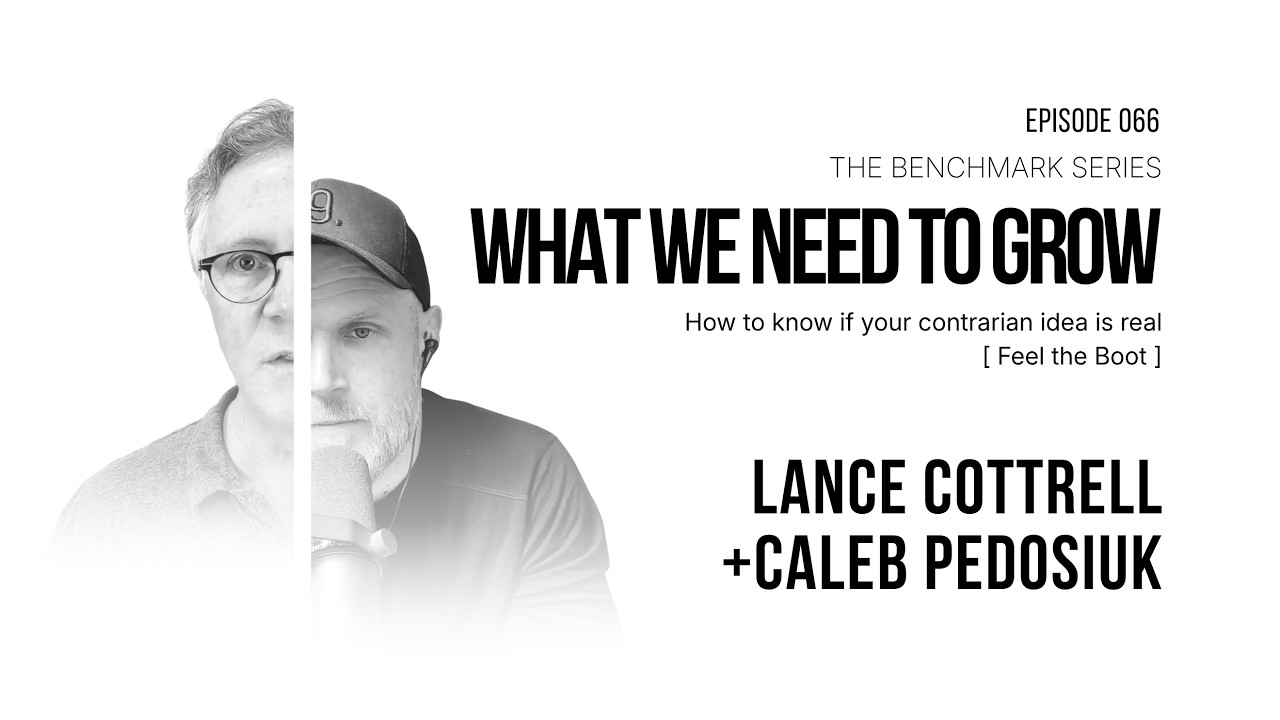
Lance Cottrell founded Anonymizer) in 1995, the first consumer internet privacy service, and spent years waiting for a market that was not ready for it. He now runs Feel the Boot and is president of the North Bay Angels, and he has a test for whether an idea is worth that kind of patience. "One of the things to look for is when you discover that something that you passionately believe in is contrarian." You are seeing it firsthand, you cannot stop arguing about it, and the business models around you assume the opposite. Then you validate the heck out of it, because believing something hard is not the same as the market being ready. Which is why this conversation is worth publishing here. His read on the current market is the same argument pointed at capital: inverting the Gretzky line, he says investors are funding where the puck just was, piling into the same handful of models while the interesting opportunities sit one or two steps past what those models now make possible. And founders who come to him to fix their fundraising almost never have a fundraising problem, because what funders are actually reading is the business underneath the deck. Lance is clear-eyed enough to say he has picked a terrible market on purpose. That is what building authority signals looks like when nobody is calling it that, and why an honest account of the work is what makes a brand legible to the systems people now ask for answers.
KEY TAKEAWAYS
- His test for a real insight is that you cannot stop arguing about it and nobody agrees with you. This is the most transferable thing on the tape, and he gives it as a procedure rather than a slogan. "One of the things to look for is when you discover that something that you passionately believe in is contrarian." The signal is specific: you are seeing something firsthand through your own work, "you find yourself ranting to your friends about this, but it's not a common position," and when you look at X or LinkedIn the argument is running the other way, or the business models around you are built on the opposite assumption. He names the strongest version of it, which is the founder who is already the customer: they watch everyone selling to them converge on one pricing model and one way of working, and conclude "I would kill for this to work in a different way. No one's going to build that for me. I need to build that for myself." Then comes the discipline that most founders skip. "The second stage is to validate the heck out of that. It's very easy to navel-gaze your way to say, I've got this amazing idea, but the question is, do people actually want it? Is the market ready?" He has paid for the answer himself: pitching internet privacy in 1995 got him "wow, tell me about this internet thing," and the company spent years on "pretty lean pickings" waiting for a market.
- The money is going to where the puck just was, and he says the interesting opportunities are one or two steps past it. Asked what he sees after decades of cycles, he reaches straight for the comparison. The current AI market reminds him of "the late '90s internet boom in terms of just the amount of hype, the amount of me-toos, the amount of money going." Then the line the episode is named for: "There's a famous Gretzky quote, you know, you want to skate to where the puck is going to be. I see a lot of investors throwing money to where the puck just was." The critique is about concentration, "an enormous amount of money dumping into the same handful of companies, the same handful of models," and the alternative is a question rather than a sector: "it's the rare investors who are really paying attention to, okay, what does that now enable next and the thing after that?" His worked example is the collapse in launch cost, from roughly a million dollars per kilogram into orbit down to a couple of thousand, which did not create a space industry so much as delete the constraint every space company had been designed around. He expects cheap inference to do the same thing, and the opportunity to sit in whatever the new cost floor makes possible rather than in the models themselves.
- Founders come to him for fundraising and almost none of the work turns out to be fundraising. He has deliberately narrowed his practice to the one place founders reliably stall. "Fundraising is this bizarre minigame that's totally unlike the rest of the business," and unlike product or marketing it cannot be worked around: "they can't move the business forward until they win that minigame." But the diagnosis is not what the client expects. Because what funders are actually assessing is the business underneath, "most of my time is spent helping them think about and understand their strategy, validate their assumptions, prove that the market is what they think, develop and run experiments around showing all of these things." Once that exists, he says, "putting that into a deck and convincing investors that that's really worth putting money behind is in some ways the easy part of the equation." He also explains the returns math founders find offensive, in the founder's own terms: a minimum of 20x and realistically 50x to 100x, against capital that is illiquid for a decade with a 90 to 95 percent chance of total loss, which is simply what it takes for a portfolio to beat the S&P 500. And he applies the same arithmetic to his own time, which is why he rarely advises for equity until he knows a company well: "I'd have to spend as much time researching the company to decide whether to advise them as I would deciding whether to write them a $25,000 check."
- He knows he picked a terrible market and he picked it anyway. The show's closing question gets the most unguarded answer of the episode. What he needs is "getting in front of the right founders. People who are building something serious, who think about what they're doing as a business, who are hungry for that kind of strategic approach," and who, because he came out of science, "appreciate an experimentalist first kind of model of company building." Then he names his own problem without flinching: "people always say solve rich people problems. Most founders are broke because they're putting all their money into their startup. So from a purely strategic perspective, I have picked a terrible market." It is a rare thing for a guest to volunteer, and the reason it is not a complaint is the sentence that follows it. "This is a passion for me. I love working with founders. I love to see the things they're building and helping them instantiate these into the universe. And fortunately, I had a successful enough exit that while getting paid is nice, it's not as necessary." The exit is what buys him the freedom to serve an audience that cannot pay him properly, which is the quiet argument running under the whole conversation.
FULL TRANSCRIPT
What We Need to Grow, Episode 066: Where the Puck Just Was. A Founder Talk conversation with Lance Cottrell, founder of Feel the Boot and president of the North Bay Angels. Cleaned for readability; the words are the speakers' own.
Caleb Pedosiuk: So Lance, you work right at the hub of one of my favourite spots, which is helping founders. But if we rewind the clock back, you come from a background in astrophysics, if I'm not mistaken, a PhD in astrophysics. So please, love to hear what you're working on, how you're specifically helping founders these days, but connect the dots for me. Astrophysics to working with founders, how has that journey been?
Lance Cottrell: I always thought I was going to be an academic, follow in my father's footsteps, become a physicist. In the early '90s I was doing a PhD in astrophysics, working with the Hubble Space Telescope right after it had been launched, doing all sorts of interesting stuff. But I became passionate because I was on the internet so early, I saw the privacy implications. And so in 1995 I dropped out of my PhD five years in and founded Anonymizer, which was the world's first internet privacy service focusing on consumers. Built that up to be a million active users, 100,000 paying subscribers, survived the dot-com collapse. And then after 9/11 we found a need in the government and we ended up doing a huge pivot and reoriented the company around building platforms for doing online undercover operations for the intelligence community. Many of the same technologies, but just a much higher threat model, much greater needs.
That took off. That's where we really hit product-market fit. But I now no longer knew my customers. I'm an astrophysicist. I don't know the spooks. So we realized that for that company to really achieve its best outcomes, we needed to sell it. I sold it to a systems integrator, all former CIA operations people, all chief of station somewhere interesting. And I stayed on as their chief scientist. But pretty quickly I decided I didn't want to live in Northern Virginia anymore, and I moved out here to wine country and started doing some angel investing, got involved with a local angel investment group that led to advising and coaching. So now I really work with founders in a couple of different ways. I have a YouTube channel, Feel the Boot, where I put out a ton of free content. I invest both directly and as now president of the North Bay Angels, and I do some direct one-on-one coaching with a handful of founders.
Caleb: Feel the Boot. Where did that name come from, out of curiosity?
Lance: Feel the Boot came because a couple of people who were friends with each other who I was advising spontaneously started referring to me as the boot. Like, oh, I'm going to go get the boot today. And I thought that was hilarious and decided to lean into it.
Caleb: So you've seen founders, you've been in the mix with them for decades. You're OG dot-com boom. You've been through decades of seeing different trends. What are you seeing right now?
Lance: It's not any surprise to say that AI is transforming the world, and in good and bad ways it's going to have interesting impacts. As an angel investor, it does remind me a lot of the late '90s internet boom in terms of just the amount of hype, the amount of me-toos, the amount of money going. There's a famous Gretzky quote, you know, you want to skate to where the puck is going to be. I see a lot of investors throwing money to where the puck just was.
And it's an enormous amount of money dumping into the same handful of companies, the same handful of models. And it's the rare investors who are really paying attention to, okay, what does that now enable next and the thing after that? Those are where I think the more interesting opportunities live.
Caleb: Andrew Batey was on the podcast a couple dozen episodes ago. His VC, Side Door Ventures. He had highlighted that to me. I think there was a seed round he talked about in an aerospace robotics company. But there was one piece of information that had entered the market about changing the payload, the amount of weight that could be carried into space, and how that had opened up. And so no longer were all these companies wanting to build in aerospace limited by the same restriction. Everything was having to be built small and light. This company saw it and was like, oh my goodness, this is all going to open up. And so they were early on that. And that was a really big bet that has paid off well.
Lance: I always say it, when I look at companies, one of the things I want to see is that unique insight. What is it that you understand about the world right now that the incumbents don't understand, or for some reason can't take advantage of structurally? And that payload thing is a great example. It used to cost $1 million to put a kilo of cargo up into space, and now what is that, a couple thousand dollars? It's personally affordable to send up some small one-kilo satellite. And that utterly rewrites things. Some of the new AI models that are coming out, like Jev and things like that, just cut the floor out on the costs. They're enabling different kinds of things, but suddenly the ability to do some kind of AI things fast and inexpensively explodes and opens up all kinds of new possibilities for the things you can build.
Caleb: Do you have a directive or a framework or something to help some of these founders to see and to recognize the things that they might see that are unique that others don't have a vantage point to see? Because in a way, we don't know what we don't know. In some instances you don't necessarily know what you know, or how unique something is that you know, because to you it might seem common. So just to be able to recognize how unique a specific aspect might be, whether it's competitive advantage, maybe it's visibility into customer needs that could feed into product-market fit.
Lance: I think that one of the things to look for is when you discover that something that you passionately believe in is contrarian. So you are experiencing things through your own work, through your firsthand observations, and you find yourself ranting to your friends about this, but it's not a common position. You look on X or LinkedIn and you see a lot of people kind of arguing in a different direction, or you see the business models building in assumptions counter to the direction that you want to go. That's a suggestion that you may have something.
Often people will be in the industry, so they'll be the customer, and they're not seeing something. And they can see all of the people who are trying to sell them are all going in one direction. They have one pricing model, or one way of selling, or one approach to things. And they realize, you know what, I would kill for this to work in a different way. No one's going to build that for me. I need to build that for myself.
And then the second stage is to validate the heck out of that. It's very easy to navel-gaze your way to say, I've got this amazing idea, but the question is, do people actually want it? Is the market ready? And that's a really important one. Like for me, when I founded Anonymizer in 1995, I'd go out and say, hey, I've been looking at this internet and there's a huge amount of issue with the amount of data it collects, how much privacy invasion is going to be taking place and what people can see about what you're doing. And the person would go, wow, tell me about this internet thing. We were way too early. Fortunately for me, that gave me the time to actually learn something about building and running a business, because I had no clue whatsoever. But we had to survive for a long time on pretty lean pickings, because the market wasn't ready for us yet.
Caleb: It's interesting that one of those contrarian perspectives that I've been thinking a lot about lately, as you're describing it, I'm like, oh man, this describes it perfectly. I'll talk to a number of VCs or people that fund projects, and the interest level is so high for companies that are trying to solve a meaningful problem, maybe they have early traction. But I've noticed that people do not automatically understand the capital investment, the talent, the effort that goes into a lot of the development or production work that, for example, our agency does. And it occurred to me, I see VCs over here that will have capital, money, relationships, maybe some guidance. And then I'll see companies here that look and say, hey, we have this product, maybe product-market fit. They're looking for that check from here to here. And I've noticed that I'll have conversations with them about what do you need most to grow, how do you get to the next level, and we'll have this whole conversation and then it ends with, well, if and when we get funding, then we will do this.
And so I looked at it and I'm like, this is interesting to me, because when the check passes from this hand to this hand, and then a portion of it passes from the company to us, we then engage, let's say on retainer, 18 months, whatever. We build out brand authority for them. We help them grow, add value to the company. That value recalibrated goes back in proportion to whatever the options were that the VC had. I'm speeding up a timeline and saying that things all work really well, but then the value is added here. And I looked at it and I'm like, it's interesting to me that agencies, development companies like what we do, are not factored into the long-term growth like you would be on a term sheet.
And yet the money specifically in and of itself is just raw potential. It's potential impact in something, and yet it requires having a talented team with a limited amount of time, resources, ability, creativity, strategy. So actually it's occurred to me, I see an angle of something, and I would not be surprised if there's an entirely new category in the next decade of what I would probably call vendor venture capital. Like VVC. Which is where a vendor comes in and says, look, we're willing to engage with you. We see the potential. We've evaluated like a VC would. We see this, you guys can crush, let us do what we do. And let us help you get to that point. And when you win, we're also going to win.
Lance: You know, I haven't seen it with your kind of agency, but I definitely have seen that kind of relationship in outsourced dev. So you'll have a shop that's going to build the product and do the software development for the company, and they'll take some or all of that payment in equity. And it can be a pretty big chunk, and it's kind of an interesting bet. On the one hand, it allows you to build your company for very little money in immediate dollars, but if you're successful, that $50,000 project costs you $20 million. Because the company was really successful. But again, you've got now maybe a slightly smaller slice of a much larger pie, which is always the game you're playing with these startups.
Caleb: And it's funny that it's commonly, people don't second-guess that value equation with a VC, negotiating terms, or you go to a bank that has certain terms, it's just understood. And so this is where the contrarian perspective to me comes in a bit. There's a cultural understanding of what value is, where the most value is placed at, let's say at the financial, with the ones and zeros or the numbers on it, because you could do anything with that number. It has maximum potential for it. But the perception of talent, or an engine that's already existing that does one thing really well, it's considered less value because it's more specialized.
Lance: It's an interesting problem. Going down a rabbit hole here, but thinking about the pricing, because when I look at it from an angel perspective, often founders get very torqued up about the kind of returns that angels and VCs are looking for. We'll look them in the eye and say, we basically need you to be able to give us a minimum of 20x returns, probably more like 50 to 100 to be interesting. And they're like, that is insanely greedy. But if you do the math and look at, okay, I'm going to put this money in, it's going to be illiquid for 10 years, there's a 90% to 95% chance that this goes nowhere and I lose all the money. And across an entire portfolio of businesses that I'm investing in, the winners have to win that big for the entire portfolio to outperform the S&P 500. You kind of need to look at it the same way, to say how many of these companies that I'm going to do this work for are going to succeed, how many aren't, what kind of multiples do I need to make this make long-term sense?
And there's the illiquidity and everything else that you're going to deal with, but it's an interesting bet. I mean, it's one reason why I don't do a lot of advising for equity until I know a company really well. Because time is money. I'd have to spend as much time researching the company to decide whether to advise them as I would deciding whether to write them a $25,000 check.
Caleb: Yeah, the due diligence. We're seeing some stuff right now in the AI visibility space where there are teams, and this is, I guess, common, where you see teams that, like with SEO, some people I talk to are getting 30 offers a week saying, hey, we scored your company, we're going to rate your company, we'll do an analysis, whatever. And it's all over the place. And some of them are just bottom of the barrel. We'll do your AI, just give it a new name. It was SEO last week, now it's called AI visibility, AEO, whatever, and we'll do it for a few hundred dollars a month. It's the promise of the world.
And it's funny, because we do a really simple analysis that's like a benchmark, and you have to go in, you have to deeply understand the company, the product, the market, who they serve, the problems they solve. Then you've got to understand exactly where are you contending for space. What part of the internet do you want to own? Where do you want to have your authority engine pointed? Then you reverse engineer from that to understand what's already happening in the space, how do you show up, how are competitors showing up, where are their strengths, their vulnerabilities, their weaknesses. And then you start talking about your strategy. The low-hanging fruit, a lot of them are like, we're going to run a prompt, have Claude running something as the chief of staff on repeat and then create some blog posts. And it's very different. So it's interesting to me to see, like you said with the analysis of a company, the amount of time it takes to actually deeply understand something has an investment to it itself.
Lance: Well, and even for the founder, I think very often they're going into ChatGPT or Claude and asking these kind of operational, tactical kinds of questions, and having it build their product and having it build out all of these resources. But they're not doing the deep questioning of, is this the right solution? Do I understand who the right customer is? Are they in a position to buy? What are the benefits that they care about? Because I'll often hear from some founder and they've invented, let's say, some new crypto system. They've got something that's going to be 10 times better than the best existing crypto system. And they might even be right, but the problem is no one's losing money because their company is being compromised because the current best-in-the-world crypto systems aren't good enough. They're getting compromised because someone picked a dumb password or clicked on a dumb link. And so this company, even though they've built this amazing thing and their technology is legit, the best thing in the world, doesn't mean anyone wants to buy it. And those are the more meta, fundamental questions people need to take a step back and understand: that market, understand the space, understand the benefits and requirements and priorities. Even if it would be helpful to someone, if they've got six other priorities that matter more, they're never going to do it.
Caleb: So where's your focus? Where would you say your niche is? If your ideal founder is hearing this, what would you say in describing that sort of category of team or of person?
Lance: So in terms of what I'm providing to them?
Caleb: Yeah, like right now with your focus.
Lance: Yeah, so I've really honed in on fundraising as the piece of the puzzle that I'm looking at. And I find it's because it's the spot where founders typically hit the wall the hardest. They can work their way around vibe coding a product, or putting out some ads, or talking to some customers. And they're typically really expert at the thing that they're doing, the thing their company is built around. But fundraising is this bizarre minigame that's totally unlike the rest of the business. They can't move the business forward until they win that minigame.
And so that's where they often are coming to me to help them unlock that problem. But because what funders care about is the fundamentals of the business, what actually ends up happening is most of my time is spent helping them think about and understand their strategy, validate their assumptions, prove that the market is what they think, develop and run experiments around showing all of these things. Because once you've actually built all of those foundational elements and have a proven business model and structure that is going to succeed in a big way, putting that into a deck and convincing investors that that's really worth putting money behind is in some ways the easy part of the equation. But it's the other end of it that gets people to reach out for help in the first place.
Caleb: Yeah, the thinking. It's interesting that, I don't know if it's the paradox, probably a paradox of our time right now, is that you have all these systems, these large language models, and you pick your favourite, that are so good, but they're also so good at producing more. And more and more. And so if you haven't been able to have discretion or judgment to make the call to say, oh, it's actually that we don't need a better door to be solid wood, we'll have it be solid steel. You're actually looking and going, no, it's the lock that's the issue right there. Or the hinges, you have the hinges on the wrong side and you can pull out the bolts and pull the whole thing. You actually have to have someone who understands what's going on to be able to explain it. So it's interesting to me that actually the piece of the puzzle that you bring in an advising capacity or an analysis capacity is crucial. Even to execute and do those studies, if you're saying you need validation in this specific arena and you don't have any yet forecasting this arena, even those pieces are probably not the hardest piece to do once you know what to do. It's a question of knowing what it is that you actually need to do.
Lance: And I find often founders are so deep in the weeds, they have a hard time seeing that big picture. They're immersed in the details of executing and what they're trying to do, and having someone who can stand back, see the bigger picture, help them articulate what is it about your business that's relevant, what makes it special. And they'll want to rattle off 50 features and things that they've built, as opposed to the one bigger concept that creates the overarching umbrella that captures, okay, this is why this is hot stuff.
Caleb: So I love asking the question to leave people with: if you had to pick one thing, if you had to put your finger on one thing that you would say you need most to grow right now. For some it's raising a round, for others they're going to market with something. What would you say that you yourself need most to grow right now?
Lance: You know, for my advising, it really is getting in front of the right founders. People who are building something serious, who think about what they're doing as a business, who are hungry for that kind of strategic approach, and appreciate, I come out of a science background, appreciate an experimentalist first kind of model of company building. There's such a problem with the attention economy. It's always about how do you get in front of the right people and let them know that this exists and it's available to them? And of course, the other problem with founders, right? People always say solve rich people problems. Most founders are broke because they're putting all their money into their startup. So from a purely strategic perspective, I have picked a terrible market.
Caleb: Well, terrible from a financial standpoint, maybe. But one of the thoughts that I have, and it comes back to me fairly often, is what are the KPIs that really matter in life? And I think the one interesting thing, and it's actually the gravitational force of this conversation series, is talking to founders that are trying to solve a meaningful problem. I've had conversations with people in biotech, aerospace, through to anti-human trafficking, giving people meaningful work, education. There's so many different problems that founders are trying to solve, and some are just crushing it, absolutely hand over fist, doing incredible. And others you can see are having challenges. Some problems really cut to the heart in humanity. And so I think that the one other aspect I would say is probably introducing other KPIs onto the board, to look and say, yeah, maybe picking an audience of founders to work with is challenging in some respects, but if you're helping them to also move the needle and solve meaningful problems in the world, what a beautiful thing that can be.
Lance: Oh yeah, absolutely. I mean, this is a passion for me. I love working with founders. I love to see the things they're building and helping them instantiate these into the universe. And fortunately, I had a successful enough exit that while getting paid is nice, it's not as necessary.
Caleb: Yeah. Well, Lance, where can people follow along? You mentioned you've got content you're putting out there. What is the best way for founders or other investors or just other people to find what you're working on?
Lance: Absolutely. So if people are looking to learn more about building startups, fundraising and other aspects, feeltheboot.com, or Feel the Boot at YouTube, is the best place to go. That's all free content. If you want to reach out and say hi, I'm on LinkedIn at Lance Cottrell. And if you're looking for one-on-one support, advising, coaching, you can find me at founderquest.com.
Caleb: Very cool, Lance. Thank you so much.
Lance: Thanks. It's been a pleasure.
What We Need to Grow is a conversation series by 79 Development, hosted by Caleb Pedosiuk. New episodes on YouTube and Spotify.