How to Make a Startup Investment Ready Before You Raise
For founders preparing to raise, finance leads building a data room, and anyone who has lost an investor between the pitch and due diligence.
About Gabriel Osamor
Gabriel Osamor is the founder and CEO of Migasuto, a London fractional CFO firm that prepares startups and scale-ups for investment, and the chief financial officer of the Black British Initiative, a charity working to close the wealth gap between Black entrepreneurs and the wider UK public. He is known for translating founders' visions into the financial legibility institutional investors require, a gap he calls the idealism versus audit divide. Trained in law, he spent close to a decade in investment management, including at Nomura and T. Rowe Price, before co-founding Migasuto in 2023, whose Ascension portfolio, run with the Black British Initiative, aims to help 60 Black-led businesses break the £100,000 revenue ceiling within two years.
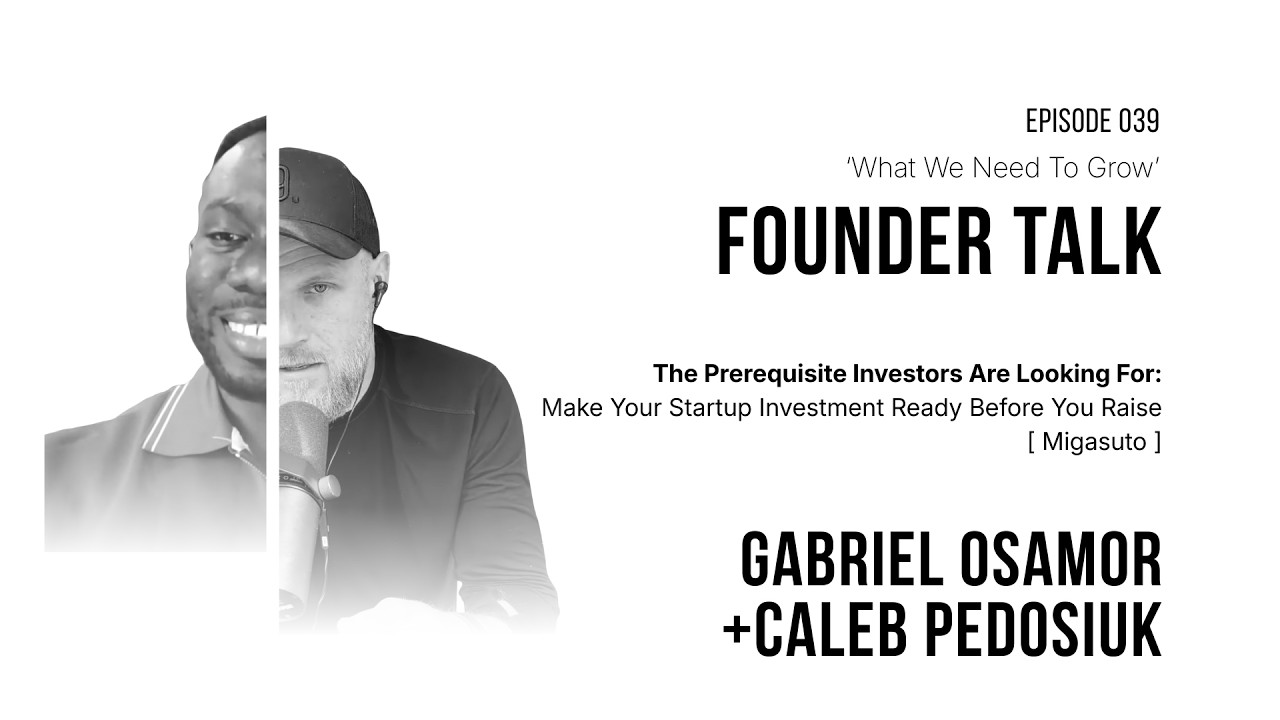
Gabriel Osamor is the founder and CEO of Migasuto, a London fractional CFO firm, and the CFO of the Black British Initiative. After close to a decade in investment management, he names the gap that loses founders their round: the idealism versus audit divide. A founder can defend the vision to a room of experts and still lose an institutional investor, because the vision was never translated into financial legibility. Due diligence, in his account, is a search for predictability, which is why the CAC to LTV ratio comes first, why cash timing kills more companies than weak revenue, and why reconciled books and a clean cap table have to exist before any forward-looking model is worth building. Capital does not flow to the loudest story. It flows to evidence. That is the throughline 79 Development keeps coming back to. Authority is earned by building things worth talking about, and an honest account of that work is what makes a brand understood, trusted, and findable by the systems people now ask for answers.
KEY TAKEAWAYS
- The gap he names is the idealism versus the audit divide. "Most founders can defend their vision, their technology or their products to a room full of PhDs or industry experts. But where they then lose a tier one capital allocator, like an institutional venture capital firm or private equity firm, is translating the vision into financial legibility." A founder who cannot show the numbers behind the story makes a sound business look risky.
- Due diligence exists to buy predictability. Past performance is not a reliable indicator of future results, so a questionnaire is really asking how £6 to 7 million of revenue becomes £12 million: is there a real business development process, a sales motion, customer service that retains people, unique IP. "The more you can help a potential investor understand your business, the higher the probability." The ratio he watches first is CAC to LTV, because lifetime value is evidence that the operation actually keeps customers.
- Businesses fail on cash, not on revenue. "We live or die by our cash flow. Many businesses don't really fail because of revenue, they fail because they're not able to time the cash." So the models he builds pair a 13-week cash flow with a monthly one, add a collections process and debt ratios, and run a bull case, a base case and a recession case so a founder can answer what happens in year three if delivery slips.
- Capital does not flow to the loudest story. "Investors aren't buying into those stories. They're really buying into the evidence you can present." A lender does not fund a great idea, he says, it funds an enforceable stream of payments with named counterparties and default remedies. A founder who is brilliant at closing sales still needs the systems that prove it during diligence, or it is just a story.
- The boring layer is the first ninety days. Audited accounts, a clean cap table, and a closing bank balance on the statement that matches the closing balance on the balance sheet. "The moment there's variances in your books, it already tells a story that you don't even know what you're doing." Migasuto's 90-day foundational roadmap starts there, in the historicals, before anyone builds the forward-looking models that tell the story for the raise.
- AI shortens the build, it does not replace the foundation. QuickBooks or Xero reconciled to the penny comes first. On top of it his team uses Claude and Gemini, inside closed internal environments with peer review and compliance policies, to generate the code behind unit economics and business development dashboards. A financial model that took two weeks now takes less than one. None of it is client-facing yet, by choice.
- The constraint he wants filled is capacity he already built. The portfolios are deliberately capped at ten Pinnacle Performance companies and twenty Ascension companies a year, and he puts the firm at roughly half capacity. "Capital just comes naturally." He is not raising for Migasuto itself, and the work stays international, with live engagements in Nigeria and the United States alongside the UK core.
FULL TRANSCRIPT
What We Need to Grow, Episode 039: The Idealism Versus Audit Divide. A Founder Talk conversation with Gabriel Osamor, Founder and CEO of Migasuto. Cleaned for readability; the words are the speakers' own.
Caleb Pedosiuk: All right, Gabriel, I'm stoked for this. You live between two worlds. You've got capital, VCs, money, essentially. And then you've got these founders in AI, in B2B SaaS, and in fintech. You're based out of the UK, and you've established something that serves both a local audience and people abroad. You have the ability to go and help empower these founders, innovators, often very tech-savvy individuals, to ready their businesses from a financial standpoint with your fractional CFO services through Migasuto, and connect them when they're ready for the money.
I think this is really neat, because from what I understand, the gap that you serve is such an important one. So many times there's a really strong idea, there's real traction, a project, even a company, but they're not necessarily ready to have that supercharged with capital. And you serve that gap, to get them to a position of readiness. So I'd love to hear a little backstory, how you got into it, where things are at, and let's get into it.
Gabriel Osamor: Thank you so much, Caleb. Really appreciate being here today. My world is finance and infrastructure, high-velocity corporate scaling, and also civic leadership. I like to think of it as being an economic statesman as well, on the BBI side. So I wear two hats: CEO of Migasuto, and CFO of the Black British Initiative, which is a charity established to close the wealth gap between Black entrepreneurs in the UK and the broader UK public.
Across both pillars, our absolute mandate is really the financial planning of the businesses and portfolio companies we work with, equipping them with the ability to present their vision in a more attractive way, in a quantifiable way, so that they're able to sell it to VCs or corporate buyers and remain well capitalized.
A very short backstory. I initially went to university and studied law. While aiming to become a corporate lawyer, I learned about the world of investment banking, which is mainly the clients of corporate lawyers, and that got me into commercial awareness and learning about the stock market. After graduating from law school I found myself in investment banking. I was interning at Nomura for some time, before I got into a trainee program at T. Rowe Price, which is currently a nearly $2 trillion asset manager, managing equity, fixed income, now ETFs, and many more. And then I spent the last five years of my career before incorporating Migasuto at a different investment firm called Brown Advisory, also an asset manager, managing nearly $200 billion in fixed income, equities and more.
One of the key things from my nearly decade of experience in the investment management industry was being part of a high-performing team: consistently fundraising, understanding how to pass rigorous due diligence, understanding how to tell stories, how to report on performance analytics that can support unlocking capital, and answering RFPs, which are requests for proposals, or DDQs, which are due diligence questionnaires. Investors usually ask these important questions to understand whether they're interested in potentially investing in a company. So that's a quick backstory, and I can dive into some live deals I'm currently working on and how all of this ties into the current world.
Caleb: I'm jotting notes as you're chatting, because you're touching on so many things that I'm like, oh man, that's interesting. I'd love to hear more about DDQs. I'm familiar with the RFP world, but I've never put that language to it. I'm not as involved in the VC world as some others, but doing due diligence and asking certain questions I'm very familiar with. We realize that the questions you ask are so often key to solving the problem, because if you're asking the wrong questions, you're wandering around in the dark. But you mentioned storytelling. Fractional CFO, we're talking about numbers. How does the story that's being told impact the numbers? Can you contextualize that?
Gabriel: Yes, thank you, very important question. So linking storytelling with the DDQ, I'll present it this way. Say you're a startup or scale-up currently doing £6 to 7 million in revenue. There's a popular saying in investment management: past performance is not a reliable indicator of future results. So yes, you've just done six or seven million pounds in revenue, but within a DDQ, investors are really curious to understand how that performance carries on. How do you go from 6 to 12 million? What is your current operational infrastructure? Do you have a robust business development pipeline or process? How do you navigate sales? Do you have unique IP or unique business assets that make it predictable?
So one of the key reasons for all of these due diligence questionnaires is really to help foster predictability. Nothing is predictable, but the more you can help a potential investor understand your business, the higher the probability. This is how sales are done, this is how they onboard clients, this is how the operations function. They have robust customer service, which means they can retain customers.
Because when we then take it to the golden ratio that investors look for, which is your CAC to LTV ratio, you think of it this way: how much is it costing you to acquire these customers, and when you acquire them, how long do they stay? Or do they buy once and then come back later? Lifetime value is really important because it tells a unique story: that your customer service is good, that your operations are functioning, that you're able to keep customers for a long time or have them come back as repeat customers. All of these little things help to show that your operations and future revenue could be predictable. It gives investors comfort.
Another thing is that we live or die by our cash flow. Many businesses don't really fail because of revenue, they fail because of cash flow, because they're not able to time the cash. So having clear models, like a 13-week cash flow joined with a monthly cash flow, really helps you understand that money is coming in and revenues are being recorded. Do we have a good cash collection process? What's your current debt-to-equity ratio?
A good example is a live deal we're currently on, a million-dollar private debt deal for a company doing around $6 to 7 million in revenue. We're looking at really important things like their debt-to-revenue ratio, where being under 25% is good, and at the entire operation. One thing that makes this company very unique, especially for gender lens investors, is their diversity. They have a lot of women on the executive board, so there's a path for sustainability and gender lens investing. And it's being run in a phenomenal way. Very impressive team. I always call them a sales machine. They really know how to sell.
So, to put all of it into context: you could be performing well and selling well, but how do you put all of these things into predictable assets, so that an investor can look at your data room and say, I understand this business, I understand how they make money, I understand how the cash flow rotates across the business? All of that proves predictability and makes it easier to pass these DDQs.
Caleb: One question that came to mind while you were explaining this was about AI specifically, in the collection of this information. Have you found any really helpful ways, maybe a third-party tool, to source it? I think of it from an agency standpoint. When we do a discovery process, it is imperative. Somebody new comes in and says, you can help us solve this problem. Great. We have an engagement. The due diligence process is crucial, because you need a sense of the landscape before you start saying anything. Somebody who comes in and advises without that, it doesn't make sense.
And because you're dealing with numbers, you need a quantifiable aspect: what are the books like, what are the current numbers. But you also want the qualitative aspect: is this the direction things are going, where's product development, how's the team, what's the sentiment from customers. So are there specific tools you're using, specifically with AI, or is most of it still fairly manual?
Gabriel: So it's a good mix. Firstly, as a CFO firm, I always advise the portfolio companies we work with to start with the very basic foundation, which is QuickBooks or Xero. These are accounting software, and that is where all of the historical financials sit. We make sure it's all reconciled to the penny.
Caleb: So if I can recap: you advise everybody to use QuickBooks or Xero, and that gives you the historical picture of the numbers. You see numbers telling a story for those who can understand it, and as AI tools become more advanced, they can probably help paint that picture, maybe even visually. You're ingesting them in a structured way, because QuickBooks has a certain structure, and that historical picture gives you the main components to diagnose. From there, how is the storytelling interpreted, or guided, when you're helping these founders?
Gabriel: Fantastic. So from QuickBooks telling us the historicals, we have a very good foundation to build forward-looking KPIs. That's where we leverage AI tools like Gemini or Claude to help us generate code we can use to build dashboards. That could be a dashboard that calculates the CAC to LTV ratio, which we call the unit economics dashboard, which tells a story about how long clients are staying. Or we could use it to build a business development dashboard that helps you understand your silence rate when you do outreach. Are you using a certain type of messaging sequence? Have you sent 100 or 200 messages and you're not getting a response? Outlining KPIs and then building forward-looking tools really helps you understand how to operate the business consistently.
That's another key part of our capabilities. We have a technical team that can build all these automations. When you sum up the foundation, which is Xero or QuickBooks, plus tools like Gemini and Claude and Google Sheets capabilities, then even at the basics you can build a number of dashboards that do complex things behind the scenes while answering very clear KPI questions. That adds value to investors' due diligence, and to understanding how to communicate the future prospects of a business.
Caleb: I'm trying to think of an analogy. I'm not sure I have a great one yet, but you get to see founders who are very technically advanced. They're very good at what they do, strong innovators, and a lot of them, especially technical founders, are so focused on building the product that this other aspect, sustainability, cash flow versus just revenue, may not be there. They may not have a history of applying themselves to understand it. Even if they have some understanding, it may not be a strong suit for them, or they may not have the bandwidth. So you get to see what happens when your team comes in from a fractional standpoint and becomes a force multiplier for them. And then you get to see what happens once they've been prepared, how the story gets told and how the documents get presented to someone looking for companies that are ready for investment. What is that like, to work with founders and see that whole process?
Gabriel: It's really exciting, it's fast-paced, and I think it really matters because, as you said, some of these founders are technical. They're absolutely bought into the vision. But it's also helping them understand that capital doesn't just flow to the loudest story. It's not just about the vision. Capital flows to governed, compliant, contractable assets. I always like to think of everything as an asset ecosystem, helping founders convert each of their stories into actionable insights.
For example, a founder could be really good at closing sales. That's really good, and you can tell a story about how many sales you close. But if you don't build the systems and processes that can communicate that during due diligence, it's just a story, and investors aren't buying into those stories. They're really buying into the evidence you can present.
One of the single biggest bottlenecks I see, whether in early-stage climate tech or a rapid software scale-up, is something I call the idealism versus the audit divide. Most founders can defend their vision, their technology or their products to a room full of PhDs or industry experts. But where they lose a tier one capital allocator, like an institutional venture capital firm or private equity firm, is in translating the vision into financial legibility. Because of this divide, these two different worlds, the business looks so risky, when they just don't understand how to communicate the financial legibility.
It's conflating the thesis with cash flow. A good example: an investor or lender doesn't fund a great idea. They fund an escrow, an enforceable stream of payments with named counterparties and default remedies. The analyst asks, who pays for this? Under what legal jurisdiction? What happens in year three if delivery slips? And a founder might not be able to explain what happens in a boom or a bust. That's one reason that at Migasuto, in Ascension and Pinnacle, we build scenario models covering the bull case, the best case, and what happens if there's a recession. That helps avoid the situation where revenue is coming in but cash is flat, and then it hits a breakpoint where they run out of cash. That's why most businesses fail.
Then there's buying fragile demand. Too many scale-ups spend capital inefficiently to buy top-line growth. They want to raise capital just to invest in marketing, while ignoring the unit economics, the churn, the net revenue retention. High burn masking weak customer retention. I think it's a liability when you're just hyped on the ideas and you don't understand your unit economics. How much are you spending to acquire each customer? Is it worth it? Do you want to scale that inefficient system, or do you take a step back, fix the unit economics, and then scale?
And the final point on this is underinvesting in the boring layer. Oh my goodness, I could say this all the time. A lot of founders don't really like the boring layer. It's audited accounts, cleaning up cap tables, understanding something as simple as why the closing balance on your PDF bank statement should match the closing balance on your balance sheet. Some founders ask, why do we have to do all this work? But the moment there are variances in your books, it already tells a story that you don't even know what you're doing, that you're inefficient in managing your finances. So closing all those variances and really doing the boring layer of work is super important. That's usually the first thing we do on our 90-day foundational roadmap. We dive deep into the historicals of the business and build up from there, before we build the more exciting forward-looking models that tell the story for the investment raise.
Caleb: Dude, there was so much in that. I have questions coming in, but I also realized you were dropping a lot of keys in there. That whole monologue has so much treasure in it, and I'm glad these transcripts live on next to these conversations. I have a couple of quick questions. Have you started working on an AI trained specifically on the tools you use, so that people who come into your Ascension program, or into the regular fractional CFO work, can query it and get responses that aren't vaguely based on the world of financial information from ChatGPT or whatever, but trained in a closed environment on your own resources? Do you have something like that?
Gabriel: Yes. When my co-founder and I built Migasuto in 2023, we started to build what we call the Migasuto Academy, which is our database of how we do things in Ascension and in Pinnacle. What we've done is set up multiple closed, paid instances of AI like Claude and Gemini that are trained to work internally, so we can use them to query things and find data faster. We have that technology in-house, but in terms of rolling it out to customers, we're not there yet. Maybe in the future. For now it's more efficient to use it internally.
A financial model that would usually take two weeks to build can now take less than a week, because of being able to query the AI, and because the back-end technology provides formulas and code that let us build these things faster and know where to fit them in, connect them, and build models that tell stories. So we leverage it, but internally. It's not client-facing yet. And we've built a lot of compliance around it as well, data compliance policies to make sure it's all peer reviewed.
Caleb: Very cool. If you're curious, of all the tools I've tried, one I really find helpful is called Dan AI, based on Dan Martell's work. He built and exited, I think, three SaaS companies before he was 30, was an early investor in a number of companies, and he's at the hub of a lot of founders. He's got a venture firm, Martell Ventures, that I think right now is overseeing 18 AI startups. He trained this AI and it functions through Telegram. You can text it directly, or if you voice note it, it will talk back to you in his voice. It's not the World Wide Web. You can't task it like you would Claude or ChatGPT, but it will oversee and review things. It's very much like having a coach in the corner.
I mention it because of what you're building. You might have, further in your funnel, a group of aspiring entrepreneurs, maybe Black founders, as you go broader, who might not be ready for the main program. You could make something like this available, maybe at a lower cost or with a grant program, so they can start to ask: this is where we're at, what do we need to do to get ready? An intermediate level.
But the next question I wanted to ask was about international work. When we first chatted, you mentioned you have the ability to do international work, and part of what you serve with the Ascension program is closing the wealth gap for Black founders. Africa certainly is a continent where I'm hearing about some really amazing things happening. I'm curious what your thoughts are on the international component.
Gabriel: So we're a UK firm, and the majority of our clients are in the UK, but recently we've worked with a company in Nigeria and one in the US. As we continue to scale internationally, it's a very exciting experience to learn the different challenges that come with those markets.
Starting with Nigeria, one of the companies we're currently working with is quite large, a scale-up with over 200 employees, and we're helping them build the key assets, stabilize, and raise an initial funding round to keep their projects and their expansion running. It's really learning about that specific market and its challenges.
In the US, we worked with an Ascension-type company as well, preparing them for initial conversations with angel investors: getting all of the business concepts and ideas into strategic financial models and forward-looking analysis. It started with the usual process of setting up their QuickBooks properly, then converting that into the unit economics model and the three-way financial statements, which are your income statement, cash flow statement and balance sheet, and then converting all of that into valuation models that tell a story about what the company is worth, along with the other important investment readiness tools. Those are the projects we've worked on internationally so far. We're still learning, still on this journey, and the majority of our work has been in the UK.
Caleb: Very cool. So, last question from my side. If you had to put your finger on the one thing you need most to grow right now, what would that be? Maybe it's capital, you're in a great position to grow and just looking for capital to get to the next level. Or maybe it's a larger pipeline. If you could wave a magic wand and have one thing solved before the end of the year, what would it be?
Gabriel: I would say it's about maxing out the capacity we've built. With Migasuto, we've built robust infrastructure to support portfolio companies with their fundraise and their scaling, and we have a total capacity of 30 portfolio companies through year end. If we can max that out, that would be phenomenal. We keep it selective. In our Pinnacle Performance portfolio we only work with 10 companies annually, and in Ascension only 20. All in all, we're currently at around 50% capacity. So if I had the magic wand, it would be to fill up the portfolio as soon as possible. Then capital just comes naturally. We're not really looking at fundraising internally at the moment. We're focused on organic growth, on making a difference for our portfolio companies, and on helping them raise capital that unlocks the projects that lead to their expansion.
Caleb: Very cool. Well, Gabriel, I have thoroughly enjoyed this conversation. Thank you so much for the keys you've shared and the work you're doing. Sometimes we're so focused on the one thing in front of us that we forget the work we do can be a door opener that otherwise wouldn't open, or a force multiplier. And then it impacts families, it impacts people's lives, and a couple of orders of consequence later it's impacting their customers and their communities. It's really beautiful to pause and think about the ripple effect this work can have. So thank you very much for sharing and for the work that you're doing.
What We Need to Grow is a conversation series by 79 Development, hosted by Caleb Pedosiuk. New episodes on YouTube and Spotify.