How to Manufacture in the US Without Raising Money
For consumer product founders, hardware and physical-product builders, and operators weighing domestic manufacturing against producing overseas.
About Adam Baker
Adam Baker is the founder and CEO of SodaPup, the Boulder, Colorado dog enrichment brand he started in 2012 under True Dogs, LLC, known for building one of the leading names in food-based enrichment for dogs while manufacturing every product in the United States, in a category where almost everything is made in Asia. He spent his earlier career in product management and product strategy in sporting goods at Nike, Under Armour and Crocs, and brought that playbook to a pet industry he judged to be passionate about its customers and unwilling to build for them. He financed roughly a million dollars of injection molding tooling out of low-margin subscription box orders rather than debt or outside investment, and turned the lick mat from a functional feeding tool into a collectible design object by treating it, in his words, as a graphic t-shirt business.
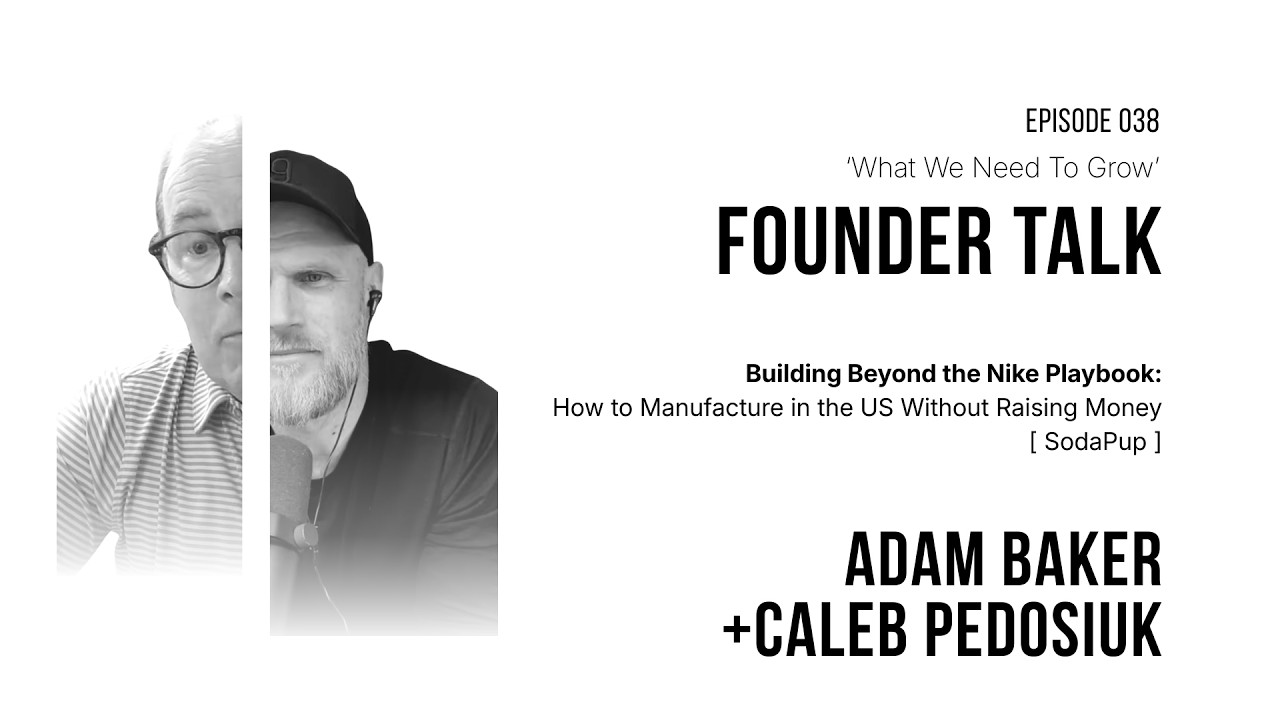
Adam Baker is the founder and CEO of SodaPup in Boulder, Colorado, which he started in 2012 and built into one of the leading names in food-based enrichment for dogs, with every product manufactured in the United States. He came from sporting goods, having worked in product management and product strategy at Nike, Under Armour and Crocs, and the most useful thing in this conversation is what happened when he refused the industry's default. Somewhere between 95 and 98% of pet accessories are made in Asia, and the barrier to making them at home was never labour, it was the cost of injection molds. He covered his tooling with large low-margin subscription box orders until he owned roughly a million dollars of molds without debt or investment, then built a system that reuses half of every two-part mold so new designs ship faster than his competitors can match. What falls out of that decision is the whole business model: short lead times, a wide assortment on shallow inventory, and demand chased rather than forecast. The other half of the story is a reframe worth stealing, which is that he stopped treating a lick mat as a functional tool and started treating it as a graphic t-shirt, after watching customers turn a jigsaw-pattern mat into paint by numbers and photograph the results. The tools his company gives away, a podcast, an Enrichment Learning Center and a new DIY Recipe Maker, sell nothing at all and exist to put SodaPup at the centre of a conversation instead of at the end of a funnel. That is the throughline 79 Development keeps coming back to. Authority is earned by building things worth talking about, and an honest account of that work is what makes a brand understood, trusted, and findable by the systems people now ask for answers.
KEY TAKEAWAYS
- The playbook is borrowed on purpose, and it opens with knowing exactly who is shopping. "I'm trying to run the Nike playbook here, which is pretty simple when you boil it down. You know, the first thing you have to do is know who you're building products for." In his case that is women, because women do most of the shopping for the family pet. Everything downstream is an attempt to surprise and delight that specific shopper, which is why the products have to be beautiful as well as functional, safe and durable. "That creates some sort of emotional connection when that shopper is shopping online or shopping in a retail store."
- Pull, not push, in an industry that runs on promotion. The second move in the Nike playbook is demand you do not have to buy, and Nike creates it with athlete sponsorships. SodaPup has no athletes. "We don't have that, but we do have social media where there's lots of social proof of people using our products." So rather than the promotional push that is standard in the pet category, he almost never sells off price and lets the social proof create the retailer demand instead.
- A lick mat is a graphic t-shirt business. He did not invent the lick mat. What he did was notice what customers were doing with the first one, a jigsaw puzzle pattern made during the pandemic whose self-contained shapes people were filling with spirulina, kefir and yogurt and treating as paint by numbers. "I was stunned by this when I saw it on social media for the first time. I was like, what is going on here?" Every SodaPup pattern has had that attribute since. The frame he uses for it comes straight from apparel: "I think of lick mats as a graphic t-shirt business. You know, personally, I must have 50 to 60 different t-shirts in my t-shirt drawer. Not that I need that many, but I like the design, so I keep buying more."
- The consumer insight underneath it is that the owner is getting something too. Treating the mat as an object of desire rather than a functional tool produced repeat customers who collect the designs, and the reason it works is that the purchase does two jobs at once. The dog gets something good for its wellbeing, and the owner gets to express their creativity, photograph the result and post it. "There's a bit of showmanship involved. So there's kind of a performative element to it as well."
- The designs are autobiographical, and that is why the assortment is not the same in every store. He grew up around Boston, spent a summer as a deckhand on a windjammer, then moved to the Colorado Rockies. The early designs were simply telling stories about that. The commercial consequence is regional: a lighthouse or a whale mat sells to Scalawags in Kennebunkport, a tourist town on the Maine coast, and a mountain town like Vail carries something else entirely. "This is what I love about what we're creating, is that we're not the same thing to everybody." His competitors, by contrast, have a handful of SKUs and sell them to every account, so everybody looks the same.
- A pet store is a grocery store, and he is treating his shelf like an apparel store. People come back for the milk and eggs, and historically the toys and bowls beside them never changed. "If you walk into an apparel store and you see the same thing every time you go in year after year, you don't have a reason to buy." So he ships seasonal and thematic assortments, fall, spring, Fourth of July, back to school, Thanksgiving, Christmas, and gives retailers a way to keep the section looking new. At roughly $15 a product, the whole thing is engineered as an impulse buy that did not previously exist in the category.
- The mold is the real barrier to American manufacturing, and he financed his out of other people's orders. Somewhere between 95 and 98% of pet accessories are made in Asia, and he had spent his career building things there. He chose not to. The obstacle was never labour, it was tooling: every product is injection molded and molds are expensive. So he took large, low-margin orders from subscription boxes that needed a new toy every month and used them to cover R&D. "I wasn't making very much money from those sales, but I was covering my R&D. So if you do that long enough, suddenly you've got this huge arsenal of molds, a million dollars worth of molds. That's all paid for without taking on debt or investment." The second trick is structural: a lick mat is a two-part mold, so he reuses one half and makes only new pattern inserts for the other, which is why he can introduce designs at a pace his competitors cannot match.
- He accepted the constraints that came with it, and they turned into the business model. The molds are why every mat is round or eight by eight square, never heart-shaped or fish-shaped. What he got in exchange is speed. Domestic production means he can fill a large retailer's order in two to three weeks and ship direct from the factory, so he carries a broad assortment while staying shallow on inventory and chasing demand rather than forecasting it. "We're a cash flow business. Like, if I don't have the money for it, I don't do it." Where competitors are narrow and deep, he is wide and shallow, and he is explicit that he could not be either without producing at home.
- The thing worth stealing is that he audited the industry's one piece of common knowledge. Everyone told him this category has to be made in Asia. "And I was kind of like, wait a minute, do we really? Like, why is that?" Once he priced in ocean freight, a six-week lead time and capital tied up in inventory bought before it was even loaded on the boat, the advantage stopped being obvious. He also notes, on the record, that tariffs and US trade policy have hammered importers in his industry and pushed some customers to boycott American brands, and that the tightening market reaches him too even though his own products carry no duty.
- The free tools are the marketing, and none of them sell anything. The podcast, the Enrichment Learning Center and the newly launched DIY Recipe Maker all exist to put SodaPup at the centre of the enrichment conversation rather than to move product. "Some of what we do is to try to develop these resources where we're not making any money off of it. These are just, we're just trying to help people." The recipe tool is the clearest example: it takes a dog's weight and age, rates the recipe the owner builds, suggests what to add to make it nutritionally balanced, and emails it to them with preparation instructions, all of it drawing on real canine nutrition profiles. The gallery at the end lets anyone open someone else's bowl and take the recipe. "So you don't even have to create your own recipe, you can learn from recipes that other people have made."
FULL TRANSCRIPT
What We Need to Grow, Episode 038: Run the Nike Playbook. A Founder Talk conversation with Adam Baker, Founder and CEO of SodaPup. Cleaned for readability; the words are the speakers' own.
Caleb Pedosiuk: Adam, very good to see you again. From our first initial conversation, you were sharing a little bit about SodaPup, the company that you have built that helps with enrichment for dogs. You came from a background working in apparel with Nike at an executive level. One of the things you mentioned is the Nike playbook, and how a lot of the insights and success you had before let you observe different things and then apply some of your skills in a different capacity. There were many things you were talking about that really stood out to me. But if you could share a little bit about what you're building right now and where that's at, that would be awesome.
Adam Baker: Sure. So as you said, SodaPup is a brand dedicated to enrichment-related products. We are not dog nutrition experts, but we are experts at making things that will help your dog in a variety of ways, whether it be slowing your dog down for better gut health when they eat, or licking products that have a soothing impact on dogs. We have enrichment-related training devices, we have enrichment-related chewing devices. Enrichment is actually a very broad concept, but what we're trying to do is replicate the natural instincts of a dog, creating tools that allow a dog to be a dog.
Rather than viewing a lot of these dog behaviours as misbehaviours, we're directing those natural behaviours into things that are acceptable for a dog to do with our products.
But, you know, as you said, I come from a different industry altogether. I actually come from sporting goods, having worked at Nike and Under Armour and Crocs. And in particular, I'm trying to run the Nike playbook here, which is pretty simple when you boil it down. You know, the first thing you have to do is know who you're building products for. In our case, we're building products for women, because women are doing most of the shopping for the family pet.
So we're trying to surprise and delight that female shopper. And that boils down to, not only do you have to have functional products that work for a dog, but we think they can be beautiful as well. So we're trying to have this combination of functionality and safety and durability married with really beautiful designs. That creates some sort of emotional connection when that shopper is shopping online or shopping in a retail store. But it starts with knowing who the consumer is and then trying to create products that will surprise and delight that person.
And in the Nike world, the next step is to create a pull strategy. And they do that through athlete sponsorships. So you see this athlete on TV and you want to wear what they're wearing. We don't have that, but we do have social media where there's lots of social proof of people using our products, and then that creates demand with retailers. So rather than a traditional push strategy, which would be more promotional, which is very common in the pet industry, we're not promotional, we rarely sell off price, but we are creating social proof through social media, and that's driving demand for our products.
Caleb: One of the unique aspects of innovation that came up in our first discussion was that you did not invent the lick mat. But you did bring a whole new level to the design of them. For example, these mats that previously might be a pattern of hexagons, you looked at and said, wow, there's a lot that we could do here. And I thought it was so cool to see in some of the content on social or on your website how some people have taken a mat that might be geographically relevant to them, maybe the mountains in Colorado, maybe a river, and then owners would create their own blends of food and decorate that mat in a unique way.
That really stood out to me. First, from a product standpoint, the innovation, but then it's such a unique level of engagement. One of the things you mentioned was that typically a lot of the way women will care for their families is through food, that there's a very natural instinct to cook and share that way. And what a unique way to create connection with your dog, where that time of eating can be sharing nutrition but also can be a way of almost breaking bread with your pet.
Adam: Yeah. You know, we kind of stumbled into this. We made our first lick mat during the pandemic, and it happened to be a pattern. It was a jigsaw puzzle pattern, and so each piece was a kind of self-contained piece that could be filled with a fluid. And so people were mixing up spirulina with kefir or yogurt, doing these different colours, and doing kind of a paint by numbers. And I was stunned by this when I saw it on social media for the first time. I was like, what is going on here?
But then we very quickly leaned into that, and so all of our lick mat patterns have that attribute, that there are self-contained shapes that allow you to essentially paint your lick mat with different foods and different colours. My strategy around lick mats is definitely informed by my apparel background. I think of lick mats as a graphic t-shirt business. You know, personally, I must have 50 to 60 different t-shirts in my t-shirt drawer. Not that I need that many, but I like the design, so I keep buying more.
And so by treating the lick mat more as an object of desire versus just a functional tool, we've been able to create, for lack of a better term, a fashion business in a category that used to be not that. And we've created repeat customers that collect our designs. And there is a deep insight into the consumer, because not only are they giving their dog something that's good for the dog's wellbeing, but they're getting something out of it as well, because they're getting to express their creativity. There's a bit of showmanship involved, because they take pictures and post it on social media. So there's kind of a performative element to it as well.
In the very beginning, I chose the pet industry for a couple of reasons. One is that at the time I had three dogs and two cats, and we love our pets. But in addition to that, I was looking for an industry that was really driven by passion. Because if you think about the sporting goods industry, it is driven by people's passion for sports, right? Every year there's a new NFL season, a new hockey season, a new basketball season. Kids grow up playing sports. People are passionate about their teams and their sports. And what I saw in the pet industry is this comparable type of passion, but I didn't see brands looking for ways to harness that passion through the product itself and through marketing efforts and so on, and bring that to life in this, at the time, very slow-moving pet industry, which is really driven by kibble and cat litter.
And so I thought, well, shoot, if I could take some of what I've learned at Nike and Under Armour and places like that, then maybe we could make a mark. So that's what we're trying to do.
Caleb: Interesting. I think another point you mentioned was that you find some of your customer base is collecting these mats. So when there's a new design, if previously a walk down the aisle at the pet store was rather mundane in terms of the toys that were available or the interactive options related to food, now, because you have these specialized designs, I'm assuming they have some degree of limited edition, there's some scarcity involved in it, and they're regionally relevant, whether it's on the East Coast or whether you're in the mountains in the West.
That to me seems really interesting in terms of a level of engagement. So I don't know if organic growth happens through users sharing how they're using it, if it's people stumbling across it in stores, or if it's through people that are happy that are gifting these to others as a way that it's now naturally spreading.
Adam: Well, truthfully, a lot of our designs are autobiographical. I grew up in the Boston area. I was a deckhand on a windjamming ship for a summer job, so I spent a lot of time on sailboats and around the coast. I then moved to the Colorado Rockies, which is where we're based now. My wife is from the mountains. And so in the beginning I was just creating designs that were telling stories about us.
And the happy impact of that is that I could sell a lighthouse or a whale design lick mat to a retailer on the Maine coast, where Scalawags is an account that we work with, and they're in Kennebunkport, and so they have a big tourism business. A lot of people travel with their dogs, and their assortment would look very different from the assortment of a retailer that carries our products in, for example, Vail, Colorado, a ski town, a mountain town.
And so this is what I love about what we're creating, is that we're not the same thing to everybody. You know, most of our competitors, literally, they've got a handful of SKUs and they're selling those SKUs to every account. Everybody looks the same.
And a pet supply store is an interesting place, because it's a little bit like a grocery store. Every time you go to the grocery store, you want to be able to find milk and eggs and bread and whatnot. So it's partly like a food shopping experience. Then there's all of these other products like toys and lick mats and bowls, and historically those have also not changed very much.
I liken that more to an apparel or footwear business. If you walk into an apparel store and you see the same thing every time you go in year after year, you don't have a reason to buy. And so what we're trying to give retailers is the ability to flow product through the store so that it's always looking different. We have a lot of seasonal product. I have fall products, I have spring products, I have Fourth of July products. I've even got back to school products, Thanksgiving, Christmas. So people can start to run these thematic assortments through their store so it always looks fresh, and it gives a customer a reason to buy.
And most of our products cost like $15, so it's not a massive investment. So we're definitely trying to create this impulse buy that wasn't there before.
Caleb: And because it's a low ticket price, you've got manufacturing involved in that. Were you at all intimidated about the ability to create a sustainable business? You haven't taken investment, although from what I understood it certainly has been offered to you. You come from this apparel background, so you understand lower ticket items. So was that intimidating, to look at the landscape and say, well, we would need to be in this many stores or be doing this amount of e-commerce?
Adam: I wouldn't say it was intimidating. It was more of an intriguing challenge. How do I do this differently than everybody else?
So we do a lot of things differently than everybody else, starting with we produce 100% in the US. Almost probably 95 to 98% of all pet accessories are made in Asia somewhere, whether it's China or now Vietnam or some other place. And I've spent my career building things in Asia. I know how to do that. But when I started this brand, I wanted to make everything domestically.
And so the first question was, well, how do I do that? And is there a benefit to doing that? Well, the most obvious benefit is that in the US, that's what most consumers want. They want American-made products. It was very hard to come by. Then the question became, well, how do we overcome the cost of molds? Because molds are very expensive and all of our products are injection molded.
And so I did a variety of different things. First, I worked with large subscription boxes that needed a new toy every month, and they could order a lot of volume. And so I was using those large orders to subsidize my new product development. And honestly, I wasn't making very much money from those sales, but I was covering my R&D. So if you do that long enough, suddenly you've got this huge arsenal of molds, a million dollars worth of molds. That's all paid for without taking on debt or investment. So it was worth it to me to do that in order to acquire the catalogue, if you will.
The other thing we've done is work with our manufacturing partners to build systems that allow us to reuse parts of molds. So when I make a new lick mat, that mat is typically a two-part mold. So what we've created is a system that allows me just to reuse one part of the mold and just make new pattern inserts on the second side of the mold. And so you reduce your cost of new product development and you can introduce things at a pace that none of our competitors can match.
So my new product investment is lower because of the systems that we've created. And there are constraints. My lick mats are all round or eight by eight square. So I'm not doing a heart-shaped mat, or I'm not doing a fish-shaped mat, because then that would drive up the cost. So I've said, okay, I can accept the fact that I have to stay within these containing shapes, and so I'm going to differentiate myself by pumping out lots of cool different patterns within this constraint. And so I've accepted certain limitations in order to do this other thing.
This is the fun for me, is to figure out how to do it differently and be more responsive than my competitors. Because we produce in the US, there's some benefits to that. We have much shorter lead times. And so that means I don't have to carry as much inventory and I don't have to take as much risk on inventory. If you're building in Asia, you've got to fill containers, you've got to buy a lot of product, and then if it doesn't sell through, then you're stuck with closeouts and markdowns, and more often than not you're losing money on that.
So by producing in the US, I have a broad assortment, but I'm shallow on inventory, and then I can chase demand. When we get a big order from a big retailer, in most cases I can get that inventory in two to three weeks and ship direct from the factory and save even more costs, because we're bypassing our warehouse. So it's a completely different business model, which is fun for me.
Caleb: Having seen both the large apparel, multinational production overseas and now a much more local, niche, closer to the pulse of what people are buying model, do you have more visibility into a niche aspect of manufacturing that is stateside across the board, not just in this industry? Having both of these worlds of experience, do you feel like there is opportunity that a lot of entrepreneurs aren't seeing yet in terms of being able to find niche product opportunities and then source manufacturing locally, and build these small, mid-sized companies that way?
Adam: Well, I think it depends on what the product type is. So, as I said, all of our products are injection molded. So the big hurdle for me is just the cost of the mold. I have to make an investment in the mold. Hopefully I can recoup that investment by selling enough over time. Those molds will last for a long time, so I can recover that investment for a longer period.
There are other product types that I would like to make, but I don't, because I can't make them in the US. And because this is a pillar of our business, again, I have some self-imposed constraints. If I have to make it in Asia, I won't do it. So for example, if I wanted to make plush toys, which are like stuffed animals, that is a very labour-intensive type of production, and so almost all that stuff is made overseas. I do have friends in Denver that make plush here in the US, but they're doing big ballistic nylon types of things that carry a higher price point.
So I do think that there's an opportunity to produce more in the United States or in Canada. There are plenty of Canadian companies that produce in Asia as well when it could be done in the States. But because we're doing injection molding, which once we have the molds is fairly automated, you still have a machine operator, but your cycle times are quite high. So the cost of labour as a share of the total cost of the product is quite small with our product type. But as I said, the big challenge with domestic manufacturing is overcoming the product development cost, the cost of the mold. If you can figure out how to deal with that, then the rest is much easier.
And it's easier logistically, and you don't have to deal with all the crazy tariffs that this administration is doing. There's so much turmoil. So many pet companies have just been hammered by the US's trade policy. It's frustrating, and I don't have any of that, although I still suffer from the effects of the tariffs because everybody's got less money to spend. So even though I don't have tariffs on my products, I struggle with a tightening market, if you will. And of course, we had a lovely, large business in Canada, and US trade policy has impacted that business as well, because people are boycotting US brands. I don't blame them for that.
But that's a whole other discussion. The real challenge here is figuring out how to get stuff made in the US. And what I found when I came into the industry is that everybody defaulted. It was common knowledge that if you're going to produce this kind of product, you have to make it in Asia. And I was kind of like, wait a minute, do we really? Like, why is that?
By the time you land a product in the US from China and you've paid for the transportation and you've had a six-week lead time, you've paid for your inventory upfront, before it even got put on the boat. So your capital is tied up for all this extra time. When you really dig into it, I'm not sure there's a real advantage to manufacturing overseas.
I mean, think about what domestic manufacturing has done for me, because I have just-in-time inventory management, quick turn times on production. That allows me to have a broad product offering because I'm shallower on inventory. So it has shaped my business. It has allowed me to do many, many things that I wouldn't have been able to do had I produced in Asia, because my capital isn't tied up. We're a cash flow business. If I don't have the money for it, I don't do it. And so where my competitors have a narrow assortment and they're deep on inventory, I have a wide assortment and I'm shallow on inventory. And I can do that because I produce in the US.
Caleb: Yeah, I love that model. One of the things that I think is so cool that you're doing is you have been helping create tools to empower pet owners to create nutritious blends of food at home for their dogs, and giving them a resource. One of the things you mentioned that I thought was so neat is that some of your product, the lick mats or the trays, can have the meal prep done in advance, stack them in the freezer, and some of your customers will just take them out when they're needed. And I thought, what a great way to engage and build community in a way that adds to the nutrition and the wellbeing of the pets and the connection between the owners and their pets, but also keeps you engaged with them outside of just a straight purchase.
Adam: Yeah, so again, this goes back to the idea of trying to build community and putting SodaPup in the centre of this enrichment community. Some of what we do is to try to develop these resources where we're not making any money off of it. These are just, we're just trying to help people engage in enrichment activities for their dogs. It's great for their dogs. And then, in a roundabout way, it will be good for SodaPup.
So we've done that in a couple of ways. I mentioned before, we have a podcast. It's called the Sodapup Enrichment Lab. So we are talking to experts about enrichment and just putting that out. It's available on our website, on a YouTube channel, so people can learn about enrichment. That's not a money-making activity. That's more of a soft marketing type of activity.
We have an Enrichment Learning Center on our website. So this is if you want to just learn more about enrichment. There's all kinds of free content there for you to learn about the different kinds of enrichment products that SodaPup makes, but also other companies make.
And then most recently, actually just this weekend, I finalized a do-it-yourself recipe maker. So you can access the app on our website. A lot of people want to cook for their dogs, but they don't know about canine nutrition. And so this app actually accesses real resources where dog nutrition profiles exist. The app will have you enter the weight and age of your dog, and then you can build a recipe, and the app will rate the recipe and give suggestions of things you should add in order to make it nutritionally balanced. And then the cool thing about it at the very end, you can make this recipe, email it to yourself, and it will tell you how to prepare it, how to cook it.
But then at the very end, you can actually select one of our bowls and create an image of your meal in the bowl that you selected, so you can actually picture it as well. And it uses AI to generate the image, and some people don't like that. So if you have a problem with it, then you just don't do that step. And again, we're not trying to sell. We're just saying, if you want to see what it looks like, here you are. And that gets posted to a gallery, so you could just go to the gallery and look at everybody else's bowls that they've created, and then you click on them and it will bring up their recipe, and then you can email that recipe to yourself. So you don't even have to create your own recipe, you can learn from recipes that other people have made.
So again, it's just a way to build this community around enrichment.
Caleb: Excellent. So sodapup.com. And then the podcast you mentioned.
Adam: Yeah, it's called the Sodapup Enrichment Lab. It's on all major podcast platforms.
Caleb: Excellent. Well, Adam, really appreciate you taking some time to share a little bit more about what you've been building, and I hope that anyone coming across this will take the time to go check out both the podcast and the new tool that's just launched as well. So thank you.
Adam: Awesome. Thanks, Caleb. It's been a pleasure.
What We Need to Grow is a conversation series by 79 Development, hosted by Caleb Pedosiuk. New episodes on YouTube and Spotify.