How to Measure the Mental Side of Athletic Performance
For athletes and coaches at the college and pro level, athletic departments, and anyone planning a career transition out of high performance.
About Ryan Schachtner
Ryan Schachtner is the co-founder of Success Beyond Game Day, a neuroscience-based athlete development company, and the president of Carolina Asset Management, the Charlotte financial planning firm he built after a career-ending injury ended his college baseball career and professional prospects. He is known for measuring the behavioural side of performance, traits like grit, work ethic and coachability, and coaching athletes on it alongside preparation for life after sports. He is the co-author, with former NBA player Anthony Tolliver, of *Foundation for Financial Excellence: Lessons From the Pros: A Game Plan for the Collegiate Athlete* (2021), and has worked in financial services since 2000, including with professional athletes.
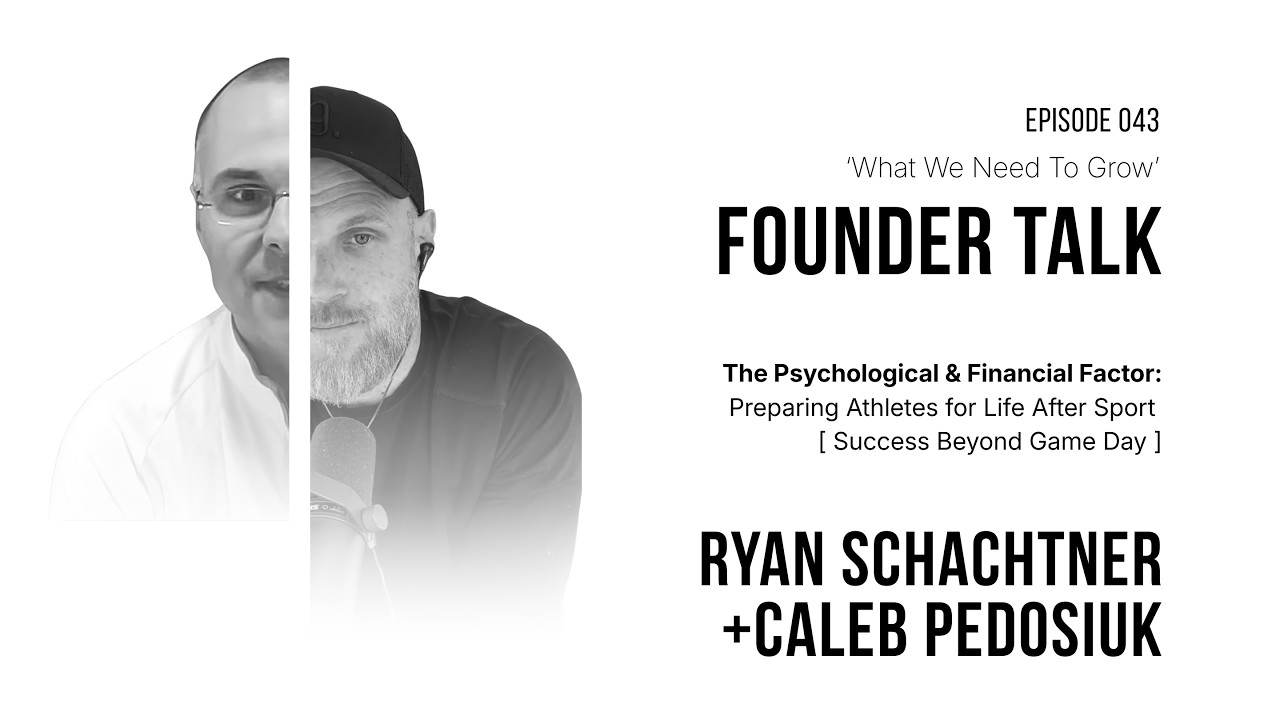
Ryan Schachtner is the co-founder of Success Beyond Game Day and the president of Carolina Asset Management, the financial planning firm he built after an injury ended his baseball career. His work with professional athletes taught him that the difference was never the portfolio, it was the psychology, and that led him to build a way of measuring the behaviours behind performance: grit, work ethic and coachability, tied to specific moments on game film. His principle is that experiences drive beliefs and beliefs drive behaviour, so the behaviour is what gets measured, and the coaching goes either to a quick competitive fix or to the foundational experience underneath. The argument that carries beyond sport is about visibility. Athletes invest in what they can see, so the job is making the invisible side of performance specific enough to act on. That is the throughline 79 Development keeps coming back to. Authority is earned by building things worth talking about, and an honest account of that work is what makes a brand understood, trusted, and findable by the systems people now ask for answers.
KEY TAKEAWAYS
- Every athlete becomes a former athlete. "At some point our athletic career is going to be over. I just found out a little bit sooner." The shoulder injury that ended his baseball career is why the company exists: to help athletes get better at their sport and, in parallel, prepare for the day "the final whistle is done and somebody else is wearing their jersey number."
- His edge with pro athletes was psychology, not portfolios. He worked with Super Bowl winners, Pro Bowlers, World Series ring holders and NBA Finals players, and it was never about connections or trades. "It was really the psychological side that I was able to unpack and uncover" that let them rebuild in the time left on their contracts.
- Experiences drive beliefs, beliefs drive behaviour. Success Beyond Game Day measures behavioural characteristics like grit, work ethic and coachability, then ties them to game film. "I know you think you should score a 100% on work ethic and being coachable, but here are 10 instances where I can show you just from this game where that slipped." From there it is either a competitive band-aid, visualization before a big game, or foundational work on the experiences driving the beliefs.
- Make the invisible visible and athletes buy in. Athletes work on the physical because they can see it. Development content that is generic, or that tells them to "get tougher" when the issue is larger, loses them. "If we can take something that you can't see, make it visible, and then give them the specifics, just like you would on the physical, we get a lot more buy-in."
- The results he reports come from specificity. Working with NFL Combine prospects for five years, he reports that 32% of the players they work with are drafted higher than projected and 90% go at or above projection. In two years in college athletics, he reports three national championships and seven or eight conference champions among the programs using the tools. These are his figures. AI's role today is on the coaching side, helping programs recruit for culture and position fit and target the development drivers, with wearables like the Oura Ring as the next layer.
- Money in college sports has shortened every coach's clock. With money flooding into athletics, expectations are that a program should win now, while the reality of recruiting, installing a system and developing players has not changed. The tools exist to shorten that curve: select the athlete who fits the culture and the tier of competition, then streamline the development.
- The constraint is awareness among the right people. The business is entirely word of mouth today, carried by coaches who change jobs and bring the tools with them, and by players who call other players. He has turned down money from the wrong investors. "It's the awareness among the right people," athletes trying to reach the next level and coaches trying to keep their jobs and advance, and the revenue that follows solves the rest.
FULL TRANSCRIPT
What We Need to Grow, Episode 043: Experiences Drive Beliefs. A Founder Talk conversation with Ryan Schachtner, Co-Founder of Success Beyond Game Day. Cleaned for readability; the words are the speakers' own.
Caleb Pedosiuk: So Ryan, I could read the opener: that you had a career-ending injury playing college baseball, that you built one of the fastest-growing financial planning firms in the Southeast, that you wrote a bestselling book, and that you co-founded this whole athlete development company. I just read it, but I'm not going to read it. I just want to ask you: you're doing wild stuff with athletes. You understand high performance. You were a high-performing athlete, and you get that high-performance aspect of life. But you also have a real strength on the financial planning side. I'm interested if you can explain a little of where some of that is at right now. But the thing I'd love to understand is how you do both of these things and have them functioning in sync. You see success on both sides, and I could certainly see parallels. But by all means, please introduce yourself and share a little about what's going on.
Ryan Schachtner: Yeah, I appreciate it, Caleb. And I appreciate you not having me relive that shoulder injury where all my dreams and hopes and desires were shattered. Because I'd just be another statistic, right? That's really all I am. At some point our athletic career is going to be over. I just found out the reality of being an athlete a little sooner.
I navigated from that not knowing what I was going to do with the rest of my life, got into the financial space, had some early success, and found that working with athletes was a niche I carved out. But it wasn't because I had all these super connections, and it wasn't because I could make them all these great financial buys and sells and make them all this money. It was really the psychological side that I was able to unpack and uncover that allowed me to take guys who won Super Bowls, who were Pro Bowlers, who had World Series rings, who were in the NBA Finals, and help them rebuild in the limited time they had left on their contracts, before they ended up like me: a former athlete trying to figure out what to do with the rest of my life.
Then COVID happened, and I wrote a book, because for the longest time they had been telling me I needed to write a book and help more people. I'd been focused on growing the firm and expanding, but when I was forced to slow down, I wrote the book. A couple of them helped me out. The book did really well, not because I'm a super good author. Listen, I'm a former baseball player. But the book ended up becoming a bestseller, and then I was introduced into the world of college athletics and top AAU athletics from a different angle. I was doing the financial talks, but I was also watching all the athlete development that was happening, and I saw the disengagement. Athletes were being put through it like a conveyor belt. The content was absolutely needed, but it wasn't relevant to them in their situation at that time.
So I said, how can we help them get better at their sport, and at the same time help them prepare better for when the final whistle is done and somebody else is wearing their jersey number? That's really where I uncovered the behaviour side. How can I measure those behaviours, with such specifics, and then show them how to align and coach around those behaviours, to get them performing better on the field or on the court, but also set up better for life after sports?
Caleb: I'm assuming that's where the neuroscience came in.
Ryan: Yeah, absolutely. What I did was start doing a ton of homework, reading all the books you'd have to pay to get a degree for. I bought those and read them on my own, and realized I would have been disengaged in those classes too.
Caleb: Let me ask a question about what you were explaining. At what point do you find that athletes who have had tunnel vision on one goal, some of them from such a young age, while their brains were forming, with ambition and identity set from before grade school, everything from what they watch in the evenings and on weekends to what they play and practice and eat, depending on the culture around them, they're so wired for this. At what point are they psychologically open to embracing the idea you described, that when the final whistle blows someone else is wearing your jersey? Is it usually when they're feeling their physical limitations, an injury, or feeling themselves slow down? How do you typically find that conversation picks up with them?
Ryan: I think they're so conditioned to being coached that they tend to embrace the coaching. Now, when we start to measure behaviour, the behavioural characteristics like grit and work ethic, and they come back with a lower score, there can be some pushback. But a lot of times the environment, like you said, that surrounds them, especially with the amount of money they can make now in college and pro athletics, everyone there is trying to elevate them. Nobody is sitting there telling them the truth.
So these are things where, if we watch game film, not from the standpoint of whether they're making the right moves, but for cues of the behaviours we're measuring, they show up. By doing that we can point out: I know you think you should score 100% on work ethic and being coachable, but here are 10 instances, just from this game, where that slipped.
Being able to do that lets us customize a lot of the psychological development work on the gaps we need to close, instead of making it generic. A lot of times I think you lose athletes when it's too generic. We mislabel them a lot of the time: you need to get tougher. But it could be a larger issue. Being very specific in the training lets us go one of two directions. We can fix the foundational aspects, or we can put on band-aids to help them in competition so they can be focused in the moment.
We always tell them: experiences drive beliefs, beliefs drive behaviour. We're measuring the behaviour. We can band-aid that with visualization and those techniques when you're going into a big game. Or we can work on the experience you had that's driving the beliefs that are driving the behaviours. The technical term is neuroplasticity, but we can rewire the brain and start conditioning you in practice, so that when you get to the game, that behaviour is either gone completely or its impact is significantly reduced.
So it's being specific and meeting them where they're at, and it's not a judgment. They know from a physical standpoint they're not at the pro level yet. They may want to get there, but they're not there mentally either. A lot of times they're more inclined to work on the physical because they can see it. But if we can take something you can't see, make it visible, and then give them the specifics, just like you would on the physical, to work on it and develop it, we get a lot more buy-in.
Caleb: Do you find that you're actively looking to reinforce or augment your toolkit, psychologically, physically, all of it, with technology, AI tools and so on? So much of what you said, experiences drive beliefs, rewiring the brain, neuroplasticity: I'm thinking about using technology, taking something that's been recorded so you hear words again at a certain time, but also ingesting inputs, whether it's game tape or more, and using AI to analyze aspects of it. I'm also thinking about the financial side, ingesting all the data from a purchasing standpoint: this is how you're spending, this is your budget. More and more, it seems like you may have the ability to create a more quantifiable picture with these tools.
Like you said, if you're vague in your coaching with athletes, they're like, what? But if you say, I know you feel you're giving it 100%, but look at this, this is you at 100%, and we see that from your resting heart rate, and this was flow state for you in that game. So I'm curious, not that you have to put a number to it, what part of the engine you run involves finding tools, saying, this just came out, maybe we could use it for data collection or analysis?
Ryan: I think there's a big picture where we can start to marry some of the psychological tools we've built with some of the measurables, Oura Ring and those types of things, where we combine that data and create really fine-tuned coaching profiles, not just for the coaches but for the athlete. That, I think, is on the horizon. Have we got there yet? No.
But where we use a lot of AI is this. If you're a coach, especially with all the pressures you have right now, money is flooding into athletics, and because more money is flooding in, the expectation is that you should be able to win the championship, or at least be on that track, immediately. Then there's the reality that you still have to recruit your people, develop them, get them used to the system and coach them. So if we can shorten that curve through technology, helping them select the athlete who aligns with the culture, the athlete who aligns with the position they're playing at the tier of competition they're playing at, and help them figure out the key drivers they need to develop in that athlete, then we can streamline a lot of that development.
We got our start working with NFL Combine guys. We've been doing that for the last five years, and the appetite of these athletes to get better is significant. They want those little things, because it means money, it means career longevity, it means all of those things. So we're able to use some of the tech and data we've built, along with some AI, to build those development plans. What we've already seen in the NFL guys we work with is that 32% of them are going higher than they're projected. That's real money, real longevity in your career, a chance to make the team. And across all the guys, 90% of them are at least going as projected or higher. They're not falling backwards, and that's a significant jump from anything else out there.
And we're seeing the same jumps at the college level. We've been in college athletics for two years now, and we've got three national championships in two years. We've got seven or eight conference champions that weren't there before, programs that closed big gaps between where they were and where they are now, just from using some of the data we're able to compile. And again, it's the visualization aspect that makes it relevant, even to the coaches.
Caleb: All of this sounds phenomenal, by the way, and next level. If we shift for a second, I'm curious: how are your clients finding you? You mentioned the book, and obviously word of mouth. Coaches speak to each other: what are you doing that's shaving time off, or increasing strength, or cohesion, or belief? There's got to be a natural organic discussion. But how are you finding that the results your team gets are actually reaching the people you ideally want to work with?
Ryan: It could always be better, right? Right now we're solely word of mouth, and that's worked for us because of how often coaches move to new places after having success with our tools, and they bring the tools to their new environments. The players we've worked with are calling teams, calling other players, calling coaches, saying you need to work with these guys. So the more success we have, the more it spreads. It's largely been word of mouth.
Doing shows like this is also a strategy. But could it be easier for people to find us? Probably. Between finance, working with athletes on physical performance, and working with coaches to better align their recruiting and draft efforts, it only leaves so much time to open the door to other avenues.
Caleb: Well, I feel like we should do a part two, because there are so many aspects of performance affected by this. Athletics is a giant metaphor for so many other things in life, and a really ideal environment for developing human potential, individually and collectively, when you have that level of cooperation, teams willing to compete on a board with certain rules, much like a free market is supposed to work, and arguably the way a lot more things should work geopolitically.
The one question I like to ask as a final note: if you had to put your finger on one area for growth, what is the one thing you need most right now to grow? For some it's, we're raising money, we're doing a series. For others it's more exposure and awareness. For some it's key talent in an area they're branching into, so it's human resources. If you had to pick one, what would it be?
Ryan: I think it's awareness, and awareness among the right individuals. We've looked at, and opened the door to, the raising-money aspect, and people want to give you money, but are they the right people? So it's awareness among the right people: the athletes trying to get to the next level, and the coaches trying to sustain and keep their jobs, but also grow and advance to higher and higher opportunities. At the end of the day, that's really it. The other aspects, hiring the right people to handle the demand, all come down to the revenue side. When you have enough of that, you can solve a lot of problems. We're operating well now. We'll find the right people to help handle the workload. But it's awareness, because there are so many athletes out there trying to figure out: I'm big, fast, strong and talented, but something else is missing. I'm faster than that guy, I'm bigger than that guy, but that guy got the contract, or that guy got the opportunity.
And not only do we help them in athletics, we help position them for life after sports: better opportunities, quicker opportunities, and more successful ones.
Caleb: Well, Ryan, thank you so much. Like I said, if you're open to it, I think we should do a part two, because there are a number of things I'd love to pick up on, even the spot you left us at right now, how this prepares athletes to move seamlessly into what's next. I've heard a lot of similarities with servicemen, especially special forces. Their whole world is here, and once they retire and are no longer deployed, it's very similar to a high-performing athlete asking, now what? If you're not careful, the things that fill that gap, to give you that rush, that sense of focus, that tunnel vision, aren't always constructive. Some can be addictive or very destructive. If you're used to thriving in chaos, and your best comes out in the heat of battle, whether on a sports field or elsewhere, you have to be careful you're not creating those scenarios in life with people, or in situations where they don't belong. But Ryan, thank you so very much for the time, and I do hope we pick this up for a follow-up.
What We Need to Grow is a conversation series by 79 Development, hosted by Caleb Pedosiuk. New episodes on YouTube and Spotify.