How to Stop Losing Your Audience to the AI Chat Window
For expert creators with an archive they do not want flattened, founders whose organic traffic has stopped converting, institutions and nonprofits guiding people through hard transitions, and anyone weighing what it means to own the channel between their work and their audience.
About Karin Andrea Stephan
Karin Andrea Stephan is the Chief Growth Officer of Sidekick Platform, the AI knowledge platform operated by Sidekick Wellness Inc. that turns an expert's approved body of work into a branded conversational channel, answering only from that material and linking every answer back to the exact page or timestamp it came from. She is known as a co-founder of Earkick, the AI mental wellbeing app she started in Zürich in 2021 with Herbert Bay and grew past 250,000 users, and which Elomia Health acquired in November 2026, taking on Earkick's AI models and continuing access to the Mia21 memory engine her team built. She works on the growth side of a platform whose first veteran-facing channel was approved by the US Department of Veterans Affairs after a review for privacy, safety and accuracy, and her argument in public is that the loss experts have not yet priced in is not traffic but ownership of the relationship between their work and their audience.
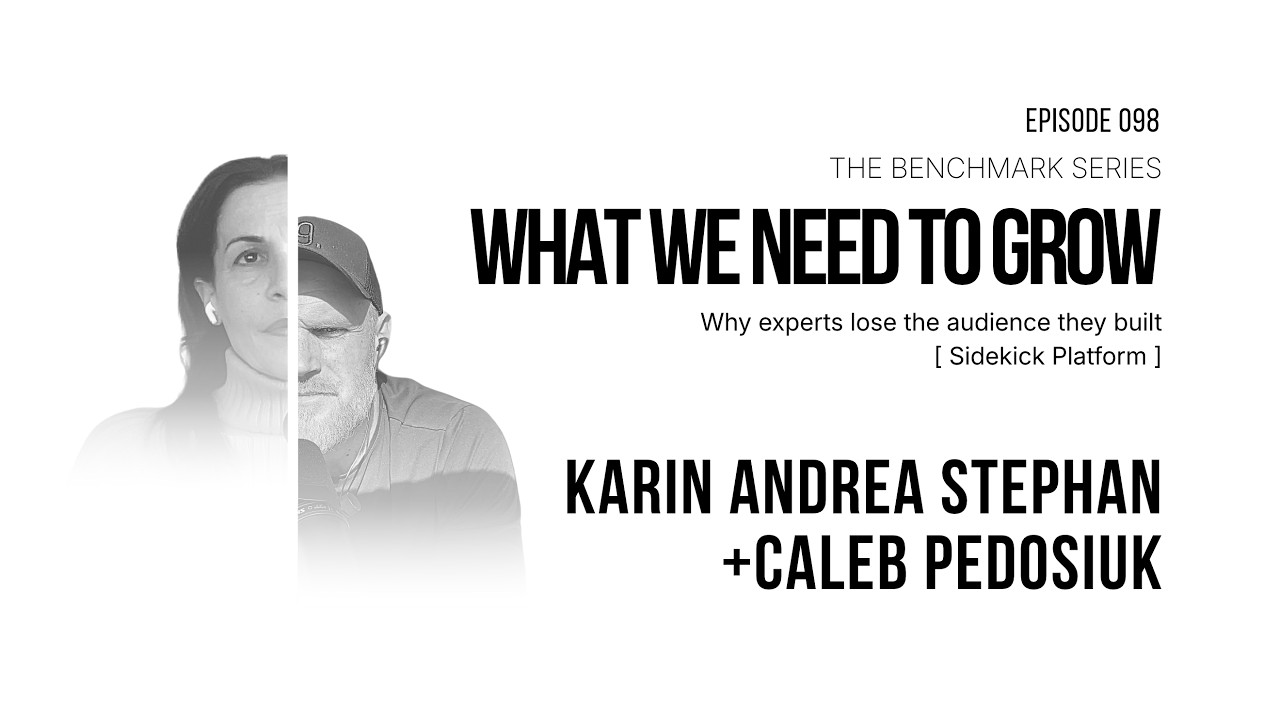
Karin Andrea Stephan is the Chief Growth Officer of Sidekick Platform, which turns an expert's approved body of work into a branded conversational channel where every answer links back to the exact page or timestamp it came from, and a co-founder of Earkick, the AI mental wellbeing app that passed 250,000 users before Elomia Health acquired it in November 2026. Her argument in this conversation is the one 79 Development keeps running into from the other direction. People no longer Google, so the answer about your work gets assembled inside an interface you do not own, and what you lose there is not a click but the relationship itself. Her response is to make the expert's own material the only thing a channel can answer from, and to hand back the source every time so a person can check it. The use cases she cares about are transitions rather than searches, a veteran leaving active duty or a family hit by a diagnosis, where not knowing the first step is the whole problem. What makes this 79 Development's kind of conversation is where she puts the burden of proof. A trustworthy answer is one you can trace, and a company that can be traced is a company the machines can explain.
KEY TAKEAWAYS
- The loss she names is ownership, not traffic. Her sentence is the sharpest thing on the tape: "If you have an interception between you and your community or your audience that you don't control, you will lose ownership. You will lose the potential business. You will lose what you have been building over years, to an LLM window, to an interface that you don't control." The mechanism she gives is plain, and it is the mechanism 79dev sells against: "people no longer Google things. They may not find you over the website. They may not look for you. They may just stay in their LLM window, and be happy with that very superficial information they get." She says the group of people who understand this is getting bigger every time she looks at her feed, and that it is still early.
- Grounded means verifiable, and verifiable means a link to the exact second. A Sidekick channel answers only out of content the expert has approved and curated, and it hands back the page of the paper, or the timestamp of the video or podcast episode, so a person can go and check it. Her illustration of the boundary is the useful one: ask a university's channel for a chocolate cake recipe and it tells you it does not know, because that is not in its wheelhouse. The thing on the user's side she calls a sidekick, an avatar whose job is to guide rather than to perform knowledge: "explorative, very encouraging, without making up things, without going out on tangents."
- The use case is a transition, not a search. The pattern she keeps returning to is a person at a moment where not knowing the first step is the whole problem. Veterans moving off active duty who do not know which benefits are theirs or how to find work, inside a channel curated by subject-matter experts rather than built from what veterans themselves said. A stroke nonprofit, where a diagnosis lands on a whole family from day one. Cancer patients. Students going from home to college. Her argument is that the outcome is measurable, because when a person knows what the next step is you can watch them get through the transition faster. "A lot of us, and I include myself, don't do certain things just because we don't know what the first step is."
- Agents augment, they do not star. Asked where agent-to-agent interaction fits, she declines the premise that it replaces anybody: "the agents are the AI. The agents are like the Iron Man suit. They enhance, they augment the capabilities of the human." Whatever becomes possible, she says, still needs a human in the loop, and exactly where that human sits and how much agency they keep is the design question at the front of the work rather than a footnote to it.
- What she needs to grow is the slow kind. Organic growth and exposure, advisors and team members writing papers and speaking, and conversations like this one, because the constraint is not awareness of a product, it is belief. "Mind you, we're in the trust business, and people need to create channels, to work with channels, to understand the difference, and that will take a little time." The ask is for more people to hear about it, try it, refine it, and add to the network of channels until the ecosystem feeds itself.
FULL TRANSCRIPT
What We Need to Grow, Episode 098: The Interception You Don't Control. A Founder Talk conversation with Karin Andrea Stephan, Chief Growth Officer of Sidekick Platform. Cleaned for readability; the words are the speakers' own.
_Cleaned from the Granola capture, fillers and backchannels removed, on-record window only (11:33:20 to 11:52:03). 🟡 Machine draft from a single mixed capture: proof before it ships, and re-check against the Riverside tracks when they land. Proper nouns corrected against public sources: Granola rendered her first name as "Corinne" in every instance, "Sidekick" as "psychic" and "side kick", "Earkick" as "ear kick" and "AirKick", and the acquirer "Elomia Health" as "Elemia Health"._
Caleb Pedosiuk: All right, Karin. Excited for this conversation. You have had a couple of ventures. You built a few successful things. You're working on something called Sidekick right now. Please introduce yourself and share a little bit about what you're working on right now, and if you don't mind even touching on a couple of your past ventures, that would be awesome as well.
Karin Andrea Stephan: Sure, happy to, and thanks for having me. So yes, I'm a serial entrepreneur. I just was lucky to announce a couple of days ago that my former company, Earkick, has been acquired by Elomia Health. Earkick is an AI for mental health. And now I am really, really happy to be working with the Sidekick platform. I started earlier this year, and I am the Chief Growth Officer there.
What Sidekick does is we turn an expert's body of work, their podcasts, their books, talks, papers, videos, into a branded conversational channel. And whether that expert is an institution, or it's the VA, or it's a single person or a group, doesn't matter. What matters is that people on the other side, the audience of that channel, can ask questions and get answers that are grounded in that work, that come with a link back to the exact timestamp, or page of a paper, timestamp of a video, of a podcast episode, so they can actually go and verify every answer.
This matters because we live in times of abundant information and knowledge, and you don't know what to trust. You don't know where things come from. You don't know if there is a person behind it. You basically don't know who to trust and what to trust. And so we at Sidekick firmly believe that experts should own their knowledge and they should get the value that it generates. They should participate in that value creation. And the audience that is on the other side should get the full value, the answers that they can trust, something that they can use to create their own opinion, to base their decisions on, especially in high-stakes topics like health or parenting or education, career, financing and so on.
So roughly, that's what we do. And my role there is to make sure that anyone who has knowledge and expertise hears of that, and anyone who needs a certain expertise and knowledge also hears of that, and that they come together via channels that are conversational, so easy to use.
Caleb: So first of all, this really sits in an important place in the market right now. Like you said, we've got generative AI just like a fire hose flooding the market, really unchained. And I don't necessarily think that it's the worst, in the sense that quite often where there's a new technology, there can be just the floodgates open and people are experimenting with it. But to really get good stuff, you have to prune. Get the pruning shears out. You've got growth all over, you have to prune back and really push it in the right direction. I think that's what a lot of people are doing right now, is they're looking and saying, look, I need to hone in. Where's the signal in the noise?
Can you share a little bit about some of the success stories you've had? Specifically, who are some of the brands, the people? Is there a target audience that you found that have really picked up and really benefited from what you guys are building?
Karin: So basically, where it is currently most powerful is when people are in life transitions, where it really matters that they get expert knowledge at the right time, in the right size, in the right language so that it's actionable. A lot of us, and I include myself, don't do certain things just because we don't know what the first step is. And then maybe you go search and then it's all scattered.
So a great example is what we are doing with the veterans, where they transition from active duty to normal life. And they can, via that channel, the Sidekick channel, that has been created and curated by subject matter experts, they can access it in a conversational way and therefore find their job quicker. They know what their benefits are and they just can navigate this huge amount of knowledge and of information in a way that suits their lives, their situation, their personality.
Another example would be institutions like universities that want to give their students access to a channel with a certain topic where they can explore that topic within a curated environment, and where they can start wherever they are, whether they're beginners or they already know a lot. And the very important thing, especially in nowadays' time, is that the content that is in those channels is not mixed with the web. So it's not this smooth-sounding, I-know-everything kind of answer. It is fully grounded in the content that has been approved, curated, and so on. So if you're a student here, you can't ask for a chocolate cake recipe. It's going to tell you, I don't know, because this is not in my wheelhouse. This is not the expertise, the content module that I have. That's what the sidekick will say.
By the way, the sidekick is an avatar that is on the user's side to help him or her navigate the content that they want to access in a way that they can understand. Very explorative, very encouraging, without making up things, without going out on tangents. Very, very focused on what needs to be achieved.
Another example is, for example, if we have this nonprofit about stroke. So when people have a stroke, that affects not only the whole family, but it affects you from day one onwards, and you scramble and you have to know what to do and who to ask and who else is doing this and what does it mean for me, what does it mean for my environment. And so a channel that is completely dedicated and curated by experts can absolutely make the difference in such a heavy transition. The same applies to cancer patients, to students who go from home to college, for example. And all that you can then measure to see the outcome, because when people know what the next step is, and when they can work with a sidekick on their sides and be safe and know where that is coming from, then you get a person through a transition much, much faster and much more successfully.
And now I spoke about the expert creators. That is the next big, big chunk of, let's say, people we're targeting and we're working with, where someone like you, for example, who has episodes over episodes, a whole archive that you've worked on, make it accessible to your audience in a conversational way where they can, within seconds, know, for example, whether you spoke about a certain topic ever and where you spoke about it and what you said. The sidekick is going to give them the exact video, to the timestamp second, where you said something or your guest said something. And now imagine this further. If you have a huge archive with papers and other content pieces, to be able to make the entire archive accessible conversationally and in a way that everyone can understand, that is a true game changer for how we consume expert knowledge, content, and things that are really relevant to our own lives.
Caleb: You mentioned veterans, if I'm not mistaken. How would this work with veterans? Because I understand public-facing content, let's say the academic space, or if there's content creators that have been publishing content. Maybe they've written some stuff, maybe they're publishing through media. But for veterans, if I'm not mistaken, a lot of their work probably was more contained in the service. What sort of work would they have amassed during their time of serving that would then be compiled with Sidekick?
Karin: Well, it's not what the veterans said, but what they need to know for their transition. So there are experts that curated that channel so that when a veteran asks for a benefit, or asks what is the next step when I come home, how can I get a job, all these questions that all of a sudden are there, that they get the right answer. And that they are helped on the way to take those next steps.
But we can also think it further. You said a veteran, for example, has amassed a lot of experience. Yes, there are fantastic veteran podcasts out there. So think this further: someone who has a podcast with very specific topics and content can also use Sidekick for their audience.
Caleb: Yeah, interesting. So I understand it now, that we're looking at a use case for a brand or for a company, product, service, where Sidekick can compile all of the resources, the tools, to better facilitate the success of its customers, versus perhaps an individual that may be looking to leverage content they've produced, papers they're writing, things like that. Both instances, I can see how there'd be real benefit.
What are your thoughts with agent-to-agent interactions? As more and more people are using agents to filter information, to make certain decisions, how do you see agents functioning within this mix?
Karin: So we have an agent system basically, but for us, the agents are the AI. The agents are like the Iron Man suit. They enhance, they augment the capabilities of the human. So if you're an expert, or you're a group of experts or an institution, you use this agent system, this infrastructure that we provide via Sidekick, to make sure that your expertise, your human expertise, and everything you want to convey reaches the people that need it most.
So what I'm saying is, whatever is possible, and there's a lot possible in agent times, still needs the human in the loop. And where exactly the human is in the loop, and the ownership that has to do with that, the agency that a human is given, that is at the forefront of what we do.
Caleb: Interesting. How are you currently finding people are coming across your work? I know that it's super busy. There's a lot of noise, like we were talking about earlier. How are you finding that actual individuals that would potentially be customers, how are they finding you?
Karin: Well, they find us because they either hear from us through a live event. We have, for example, just had a very, very important summit with a partner of ours, TechEquity, in Silicon Valley, where we have been able to show a lot of the work, not just from a scientific side, but also from how it's applied. And so people tell other people, that's one way.
And the other way is that people are actually trying to find a solution for a problem that they feel coming. As a creator, I'm going to speak to the creator side because I'm a creator myself. As a creator, you know that if you have an interception between you and your community or your audience that you don't control, that you will lose ownership. You will lose the potential business. You will lose what you have been building over years, to an LLM window, to an interface that you don't control. Because people no longer Google things. They may not find you over the website. They may not look for you. They may just stay in their LLM window and be happy with that very superficial information they get.
And so I have been interviewing and talking a lot to these experts who understand that their work is at risk and that their business model will also be at risk when nobody finds or looks for them anymore, when Google doesn't bring them any business, any eyes, any clicks anymore. They understand that they have to find a way to own the relationship between them, their work, and their audience.
And so I have had very interesting conversations. People trying out what is possible and understanding that they can build that Sidekick channel next to their other things, whether that's a Substack or a YouTube channel. All they need to do is set up a channel that really they own, that belongs to them fully, that they don't have to give us a cut of. And they can start creating that alternative for when things get really, really difficult with the noise and signal ratio. That's how they find us. It's early times still. But every time I look on my LinkedIn, every time I talk somewhere, the group of people who understand the problem gets bigger and bigger.
Caleb: So what is the first step for someone that is interested or curious? What do you typically take them through?
Karin: So first, they would need to understand what it is that makes them unique, and what that knowledge, content, expertise comprises, and who is on the other side. And then they can just open a channel within minutes. Doesn't cost them anything. They can open a channel, they can curate the content, test it, invite people, and see how people interact with their content, and then take it from there. And then they can start monetizing that. They can add it to a subscription that they already have. They can create a new subscription. There are many ways that they can start thinking about how they are going to make this work as a business for themselves. So the setting up of the channel is self-served, and it's not hard to understand, and then you just have to go and fly with it. That would be the first step. And if somebody's overwhelmed with that, they can just DM me. I'm very, very accessible.
Caleb: Awesome. All right. Well, last question I'd like to ask guests relates to what it is they need most to grow right now. I know that there's always many things on the go. Some companies are raising money, some are going to market, some are looking for beta users, testers. What would you say right now that you with Sidekick need most to grow right now?
Karin: Actually, the current organic growth and the exposure. And also, we have fantastic advisors and people who really push us in our team, them writing papers, speaking about this, and getting the word out. This is what is needed most, and this takes time because, mind you, we're in the trust business, and people need to create channels, to work with channels, to understand the difference, and that will take a little time.
So most needed is something like this here, this conversation, where more people will hear about it, they will go try it out, they will help us refine it, and they will help create that network of channels, that ecosystem that is going to feed itself over time.
Caleb: Excellent. Well, Karin, thank you so much for sharing more about Sidekick. Do appreciate it.
Karin: Thank you so much.
What We Need to Grow is a conversation series by 79 Development, hosted by Caleb Pedosiuk. New episodes on YouTube and Spotify.