What Happens to Future Leaders When AI Takes Entry-Level Jobs
For CEOs and people leaders deciding how to train the next generation as AI absorbs entry-level work, and for executives weighing their next role.
About Chris Berta
Chris Berta is a partner at Laurel Group, an executive search firm placing C-suite and senior leaders at technology companies, where he leads business development and senior management searches. He is known for pressing a question most companies have not yet answered: if AI absorbs the entry-level work where people learn their craft, where will the next generation of leaders come from. He brings more than 24 years in recruiting, sales and marketing; earlier he was Head of Digital Marketing at Washington Mutual, a Client Strategist at aQuantive before its acquisition by Microsoft, and led product management for Amazon.com's first online advertising capabilities. He writes on AI and hiring for outlets including GeekWire and holds a BS in Economics and a BA in German from the University of Washington.
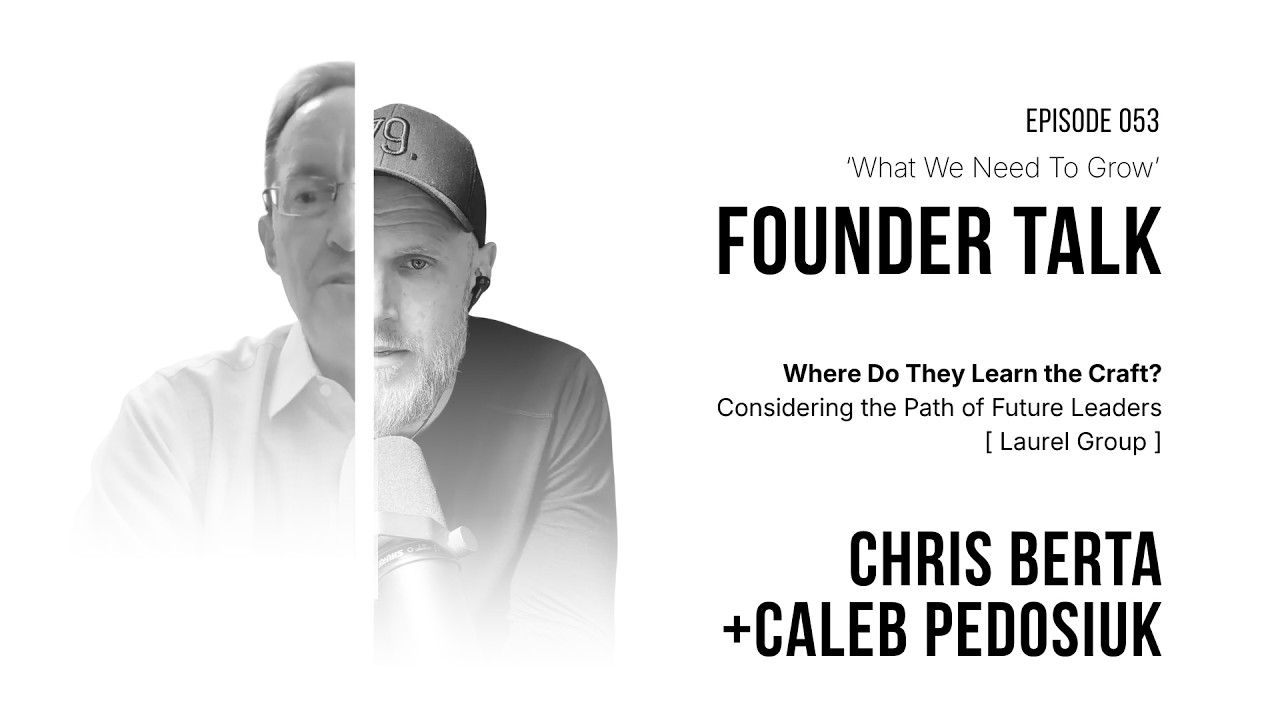
Chris Berta has spent more than two decades at Laurel Group placing senior leaders at technology companies, and since 2023 he has been asking every leader he meets the same question: "If those roles all go away, where are they going to get their training?" Entry-level work is where people learn a craft and then learn to lead, and without it he expects companies to be "kind of rudderless" in five to ten years. He proposed an apprentice-type program, and he is candid that most growth companies say they lack the bandwidth. He also explains how search really works, a business where clients become candidates and candidates become clients, and why the conversations that win a placement are often the ones from six months earlier. His rule is to leave every person with a nugget worth remembering, so there is a reason to take the call. That is the throughline 79 Development keeps coming back to. Relevance over years is earned one useful exchange at a time, and a consistent public record of what you know is what builds the kind of signal AI systems draw on.
KEY TAKEAWAYS
- Asked what he needs most to grow, he said new clients, the kind that keep coming back. Laurel Group is in a business development cycle after finishing a run of engagements. "Most of our clients, I want to say 90% of them are repeat clients." The model he wants more of is the one he has had for two years with Bloom Energy, "on an absolute tear in the power generation space," where the firm has filled senior role after senior role: "an ongoing relationship, filling the needs that they have as those come up."
- If AI takes the entry-level job, nobody learns the craft. He first asked it from the audience at a 2023 conference, while a panel that included AI leaders from the Allen Institute for AI and the University of Washington argued for using AI everywhere. "That sounds great, but I've got college-age kids. If those roles all go away, where are they going to get their training?" He has put the same question to leaders ever since, and "no one really had a good answer for that." The stakes, as he sees them: entry-level roles are where people learn the craft, "and then also where they learn to become business people and then ultimately leaders. And if we get rid of that whole function, we're going to end up being in an environment where we in 5, 10 years are kind of rudderless." He wrote it up and proposed an apprentice-type program. The pushback was bandwidth, time and resources, "but at least it started a dialogue."
- Large companies can afford to build leaders. Growth companies mostly cannot. Amazon, he points out, runs a role in which someone shadows the CEO "just to give them exposure across the organization and just see how decisions are made in that environment." A smaller company "just trying to drive to revenue and scale the business" rarely has the resources to invest in an apprentice-type setup, which is exactly where the gap will show first.
- In search, clients are candidates and candidates are clients. He calls the core tension "the consultant's dilemma": you got into the work for the engagements, but "the tough part is the biz dev." What makes it work is that the two sides swap. "If we are having a conversation with the CEO, then when that person lands in the CEO spot, hopefully they bring us in for other C-level roles within that company." The balance never settles: "it always indexes one side or the other." Laurel Group cuts out layers so the people placing a candidate know both the client and the candidate "intimately," which is how they judge cultural fit and not only functional fit.
- Leave every conversation with a nugget, and keep the notes. His method for staying worth hearing from across months and years: "When we reach back out to somebody, call it 3 months, 6 months later, there's a reason for them to take the call." He tells the story of a CMO candidate who saw a role open and dismissed it. Because he had notes from a conversation six months earlier about what she wanted, he could show her how the role lined up. "She was on board in no time." Without the earlier conversation, "this would have just passed."
- Every channel carries a different depth, and culture fit lives in the deepest one. Email, text, a phone call, a video call and a meeting in person each give "a different layer and depth of knowledge and association with that person." Some of what decides a placement, the energy someone brings into a room, may not come through on a call at all, and a strong candidate who does not fit a company's culture gets rejected "kind of like cancer" by the host. He has seen it at Microsoft, where people "get rejected because they don't know how to assimilate correctly into that culture."
FULL TRANSCRIPT
What We Need to Grow, Episode 053: Where Do They Learn the Craft?. A Founder Talk conversation with Chris Berta, partner of Laurel Group. Cleaned for readability; the words are the speakers' own.
Caleb Pedosiuk: Okay, Chris. Oscillating waves in life. They go like this, big wavelengths. We see them all through nature. There's ups, there's downs. There is an oscillation happening right now with talent. There are so many people in a time of disruption. You've got AI, you've got robotics, you've got geopolitics, you've got technology, even monetary systems are shifting. And I'm seeing so many talented leaders that have come out of this past epoch that are now at a point where they're wondering where their next thing is. Some have gotten great packages, great exits. Some of them are positioned so they don't have to work, but they want to work. Some are looking and saying, my whole life's purpose has been with this company or these companies that I've been building my whole life. My kids are out of the house, maybe they've got grandkids, and they're asking, what am I going to do now? And they find themselves with companies constantly being sold, restructured, rolled up, and AI certainly streamlining things. So you have all these talented human beings that are looking to see where they go next.
So I say all that to say, I'm really interested to hear from you about what you're building and what you're working on. You're 22 years in executive search. I don't like the term headhunter, but in a way you're like a scout. People get excited at their kids' hockey game when they hear the scouts are here. That's you. When you open up LinkedIn and you're looking through stuff, or you're in a room with people, or you're at a roundtable with other CEOs or other leaders, you are one of those scouts. So please, by all means, introduce yourself and the company and what you guys are building.
Chris Berta: Sure. So I look at it as talent management. Yes, we need to know who the right people are for companies when they're ready to hire that specific role. The Laurel Group's been around for 24 years. I joined when they were about two years into their growth, and it was a startup. We grew it. We've had some different businesses that we've built, consulting practices that we've then spun off and sold to VCs. And we've always had a through line of the executive relationships that we've established over the years.
We focus primarily in the technology space. I'm in Seattle. My partners are along the West Coast, in San Francisco and Oregon. Twenty-two, twenty-four years ago, the big evolution of technology was moving from on-prem to the cloud, into a SaaS type of environment. So we were educating companies on what that was going to mean for them from an organizational structure, from a skill standpoint, a talent standpoint, and what they could expect in the market. That was one of the first technology evolutions that we were a part of. Then of course the cloud and the build-out of AWS, Microsoft Azure, Google Cloud. Oracle was also built here. They call Seattle the cloud capital, in large part now because of those large players that have built cloud businesses.
And now we're facing AI, and we're, what, four years into this? November of '22. People are still trying to figure out, is this the extermination of humanity, or is this going to allow us all to move into different adventures that we choose? I haven't seen a technology that has become so polarizing on the fear side of things, with what Bill Gates has been saying, and Dario Amodei, on that side. And then you have the proponents of it saying quite the opposite. So it's fascinating to be in the middle of this and see it evolve in real time, and try to figure out where the tea leaves are going to land, and look at that crystal ball and ask, what are we going to need in the future from a skill standpoint, a role standpoint, a functional standpoint?
I've written a couple of papers about this recently, just saying: if this technology takes away that early-stage career person, where do new graduates get their training? Where do they learn how to do that craft, accounting, whatever it is, and then also where do they learn to become business people and then ultimately leaders? If we get rid of that whole function, we're going to end up in an environment where in five, ten years we're kind of rudderless. So how do we anticipate that? How do we plan for it, and how do we build on it? That's one of the things that we're trying to address now as well, just getting people talking about this so that they're not behind the eight ball when it does come to pass.
Caleb: So how much of your equation is finding the seat to fill? For example, you're building relationships with companies that have real product-market fit. They may be a leader in their space or a contender. They may not have any leadership seats that need filling yet, but at some point they will. So is most of your effort making sure that you're top of mind and understood, the role that you play, the advantage you bring to these companies when the time is right, so there's as little downtime as possible in transitions? Or is it building a roster of talent? I know some leaders have said, look, if I find an A-player, I will make a role, because A-players bring a disproportionate amount of value to an organization.
Chris: I call it the consultant's dilemma. Whatever consulting practice you have, you're in it because you enjoy that function and you enjoy executing on that engagement or that mandate. The tough part is the biz dev, defining those new roles. The nice thing with us is that clients are candidates and candidates are clients. It's really quite interchangeable. We end up having conversations with people who are maybe looking for a role, but once they find that role, they'll bring us in to fill roles below it. If we're having a conversation with a CEO, then when that person lands in the CEO spot, hopefully they bring us in for other C-level roles within that company.
You're talking about the oscillating structure. We face that same thing. You're never at a complete equilibrium where you have an equal number of roles coming in and an equal number of people that you're talking to. It indexes one side or the other constantly. It's a balancing act that never sits at one consistent percentage. It's always fluctuating. Right now we've completed some different engagements, so we're putting more time on the biz dev piece.
Larger companies have those functions built and separated. Part of the reason we established our business the way we did is that we cut out a lot of those layers, so that when we're talking to a client, we know who they are, what they are, intimately, so that when we represent them in the market, we know how to position them correctly. And vice versa, when we're talking to candidates, we know them, their advantages, their disadvantages, their goals, very well, so that we can represent them correctly to a role, and make sure that it's not just the functional fit, but also the cultural fit. It really does marry those two, and you really need to have that.
Caleb: So at a point of transition, let's look at VCs or roll-ups. With growth strategy, acquisition can be an important part of it. And we're certainly seeing a shift with the baby boomers, that silver tsunami. There's a lot of succession happening well, and some that maybe isn't, and wasn't planned for. There's a lot of transition. Inevitably you have some redundancies, so you have talent that's looking to see where to land or how to be positioned. At the level you've established some of these relationships, and you mentioned venture capital earlier, do you sit closely to VCs that want to see these acquisitions and transitions go well?
Chris: Yeah. We have conversations with VCs. They have their thesis, they have their objectives. Oftentimes they'll say, in this acquisition we're going to have some redundant roles. Some of those people are quite good. Can you help us find landing spots for them? Or, when you're in need of a VP of product or a CMO, these people just came out of this acquisition and they may be appropriate for you. So we have those conversations regularly. And I find with VCs that they want to move quickly. They're looking for those growth things.
In terms of internal succession planning, and this goes back to that conversation about early-stage career people: how do you set up a structure internally that trains that entry-level person to become a better leader when AI is doing a lot of that function? Same thing with succession planning at the more executive levels. I don't know if smaller growth companies have the bandwidth or the resources to truly invest in an apprentice-type setup, where you're learning new functions across the organization, because they're just trying to drive to revenue and scale the business. That's where larger companies have more ability to build in those kinds of functions. They have training functions. Amazon has a shadow role, where there's a person shadowing the CEO, just to give them exposure across the organization and see how decisions are made in that environment. I don't know if a smaller company really has the resources to invest in that when they're trying to scale as quickly as possible.
Caleb: So how are you leveraging AI to keep tabs on all this? This is my assumption, but you have this roster, this collection of talent that's a revolving ecosystem of human resources. Some may be available on the market, and six months later they're no longer available. Some, over a period of time and with the tools changing, have upskilled, or now have an advanced understanding in an area that they didn't have before. How do you keep on top of that? Are there AI tools that you've developed or that you're using for it?
Chris: We have an AI tool that helps in the research and helps in outreach. And we have our database of candidates that we've spoken to over the years, and of course clients that we've worked with. A lot of it is ongoing conversations, and making sure that we add value to every conversation that we have, so that when we reach back out to somebody, call it three months, six months later, there's a reason for them to take the call, to respond to our email. You want to make sure that every interaction leaves them with a nugget. You had mentioned that grizzly bears don't attack groups of three. That's a nugget I wouldn't have known before we had this conversation. That's something I'm going to take away.
That's the kind of thing I want to leave with people: did you know this? So that when they hear from me about some future engagement, they'll respond, and I'll remember, hey, we had this conversation.
I'll give another example. Years ago I had a search for a CMO for a fast-growing SaaS company. I had had a conversation with this woman six months before, and she said, I'd be interested in taking a role if it had these different components. So I reached back out to her and said, this company's looking for a CMO. And she said, I know. I saw that it was open. I'm not interested. And I said, but from our conversation, you said you're looking for these types of things. In my conversation with the CEO, this is how it lines up. It may be worth a conversation. And she said, okay, if it lines up like you're saying, let's have a conversation. They hit it off famously, and she was on board in no time. If I hadn't had that conversation six months earlier, if I didn't have the notes on what that conversation was like, this would have just passed, because she had seen it and she knew they were looking for that role, but she wasn't interested until someone positioned it to her correctly based on a previous conversation. That's part of where the art of this comes into play: understanding not only the functional role, but what areas the company is looking to grow in, and then who is available, or who would be open to hearing about it, with those same aspirations.
Caleb: We built something interesting going back to probably December, using voice agent tools. We developed a voice agent that does the information collection. It's trained on a master protocol that facilitates a certain set of questions. When you're first working with a client, deciding how you're going to help them, rather than sitting on a Zoom call and going through the process, a lot of it is listening. Before you start rattling off ideas, or deciding there's this really cool strategy that may or may not be a fit, you've got to listen. Most of that is information collection, which reminds me of talking to talent that's deciding where they're going to land: hearing, what is it you want to do? Call it fifteen or so categories, and within each of those, questions that go a couple of levels deeper.
There are two agents. One is on the voice side, facilitated through a phone call. We would just say, call this number at your convenience, when you're going for a drive or wherever you think clearly, and talk. It understood the kind of output this was going to be formatted into, so it would know where to probe deeper. In this case it might ask, five years out, where do you see yourself? Do you want to be in the corporate world? Do you like the idea of being a CMO again? And if the answer was yes, it would go deeper. Okay, so what does that look like? What does a Monday look like?
The beautiful thing, and I don't think it's fully understood right now, I think it's definitely under-indexed, is that the manner in which we set the stage for human beings to express themselves is somehow reflected in the depth we get from them. That's not to say they're not willing to answer the question. But when that same talented individual decides to go on a hike with her AirPods on a Saturday morning after a cup of coffee, and she's got this view and she's walking and having this incredible conversation, one person afterwards asked, was that an AI asking the questions? You get that depth of conversation, where every word and every bit of nuance is captured. Then it's handed over to be synthesized by another agent that has already contextualized their background, the company's website, product, competitors, all of that. It synthesizes it and reverse engineers it into a document that establishes clarity and strategy. We sit back and shape it, and then they get to use it. My reason for saying that is I think what people are actually able to articulate and draw out of themselves is much different on that drive, when you're calm, or out on that walk, than when you sit down at a computer with a Google Form and type in your response.
Chris: Oh yeah. I look at it as different stages. You can email somebody, you can text them, you can have a conversation on the phone, you can have a video call, or you can sit down with them in person. Each one of those gives you a different layer and depth of knowledge and association with that person. If I could be in person with all the people I meet with, that would be fantastic, because I would get to know them at a much more granular level and know how to best represent them to a client, and also know whether that person is going to fit that client's culture.
There's that energy. Sometimes you can see someone just sitting in a chair, but the energy around that person, they're a Type A personality and they're ready to go. They could probably run a marathon, and it feels like it's bursting from them. You may not get that over a phone call. You may not get that over a video chat. And it's that kind of presence that you want to make sure aligns with your client, because in some environments it would be very well received, and in others the host would reject it, kind of like cancer. So you want to make sure everything's aligned, so that the person is going to have a meaningful impact on that company and help it move forward. We've worked with Microsoft, and Microsoft has a lot of different personalities, if you will. There are a lot of people who come into that environment and just get rejected because they don't know how to assimilate correctly into that culture. It's unique, and you need to find the right kind of personality that's going to align with that group.
Caleb: You mentioned your writing a couple of times. For people on either side of the coin, who may need your firm's services, or who might potentially be a fit for a specific role, what's the best way for them to come into your orbit and get a sense of what's going on? Would it be LinkedIn, or where are you publishing a lot of this?
Chris: I've put it on LinkedIn, on my profile, Chris Berta. I've had it on our website, laurel-group.com, so it's posted there as well. I've had a couple of different things published, one on GeekWire, another in an HR industry newsletter. And I just have all these conversations, and when I have time to think about them, I'll write.
I'll give an example. Early on with AI, I think it was '23, I was at a conference, and you had the head of AI from the Allen Institute for AI here in Seattle, you had the University of Washington's head of AI talking, and some consultants on the panel. They were talking about how we all need to use AI more and more, and it's going to build efficiencies, and it's going to take away some of the rudimentary roles and allow people to move into other functions. And I was like, okay, that sounds great, but I've got college-age kids. If those roles all go away, where are they going to get their training?
Since then, I've been asking this question of all the leaders I've had meetings and conference conversations with. Have you thought about this? How are you addressing it? Because I see it as a potential problem in the future. And no one really had a good answer. They were like, yeah, that is something we probably should think about, but nothing concrete came out. So I started thinking about it more and more, and I put all my thoughts on paper and put it out there to see if people think it's a problem. Does it resonate? My solution was to set up an apprentice-type program. The pushback is, we don't have the bandwidth, we don't have the time, we don't have the resources to put toward this. But at least it started a dialogue. That's really what I wanted to get out of it, to have people start thinking about it, so that we're not all blindsided when some of these things come to pass.
Caleb: As you were saying that, it made me picture, and I wonder how soon this is, or if it's already here, a tool almost like a plugin for LinkedIn, where you have one of your agents, whatever you use, monitor your feed. And for anyone publishing a post or an article, something like what you're describing that you find insightful, take a deeper look at what they do and their profile, and decide for me who I should be connecting with. Because in a way, the current version feels a little rudimentary, almost self-serving to the platform's goals: you might want to know this person because two other people you know know them. That seems like an early iteration of a product, versus getting to a point where, if you have a Claude chief of staff with an Obsidian brain that understands what's going on with you and what your goals are, because you use these tools every day, it would look and say, you should chat with Chris, and the context of your discussion should be this. I've drafted a request to meet with him, and even an agenda. And probably you or others might have an agent monitoring your inbox to filter some of that. If that's the case, being able to go deep pretty quickly would be helpful.
Chris: That's an interesting thought. I like that. How do you draw those tie-ins? Because there are a lot of thought leadership pieces that people publish, but who really would be appropriate for that, and how does that connection get made?
Caleb: With LinkedIn specifically, for its feed, and maybe you feel this way too, I'm sure I'm not alone, even Instagram is at the point where its feed has become so optimized that there are times when I intuitively look at it and think, this has been optimized as a means to ends that are not aligned with what I actually want. You have this duality, where it's optimized for hacking attention. And with LinkedIn, I know there are a lot of incredible people and companies looking to solve meaningful problems, and you look through it and it's a blend of news and updates and all of this stuff. Part of me intuitively wants to push back. I'm not rejecting the people or the companies or the systems behind it, but I'm saying, this is not as palatable, this is not as efficient.
Chris: Relevance. I was going to say relevance, because of the lack of efficiency, but I agree with that.
Caleb: It's almost like the teeth of the gears are sized differently. Or the elephant's too big to take a bite. I'll be chewing on this one a bit, but I know instinctively there's something there.
Chris: I like that concept. I've tried to set up my own chief of staff agent that goes through my inbox and brings in what's relevant, because I have a ton of newsletters and I was finding I was putting a lot of time into reading them all. Make the summaries for me, and then I can drill into the ones I want to truly read. Just give me the headlines, because a lot of them end up being redundant, the same issue from different angles. So I was asking, okay, how do I optimize for this? A similar thing could be done for LinkedIn. I guess you'd have to classify what topics you'd want presented to you and then make those connections. You've got me thinking about this too. If you come up with the answers, let me know.
Caleb: It's interesting, because in this conversation series I'm meeting so many people. I'll step out the door after locking in with someone, feel the fresh air, take a deep breath, and think, whoa. I feel the energy of possibility with people when you're in their world. I think that field of possibility is a combination of three things: what they're talking about and what they're doing, the potential you bring to the equation on this side, and what's actually happening in the grander scheme of things. And it feels like lost value to just tune it out, shut off the signal and move forward. But you also recognize we only have a certain amount of conscious bandwidth.
So it's been interesting to me, riffing with some of the tools on the side, to ask: what's the best way to provide as much value to these individuals as possible, understanding what their goals are? The one question I like to end these calls with is, what's the one thing you need most to grow right now? So you have that piece, you have the context of what they're doing, plus all the research that's been done. And for the ones you really resonate with, there's this other tier of people you want to keep in touch with, but I need to train the tools to monitor. What are they doing? When are they posting updates to their company? And then, if I see or understand something, how do I surface it? When I'm meeting other people, to say, you're a VC doing aerospace or advanced biotech, and this founder is at that point, and to be able to create some of those connections. It still feels rudimentary, but instead of waiting for an algorithm to do it, how do we shape the algorithms through the agents around us: these are the things, this is how I can help, these are the people I'm increasingly coming across, and I want to make sure I'm not losing any of them in my ability to lend momentum or creative essence to what they're doing.
Chris: I agree with that, because for 22 years we've been having these conversations, and there are many I'm sure I don't remember, from 16 or 18 years ago. As I look through different emails that surface, I think, oh my gosh, that person has gone off to do some really cool things. It's really cool to see that progression, but we lost touch. With us being around as long as we have, all of a sudden a decade's gone by. I was reaching out to somebody recently and said, we talked pre-COVID, didn't we? And they said yes. And that's now six years ago, going on seven. It seems like it was a year or two ago. Time passes quickly. But to your point, how do we make sure we continue to engage with people in a meaningful way that provides value, where you're not harping on them or intruding on them, but you're actually a valuable resource for them?
Caleb: I've started drafting emails, or sometimes WhatsApp messages, where I'll say, heads up, flag this for later. The message following this is for your agent. You don't have to read this, but I'm flagging it. And then I explain something in detail, often just voice to text, and they can let their AI tool filter whether it's important or not. And if they don't have an AI tool set up yet, six months or a year from now, they will, and when it goes through, it'll surface it. For some of them I've explained, this is very important right now. The tide's turning. This is blue ocean when it comes to some of the work we do. You need to act on this. Here are some best practices, here's what you should be flagging. And I just put it there and tell them, don't sweat it, I know you've got stuff going on, but this is going to be helpful.
Chris: And if that was something we could have done 20 years ago, it would have been huge. That's interesting. I like that. This isn't relevant right now perhaps, but have your agent pay attention to this when the time is right.
Caleb: One hundred percent. So, last question for you. If you had to put your finger on one thing. For some people it's, we're raising money. For others, we've got a big product we're bringing to market and want to get the word out as much as possible. What would you say is the one thing you need most to grow right now?
Chris: Like I said before, we're in that cycle of business development, so adding clients to our roster is where we are right now. Most of our clients, I want to say 90% of them, are repeat clients. So establishing that kind of relationship is what we're looking for, finding those companies that are in that growth stage. For the past two years we've been working with a company called Bloom Energy, which has been on an absolute tear in the power generation space, and we've filled eight, fifteen senior-level people there. That's been a great relationship, and we would love to have others along those lines as well, where we end up with an ongoing relationship, filling the needs that they have as those come up.
Caleb: You certainly see it with the AI companies. The people they're getting, at Meta, was it Alexandr Wang? Deals that amount to billions of dollars in some of these instances. If we see it at that level, then what is that impact, with fewer zeros, on smaller businesses? There's still that impact. So, Chris, you mentioned LinkedIn and your website. What's the best way for people to get in touch?
Chris: Exactly. My email address is chris@laurel-group.com. Laurel, L-A-U-R-E-L. The way we came up with that name is not to rest on our laurels. And one of my partners was living in a community called Laurelhurst, so it was a good play on words. But that's how we've been able to grow over the years.
Caleb: Very cool. All right, Chris, thank you so much.
Chris: I appreciate it. Thanks for having me.
What We Need to Grow is a conversation series by 79 Development, hosted by Caleb Pedosiuk. New episodes on YouTube and Spotify.