Why Agentic AI Still Runs on Human Trust
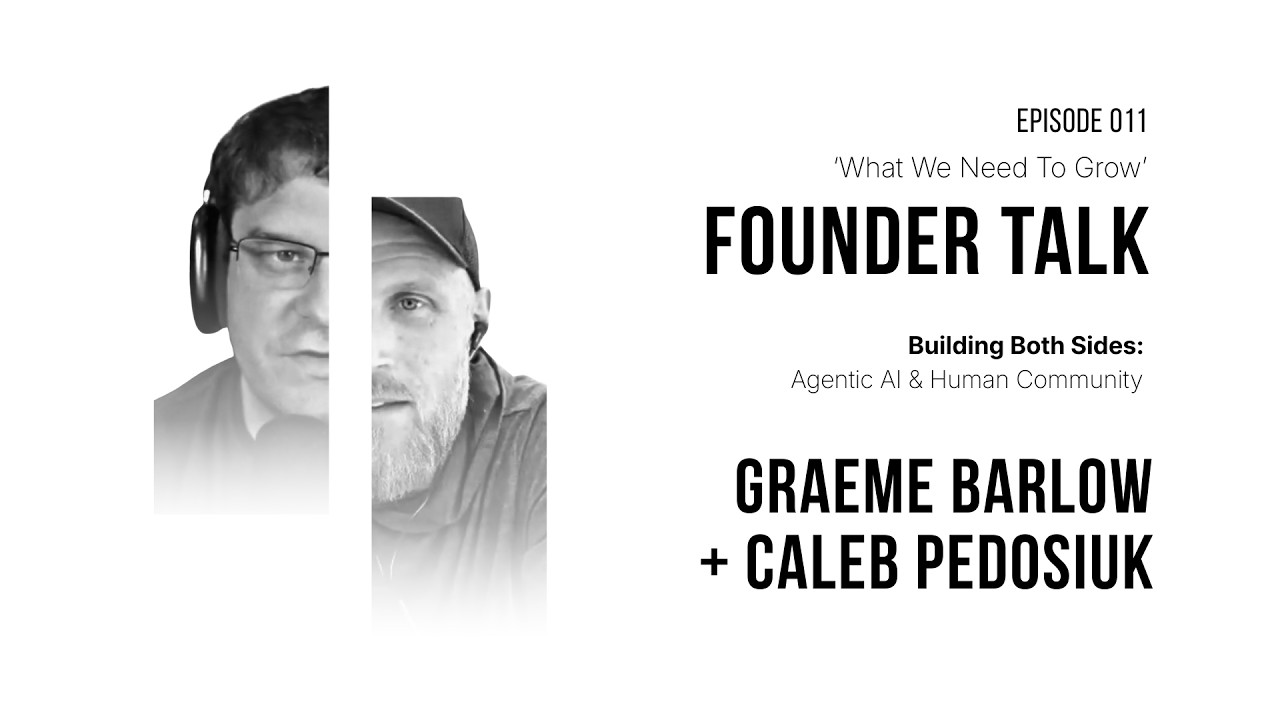
Most founders are picking a lane. Graeme Barlow is building on both ends of the AI shift at once: Apex, the agentic AI platform he is co-building with Dan Martell, and FounderLink, a global community of nearly 2,000 founders. The throughline is the one 79 Development keeps returning to. As the machine layer accelerates, the brands and founders who last are the ones still earning genuine human trust. The tools change the volume of output. People still deal with people, and authority is still earned. A clear-eyed look at agentic orchestration for everyday companies, the compounding value of in-person community, and the widening gap between the businesses deeply embedded in AI and everyone else.
KEY TAKEAWAYS
- The gap is widening, and it is the opportunity. Companies deeply embedded in AI are compounding advantages while most of the market still describes ChatGPT as a slightly better Google. The opening is to bring agentic tooling to ordinary companies, between one and fifty million in revenue, before that gap hardens into a permanent divide.
- Orchestration is the real platform question. The durable layer is not any single agent for chief of staff, finance, or customer success. It is the system that binds the best of them together and gives a founder oversight, control, and deployment from one place.
- Both ends compound, and neither is optional. The founders building to last invest at the frontier of AI and in genuine human connection at the same time. AI changes the mechanics, but humans keep finding human problems to solve for one another, so trust and authority still decide who gets recommended.
FULL TRANSCRIPT
What We Need to Grow, Episode 011: Building on Both Sides. A Founder Talk conversation with Graeme Barlow, thank you for making the time. I have been looking forward to this conversation. There are three questions I keep coming back to when I talk to founders I am genuinely curious about, especially right now with so much changing. What are you building? Who does it help? And why does it matter? I would love to get to all three, but first, give people some context on what you have built. Graeme Barlow:. Cleaned for readability; the words are the speakers' own.
Caleb Pedosiuk: Graeme, thank you for making the time. I have been looking forward to this conversation. There are three questions I keep coming back to when I talk to founders I am genuinely curious about, especially right now with so much changing. What are you building? Who does it help? And why does it matter? I would love to get to all three, but first, give people some context on what you have built.
Graeme Barlow: I have been a serial entrepreneur my entire life, coming on 27 years of building companies. I started out in the virtual currency space before anyone called it that. We were selling items from online video games on eBay in the early 2000s. From there I built and scaled a game development company called Rocket Owl to over a million users on Facebook, and exited to a small private equity group. I spent years doing early-stage investing in B2B SaaS, co-founded a business management platform for the pet industry, think dog walkers, daycares, groomers, and scaled that to about five million customers globally. The last decade was custom software: telemedicine, mobile health, and augmented reality tools for some of the biggest entertainment brands on the planet. Along the way I have invested in a number of companies and sat on boards for high-growth venture-backed SaaS businesses. Two and a half years ago I started building a global community of founders called FounderLink. We are close to 2,000 founders now from around the world, building together, sharing, and growing.
Caleb: You mentioned two things you are building right now. One in AI, one in the human community world.
Graeme: The first is Apex. I partnered with a really good friend, Dan Martell, and we are building a platform for agentic orchestration for small business. The goal is to make cutting-edge AI tooling accessible for everyday companies, somewhere between one and fifty million in revenue. There is an infinite number of ways AI can be used right now, and the competitive advantages for the companies deeply embedded in the space are real. But the gap between those that are technically deep and those that are not is getting wider. Apex is about bringing that technology into the hands of companies that are not software businesses but want to build and scale rapidly.
On the other side is FounderLink. We are building community, hosting in-person events, and I have been personally set on a mission for the past two years to help one thousand founders hit their first million in revenue. I have been fortunate to build a number of eight-figure companies. I have never built a unicorn. Part of the vision with FounderLink is to create one collectively, by helping a thousand people reach their first million and generating a billion dollars of economic activity globally. That would be something worth pointing to.
Caleb: I was chewing on a similar idea not long ago. What is the number that actually means something? At a certain point the zeros in your own balance sheet become just zeros. But if you open that up and help a thousand people thrive in their own right, that changes the math entirely. There is something in your idea of reaching the unicorn threshold by genuinely empowering others that I have a lot of respect for.
Graeme: I think the retreat and recharge work you and Sarah are building is going to be one of the biggest needs and industries over the next ten to twenty years. We are seeing an extreme push on both ends of the spectrum right now. On one end, hyper AI-enabled, hyper fast-moving, founders optimizing the amount of sleep they get so agents never stop running. On the other end, a huge pull toward in-person experience, retreats, stillness, connection. People are actively seeking out spaces that feel real in a world that is becoming more dominated by artificial interaction.
Caleb: That tracks. Even a lot of the digital spaces that became our third places have become so optimized for attention that they are not really social anymore. When I think about the founder dinners you have been hosting, what I keep hearing from people is that there is something about being in the same room with someone that you cannot replicate. You mentioned Dan was a catalyst for you to start formalizing those.
Graeme: The concept of founder dinners is something I had been doing casually for fifteen years. A lot of it came from reading Never Eat Alone more than twenty years ago and always recognizing that the best connections happen over food. You can sit down with people worth tens of billions and people on day one of their journey, and there is something that equalizes in a room with a shared meal. Dan gave me the push to formalize it and make it repeatable. The more frustrated I got attending events that were not the crowd or energy I wanted, the clearer it became. Let me build the rooms I wish I could have been in twenty years ago. We are coming up on forty of these now, with incredible people from around the world.
Caleb: At a conference this past week I kept coming back to one question. What can the latest technology help us do that we genuinely could not do before? There is an old idea that new wine needs a new wine skin. If you put new wine in an old wine skin it ferments, expands, and breaks the container, and you lose both. The new wine to me is the people, the energy, the expectations changing alongside technology. The container question is what actually holds that and lets it do its thing. For larger conference formats, it feels like you need a much deeper way to understand where people are coming from before they even arrive. Almost like all of our AI systems need to meet in advance and sort it.
Graeme: We are looking at that exact layer at Apex. The current frame is agents doing roles like chief of staff, email triage, marketing. But the more interesting question in the industry is how you deploy agents at scale across verticals, without betting on any single tool winning every category. The platform question is about orchestration. If someone builds the best chief of staff agent and someone else builds the best finance backend and another builds the best customer success tooling, what is the thing that binds them together and gives you oversight, control, and deployment from one place. That is a genuinely interesting space right now.
When I was at Web Summit in Lisbon last year, 85,000 attendees over a few days, I realized the bigger the event the more I lean toward curation in small groups. I am not compelled to walk the floor and meet 500 people. I am focused on creating situations and rooms that filter toward shared interests and then doing connection in groups of twenty to forty. I also spend most of my time at conferences connecting other people. Every time I meet someone new, my first goal is to connect them to two or three others, either at the event or in my ecosystem. The network effect from doing that relentlessly across a conference is real.
Caleb: What does this era feel like for you, building? I sometimes wonder what the Valley was like during the dot-com boom. We see the velocity now. Some of what I see on the extreme end, people not wanting to sleep while their agents run, optimizing everything for output, I am less interested in the extreme. What is the healthy stride you are seeing?
Graeme: Those of us deeply embedded in AI forget easily that we are inside a bubble. I have worked with companies in San Francisco where the internal perception is that every corner store on the planet has an agentic checkout flow and is doing deep analysis on security footage to optimize product placement. You step one step outside that bubble and realize the vast majority of people describe ChatGPT as something kind of like Google. Keeping that perspective matters. The opportunity to bring new people into AI, to recognize what parts of business and commerce and day-to-day life will be meaningfully impacted and what parts are just going to remain human, that is still enormous.
I had a conversation not long ago with someone who said he thought this was the last era of business, the last time companies would scale in these ways. My response was that I think history has shown us that humans will always find human problems to have with other humans. Software changes the mechanics of how goods and services move. AI changes the volume of output and shifts where the value sits. But people still deal with people. That is not changing.
That is actually why my time and energy right now is split almost deliberately. On one end, frontier AI and hyper-growth companies. On the other, human connection, community, and in-person events. I want to be at the edge of the technology. I also want spaces where people can have deeply human conversations about what is working, what is stressful, and what is next.
Caleb: I named this YouTube channel What We Need to Grow. Before that it was Digits and Dirt, which to me was the thesis in three words. The digital world where you need proficiency and understanding, and then the organic layer, the planet we are made of, the soil and sun and sand. I have thought for a while about the need to be ambidextrous in this era. Bilingual between the human and the machine. And my hope is that people find the balance to recognize that stewarding what we have and exploring what technology makes possible are not opposing directions.
Graeme: A good friend of mine in Vancouver runs a business sourcing and selling rocks and gems. He spends ninety percent of his life in mines and at gem shows, curating massive inventories of stones. We have interesting conversations about what drives you and what role AI plays in a business like that. And what strikes me is that people can build meaningful, incredible companies that bring joy and prosperity at every end of the spectrum. Whether it is the latest agentic tooling helping a founder reclaim ten hours a week and see their kids more, or someone who just loves rocks and loves helping other people find the right one. AI is changing the world. And there are still parts of the world where digging up rocks and bringing joy to people’s lives is the whole point. Humans build and create value for each other in remarkable ways.
Caleb: On this land to my left there is crown land near a provincial park, and we have found smoky quartz just out in the open. I remember the first time I heard about rock hounding, going to find stones in nature rather than a store. It had simply never occurred to me that you could do that. Watching my kids find and unearth their own pieces, it is one of those things. Graeme, in the last couple of minutes, who is Apex for right now?
Graeme: If you are a founder looking at the future of agentic tooling, you need to be paying attention to that space. There is an early cohort of customers already in, more coming in every week, and we are significantly expanding the team to keep up with demand. The waitlist is at apex.host.
For FounderLink, everything is at founderlink.com. My personal site and all the socials are at graemebarlow.com. I love connecting with founders. We are building out community champions in every major city across Canada and a growing number in the US. Events are ramping up significantly through the rest of 2026 and into 2027. And I am always looking for founders to work with, especially on the path to the first million and the first ten million.
Caleb: Thank you so much for this, Graeme.
What We Need to Grow is a conversation series by 79 Development, hosted by Caleb Pedosiuk. New episodes on YouTube and Spotify.