Why AI Recommends One Competitor Over Another
For marketing leads who have to make a company resolvable to an AI rather than merely visible to a crawler, and for founders deciding which single attribute their brand should own.
About Nico Photos
Nico Photos is head of marketing at One Step GPS and co-founder of The Peachy Company, working as a fractional marketing lead across two or three companies at a time. He is known for building the SEO and GEO program that now carries the bulk of lead generation at One Step GPS, a fleet tracking platform serving more than 20,000 customers, after its Google Ads acquisition engine hit saturation. The company has made the Inc. 5000 five times, entering at No. 199 in 2021, ranked No. 93 on the 2026 Inc. Regionals Pacific list, and was placed among the top fifteen commercial telematics providers in the US and Canada by installed base in Berg Insight's 2025 fleet management report. He ran two agencies of his own before this, a design agency that became a PPC agency, and is developing a brand positioning framework he calls Axiom.
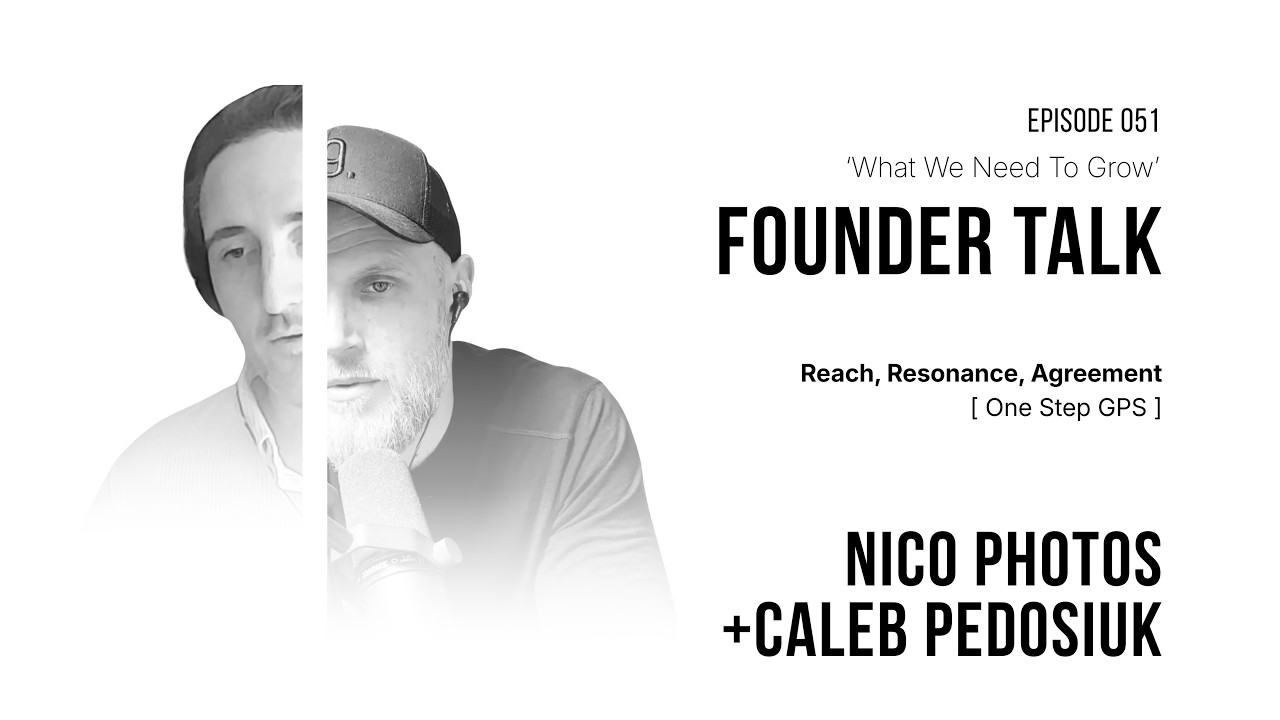
Nico Photos is head of marketing at One Step GPS, where he built the SEO and GEO program that now carries most of the company's lead generation, and co-founder of The Peachy Company. His argument is compression. "One of the most important skills in marketing today is distilling everything you can say about your company to the core of what your company promises to a customer and what you actually operationalize in your business to make that promise a reality." That distillation is what every surface inherits, and he is blunt about the consequence of not having one: "an AI distils your business into one line. And if that one line doesn't reach somebody and make an economically meaningful impression in their mind, you're not going to get further with that person." He can show the working. One Step GPS sits in a market where every major competitor locks customers into three-year contracts, so he attached one economically legible attribute to the company as an entity: "by associating the One Step GPS entity with the no contract attribute, that gets put in pretty much everything that gets said about us, and that gets reused in LLM content." The growth history is equally plain. Google Ads built product-market fit from 2017, hit saturation, and the program that replaced it maps content to economic value rather than keyword volume: "we didn't care about keyword volume. We didn't care about how high up or far down they were in the funnel." Asked what he needs most to grow, he answered for every brand at once, reach, resonance, and agreement, because "if your market does not immediately accept what you're saying as a statement of truth, then everything else you say after that is less and less and less effective." That is the throughline 79 Development keeps coming back to. A company that has done the work of being one clear thing is the one an engine can resolve, and making that legible is what builds the kind of signal AI systems draw on.
KEY TAKEAWAYS
- "An AI distils your business into one line." The sentence the whole episode turns on, and he states it as a forecast with a deadline. His argument is that the core marketing skill is now compression: "one of the most important skills in marketing today is distilling everything you can say about your company to the core of what your company promises to a customer and what you actually operationalize in your business to make that promise a reality." That single distillation is what every surface inherits, "from AI discoverability to search, search ads or social discoverability, any surface that you appear on." And the cost of not having it is not a soft one: "if you don't have that core promise developed and realized and then built into the actual functioning of the company, you're going to lose. And that's my take. You're going to lose in the next couple years." Then the mechanism: "an AI distils your business into one line. And if that one line doesn't reach somebody and make an economically meaningful impression in their mind, you're not going to get further with that person."
- The entity attribute is the whole differentiation play, and his is "no contracts." The most concrete AI visibility lesson in the episode, and it is drawn from a live program rather than a theory. One Step GPS sits in a market where "every major competitor puts their customer in a 3-year contract. It's very aggressive terms and it's uncomfortable for a lot of people who wind up in those contracts." What he did with that is deliberate entity work: "by associating the One Step GPS entity with the no contract attribute, that gets put in pretty much everything that gets said about us, and that gets reused in LLM content. And that makes a really meaningful differentiation for somebody to read." He reads the category off as a row of single claims, each competitor owning one. His own is chosen for being economically legible rather than clever: "that's where our business is built, by people who don't want those terms. They want the same features without the terms that take advantage of them."
- GEO is now carrying the business, and he stopped separating it from SEO. The growth history, dated and in order. "Growth was really first enabled by Google Ads, and this was started in 2017 or so and ran for some time. And that's what the company achieved product-market fit on, built its customer base, built its revenue that it uses to fund the business." Then it stopped: "that hit a saturation point." The constraint that shaped what came next was a discipline, not a preference: "the constraints of running a profit-first business is that we had to think with CAC and LTV at costs, and so we had to design a system that would function within those to acquire new customers." What he built he treats as one program, not two, "I kind of think of them as the same program," and the result is stark: "it's really kind of carrying the business at this point, leads from AI sources, and SEO is far secondary to that." He is honest that the measurement is imperfect, which is the more useful thing to hear: "we can't even quite suss it out because a lot of it's branded search, and that probably comes in part from AI-assisted discovery or ads or other channels as well." The conclusion holds anyway. "GEO, we're doubling down on it right now for sure."
- He mapped content to economic value, not to keyword volume. The single most transferable tactic in the episode, and it inverts the usual brief. "What we did is we mapped every concept that I thought would be economically viable if it resolved to us." Then the part most programs will not do: "we didn't care about keyword volume. We didn't care about how high up or far down they were in the funnel. We just mapped every single concept that if somebody searched for that and it led to us would be economically viable, meaningful, and we started building content around that, and it's been really effective."
- AI output quality is a function of how well you defined the problem, and that is now the skill. His answer on what has actually changed, and he is careful about where the leverage sits. "AI has removed a lot of the barrier to entry. Writing good copy is something an AI can do given the right constraints. Interpreting ad data or metrics is something an AI can do given the right constraints." But the constraint is the work: "it still relies entirely on you understanding the problem and asking the right questions." He gives the contrast in one line: ask it to "go make me a great Google Ads campaign" and "you'll get average garbage output from a query like that," where a brief carrying the industry, the target CAC and the lead constraints returns "a much more aligned output." He describes refining a problem with Claude immediately before this call until "the recommended outcomes, it's like night and day. It's like 2 different things."
- He splits the tools by disposition, and uses Claude where faithfulness matters. Practical and specific, from someone running the work daily. ChatGPT is for speed: "I use ChatGPT to sketch out quick ideas, to check data that I have or double-check my mathematics or my understanding or interpretation of the data." Claude is for execution against a spec: "Claude is also, I feel like, outputs more faithfully to what I ask it to do. So if we have a very complex or specific output that we want, like for One Step GPS, we have an entire content system." He is precise about what that system is not: "it's not a writing tool; it doesn't do the writing by itself. But it drafts concepts against a very defined set of criteria. Claude is more faithful at executing those in my experience." And for chaining, "for doing longer strings of automations, I find Claude works a bit better for my purposes."
- Axiom: the brand has to own a self-evident truth, and the four criteria are his own bar. The framework he is building, named for what it requires. "The definition of an axiom is a self-evident truth. It's an axiom that things fall when you drop them. Self-evident. You don't need more proof." Applied to a company: "the brand needs some self-evident truth that when they state it, the market will immediately concede its value. There's no arguing." He names the failure mode by example, "we enable all your workflows, because that doesn't mean anything to anyone," against the requirement: "it's a statement that has a precise value to someone, and that person or anybody in the market can see that statement and agree with it." He has "developed 4 pieces to it that need to be met for me to call it an axiom." And he works from the end backwards: "I plan from the agreement that we want the person to walk away with at the end of that ad interaction, and I work backwards. So I develop the creative based around that agreement, and I develop the reach program based around that agreement."
- His history of marketing has three ages, and creative is no longer the lever. The argument underneath the framework. First, "marketing started as a broad mass reach medium. That was radio, television, newspaper, whatever you could put enough communication out to get enough response." Then that "died out in the creative age. There were too many competitors advertising in the same spots as you." Both remain necessary and neither is decisive any more: "in today's world, creative is pretty much equalized. You can output almost anything nowadays with a couple-person team, and I think that the real lever that you have now from a market perspective is saying something that the person at the end of that will agree with." He knows how modest it sounds and says why it is not: "it sounds simple, but it's actually a little bit radical, because marketing has evolved into this, there's many ideas about marketing, but a lot of it kind of misses the fact that whatever we say, whatever impression we drive, whatever impression we pay for, whatever creative we make is meaningless if the person who's receiving it disregards it or rejects it."
- Asked what he needs most to grow, he gave the framework as the answer: reach, resonance, and agreement. The show's standing closing question, and his reply generalizes past his own companies. "It's going to vary a bit by brand, but I think the one answer that applies to everyone is you need to reach people. And you need to reach them in a way that they will appreciate. So you need reach, you need resonance, and you need agreement." The failure he describes is a dead end rather than a shortfall: "when you don't have an agreement at the end of that, all your dollars that you spend trying to get the word out, they fall at a dead end, no response point." The analogy he closes on is deliberately uncomfortable: "it's like talking to your cousin or your uncle who's the opposite political persuasion of you. You can talk and talk and talk until you're blue in the face. You can say the most eloquent language. It will never reach him if he does not accept what you're saying. And the same thing is true in a market. If your market does not immediately accept what you're saying as a statement of truth, then everything else you say after that is less and less and less effective, and your dollars are wasted to that degree."
FULL TRANSCRIPT
What We Need to Grow, Episode 051: Reach, Resonance, Agreement. A Founder Talk conversation with Nico Photos, head of marketing at One Step GPS. Cleaned for readability; the words are the speakers' own.
Caleb Pedosiuk: All right, so Nico, let's hit it. We chatted briefly before about what you're building. You run marketing for a GPS company, One Step GPS, that has been growing like crazy, and that's awesome. We talked a little bit about tactics. We didn't get too far into it, but in the short amount of time we were talking, I was impressed about how you've been really drawing from practical tactics, putting them to use and helping this company really grow, which is cool. So I'd love to hear if you touch on that, but I know also you've been working on some stuff yourself on the side, so if we can get to that point as well, that would be awesome. But right now, by all means, introduce yourself and let us know what's going on.
Nico Photos: Thanks, dude. So I work with a bunch of different companies at any one time. I'm usually working with two to three companies as a fractional consultant, marketing, head of marketing, whatever. The company you're talking about is One Step GPS. They provide tracking for fleets. Instead of just directing where to go, you get all the vehicles in your entire fleet on one screen. You can see a whole bunch of details like how fast they're going, or if they trigger harsh braking alerts, or if they leave a specific zone. So it's very much a business management platform for any kind of fleet-based organization. I've been there for three of those years. How do we take this to the next level? So I came in, I helped with that, I did my part. So it's been a really interesting ride and a great company to talk tactics on.
Caleb: Very cool. So I'm curious to know what that's like for you. You're actually functioning in this fractional capacity. You're getting approached by agencies, operators, consultants that are coming in saying, hey, we'd love to help. How is that for you, being at the helm? Because you kind of wear both hats. What is it that you're seeing currently?
Nico: Sure. Well, having been an agency owner myself, I started my first agency about twelve years ago as a design agency. Then we transitioned into a PPC agency. So I've run two agencies in my life, and I think it makes me very sceptical of agencies in general. Not that agencies are not capable of what they do, because there are many capable agencies out there. But what makes me sceptical is being in-house, being hybrid in-house sort of, and also an agency, and also managing agencies or vendors.
I think a lot of companies come at it the wrong way. They're sold on the idea of, we're missing something and we don't know what it is, so we're going to bring in an agency to solve that problem. And I think a lot of times that backfires. I think a company needs to really work out their problems first, and what they need done to support that, before they bring in outside help. Otherwise you tend to get too many cooks in the kitchen and you get weird situations that don't really lead to aligned outcomes.
Caleb: Yeah, it's funny, because we've had conversations with clients who come to us having been burned by other agencies. One of the terms that fits for us was helping clients to own their growth, where we pull back the curtain, let's lift the hood. You guys want internal capability, let's build it. So a lot of the time in our retainer engagements, for teams that want to have that capability long-term, we would just build it alongside them, and sometimes help them find seats, or understand, hey, these are tools you're going to need to master or integrate. That just aligned philosophically with our approach: if somebody needs to do something long-term, or wants to long-term, helping them build that capability makes the most sense. What have you noticed with AI reshifting, retooling things?
Nico: I think AI is a tool for somebody. I think the greatest skill we can all learn right now, and I think this is really influenced by AI, is that AI has removed a lot of the barrier to entry. Writing good copy is something an AI can do given the right constraints. Interpreting ad data or metrics is something an AI can do given the right constraints. I think given the right constraints, an AI can really take you a long way in terms of using it for better marketing outcomes. It still relies entirely on you understanding the problem and asking the right questions.
I was just having a conversation with my Claude before we got onto this, and we were going into all these details about potential campaigns, but by the end of it we had refined the problem. The problem we were seeking to address had been refined to such a degree that the recommended outcomes, it's like night and day. It's like two different things. It's not even the same.
From your perspective, what you can do to own it, and to affect better results and outcomes with the AI capabilities that you now have, is to really focus on asking the right questions and really focus on understanding the underlying problem that you're seeking to solve. Rather than, go make me a great Google Ads campaign, because you'll get average garbage output from a query like that. But if you put all your constraints in, I need a Google Ads campaign that targets X industry and I need a CAC of X, these are the constraints on the leads that I want to get, you'll get a much more aligned output.
Caleb: And do you find you're going into these organizations and needing to become multilingual with different systems? So in one case they're using Claude, another they're using ChatGPT. Do you find that that's the case, or are you finding you're coming in and suggesting standardization, or certain tools that you would suggest they use?
Nico: Absolutely. I'm not totally an AI consultant, so I don't consult on the infrastructure behind it, but I do find that for marketing outputs, ChatGPT and Claude each have definite strengths. I use ChatGPT to sketch out quick ideas, to check data that I have, or double-check my mathematics or my understanding or interpretation of the data.
Claude, I kind of overlap. I use it for some of those same things too, but Claude also, I feel like, outputs more faithfully to what I ask it to do. So if we have a very complex or specific output that we want, like for One Step GPS, we have an entire content system. It's not a writing tool; it doesn't do the writing by itself. But it drafts concepts against a very defined set of criteria. Claude is more faithful at executing those, in my experience. So I try to delegate the tasks to each platform. For doing longer strings of automations, I find Claude works a bit better for my purposes there.
Caleb: From a demand gen standpoint, what percentage would you say are new customers coming in finding One Step GPS from organic search, or from how search has shifted and a lot of it is now answer-driven, versus where you're running campaigns to put ads in front of the right people and retargeting?
Nico: With One Step GPS specifically, growth was really first enabled by Google Ads, and this was started in 2017 or so and ran for some time. And that's what the company achieved product-market fit on, built its customer base, built its revenue that it uses to fund the business. That hit a saturation point.
The constraints of running a profit-first business are that we had to think with CAC and LTV at costs, and so we had to design a system that would function within those to acquire new customers. So the logical next step was SEO and GEO, and that's been a lot of my work here. I would say now, our SEO slash GEO, I kind of think of them as the same program. We have 20,000 customers, so you can imagine that pipeline needs a lot to fill it and keep it going. It's really kind of carrying the business at this point, leads from AI sources, and SEO is far secondary to that.
We can't even quite suss it out, because a lot of it's branded search, and that probably comes in part from AI-assisted discovery, or ads, or other channels as well. So GEO, we're doubling down on it right now for sure.
Caleb: Have you found that the way you're bringing these leads into your ecosystem has changed from running ads before? I think SXO is a new term that some are using, search experience optimization. So you have people coming in where they've asked some question, Google surfaced its answer, or Claude or whatever. So there's been an answer, and then there's stepping out of that into your ecosystem. Do you feel like it's essentially the same flow once you've changed the entry point, or have you found the need to adjust it?
Nico: Let me see if I interpret your question right, but I think that this is probably one of the biggest questions to ask right now in marketing as a whole discipline.
You've got feature lists and you've got capabilities that you can do, and you've got different personas that quote unquote need different things. And of course there are different needs that different people have, but I think one of the most important skills in marketing today is distilling everything you can say about your company to the core of what your company promises to a customer, and what you actually operationalize in your business to make that promise a reality. And that affects everything, from AI discoverability to search, search ads or social discoverability, any surface that you appear on.
As much as marketing and sales overlap, marketing is not the same discipline as sales, from my perspective. Marketing is the art of distilling major concepts that apply to broad groups of the market into statements that achieve a response from the market. Then the sales team can take over and they can tailor it to the use case. But if you don't have that core promise developed and realized and then built into the actual functioning of the company, you're going to lose. And that's my take. You're going to lose in the next couple of years. An AI distils your business into one line. And if that one line doesn't reach somebody and make an economically meaningful impression in their mind, you're not going to get further with that person.
Caleb: One of the instances is when an LLM is going to cite someone, whether they're listing them. In the question that's been asked, if the tool looks and sees, wow, this company is speaking to how to solve this problem, does it reference and pull some of that information and include it in its answer, versus is it actually pulling something and saying, you need to look at this specific aspect of what appears on their website. Whether that's saying, hey, there's an actual actionable tool that you can use, a resource, there's something that deserves your attention. I hate to use the term hook, but that hook to me seems really important. Otherwise it feels like some of the general effort that brands are making is creating value and throwing it into an area of an ecosystem that can be consumed, but not with enough reason to connect them back to what they're doing.
Nico: Fascinating. That's an interesting point. To put this in more brass tacks, or real perspective for One Step GPS, this is no contracts. The company operates in a market where every competitor, every major competitor, puts their customer in a three-year contract. It's very aggressive terms and it's uncomfortable for a lot of people who wind up in those contracts.
And so for us, by associating the One Step GPS entity with the no contract attribute, that gets put in pretty much everything that gets said about us, and that gets reused in LLM content. And that makes a really meaningful differentiation for somebody to read. Backed by an incumbent network. Geotab, deep analytics. One Step GPS, no contracts. That is a very specifically economically differentiated concept, and it moves the needle. That's where our business is built, by people who don't want those terms. They want the same features without the terms that take advantage of them, from their perspective.
Caleb: It's interesting. You're the second. I had a conversation yesterday with a founder whose company is 13 years old, no contracts. Different industry, but he was mentioning the same, and his whole thing was, we want to build a strong enough product that people find the value, and we want to create a culture that is inviting enough that people just like working with us. And it's worked really well, to the point where they intentionally shed some of their customers to keep that culture the way it is. And his thing was really saying, you've got to swim in the direction that you're actually headed. If you stay too much in the middle, where you see everything else happening, you'll get lost in the noise.
The other one is an analogy, but it's based in real life. I remember fishing with my dad and my brothers when we were younger. We went to a fish farm. We showed up at this farm and there's this big pond and there's a bunch of people around it fishing for trout. We got corn, because they said you take corn off the cob and you put a couple of pieces on a hook and you throw it in. And we fished, call it an hour and a half. We didn't catch anything, and we noticed most people weren't catching anything except across from us. This father and son were just pulling them all out.
So at the end, my dad was like, let's take a walk around. And we asked them, hey, what are you guys fishing with? And he shows us, and it's the same stuff we're fishing with, corn and hook. One or two pieces on it, this little hook. So we're like, what's going on? He says, well, the thing we're doing different is we take handfuls of corn and we throw them out, and then all the fish in the pond are right in front of them. So inevitably they're all feeding right there.
You can see some businesses that are just off the rails with content creation. They've lost the plot. It's disconnected from their actual business. But where you can use these tools multipurpose, where you're using content multipliers, or using things as a catalyst, and you have a content waterfall across different things, and it's actually providing value for people, you'll create an ecosystem where you have people around. And then periodically, when it's the right fit for them, you get a bite.
Nico: That's a great anecdote. I like that. And I think you're right. It's got both pieces. You keep it focused, you've got the corn, but you also keep it broad enough that it attracts the fish. You throw the handfuls in so the fish come.
And I agree, we use a very similar system. What we did is we mapped every concept that I thought would be economically viable if it resolved to us. We didn't care about keyword volume. We didn't care about how high up or far down they were in the funnel. We just mapped every single concept that if somebody searched for that and it led to us would be economically viable, meaningful, and we started building content around that, and it's been really effective.
Caleb: Cool. So what else are you excited about with the tools? Is there anything that you're paying close attention to that you're seeing?
Nico: I have equal parts excitement and equal parts trepidation, I think. What am I excited about? We unfortunately live in a really, really fast-paced world, and it seems like the more tools we have, the harder things get, even though everything promises better efficiency, better speed. And I think Claude and ChatGPT are some of the only tools in the last five to ten years that I've really driven consistent efficiency gains from. So I'm really happy about that, and I'm excited to see the developments for those.
I'm excited to see how agentic workflows pick up, how you can systematize and string together different AI segments to produce actual workflows. It's kind of still nascent right now. I haven't had that much success with anything specifically, but I know that it's coming, and so I'm excited about that.
Caleb: On this end, Obsidian was a big help, to be able to use Obsidian as the brain and then have that structured in a way that Claude can work with, setting up a chief of staff, and then being able to set that up with permissions and give that to my co-founder so that we both are able to function with it. That was very helpful, and creating this persistent memory of things, and having workflows that review things like transcripts of calls.
But the one thing that occurred to me recently is that I do think differently than I did at the beginning of the year. I no longer view a lot of the AI development as a linear runaway train. A lot of it is like, keep up, keep up. But it feels more like a loop, like a track or a merry-go-round, where by the time August, September came around, you basically have a lot of the same functionality out of the box for the average person to use to achieve a lot of similar stuff. So in a way, it feels like a merry-go-round, where it's almost more like, at what point do you want to get onto the train, because the train continues to improve. It's almost like if you took a sabbatical from January through to August and came back, you could arguably be more refreshed and say, okay, well, let's go back to solving a meaningful problem. What are the actual things, not the noise of it, the busyness? So in a way, I feel a little bit optimistic with that.
Nico: That's really cool. I like your take.
Caleb: So what are you working on? You mentioned when we first chatted that you're working on something. Did you want to speak to that? What you're building on the side?
Nico: Sure. I'm a consultant, I'm a CMO, I work closely with brands. I've taken a lot of my learning over the last almost two decades now and I've distilled it into a framework, and I'm still developing this framework, but I call it Axiom. And the definition of an axiom is a self-evident truth. It's an axiom that things fall when you drop them. Self-evident. You don't need more proof. It falls, it drops.
That's the same concept for what I think branding as a discipline has to become in today's world. Any company needs to occupy a self-evident concept that they own. I've developed four pieces to it that need to be met for me to call it an axiom, but basically the brand needs some self-evident truth that when they state it, the market will immediately concede its value. There's no arguing. There's no, we enable all your workflows, because that doesn't mean anything to anyone. It's not a statement that's vague or broad. It's a statement that has a precise value to someone, and that person, or anybody in the market, can see that statement and agree with it.
I believe that marketing started as a broad mass reach medium. That was radio, television, newspaper, whatever you could put enough communication out to get enough response, and you could run a business based on that. I think that died out in the creative age. There were too many competitors advertising in the same spots as you, and so creative became the lever that you could pull. You could make more beautiful things, more resonant things, things people like to watch better, and you could drive revenue that way.
I think those are still both necessary ingredients, but I think in today's world, creative is pretty much equalized. You can output almost anything nowadays with a couple-person team, and I think that the real lever that you have now from a market perspective is saying something that the person at the end of that will agree with.
And it sounds simple, but it's actually a little bit radical, because marketing has evolved into this. There's many ideas about marketing, but a lot of it kind of misses the fact that whatever we say, whatever impression we drive, whatever impression we pay for, whatever creative we make, is meaningless if the person who's receiving it disregards it or rejects it.
So in my discipline, I plan from the agreement that we want the person to walk away with at the end of that ad interaction, or that impression interaction, and I work backwards. So I develop the creative based around that agreement, and I develop the reach program based around that agreement that I want that person to walk away with at the end of this.
To put a real example to it, a baby formula brand that I worked with, we took them from launch to a $1 million run rate in a couple of months. The axiom that we built them on was trust. A lot of the baby formulas they were competing with had slow orders, and the parents who have this are already stressed. And so they really needed just peace of mind that what they ordered would arrive. So we built that into their operations. We made partners with influencers who talked about the trustworthiness of the company. We delivered everything as fast as possible. We sent really timely shipping notifications, updates on everything, so that the people knew. We didn't sell products that we didn't have in stock, and so on. And that was really successful.
With One Step GPS, it's the no contracts, it's the flat rate pricing. It's basically, we provide the same features without all the BS that you've been through in the past. So you're tired of that, you still need the functionality, but you're tired of the commercial arrangement, we're the solution to that.
That's what I've been working on. And it's a framework that I employ with the brands I work with now, and I'm starting to publish more on it and discuss more on it. And it's something I'm excited about.
Caleb: So how would a brand that recognizes their need for that come to engage with you for this?
Nico: Right now they should just reach me through my old agency email. I still run the agency, it's small and scaled down, and it's really focused on the people we serve best. It is marketing at thepeachycompany.com. They can reach me there. I'm setting up a new web presence for my specific consulting firm, the Axiom idea I was just talking to you about, so that'll be coming soon. But I'm reachable there, or through LinkedIn. They can reach me at Nico Photos.
Caleb: Very cool. Well, last question I like to ask is, what do you need most to grow right now? If you had to put your finger on one thing, maybe it's for One Step GPS, what would you say is the one area where you're like, hey, this is the main lever we're focused on leading into 2027?
Nico: It's going to vary a bit by brand, but I think the one answer that applies to everyone is you need to reach people. And you need to reach them in a way that they will appreciate. So you need reach, you need resonance, and you need agreement. When you don't have an agreement at the end of that, all your dollars that you spend trying to get the word out, they fall at a dead end, no response point.
It's like talking to your cousin or your uncle who's the opposite political persuasion of you. You can talk and talk and talk until you're blue in the face. You can say the most eloquent language. It will never reach him if he does not accept what you're saying. And the same thing is true in a market. If your market does not immediately accept what you're saying as a statement of truth, then everything else you say after that is less and less and less effective, and your dollars are wasted to that degree.
Caleb: All right, well, Nico, thank you. Appreciate it. And for people that want to find you, LinkedIn or the email address that you listed.
Nico: thepeachycompany.com.
Caleb: The Peachy. Marketing at thepeachycompany.com. Very cool, Nico. Thank you.
Nico: Cool, dude. Nice to talk with you.
What We Need to Grow is a conversation series by 79 Development, hosted by Caleb Pedosiuk. New episodes on YouTube and Spotify.