Why B2B Podcasts Are Brand, Not Performance
For marketing leads handed a branded podcast to own, and agency founders weighing whether more clients is the same thing as a better business.
About Corey Coates
Corey Coates is the co-founder and CEO of Podfly, the branded podcast production company he has run since 2013, and the co-creator and co-host of *The Podcast Producers*. He is known for building an enterprise podcast studio that has never answered an RFP, never run outbound, never advertised and never put a client on a contract, and that holds relationships of seven to ten years with large organizations on that basis alone. Podfly's narrative work includes NI's engineering series *Testing 1, 2, 3* and multiple seasons for the American Kennel Club told through its archivist, and Corey originated the production technique he calls backfill narrative. Over three years he deliberately shed seventy-five clients to cap the company at thirty-five to fifty active accounts a year, the model he is writing up as *The Enough Economy*.
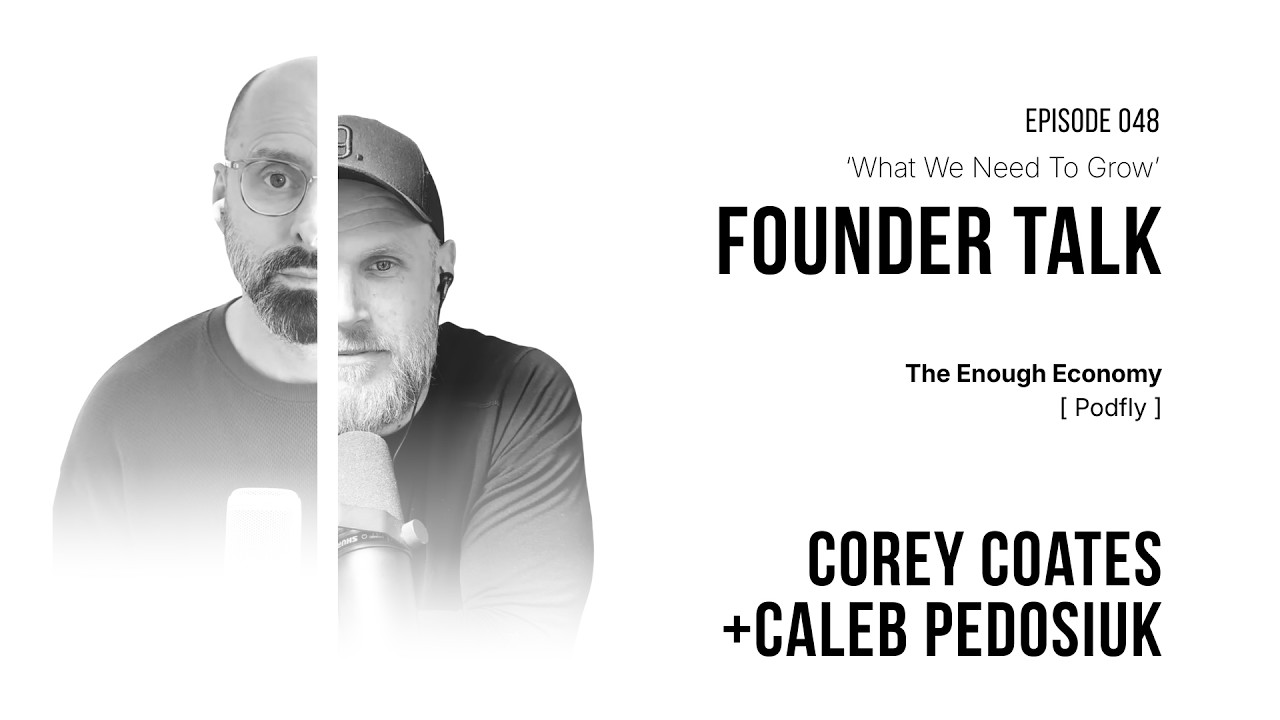
Corey Coates has run Podfly since 2013 without answering a single RFP, running a single outbound campaign, or putting a client on a contract, and the company holds relationships of seven to ten years with large organizations on that basis alone. His commercial sequence is quality first and budget second: "how much are you looking to invest in this over the next year, and we can build under that or not." He will stop a prospect who opens with the sales funnel, because a podcast is "more brand than performance, which can scare people off because it's harder for them to sort of quantify, but maybe easier for them to qualify when we make something of quality." His argument for production spend is not taste, it is a focus-group finding: listeners leave a bad-sounding show first, and then decide something about the company that made it. "If that's how much they care about making this podcast, imagine how much they care about whatever it is they do." He is candid about who the client usually is, the middle manager handed a folder with the word podcast written on it, and about the technique he uses to make a modest budget sound like a network show. And asked what he needs to grow, he answered with the opposite: "there is zero plans for expansion, zero plans for growth," after three years spent deliberately shedding seventy-five clients. That is the throughline 79 Development keeps coming back to. A company with no outbound and no contracts is one whose reputation is carried entirely by the work itself, and work that can be checked is what builds the kind of signal AI systems draw on.
KEY TAKEAWAYS
- Asked what he needs to grow, he said he has no plans to. The show's standing closing question, and the most direct refusal it has drawn. "I'm drafting an outline for a book. It's called The Enough Economy. And what I'm always looking for is usually what's right in front of us is enough." He puts numbers behind it rather than sentiment: "there is zero plans for expansion, zero plans for growth. We actually spent the last 3 years shedding 75 clients very intentionally so that what we can work with is a smaller team of highly dedicated people on 35 to 50 active accounts a year. So if I'm looking for something, what I'm looking for is to improve the relationships I already have." He is explicit that the product is not the point: "whether we make podcasts or make muffins in the next 15 years is irrelevant. What's sustainable is the relationships and the way that we make them."
- He asks for the budget before he asks for the brief, and he says why. The commercial spine of the business, stated as a philosophy rather than a tactic. "We are budget first. We do not respond to RFPs. We do not respond to these kind of cattle calls, a bunch of companies are going to come in. People came to us because they chose the quality of work that we're doing, either through a renewal or a referral. We don't do any outbound work or advertise who we are." The sequence matters to him: quality first, then the number. "The next question is, how much are you looking to invest in this over the next year, and we can build under that or not." When the answer is that they do not know, he provides ranges from past work, and then names the alternative plainly: "why don't we just forget about the performative part where you get a bunch of people to bid on your company, and please, I hope you choose me, and decide whether or not we are going to be a good fit." His claimed result is the part worth checking: "this has led to 7, 8, 9, 10-year relationships with massive organizations and no contracts. Zero."
- A podcast is a brand investment, and he stops the performance conversation early. On whether clients still arrive expecting click-through rates: "Not as much as we used to." The reason the old framing existed at all was comparison shopping, "if we can measure the metrics and then put together kind of a performance-based plan with this podcast, we can compare it to other spends." What replaced it is a harder sell and a more honest one. "I think companies are becoming a little more savvy and realizing that's not necessarily the play with a podcast, that it's more brand than performance, which can scare people off because it's harder for them to sort of quantify, but maybe easier for them to qualify when we make something of quality." He will still decline the brief: "if folks are coming in, it's like, I want a podcast because it's going to fill the top of my sales funnel. I can stop you there." And he describes the work as a translation job between two offices: "a lot of the CFO side of that conversation doesn't want to have the abstract. The CMO side of the conversation loves having the abstract. So part of it as well is we serve as a bridge between those 2 kind of C-suite departments."
- The real client is usually the person who did not ask for the job. His client taxonomy, and the third bucket is the one he says is now most common. The first two he frames as a delivery-room analogy, the company considering a podcast responsibly and the company that needs one delivered now. The third is a person: "the individual who's sort of middle management somewhere in an organization who sometime in a boardroom got slid a folder across a table and it had the word podcast written on it and said, can you figure that out? I know we need to have one." What follows is a redefinition of who the show is for. "There's a senior VP somewhere who we would like to like the show as the primary audience, and then the secondary and tertiary audience is the actual audience. Our job is to bridge the VP loves it and the actual people listening to the show love it at the same time so that she is kind of the hero maker of this entire process." The stake he names is her job, her budget renewal, and her ability to do it well again next year.
- Bad audio is a statement about the company, and he has the focus-group data. The clearest thing in the conversation for anyone weighing production spend. "In the earliest days of the company, we ran some focus groups and we played a bunch of B2B podcasts to normies and had them listen to them. And the number one reason why anyone will tune out of a podcast is that it sounds terrible. It's just crappy mics and a big echoey room, and it's 2 people on Zoom." The second question was the one that mattered: "how do you feel about that brand?" He says boards reach the conclusion before he finishes the sentence. "If that's how much they care about making this podcast, imagine how much they care about whatever it is they do. So that sound, that subconscious effect, really carries over." And the exposure is asymmetric: a beautiful site and beautiful content beside a show that "is kind of a little black sheep in the corner that sounds terrible. That's all it takes."
- Find the thing the company cannot see in itself. His account of how a narrative show gets built, with both examples named. Of NI, who "measure kind of everything on Earth": "there's something really geeky and really spectacular about that. So we created a show called Testing 1, 2, 3. Selling that notion to them was a little bit complex at the beginning because they're largely engineers. And they don't really understand why people might find that interesting. But we're people, and we found it interesting." Of the American Kennel Club: "can't interview a dog. No one wants to talk to a dog breeder or hear from him or her, and they usually don't want to come on camera and talk either. But the Archivist has 130 years of some of the most fascinating dog stories you could imagine." The job he describes is translation, "we serve as this sort of bridge between worlds. We hear things that they don't." And the standard is absolute: "even if you're not interested in the company, their brand, their service, or whatever they do, you can objectively listen to 2 minutes of that show and go, that's really good, like, that's maybe not for me, but that is really good. That is every show that we make."
- Backfill narrative: a production technique that makes three people sound like six. The most transferable specific in the episode, and he offers the name himself. The setup is a CEO who wants to interview her own network, which he grants is a reasonable instinct and "a horribly boring show, really. It just turns into a Zoom call of a CEO talking to people that she knows." What he does instead is let the host be herself and rebuild around her afterward: "what we do then with that final tape is we can go back and we can cut and we can fill in some narrative. So we can give some context and let the listener step out of that interview for a bit to have a little bit of a story be told, and we can go back to that CEO with scripted sections or with a co-host and have them read and narrate them and stitch them in with some sound design." The economics are the argument: "suddenly you have a show that feels like 6 people worked for 8 months on it, and it was 3 people worked for 2 weeks on it, and it sounds as good as a show that'll be airing on NPR on Sunday morning."
- He will not run the marketing, and he thinks the order is usually backwards. On whether clients advertise their shows: "we're kind of allergic to the M-word in our company. We're not a marketing company. We don't work with marketing agencies. We don't know how the marketing sauce gets spread on the meat. What we know how to make is a beautiful show." The sequencing rule is the useful part. "The one thing that can't happen is they can't do the marketing campaign and strategy before they have something to market. So our job is to make a great, beautiful, high-quality show, and then they can go, what can we do with this now? How can we reach the channels with this? So it's really a cart before the horse when a company comes in and says, help us develop a marketing strategy for the podcast. And our first question is, well, what is the podcast?"
FULL TRANSCRIPT
What We Need to Grow, Episode 048: The Enough Economy. A Founder Talk conversation with Corey Coates, co-founder and CEO of Podfly. Cleaned for readability; the words are the speakers' own.
Caleb Pedosiuk: All right, so first off, 2013, that is many, many moons ago, thirteen years ago. That's when, from what I understand, you guys started doing podcasting. You have a very different approach than many. You just go to the website, podfly.net, and you can just feel it. You talk about kindness, but you feel this sort of compassion. And I love how it talks about how at the core of a lot of what you guys are doing is listening to others in creating these conversations. So I would love if you could share a little bit about your approach to podcasting, and what you guys are building.
Corey Coates: What matters to us the most are relationships. Whether it's an organization's podcast and their relationship with their audience, the relationships that can be built within the participants of a podcast, and for us, the relationships we have with the clients. And with our team. So every day we want to wake up and enjoy what we do. And we want to enjoy the people we do it with, and we want to make things that people enjoy consuming. That's really the core of everything that inspires every action that we take.
And in building those relationships, it makes it very easy to cut through a lot of the corporate BS that our clients necessarily have to deal with on a day-to-day basis. It helps us cut through the media landscape BS that gets thrown at these companies as to what they should or shouldn't do, and allows us to just shed all of that and have a true, pure conversation about what we're about to make, who we're making it for, and why it's going to matter.
Caleb: One of the things you mentioned was B2B and big brands. Your agency is not a stranger to working with and helping large companies who, from our first conversation, you mentioned sometimes get tasked with, hey, we think we need to launch a podcast. And they're not necessarily sure where to start. Often they'll come to you and have a conversation about it. I really appreciated last time we spoke where you walked them through exactly what you said, which was, okay, well, let's look at this. What is the purpose of this series of conversations? Can you share some of that process you take them through? What is the reason for the inception of a podcast?
Corey: We profile our clients, and it's not to say that we can necessarily box them into a type of client when they come in the door, but they usually do fall within a variety of buckets.
The first, and I make a kind of a terse analogy, is a person deciding to have children, or someone coming into the ER because they're about to deliver their baby. We have those two kinds of clients. The "I want to make a podcast, what does that mean," analogous to "we would like to be parents, how can we responsibly consider that." And then, uh-oh, the baby's coming and you guys have to deliver it. We're equipped very well for both. We obviously prefer the former to the latter.
And then the third, more common profile that I think we've acknowledged, is the individual who's sort of middle management somewhere in an organization who sometime in a boardroom got slid a folder across a table and it had the word podcast written on it and said, can you figure that out? I know we need to have one. And she usually comes to an organization such as ours and says, I'm now responsible for the podcast part of our company. That was not what I got hired for. But that's now what I have to do.
So part of this relationship is not just building the content and the creative relationship that goes into making an ROI product, but managing that relationship so that she, who didn't get hired to do this, can actually perform well enough to likely keep her job, renew that budget, and do it well the next year. So it means defining an audience that you might not normally think of when you're developing a podcast. The reality in our industry, like many others, is there's a senior VP somewhere who we would like to like the show as the primary audience, and then the secondary and tertiary audience is the actual audience. Our job is to bridge the VP loves it and the actual people listening to the show love it at the same time, so that she is the hero maker of this entire process.
Caleb: Do you find that they are often coming with a predisposition towards certain KPIs? She may be coming and saying, hey, I now have this thing. Maybe she's been doing some due diligence. Depending on the background, if it is marketing or marketing adjacent, some people are used to a very commodity approach, looking at click-through rates and page views and different KPIs that might not land as human as something with more nuance, like a conversation, or someone coming across something. So do you help them to see the podcasting world differently?
Corey: Not as much as we used to. In the early days, because that was the closest analogy, it was to say, if we can measure the metrics and then put together a performance-based plan with this podcast, we can compare it to other spends.
I think companies are becoming a little more savvy and realizing that's not necessarily the play with a podcast, that it's more brand than performance, which can scare people off because it's harder for them to sort of quantify, but maybe easier for them to qualify when we make something of quality. So it's been less and less of that. If folks are coming in and it's like, I want a podcast because it's going to fill the top of my sales funnel, I can stop you there. If you're coming in and saying I'm creating a podcast because it's maybe a flywheel for other content, or it's a spark that ignites further conversation that can serve a greater purpose that's maybe a little bit more unknown within the organization, we can have a great conversation.
A lot of the CFO side of that conversation doesn't want to have the abstract. The CMO side of the conversation loves having the abstract. So part of it as well is we serve as a bridge between those two C-suite departments, to justify the spend. And it can be difficult at times if they're coming in looking for a metric and a measurable result, but it doesn't mean we can't achieve that either. We certainly do have audience development specialists that will say, your goal is to get from this number to that number, here are some strategies that we can make that happen, if that's what you need to show on your spreadsheet.
Caleb: So rewinding the clock, going back to 2013. I know YouTube, everybody recognizing, hey, we need a web video. A lot of businesses saying, hey, we need to be telling our story. Certainly the startup space. I remember back in the day that was early Kickstarter and other things. So you had a lot of people being like, hey, we need to pitch whatever we're doing, we need to launch products with a video, explainer videos, et cetera. Can you share a little bit about what that was like for you back then, and the journey of how things have evolved over the last thirteen years?
Corey: In 2013, we can safely say that podcasts for organizations, enterprise podcasts, branded podcasts, whatever you like to call them, were split into one of two categories.
The first being, not unlike a blog, we should have one because, and then fill in the blank of whatever that is. And that was fine. The second was those that recognized an opportunity as a gateway for long-form conversation that they couldn't otherwise have, about either themselves, their product, their service, or just internally, like B2B conversations. That sort of foot in the door with the CEO of a like-minded company, or maybe somebody that you would like to do a partnership with. You can't get that forty-five-minute sales call, but for some reason in 2013 you could get a podcast interview without an issue. So there were those two approaches, at least within the enterprise podcasting space.
The evolution of that now has become what we more embrace. It's a combination of either great storytelling, because the brand has a story they would like to elaborate on, and they're generating something that they would consider to be a gift to the audience. A great show brought to you by a brand, about a great story that's maybe adjacent to their field. Or the second is long-form conversations, to be able to sit down for two and a half hours and go deep on content that you wouldn't otherwise be able to get people to subscribe to in Substack or watch as a YouTube video. So there's a recognition of those two mediums still, and an ability to leverage them in order to tell the stories they want to tell to the audience they want to target.
Caleb: Do you have a shorthand name for those two different categories?
Corey: Yeah, narrative and interview is really the way we just break it down.
Caleb: With narrative, have you seen in recent times more brands that might look and say, hey, I clearly know my audience, I know their values, I know who they are, but what we do is maybe not that exciting. Maybe it's soap. We are not going to do a fifty-two-week series, but what we can do is talk about beauty, or self-image within this demographic.
Corey: Sorry to cut you off. If I'm understanding your question, I think that we don't know what an audience would want to hear until we've figured out what is maybe unique about that brand and that organization that they haven't seen in themselves.
So on the narrative side, two examples that we produced. One with National Instruments. They measure kind of everything on Earth. And there's something really geeky and really spectacular about that. So we created a show called Testing 1, 2, 3. Selling that notion to them was a little bit complex at the beginning because they're largely engineers. And they don't really understand why people might find that interesting. But we're people, and we found it interesting. So as producers, we serve as this sort of bridge between worlds. We hear things that they don't.
We did a great couple of seasons with the American Kennel Club. Can't interview a dog. No one wants to talk to a dog breeder or hear from him or her, and they usually don't want to come on camera and talk either. But the Archivist has 130 years of some of the most fascinating dog stories you could imagine. And dog lovers and dog breeders love that.
So the idea is that we want to find within each of these different industries what is that unique qualifying factor that maybe they don't see within themselves, but the outside world would find super fascinating, so that there's a halo effect around the brand. It's like, these guys are really cool, listen to how they talk about dogs.
The other part too is we want the litmus test to be, even if you're not interested in the company, their brand, their service, or whatever they do, you can objectively listen to two minutes of that show and go, that's really good. Like, that's maybe not for me, but that is really good. That is every show that we make.
Caleb: So the archivist example. Do you see a show like that as being mainly narrated or hosted by one person, and then heavily pre-produced? Someone has gone and found these stories, carved it out, and then it's almost like old-school radio. Is it one person, or maybe two people discussing, but heavily researched, as opposed to a revolving door of guests?
Corey: Some are and some aren't. We've developed something, and I'm sure there's an actual term for this production technique, but we call it backfill narrative.
As an example, we'll work with maybe the CEO of a nonprofit in the US, and she wants to interview her Rolodex of people for her show. And the reason being, maybe they're potential fundraisers for the 501(c)(3). Kind of makes sense. However, what a horribly boring show, really. It just turns into a Zoom call of a CEO talking to people that she knows.
What we like to do is go, we'll honour that. The producer will work on the research and the guest vetting, and then we'll do a little bit of prep, and then we'll have some pointed conversational questions and let them be the CEO that they are. But what we do then with that final tape is we can go back and we can cut and we can fill in some narrative. So we can give some context and let the listener step out of that interview for a bit to have a little bit of a story be told, and we can go back to that CEO with scripted sections, or with a co-host, and have them read and narrate them and stitch them in with some sound design and scaping.
And suddenly you have a show that feels like six people worked for eight months on it, and it was three people worked for two weeks on it, and it sounds as good as a show that'll be airing on NPR on Sunday morning, as anything else out there. And it's really going to be done at a fraction of the cost, and it still honours the impetus of the conversation and what made the CEO inspiring in the first place as a host.
Sometimes you see, I'm going to host a show because I'm the CEO. Well, that may not be necessarily great entertainment. However, if you can find a way to allow the CEO to be in her own zone and then build around that, well, you've got something interesting.
Caleb: That's beautiful. I'm just thinking of different stories I've heard like that. When you hear those well-produced shows, it does hit you. You feel like, hey, someone really dedicated time and effort researching this, crafting it. And out of respect for the listener, it really comes across like, hey, this has been prepared for you to navigate. We've paused here, done research, we brought this part back.
I'm trying to think now about the scope or scale of a podcast. How do you gauge production size for it, or approach? With Google's NotebookLM that came out, it'll ingest content and have a podcast-like, radio-show-like conversation about it. Really interesting tool for learning, for some people that just want a unique way to ingest something. If there's this plug-and-play on one side of the extreme, where people are dropping things in and getting a very templated AI summary, and then you've got this other level that's NPR quality. How do you fit that? Is it a budget discussion with B2B upfront and then you begin the creative process, or is it trying to figure out what we actually want to do, finding a strong use case for this approach, and then presenting that budget where the CFO or financial decision makers would enter the conversation?
Corey: It's a two-part answer.
In the earliest days of the company, we ran some focus groups and we played a bunch of B2B podcasts to normies and had them listen to them. And the number one reason why anyone will tune out of a podcast is that it sounds terrible. It's just crappy mics and a big echoey room, and it's two people on Zoom. Why would I listen to this, even if it's two people I care about? So the drop-off rate was immediate. And the second question was, and this was relevant to our industry, how do you feel about that brand?
Even when I say that to a board full of C-suite executives, they know exactly what the next thing is. That, boy, if that's how much they care about making this podcast, imagine how much they care about whatever it is they do. So that sound, that subconscious effect, really carries over. If you're a great company with a lot of money, and your website's beautiful and your content's beautiful, and then your podcast is kind of a little black sheep in the corner that sounds terrible, that's all it takes. Someone will click on that and someone's going to go, these guys are not good at what they do.
And then the second part is we have a very clear philosophy at Podfly. We are budget first. We do not respond to RFPs. We do not respond to these kind of cattle calls, a bunch of companies are going to come in. People came to us because they chose the quality of work that we're doing, either through a renewal or a referral. We don't do any outbound work or advertise who we are.
So we're first starting the relationship with, we're going to make something really beautiful, we're going to make something really good and respects your brand. And then the next question is, how much are you looking to invest in this over the next year, and we can build under that or not. There's a minimum threshold. It's like, we can't do that, but we can refer you to somebody who might be able to, or you can do it in house. But it starts with the budget. How much are you looking to invest in this?
And if the answer is, we don't know how much this costs to do in the first place, we can certainly provide a range of examples and costs of what it's cost clients in the past. But if you don't know how much you're going to spend, and they all do, by the way, then why don't we just forget about the performative part where you get a bunch of people to bid on your company, and please, I hope you choose me, and decide whether or not we are going to be a good fit, whether this is going to be a good relationship, and then we can figure out the budget underneath.
And this has led to seven, eight, nine, ten-year relationships with massive organizations and no contracts. Zero. And the reason is we build that trust. We want to work together. We know we can do a good job together. And it just starts with that transparency, honesty, and quality.
Caleb: I like that approach. I think that approach is very sound. It makes complete sense to me. Certainly that part about saying, I don't know if it was Marshall McLuhan, the medium is the message. The way you do one thing is the way you do everything. Not that that was McLuhan, but just that idea. Even Steve Jobs is credited with that, how something looks under the hood. I think his dad taught him that, to really care about the details.
Corey: Painting the other side of the fence. I'm a guy who decorates the back of his Christmas tree as thoroughly as I decorate the front, because you can feel it.
Caleb: Have you found, with B2B, that a lot of marketing departments, marketers by trade, are using strategy to run ads where the call to action in the ad is to listen to the podcast?
Corey: I don't know, because though we have an audience development specialist and we do work with organizations that are great at that, we're kind of allergic to the M-word in our company. We're not a marketing company. We don't work with marketing agencies. We don't know how the marketing sauce gets spread on the meat. What we know how to make is a beautiful show.
The one thing we've said often when we work with the marketing departments in these companies is, we know how to do that, you know how to do this. And the one thing that can't happen is they can't do the marketing campaign and strategy before they have something to market. So our job is to make a great, beautiful, high-quality show, and then they can go, what can we do with this now? How can we reach the channels with this?
So it's really a cart before the horse when a company comes in and says, help us develop a marketing strategy for the podcast. And our first question is, well, what is the podcast?
Caleb: What is the actual thing? Well, the one question I love asking, and I try to leave it as the final question, is specifically about growth. I don't want to guess for you what the answer would be, but what do you feel right now you guys as a company need most? And I don't mean growth for the sake of just unhinged numbers for the sake of numbers, but where do you organically feel you guys are wanting to lean into, into 2027? Is it more people, more word of mouth, more listeners? Leaning into really quality things, more brands looking to produce, to showcase the good in the world? I'm brainstorming for you, but what would you say you need, or would be looking to most, to lean into for growth?
Corey: I'm drafting an outline for a book. It's called The Enough Economy. And what I'm always looking for is usually what's right in front of us is enough.
The reason why we've been sustainable for so many years, and will continue to be, whether we make podcasts or make muffins in the next fifteen years, is irrelevant. What's sustainable is the relationships and the way that we make them. So what I'm always looking for is just improvement of the quality of the relationships that we have.
There is zero plans for expansion, zero plans for growth. We actually spent the last three years shedding seventy-five clients very intentionally, so that what we can work with is a smaller team of highly dedicated people on thirty-five to fifty active accounts a year. So if I'm looking for something, what I'm looking for is to improve the relationships I already have.
Caleb: I love it. This series, for me, I'm pretty fresh into it. This is about two months or so, and I'm just coming up on fifty conversations. To me, it's a really agile, beautiful way to connect with people. But so many times I've got off a recording and stepped outside and just been like, what do I feel? Why do I feel this? Some days when it's back to back, how do you feel more recharged at the end of a day of talking with people?
I remember walking one day in the forest after, this was up by the lake over the summer, and coming off of a call and just realizing how beautiful humanity is. Certainly there are parts that are not, but how often is the noise of just what's happening, news, politics, culture, geopolitics, social, all this stuff going on. But actually when you connect with another human being on the other side and get to hear, hey, what is it you're working on, who does it help, what problems, what are you guys going through, how's it going? When you get to hear that, you get to see, wow, there's so many people working on different parts of different problems, a lot of the meaningful problems to solve. And how optimistic I felt coming out of that. So it's been refreshing for me, and I feel very new to it.
Corey: Congratulations on fifty. That's actually a big accomplishment.
In our world, we are showered with mediocrity. The algorithms are constantly feeding us the average of everything, and we're never seeing the nuance and beauty in anything. So I think it's important that you keep having these conversations, because it introduces you to different ways of thinking.
And that's maybe the extreme part of our spectrum. That we have a point of view, and people hire us for that point of view. And it's important that you maintain that. If you can say, this is my point of view and I'm going to be holding fast to that, you have a chance of succeeding in this world. If you're going to keep moving towards the middle, you're going to get run over.
Caleb: Corey, thank you very much, I really appreciate it. If there's one thing that's certainly needed in the digital space, it is that. People drawing from the tools to be able to send a signal out there that adds to the beauty, adds to the mystery, and doesn't lose it for the sake of being worked up into a frenzy, or whatever else is going on. I don't have language for it yet. Everything just feels like pieces on the table. If you saw me, I'm in bare feet right now. I look out in my backyard, I've got a flagstone walkway and grass. I just feel more and more like somehow merging being in nature and using technology and connecting with people, that there's some je ne sais quoi there that I'm trying to bring into it. But people are very much a part of that.
Corey: I understand. There's a beauty in the hybrid. There is a world where analog and digital marry, and they can be tools that enhance each other. I think it's a matter of striking a balance. We are increasingly working on digital products in a digital workplace, but touch grass, man.
Caleb: Yeah, I love it. All right, Corey, thank you so much.
What We Need to Grow is a conversation series by 79 Development, hosted by Caleb Pedosiuk. New episodes on YouTube and Spotify.