Why Brands Are Becoming the New Buyers of Documentary Content
For production companies and creative studios watching their traditional buyers contract, marketers deciding whether to fund a story instead of buying more ad inventory, and any founder whose work is good and whose problem is that the right buyer cannot find it.
About Scott Galloway
Scott Galloway is the founder of Susie Films, a film and television production company in Charlotte, North Carolina, known for documentary and factual series built around American craft, community institutions and the small businesses that disappear first, among them Fork & Hammer on PBS, Handcrafted America on INSP and the Our Vanishing Americana documentaries made with photographer and author Mike Lassiter. His credit list runs past 800 films and television programs. His work has taken Best Documentary at the Heartland Film Festival for A Man Named Pearl, a CINE Golden Eagle for Overdraft, Gold, Silver and Bronze Telly awards, an Emmy nomination for Outstanding Historical Documentary for Downing of a Flag, a Southeast Emmy nomination for Opioids: Crisis of Substance, Audience Choice awards at the Charlotte, Heartland, Salem and Sarasota festivals, and a Peabody nomination.
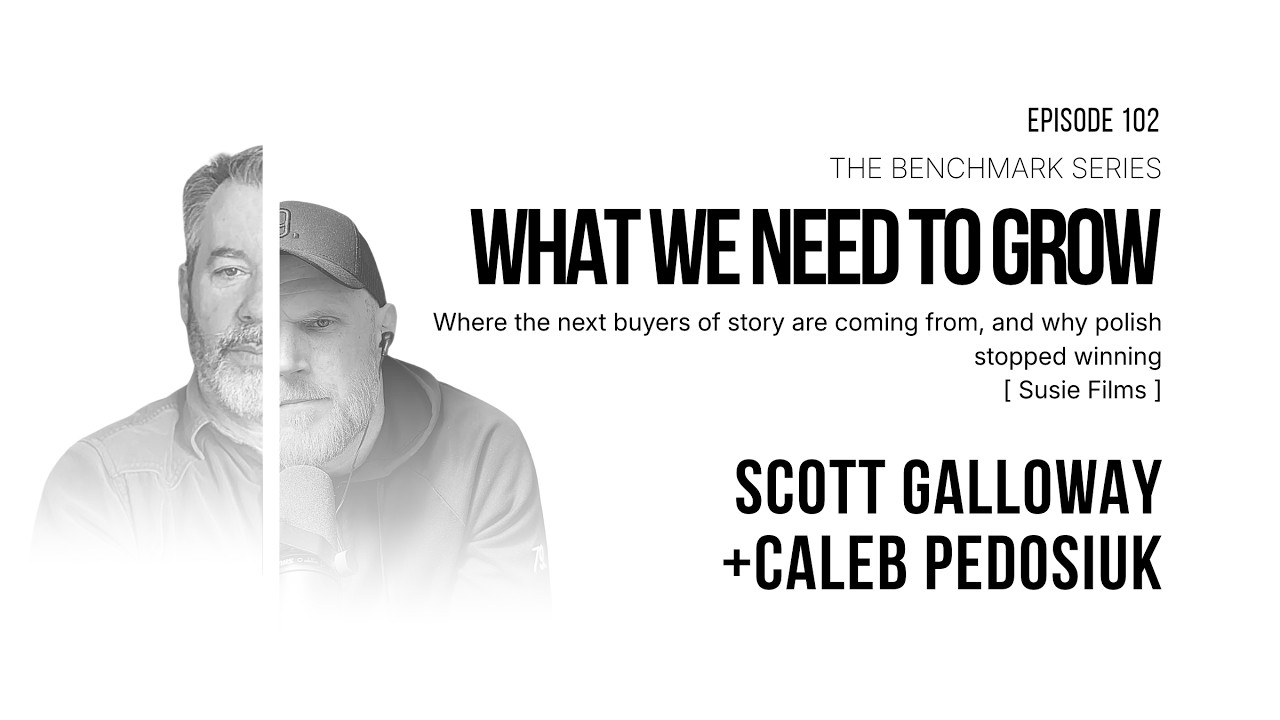
Scott Galloway is the founder of Susie Films, the Charlotte production company behind Fork & Hammer on PBS, Handcrafted America on INSP and the Our Vanishing Americana documentaries, with more than 800 credits and an award record that runs from a CINE Golden Eagle to an Emmy nomination. He has spent a career filming the hardware store, the barber shop and the artisan, which is to say the things that go first when a market gets efficient, and he is now watching the same thing happen to his own buyers. His answer is not better polish. It is more doorways, since every extra platform makes an underwriting conversation easier, and a clearer view of who the next clients are: corporations, foundations and endowments that want to be associated with a story rather than interrupt one. His conclusion from fifteen years of vanishing storefronts is that people were never there for the product, they were there for the people. That is the same thing being asked of a brand now. A company that can give a true, specific account of what it does and who it does it for is one that gets explained accurately when someone asks a machine about it. The work is not louder marketing, it is a record worth citing.
KEY TAKEAWAYS
- "It's almost like corporations are becoming kind of the new clients." This is the sentence the episode turns on, and he arrives at it by going backwards rather than forwards. Television began corporate, he says: "when television first came on, it was essentially driven by corporations. You know, Milton Berle was the Milton Berle Texaco Hour. He'd come out, tell some jokes, and then they'd have a Texaco promo, and it was very direct." His read is that we are returning to it. "You find companies, foundations to a certain extent, endowments that have interest in a story. You help them find that story, then you make it for them." He is careful about the line that matters in practice: "product placement doesn't bother people as much as it used to. You just have to find that line between when does it become egregious and when is it subtle."
- His answer to an infinite feed is not better polish, it is more doorways. Asked how anyone creates something above and beyond in a saturated market, he does not reach for production value. He reaches for distribution: "one of the things that we're doing now is we're doing a lot of deals to be on a lot of different platforms." Fork & Hammer is on PBS, Amazon and YouTube, going to Apple, and on American Airlines. The reason is commercial rather than vain: "having all of those different places helps us when we try and get underwriting." And he is honest about what he is up against, using a competitor's best asset as the example. Discovery's Shark Week is "a great series of programming... a great marketing push," and then: "you can go to YouTube and you can see instead of watching a highly polished piece where they've got all this production quality, see 2 guys in a boat off the coast of Martha's Vineyard and a shark is circling them and they're filming it with this thing and it's really compelling and it's 2 or 3 minutes long. And I watch that and then in my feed I've got 10 more... it's what I want to watch when I want to watch it. And it's short and bite-sized. And I think that has really made it difficult for television to compete."
- What audiences are actually buying is the artisan, not the object, and he has the receipts. Handcrafted America worked, he says, "in part because people wanted to see what was made, but they also wanted to know the story of the artisan behind it. Which is totally counter to mass production." The craft is learned "often from a family member or from the region where they live, and it's a celebration of both." His evidence at home is his son and baseball cards: "you can hold them, and this reminds you of your dad and your grandfather, and this baseball player who they talked about 50 years ago was amazing, now I can see it and see the statistics." When Caleb tells him about a silver dime found at a farm store that shares a birthdate with his late father, Scott gives the episode its quietest line in four words: "it's a touchstone to the past."
- The strongest finding in the conversation is that people were never there for the product. This comes out of fifteen years of filming vanishing storefronts, and he states it as a conclusion rather than a sentiment. "People talk about the hardware store, the barber shop, the filling station. And while they were there to buy something or get gas or eat ice cream at the pharmacy, they were really there for the people and that aspect of who we are." He pairs it with a working observation about his own industry: "people always tell me, oh, film industry's dead. No one's going anywhere. Well, they're starting to come back. And I think in part because people want to be with people, they want fellowship." His proof is small and local: a community players group in a college town outside Charlotte that now runs The Moth, where people audition to tell five-minute stories in a little theatre, "and people are delighted to be there with each other and hear stories from one another."
- On AI he is neither frightened nor romantic, and the detail he picks is instructive. The gains he names are unglamorous and real: at the development stage, ideas into a model that "really advances what you want to do and helps you create proposals really quickly"; in post, proxies, transcripts, questions edited out, "doing the roles of a lot of assistant editors." His favourite example is not generative at all. He needed a commercial from the 1980s with the music baked in and no split tracks available, "so I was like, I'm screwed. But there's now technology out there that will isolate the music and pull it out." Set against it is his reason for still shooting the real thing: "I do like in this particular case being able to kind of control our own circumstances... our business has always been putting picture to word... we know what we've got and we shoot to cut. And I do enjoy it."
- And his growth ask is the cleanest statement of the problem the whole episode describes. Asked the standing closing question, he does not ask for money or distribution. He asks for a map: "an awareness of the new client base and who that is, because a lot of the clients that we've worked with in the past are disappearing for the myriad of reasons that we've discussed. So we need to actively try and find out where are the next group of clients? And how we go about that, I'm not sure." A production company with more than 800 credits and four series on air does not have a quality problem or a capability problem. It has a findability problem, on both sides of the table.
FULL TRANSCRIPT
What We Need to Grow, Episode 102: Corporations Are the New Clients. A Founder Talk conversation with Scott Galloway, founder of Susie Films. Cleaned for readability; the words are the speakers' own.
> [!note] Two normalizations, and one claim left as spoken > Brand names are written as their owners write them: Fork & Hammer, Susie Films (Granola renders it "Suzy" throughout), Kitchen Curious with Vivian Howard. ⚠️ Scott's "3 of the 6 are Michelin Award nominated" is left exactly as he said it. What the public record supports is that three Tonidandel-Brown restaurants were recommended in the inaugural MICHELIN Guide American South. No 79dev asset repeats a Michelin claim in any form. ⚠️ He hedges the Milton Berle show title himself; the show was Texaco Star Theater. His hedge stands.
Caleb Pedosiuk: Scott, Susie Films, susiefilms.com. You lead Susie Films, your Charlotte-based documentary production company behind PBS's Our Vanishing Americana, profiling disappearing community institutions and small businesses, and then INSP's Handcrafted America and Magnolia Network's In with the Old. Your work is built on finding and capturing authenticity and fellowship in American craft and community traditions before they disappear for good, which is a giant word salad, but I'm trying to get the whole thing, or get a little bit of a sense of the scope of the stuff you're doing. Our first conversation we had just leading up to this, I really went away thinking about a number of aspects. You were talking about the series you guys were working on, Fork & Hammer. And correct me if I'm mistaken, but three or five locations across the Charlotte area where they've gone and renovated these old general stores and other things that become these Michelin, I think a couple of them are Michelin-star restaurants. And you just get the essence of the history, the culture, the vibe, if you will, from what that past era is. So please, by all means, introduce yourself, and love to hear a little bit more about what you're working on right now.
Scott Galloway: Great. Thank you for the setup, and nice to speak with you. I think you did a great job of capturing it. Right now we're producing two series. One is the Fork & Hammer series, which I really like, because I always wanted to do a series on the restaurant game. Did a lot of work for the Food Network and the Cooking Channel over the years, and they were always like, we don't really want to showcase a restaurant because it's the same people making the same food in the same place. Which I understood, except in the case of Fork & Hammer, it's six very different restaurants owned by a husband-wife team, and they're all built in historic buildings that were originally created to be something else. So that's the hammer: how do you modify? And then the fork is, their restaurants are really high-end. Three of the six are Michelin Award nominated. So they do a really great job.
That's one series. And then the other series we do is with Vivian Howard, who's an extremely talented chef and author. She had a series that won a bunch of awards called A Chef's Life. And the series we're doing with her right now is called Kitchen Curious. The idea is that Vivian finds a food or an idea and really delves into it and shows you how to make it and where it comes from. She's just incredible talent, so excited to work on those two series.
And then the other ones that you mentioned, we just finished In with the Old with Magnolia. And loved doing the Our Vanishing Americana documentaries, which were state-specific. And then also the other one that you mentioned was Handcrafted America, that we did with Jill Wagner, who was just the best. Big fan of hers.
Caleb: And if I'm not mistaken, I feel like you had mentioned that there was a coffee table book series that one of them is based off. Is that right?
Scott: Yeah. So what happened was, with the Our Vanishing Americana series, there's a gentleman named Mike Lassiter, who's a lawyer here in North Carolina. We were friends. He grew up in Davidson. Our kids grew up together. And Mike, when he was a senior in college a generation ago, his parents said, you know, when you graduate, we'll get you a little graduation gift. What would you like? And he said, I want a camera.
And they're like, okay, great. And the reason that he wanted a camera is he wanted to take pictures of his favourite places on Franklin Street in Chapel Hill. So it was the old pharmacy that would sell ice cream. It was the general store. It was the filling station where people would still come out and pump your cars. So he took pictures of those and he loved them. And then he went to every county in the state of North Carolina, and there's 100 counties, and captured those same kind of older places and put out a coffee table book. It did incredibly well.
PBS asked us, or we, I can't remember exactly how it all happened, but we connected with PBS and did a documentary on some of the best stories within that book for the state of North Carolina. That did really well. Then we did South Carolina, and then we recently did Florida. So the stories, in America it doesn't really matter what state you're in, there's still that desire and interest in the old. Family-run businesses on the proverbial Main Street where you know the people and they know you, and what that experience is like.
Caleb: It's so interesting to me how this is in such juxtaposition with the wave of generative AI that's here and certainly impressive. I don't know if you've spent much time with Higgsfield as a tool. I can't remember what it hit in revenue, but it broke some records of what its ARR was. When you open that tool up, it's like a fire hose. It's just blasting so many different forms of creative, and you just get the sense that it's digested the sum total of human creativity of all these styles, everything from watercolour to comic books to claymation to pen and ink. There's so much. And then you see basically at your fingertips this invitation to just like, what do you want to do? Like anything. And it's this odd, I don't know if I fully understand it, but it's such an odd sense to open something up and feel all of these paths that are really reflective of what others have created before, but then to sort of be like, well, what do you want to create? And not have a knee-jerk reaction to just see what someone else has done and be like, oh, I'm just going to do something else.
So I think it's really interesting, you guys are actually crafting this sort of, you're going and showcasing stories. I'm picturing the actual wood, the actual glass, the actual windows, the architecture, all the way down to probably shots that feature the silverware, the plates, the kitchens in some of these locations. As opposed to, in a way you're sort of documenting history, but in a format that's pulling out a story rather than just going and being like, you know, photos and videos.
Scott: Yeah. And maybe someday people look back at this and be like, can you believe how antiquated that was? But I do like, in this particular case, being able to kind of control our own circumstances, right? So you go in and you get the shots, you tell the story. Our business has always been putting picture to word, and that's kind of the way we do it, so we know what we've got and we shoot to cut. And I do enjoy it.
Caleb: What is the process like for you? Are you finding that there are aspects of pre-production, like you said, if you're shooting to cut, are there aspects of pre-production where you're finding certain tools or your process has changed over the last couple years with having different efficiencies?
Scott: Yeah, I think so. That's a great question. Certainly on the front end, in the development stage in particular, when you can come up with ideas and have an idea and then you put them into AI, and it really advances what you want to do and helps you create proposals really quickly. So that's the first step.
I have been amazed, and this isn't necessarily AI as much as it's just general technology and the fact that I'm old, but I remember when we used to film in big spaces. We used to do a series called America's Castles for A&E, and we would go in there and we had one light source and you plugged it into a ballast and plugged that into the wall and hoped that you didn't blow the wall. But it just shot out one colour temperature and one powerful light. And then you had to spend all of this time manipulating that. It's too strong, so let's diffuse it, we'll hang up some 216. And oh, it's too white, so let's change the colour temperature with these gels. Now you have a little pad, it's like this thick. You put it on a wall, you dial in the colour temperature, you dial in the intensity. It's incredible. And so I see that, I see how light the cameras are. That's amazing. So that's production.
And then in post-production, you can now shoot your footage and load it in and it'll make you proxies and it'll do transcripts and it'll edit out your questions. It's doing the roles of a lot of assistant editors. And then the other thing that I've noticed recently is just how incredible it is with audio. We did this documentary where I needed to use a commercial from the 1980s and the music was baked into it, and no one could find the original, so they didn't have the split tracks. So I was like, I'm screwed. But there's now technology out there that will isolate the music and pull it out. So I was able to use the sound cleanly. It was incredible. So it's just, it's everything.
Caleb: This is a point of maybe inflection, certainly consideration right now that I see multiple people having. Yesterday I was on a call with a number of developers in the Bay Area, and some of them are at Meta Superintelligence, some of them are just at a whole other level of doing research on these frontier models that is fascinating. But I'm seeing so many people asking the question about what it is they're working on. And this sort of, if I could simplify it to the simplest point, it's like, are we working on a means to a means? Are we improving for the sake of improvements without a clear end goal in sight, or is it a means to an end in that consideration?
But when you were mentioning what you were, the thought that came to mind, which is kind of odd, is as we increase in the amount of media we're creating and the stories that we're creating, it is competing with the attention of human beings who have a limited capacity to view things. So human beings will need to become more selective about what we consume. For your TV, your shows or documentaries to be viewed, human beings will have to be saying no to, call it whatever, endless scrolling or other productions, maybe generative AI pieces that are becoming more efficient to produce, and yes to other things.
But here's the thought. At some point, the filter is happening. I'm wondering what amount of content that's being produced today actually should be viewed by machines, not humans. Meaning how many commercials right now are being produced for toothpaste, for toilet paper, that realistically that information, those companies should actually be contending for the attention of agents that will be making those decisions, allowing human beings and their attention to not so much have their imagination captured by toilet paper and toothpaste ads. Allowing them to absorb or focus on more meaningful stories. And I mean it beyond just toothpaste and toilet paper.
Scott: There's a lot to unpack there. I would say there's several thoughts. One is, I do think things are kind of going back to the way, I'm going to start with the toothpaste, toilet paper, and work my way back. I think that when television first came on, it was essentially driven by corporations. You know, Milton Berle was the Milton Berle Texaco Hour. He'd come out, tell some jokes, and then they'd have a Texaco promo, and it was very direct. I think we're kind of getting back to that a little bit. You find companies, foundations to a certain extent, endowments that have interest in a story. You help them find that story, then you make it for them. So it's almost like corporations are becoming kind of the new clients. That's one.
And secondly, you're right, there is so much that's out there, and how do you combat that? How do you create something that's above and beyond? One of the things that we're doing now is we're doing a lot of deals to be on a lot of different platforms. So by way of example, Fork & Hammer is on PBS. It's also on Amazon, and it's going to be on Apple. We're on YouTube. And we did a deal with American Airlines where we're on American Airlines. So having all of those different places helps us when we try and get underwriting. And I think that's a possibility.
And then the final thing is, I think you and I talked about this. We used to do work for Discovery and talked to them a few months ago, and they were talking about Shark Week, which is a great series of programming. It's a great marketing push that they have, where they showcase incredible shark content. The challenge is, you can see that in their blocks, or you can go to YouTube and you can see, instead of watching a highly polished piece where they've got all this production quality, see two guys in a boat off the coast of Martha's Vineyard, and a shark is circling them and they're filming it with this thing, and it's really compelling and it's two or three minutes long. And I watch that, and then in my feed I've got 10 more that are also there. And it's what I want to watch when I want to watch it. And it's short and bite-sized. And I think that has really made it difficult for television to compete.
Caleb: Yeah, you wonder what systems are going the way of radio, or before that, going the way of telegrams, telegraphs. It's interesting. I think, you know, Meta, with what Zuckerberg did with the big bet on the metaverse, and how that went or didn't go. Some of these bets about where the future is for consumption. I think Apple's coming out with its own glasses. Certainly it had the Vision Pro sets that were apparently phenomenal. I haven't used it myself.
I have this sort of duality in mind. In fact, this little series of conversations, before it was called What We Need to Grow, the first inception was like a handful of episodes called Digits and Dirt, where it was just this idea of, you've got the digital space that we need to be proficient in understanding, so much of our world is driven by that. Then you've got the dirt, you've got your bare feet. Literally the term touch grass has a literal grounding to it. Get in the fresh water, feel the sunshine, feel that breeze, whether it's snow or whether it's sand. Get into it, and not deviating so far from understanding who we are as people that we forget where our food comes from, the role that soil plays, what it's like to be under the stars or look at a fire. That sort of idea.
But it also has this other aspect where I feel like, almost the more connected we get to that aspect of it, this idea of being able to be completely bilingual or ambidextrous, and then step into these immersive stories, and then feel what the savanna would be like, or step into Lost Americana in the southern states in some town and just be pulled into this story about crafting, taking this old general store. I'm imagining what this might be like, I haven't seen the show, imagining what that would be like, or the feel of those real silver, the fork, or some of those dishes and crafting some of that. And at the close of that 30, 90 minutes or a couple hours in a series, come out of that and feel like you have actually absorbed part of that essence of humanity without necessarily being there. Not that in-person doesn't matter, but to me, those two are a marked difference between just the attention hacking of scrolling and just feeling like you're almost, it's almost subconscious in terms of it bypassing certain decision-making as it relates to opening story loops with hooks, and of these shorts that pull you into the next shark video, next shark video.
Scott: Well, I think you're absolutely right. And I like that dirt analogy. I think that people do miss craft. And they miss the artisans behind it. And you see that in so many ways. That show Handcrafted America that we did was extremely well received, in part because people wanted to see what was made, but they also wanted to know the story of the artisan behind it. Which is totally counter to mass production. And this is an individual who's learned to craft often from a family member or from the region where they live, and it's a celebration of both. And people really like that.
I think there's this real push for tactile. My son has had a lot of success with baseball cards, and he's even at the point where he's like, well, why are these so popular? Well, you can hold them, and this reminds you of your dad and your grandfather, and this baseball player who they talked about 50 years ago was amazing, now I can see it and see the statistics. And I do think there's something to be said for that authenticity, real experience.
Caleb: It's funny, I found a dime, a silver dime, at a point of purchase at this little farm store. And the amount of joy that this tiny little silver dime brought me, that shares the same birthdate as my dad who passed away a few years ago, just an incredible man. But the amount of joy that that tiny dime has brought me, a piece of silver, maybe worth about five dollars or something like that. But the value of it is much more than a five dollar exchange. It's not just silver, it's not just a point of money, it's not just a date on it. There's something more to it.
Scott: It's a touchstone to the past.
Caleb: I remember thinking with wine, the interesting thing when it finally clicked for me with wine, the vintage of it, was that let's say that you find a bottle of wine from, I don't know, 1950, right? There's this beautiful vintage that's been cared for and restored. It's like, okay, it's super old and it's drinkable, it maybe tastes really good. But there was some poetry around it, that wine is liquid sunshine. That statement, it's kind of poetic, and I'm like, what are you talking about?
And we have some vines in the backyard, and I remember looking at our just Concord grapes and seeing the way the light hits the grape. And at certain ways, you can see the light penetrating. And I was like, oh, hold on a second. More sunshine in a season, the chemistry of it, the biology of it is different. So the sunshine is interacting with this. When it's harvested from that year, it is like a time capsule. This is a time capsule of what the amount of rain was like, what the terroir was like, what the conditions were. You are actually getting a postcard, a timestamp, a sliver of the past. So when you uncork a vintage year and you pour that, you are pouring history. You are actually going back to a point in time, almost like opening up a fresh newspaper from that era, to be able to actually recall that. So the idea of preserving something seems like it has a little bit more merit to it than just the flavour palette in that sense.
Scott: Yeah, that's true. That's good insight. I agree.
The only thing I'd say in that regard, this is tangential, but I think it's still important. This is a combination of AI and also COVID. People miss each other. They're social beings. People always tell me, oh, film industry's dead, no one's going anywhere. Well, they're starting to come back. And I think in part because people want to be with people, they want fellowship. And that's one of the things that I've learned from doing that Our Vanishing Americana series. People talk about the hardware store, the barber shop, the filling station. And while they were there to buy something or get gas or eat ice cream at the pharmacy, they were really there for the people and that aspect of who we are.
And content creation is something that all creators need to be thinking about. I don't think the film industry is dead necessarily. We live in a college town outside of Charlotte, and there's a really active community players group. And one of the things that they've kind of started to celebrate is The Moth. Do you know the podcast The Moth, where people tell stories? You have to try out. So people literally come to this little theatre and they curate it, but they tell five-minute stories and they're fascinating, and people are delighted to be there with each other and hear stories from one another. So I think we have a capacity for that no matter what happens, as far as technology goes.
Caleb: It's interesting to me. Let's say you put a cellist on a stage, like a world-renowned best in the craft, or a pianist on a platform. You can fill a stadium, you can fill a hall, a music hall, and have people just, the entire time, feel connected, like the strings of their heart are connected to the strings that bow is being drawn over, and watch it the whole time. But how absurd it would be if someone just came out, walked out with the light, same lighting, same sound, same attire, and was like, okay, start this out with a really moving piece. And then they just hold it up, and then everyone's like, oh, and now make it more moving. Even more moving, the most moving of all. It would be absurd.
And it's interesting to me, because I don't know whether, maybe some people think it's odd, I feel like I have tremendous respect for the capability of a lot of these models and the machines. I think it's profound that we get to experience and interact with them. Many times when I'm working with these, I feel immensely blessed to get to bring a vision to life for some of the work we do. But at the same time, I'm like, it is not that, right? It is not the craftsman that worked to be able to make that possible for that machine, in how many iterations. It is in the soil, the digital soil that those machines pull those cues from, those sequences, those notes, that emotion from, which is beautiful in that regard. And I think beautiful that it pulls it. But humanity is not, we would walk out of something like that and we would think this is absurd. It's just, it's something different. It's not that there's not power and beauty in some of those things, but it's not, I think that comes back to some of what you're saying about human beings wanting to be around other people.
Caleb: So what's next? What do you, you know, I know you're working on this right now, but do you have vision for where you see or are wanting to head with what's next?
Scott: I really enjoy short films, and I feel like there's certainly an audience for them. So we're kicking around the idea of doing some more shorts, either docs or scripted pieces. And then frankly, I'm not exactly sure what's next. We're excited to have these two series that we're producing right now. But we always have to be nimble and agile and figure out what buyers want. Ultimately, that's kind of our business, is we're coming up with content for studios and networks, and in some instances for companies. And I feel like maybe that's going to be a little bit more of what we're doing in the upcoming years.
Caleb: Very cool, man. I think something you said about companies, almost like we're returning back to that. I can't remember what the original company was that you mentioned, like a gas company or something.
Scott: Oh yes, the old Milton Berle was, he was one of the first people in television. He's a phenomenally talented comedian. And I think it was the old Milton Berle Texaco Hour, or something like that. Basically, the promotion was right there. It wasn't veiled at all. And people understood that. I think we're getting that way now. I mean, you've got to be careful, but product placement doesn't bother people as much as it used to. You just have to find that line between when does it become egregious and when is it subtle.
Caleb: I feel this in my chest, so I want to say it. I know we're kind of wrapping up here, but I think there's something very important with what you're talking about in terms of solving meaningful problems in the world. And here's the thought.
We saw this recently, we've been riffing on this concept and I'm hoping it goes ahead, where basically there was a farmer that had a bumper crop of something. And last year was really difficult for them, but they have a bumper crop of it this year. A farmer friend sort of mentioned this to me. And so we were talking about it, and as I was thinking about it, I was like, wow, this would be really interesting if a group paid for, like a few thousand dollars would make a wild difference. Call it like three thousand dollars. And they basically bought enough, the product right now is potatoes. They bought enough at the price you would pay for a 50-pound bag, which is very reasonable. And this is regenerative agriculture. This is great food, local food, nutrient-rich local food system. You split it into 25-pound bags, which are easier to handle, especially for seniors. And basically a sponsor of this, I thought this could be a church, this could be a company, this could really be any organization. Basically, if you took about three thousand five hundred dollars, you could get about 5,000 pounds of potatoes. You could get about 200 bags of 25-pound bags of potatoes.
And this would be, even though each margin on the bags isn't that great for the farmer, at scale it is, if it's all done at once, because then it's better than wholesale. But if you did that, and my thought was, man, if a company that's going to drop three thousand, five thousand dollars on Facebook ads, Meta ads, Google ads, radio ads for whatever, why don't you just give that three thousand five hundred dollars to the farmer? And maybe you put a little note, or you put a little sticker on the bag that just says it's from them, and just be like, hey, we just love our community. And you have it that, it's not even necessarily for the people, be like, find some way to distribute it that's like, hey, if you know of someone on your street, maybe they're a senior, maybe it's a single family, maybe it's someone who's between jobs, maybe it's someone who just, it's the economic downturn, they're feeling it. Just drop off a couple bags of potatoes for them.
The thing to me I thought was interesting is that you have this equation where the brand, the company, is the sponsor of the activity. In this case, it's an actual product with local food that they're then getting into the hands of it. They get exposure of a different kind. People get food. The farmer and your local food system is actually strengthened in some small way.
But from a storytelling standpoint, I completely agree with you that I think more and more companies will be looking to find ways to stand out and not wanting to go the route of just pouring tens of thousands of dollars into these advertising channels when they're so saturated. And especially if there's more of a singularity in terms of all companies looking the same, sounding the same, how do you stand out? But I think, like you said, there'll probably be more companies that are looking and saying, what story can we tell, where they tap the storytellers, the creatives and say, help us tell the story of gas in this region and Americana on the gas stations, or food, to connect their brand with whatever aspect of culture or whatnot.
Scott: Yeah, I like that idea. Communal marketing.
Caleb: Communal marketing. Yeah. Cool.
Well, the last question I typically ask is what guests feel like they need most to grow right now. Some companies I talk to are raising money, some are going to market, some are shopping something around or trying to get interest for something. What would you say that you would need most for Susie to grow right now?
Scott: I think an awareness of the new client base and who that is, because I feel like a lot of the clients that we've worked with in the past are disappearing for the myriad of reasons that we've discussed. So we need to actively try and find out where are the new, where are the next group of clients? And how we go about that, I'm not sure.
Caleb: Well, Scott, susiefilms.com is the place for people to check out what's going on. Anything else? Social media or anything?
Scott: I think that's right. We're on Instagram, we're on Facebook, but susiefilms.com is a great way to connect with us.
Caleb: Awesome, Scott. Thank you.
Scott: Thanks, Caleb. Nice to speak with you.
What We Need to Grow is a conversation series by 79 Development, hosted by Caleb Pedosiuk. New episodes on YouTube and Spotify.