Why Hiring From Big Tech Fails at an Early-Stage Startup
For early-stage founders making their first real hires without a people team, for operators weighing a move from a large company into a startup, and for anyone in the US or Canada deciding whether to build a team in Mexico or Latin America.
About Maria Fernanda Molina Estrada
Maria Fernanda Molina Estrada is the founder of Antares HR, the Mexico City talent agency she started in early 2023 to give early-stage companies, from pre-seed through Series B, the recruiting machinery they cannot yet afford to build in house. She is known for carrying hyper-growth recruiting practice into companies that have no people team at all, after being part of Stripe's talent acquisition team for Latin America across Mexico and Brazil. She builds streamlined hiring processes, advises founders on attracting and retaining talent, and places both commercial and technical hires across the region for companies in the US and Canada, and she has spoken publicly on building a recruiting agency around relationships and data.
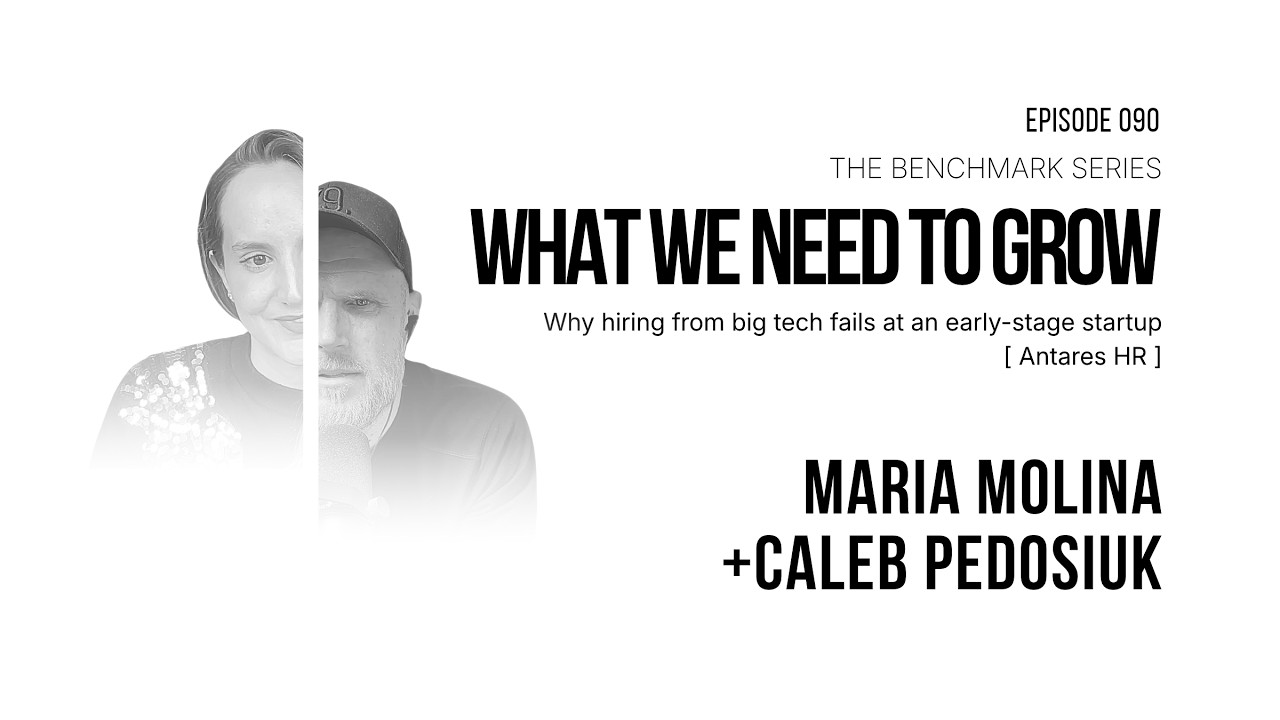
Maria Fernanda Molina Estrada is the founder of Antares HR, the Mexico City talent agency she started in 2023 after working on Stripe's talent acquisition team for Latin America. Antares builds the hiring process for pre-seed through Series B companies that have no proper recruiting team. She makes two arguments that cut against a founder's instinct. The first is that the most impressive CV is often the wrong hire, because someone who has only worked with big tech resources is being asked to build in ambiguity with none of them, and the candidate has to match the company's stage, not just the job description. The second is that the reason to hire in Latin America is not price, and that founders who go looking for cheap talent miss what they could actually find. What makes this 79 Development's kind of conversation is the gap between what is genuinely good and what gets recognized as good. Strong people in Bogotá or Mexico City are not discounted versions of anything; they are simply less visible to the people deciding.
KEY TAKEAWAYS
- The best CV in the pile is often the wrong hire, and the reason is stage. This is the sharpest thing on the tape and it is a diagnosis rather than an opinion. Maria says founders carry a heavy bias toward candidates out of large technology companies, and that the bias is mostly about reassurance. Her correction: "It doesn't matter how amazing or appealing the CV appears to be. The person needs to be at the right stage of the company." Somebody who has only operated with real resources, real structure and a settled roadmap is being asked to work in ambiguity with none of those, and when it fails it is not a talent problem. She is careful about that distinction. The practical consequence is on the founder, not the candidate: if you need somebody to build from scratch, you have to assess for that during the interview, and she says it is genuinely hard to read, so it takes specific questions designed to surface it.
- The reason to hire in Latin America is not that it is cheaper, and believing otherwise is the first mistake. Asked what founders in the US and Canada do not know, she went straight at the assumption: "The first wrong conception about the Mexican and Latin American market is that there is cheap talent, and I've realized with my founders that's not correct." Her account is that these are people who have worked in global companies and can compete directly with US talent, and that the real difference sits in how they work rather than what they cost. She describes candidates eager to roll up their sleeves and build things, and eager to work with North American companies specifically because they want to be on multicultural teams alongside people from elsewhere. Her summary is the version worth quoting: do not expect it to be cheaper, expect more diversity of mindset and of tooling.
- The map of the region is not one market, and she is specific about it. Strong engineering talent concentrates in Brazil, Colombia and Argentina. Mexico's depth is commercial, in go to market, sales and marketing. She is candid that engineering profiles in the region are often less experienced than their US counterparts, and attributes it to the work those companies get asked to do and to the education available rather than to the people. On where talent physically sits, she thinks the pandemic settled the question: big cities still concentrate it because that is where the large employers are, but remote work scattered it, and "good talent can be basically everywhere." Her read on sectors is the same kind of honest hedge. Antares works mainly with technology companies so her view is biased, but she says manufacturing had its big moment a few years ago and software is now where the strongest people want to be.
FULL TRANSCRIPT
What We Need to Grow, Episode 090: Not the CV, the Stage. A Founder Talk conversation with Maria Fernanda Molina Estrada, Founder of Antares HR. Cleaned for readability; the words are the speakers' own.
Caleb Pedosiuk: All right, Maria, so, if I get this right, you went from building Stripe's Latin American team. You helped them with hiring to be able to build this team across Latin America. You understand what it takes to find talent, and the importance for growing companies of making sure that they're finding talent that understands a region and can operate well there. Now you're working on your own, you've got your own company. By all means, please introduce yourself and share a little bit more about what it is you're working on.
Maria Fernanda Molina Estrada: Yeah, thank you so much, Caleb, for having me here. Well, hello everyone, my name is Maria, and yes, as you mentioned, I started this talent agency called Antares HR in Mexico City back in early 2023.
After being part of a Stripe talent acquisition team for Latin America, I decided to put all the knowledge from a hyper-growth tech company to the service of early-stage companies. Let's say pre-seed, seed, Series A and B, who have not a proper recruiting team, and help them build a streamlined recruitment process, help them understand how to better attract and retain top talent, and of course help them build their teams from the ground up.
Caleb: So what have you seen over the last couple of years? The tools have certainly changed. 2023 to have started that is right about the time when the first large language models, ChatGPT, came live, in that window of time. What have you seen in terms of your ability to lean on new tools to accomplish some of what before you were doing differently?
Maria: Well, AI has significantly helped to make work easier. What I want to say is that all the operational part gets on the side, because it can be done through these LLM programs, softwares. And I think you get to focus more on the strategy and on building relationships, like building a strong network, and get in touch with a lot of good, strong candidates out there who might be looking for their next professional challenge. So I think leveraging on those tools helps a lot, the early-stage founders like me, to focus on what's important on a daily basis.
Caleb: And is it mainly, are there certain regions or cities where you see more concentration of talent, or are you casting a broader net across the entire, basically wherever people are going to latch on online?
Maria: Yeah, well, of course, in the big cities is where you find the most talent, because it's where the biggest corporates and companies are based at. But with remote work, people started to live abroad, and you can find people basically everywhere. I think that was one of the biggest lessons of the pandemic.
Of course, I understand after five or six years now, companies are coming back to work at the office. So that depends on the level and the stage of the company. But I'll say good talent can be basically everywhere. It's a matter of being in the right place at the right time.
Caleb: And do you find it primarily skews to a certain position? Is it mainly CTOs? Is it people looking for co-founders? Are you looking for go-to-market, heads of marketing, or understanding sales, people who would maybe perhaps understand the Latin American market better than somebody from stateside who's trying to create those strategies or manage those teams?
Maria: Okay, let me see if I get this clear. You're asking me what type of talent is more findable in LATAM?
Caleb: Yeah, what is it primarily? Is it more on the sales and marketing side? Is it more on the technical side of things?
Maria: Yeah, that's a great question. There's both. It depends on the level.
I'll say that the engineering part is less experienced than in the US, just because the companies and their opportunity for growth isn't as sophisticated as US companies. I'm not saying this in a wrong way. I'm just saying that the level of the engineering profiles in the US can be a bit more demanding, just because of the type of work they are asked to do, and because also of the education that they get to have, although there are very good engineers in the region.
Also, where LATAM and Mexico is very strong is on the other side, the commercial part. Business development and go-to-market profiles are very, very strong within the region. But again, there is everything. We have strong engineering talent in Brazil, in Colombia, and Argentina. In Mexico, a lot of go-to-market, sales and marketing roles as well. But again, every country has its own pool of very strong candidates.
Caleb: I'm thinking about the ups and downs of market cycles, the sort of oscillating wave, and wondering if right now, in the cycle that we're currently in, you're seeing more interest as it relates to manufacturing, or companies dealing with raw materials that might relate to more production, rather than software or business services, that sort of thing?
Maria: Well, at Antares HR we work mainly with tech companies, so my perspective can be a bit biased because of that. But I do see candidates being very interested in joining tech companies, just because of the amazing and interesting projects they're working on. Of course, there's no one-size-fits-all, but I'll say manufacturing and industry has hit its huge moment a few years ago, and now it has been replaced by technologies or software companies. And I think that is the sexy place where great talents want to be part of.
Caleb: And what mistakes have you seen founders who have been hiring make, that perhaps in working with you, in your experience, you've come to understand how to avoid?
Maria: Yeah, well, I think there's a huge bias from founders, thinking that bringing folk from amazing big tech companies will get them to where they want to get. And I've found that it doesn't matter how amazing or appealing the CV appears to be. The person needs to be at the right stage of the company.
Let's say if you're bringing someone from a big tech, where everything is with a lot of resources and with a lot of structure and some sort of clarity in terms of their roadmap and everything, and you expect them to perform at an early-stage company with a lot of ambiguity and working with limited resources, they might not be the right fit. Not because they're not an amazing talent. It's just because they are not at the right stage.
So what I've seen with my clients is understanding what is the right moment for that person to feel comfortable at. What they're expecting for them to work on. If they expect this person to build things from scratch, they need to assess for that on the interview process. And I think that's very hard to read on an interview. So there are specific questions that need to be asked to discover that.
Caleb: And if there was anything that you could say to founders in the US or Canada, to let them know maybe something that they might not be aware of, of what's possible with hiring Latin American talent, what would you say to them?
Maria: Well, I'll say the first wrong conception about the Mexican and Latin American market is that there is cheap talent, and I think, I've realized with my founders, that's not correct. They're just very strong and well-developed talent who have worked in global companies, and they can easily compete with US talent.
The difference is in terms of soft skills. They are eager to roll up their sleeves and work on, get their hands dirty and really build things. Most of them are really eager to work with US or Canada companies, just because they want to work alongside great minds from other places, and being on a more multicultural team.
But if they're trying to find more diversity in terms of their talent pool, the Mexican and Latin American market is the right place to find people with strong backgrounds, strong careers, and a lot of potential to tackle any challenge they want to face.
So again, just to summarize, I'll say don't think that just because you're looking at the Mexican or Latin American market, it's going to be cheaper, because it's not necessarily. But you can find more diversity in terms of mindset and in terms of other tools, besides what you can find in the US. And people are more eager to work hard, in the sense of putting all the effort needed to get things done. I think that's something very particular of this market.
Caleb: Nice. Well, the last question that I like to ask relates to what you need most to grow right now. So if you had to put your finger on one thing, some companies are raising money, some are going to market, some are looking for users or looking to attract talent in a certain area. What would you say the one thing would be?
Maria: I'm not sure that I get the question right. Can you please repeat it?
Caleb: Sure. What do you feel like you need most to grow right now?
Maria: Okay, yeah, awesome. Well, I'd love to get in touch with more Series A to Series B companies and help them hire, build their teams from the ground up, and also walk them through and help them build a strong recruiting structure. I'd love to open up my network and get in touch with more US and Canada companies. Yes, definitely.
Caleb: Very cool. Well, Maria, thank you very much for taking a few minutes to share what you're working on. Do appreciate it.
Maria: Thank you so much, Caleb, for having me here.
What We Need to Grow is a conversation series by 79 Development, hosted by Caleb Pedosiuk. New episodes on YouTube and Spotify.