Why Nobody on the Buying Committee Mentions Your Startup
For B2B founders whose enterprise pipeline moves slower than their content calendar, for marketers selling into procurement, security and government buyers, and for anyone building an audience with no return to show for it yet.
About Yoel Israel
Yoel Israel is the founder of Wadi Digital, a B2B technology marketing agency based in Israel that works mainly with cybersecurity, defence technology, drone and fintech companies selling into North American enterprises, and the founder of Cyfluencer, a marketplace that pays vetted cybersecurity practitioners to distribute vendor content rather than buying reach. He is known for building that marketplace in a field where trust, not reach, decides whether a security buyer listens, and for doing it from inside an agency that was already running the paid campaigns it was meant to replace. He also founded IsraelTech, an English-language media venture covering the Israeli technology ecosystem across ten platforms, writes the Israel Unfiltered column at the Times of Israel blogs, and contributes to Entrepreneur.
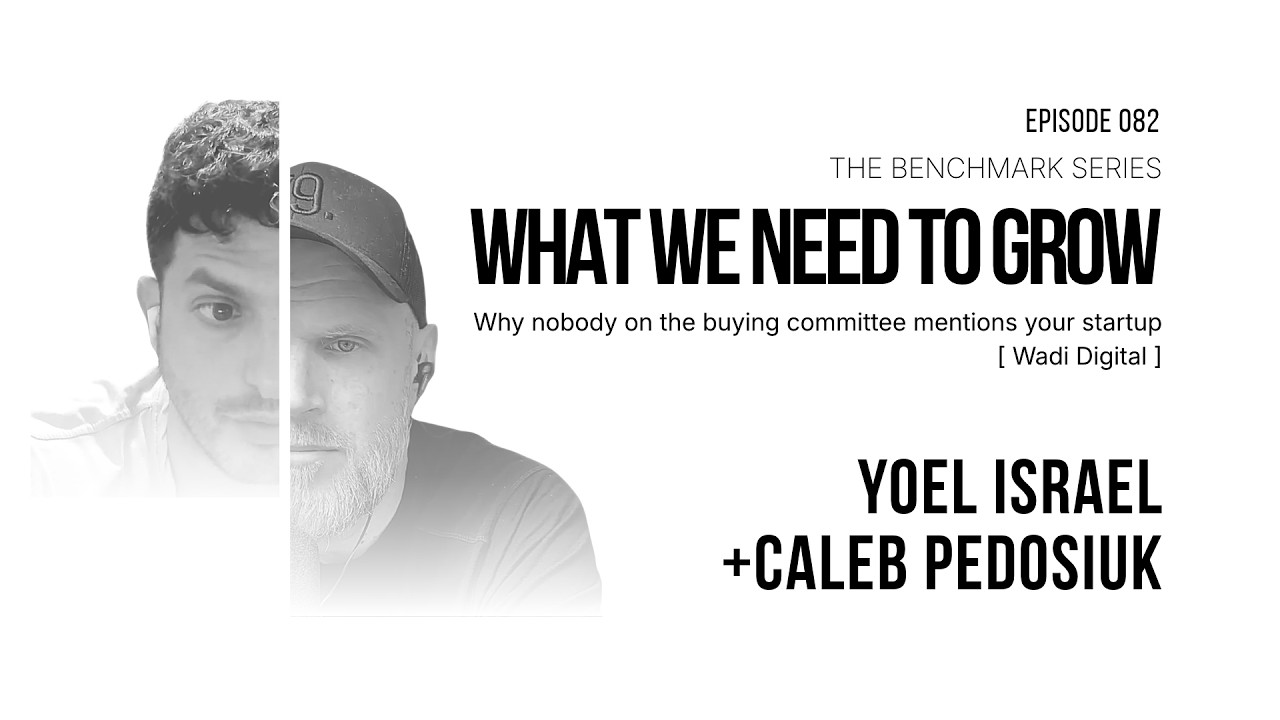
Yoel Israel sells attention for a living, and his account of how an enterprise actually picks a vendor is the most useful thing a B2B founder can hear. The decision belongs to a committee of six to eight people over a year or more, and every one of them met your content alone, which means each assumes nobody else has heard of you and nobody raises your name. His answer is to become inevitable to a very narrow audience, so that when the room asks who could solve this, your name is already the one at hand and someone else in the room can nod. He is unbothered by AI-written content, which he reads as duplicate content, and clear that trust still moves through people. That is the argument 79 Development keeps returning to, arriving from the buyer's side of the table. You cannot be chosen in the moment of choosing, you can only have built the record that gets reached for, and that record is what people and the systems they now ask for answers end up drawing on.
KEY TAKEAWAYS
- Everyone consumes your content alone, which is why nobody says your name. This is the sharpest idea in the episode and it reframes the whole problem of B2B demand. "Any ad or organic piece of content, search, social, et cetera, influencer that you see, you're consuming alone. So you can be sitting in the conference room with the buying committee at your enterprise, and all of you could have consumed content and know about this startup and none of you may bring it up because you don't think anyone else knows about it or might not be relevant."
- So the goal is not awareness, it is inevitability. "You need to make your brand inevitable to your very narrow audience, so they can bring your name up in a conference room." He describes what happens when it works: someone names you, a second person says they have seen you too, a third remembers a testimonial from a household-name customer. His verdict on the cost of getting there is blunt. "They got to do it over a long period of time. It ain't cheap. It ain't easy. It ain't fun. But it's damn effective if you know what you're doing."
- People follow people, and AI content reads as duplicate content. He is unworried about synthetic influence, and his reasoning is an SEO argument rather than a sentimental one. "AI is just rewording things that already exist. So in a sense, it's like duplicate content, right? Because it's already out there and crawled and crawlable and been crawled." Two humans can record the same conversation weekly and it is different every time. "Tell that to AI, you'll get very, very similar or identical podcasts, and not to mention add any value."
- Trust is borrowed, which is why influencers are paid on output and performance both. Cyfluencer exists because cybersecurity buyers wanted trust and LinkedIn kept getting more expensive. The marketplace was brutal to start because neither side would move first. "The best influencers only want the best content from the best cyber companies and the best cyber companies only want the best influencers, and neither of them would get on board or take a chance without having the other one." The influencers' own filter is reputational, not commercial: they only work with companies whose products they believe actually keep people and countries secure.
- If there is no visible return yet, you had better love the process. He is three years into his own media venture and candid about the arithmetic. "If you're putting out content that has no immediate view or see-through of ROI, you better love the process." He puts six hours of preparation behind each twenty-minute conversation, and names consistency, not quality, as the hardest part. "Once you look at the numbers, you'll demoralize yourself. Numbers don't move in the beginning."
FULL TRANSCRIPT
What We Need to Grow, Episode 082: Make Your Brand Inevitable. A Founder Talk conversation with Yoel Israel. Cleaned for readability; the words are the speakers' own.
A Conversation with Yoel Israel, Founder of Wadi Digital
Caleb Pedosiuk: All right, Yoel, you have built Wadi Digital into an agency that has marketed over 500 Israeli startups using LinkedIn ads, SEO, lead gen. Then you spun out Cyfluencer, a platform connecting cybersecurity brands with influencers. And you also run IsraelTech, a media platform interviewing Israeli founders and VCs. So please introduce yourself and let's hear a little bit about what you're working on.
Yoel Israel: Well, I mean, you kind of did. I'm originally from Philly and I've got a finance background, but when I was introduced to marketing, advertising in particular, I was like, oh, I fell in love. I felt like this is something I'm good at. I get to be manipulative. I get to be part of the numbers, so to speak, in the story, as opposed to finance where you don't get to interact and make changes accordingly. And I've really become a lover of media and the attention economy, and that has a lot to do with marketing.
And so my agency grew, serving B2B technology companies. We served almost 1,000 companies in the world doing overwhelmingly B2B tech, not only, but B2B tech, a lot of cybersecurity, defense tech, drone tech, fintech, things of the sort. We're a 17-person team full-time. We're all in Israel. We're all immigrants.
And we built an influencer marketing platform too, for cybersecurity only, because we saw cybersecurity professionals really want trust. And they trust influencers. And we thought that LinkedIn was getting expensive, and other platforms for us, targeting CISOs, Chief Information Security Officers.
And then IsraelTech is my new media venture. We're on 10 media platforms. The goal is just to talk about what's going on in the Israeli tech ecosystem, the hottest ecosystem in the world. And we're only in English. We're on every social media platform, everything from Rumble to Facebook to Twitter, YouTube, Spotify, Apple, LinkedIn, Instagram, TikTok even. We're there. We go to events, we get hired, we sponsor, and we're crushing it and having a lot of fun. Anything about Israeli tech marketing and media, I'm the source.
Caleb: Very cool. On the influencer side of things, when you saw that there was that gap, LinkedIn is getting more expensive, you see that there are these individuals that already have an audience, probably for good reason, they're providing value, how did you branch into that? Did you kind of stumble across it? Did you actively go find someone, or did you just find someone that was a clear fit to work with for a collab with a client, or was it something that you had to go pursue?
Yoel: Well, every platform is different, right? It has its own strategy, its own go-to-market, its own way how to get revenue.
From an influencer perspective, it was that I'm doing ads for dozens of cybersecurity companies, right? Half of the companies in cyber are in Israel. They are within a 30-minute drive from me. And their cost per acquisition and cost per click for their target personas, security architects at enterprises, mostly in North America, they're getting expensive, and I didn't like it and I knew there had to be a better way.
So I built it, and it was very hard, because I had to get better cybersecurity companies on and better influencers. It's a marketplace. And the best influencers only want the best content from the best cyber companies, and the best cyber companies only want the best influencers, and neither of them would get on board or take a chance without having the other one. So it was a very, very, very long, dreadful process to get to where we are now.
Caleb: And on both sides, is the main source of them coming in them seeing you posting things and then coming and saying, hey, as an influencer, I'd like to participate in what you're doing? Or is it you specifically kind of headhunting or talent scouting, to be like, hey, we think you would be a fit?
Yoel: There's a lot of outreach and talent scouting. People that were already posting about cybersecurity, and messaging them and asking if they want to be on the platform. Basically, you do a post a day and it pays for lunch. That was kind of my pitch. Free lunch every day, so to speak, depending, of course, on the following.
And what I would do is I would go to my ad clients, and to pilot it I spoke to three clients and I was like, can I just do $500 a month for the next three months? And then I used a spreadsheet to test it. And then I saw something going well. Then I continued the testing. I used an affiliate network link to track things. And then eventually I built my own platform and technology.
Caleb: One of the things I've been trying to get my head around myself is this idea, for the work that we do, of vendor venture capital, or when people talk about a venture studio, where an actual vendor comes alongside a client and, rather than just saying, hey, we're going to be a retainer for a couple of years or whatever, help you build and then see you later, instead we would come alongside them and say, hey, we seem to be a fit in what we're doing, to consider taking a portion of payment in actual stake in the company or options in the company. Have you seen influencers wanting performance pay, or any aspect of saying, hey, if we're going to help build this startup into something bigger, that they would want to participate in the upside?
Yoel: The only way that they get involved in equity is if it was early stage and before it even came out, while it's still in stealth before it goes public. And maybe they get a board seat and they do some marketing and they probably have a bigger responsibility, and then maybe they'd be motivated.
But in general, they come on and it's performance-based: reach, clicks, sometimes conversions. They're doing webinars. How many of the target persona you get to sign up for the webinar, how many attend and things of the sort. So it's a hybrid between output and performance. That is the work that we do, is how influencers get compensated.
At the end of the day, they only want to work with good companies, because anything that they share with their audience, they want to make sure they feel good and they can stand behind, and therefore they want to work with companies that they can trust and technologies and products that they know are actually going to keep individuals, enterprises, and countries secure.
Caleb: So if I understand it correctly, Cyfluencer sits in nicely. It's not in the same company, it's a separate company, but it dovetails or works as a gear within Wadi Digital. Is that right? For Wadi Digital, you could bring some of the influencer strategy into it if you wanted to.
Yoel: We do. Of course we work closely together, because it's a part of the media funnel. There's organic search, paid search, paid social, organic social, influencer marketing, there's events. So sometimes we know a client is going to RSA or Black Hat, a cyber event. And then we're like, hey, let's work with an influencer to try to get people to your booth. Let them promote it. Come, we'll do a happy hour or a little talk.
So I can make this influencer that they're already following online, you're going to be at the same massive event, come meet them and ask the questions that you want. They come and they schmooze at the booth. And at the same time, while there's a line of people schmoozing with this influencer, your field marketers can then talk to them. So there are all kinds of different ways. We really understand the attention economy and that's how we've been able to dominate.
Caleb: In seeing how things have moved, now at the click of a button, so many people can, with generative AI or tools, whether it's bots or agentic workflows with any of the platforms, the ability to create lots of content is not so much a challenge. So you see the marketplace flooded with more and more content. Are you seeing the role that influencers play becoming an increasingly valuable resource, because it is the human component? You're not able to automatically replicate the human beings. Or are you seeing that maybe it's tracking for every one strong human influencer, you now have ten AI-spun-up influencers that are hacking the algorithm from an attention standpoint, to try to educate or create awareness about things?
Yoel: That's not going to really work. Well, one, of course, AI is already inputs from other human beings. So the things that are already there, people trust people at the end of the day.
I mean, you just think, podcasters like Ben Shapiro will sell a mattress or ExpressVPN. People trust him to tell them the truth or the news, and through whatever his politics, now he's extending that trust that he's earned with his audience to try to make money to keep the show going, by promoting a mattress, ExpressVPN, et cetera. That's what they're doing.
So what we're trying to do is the same thing with influencers. Their reputation, the fact that people trust them when they're talking about cybersecurity or DevOps or other technology, and now they're willing to go and promote other content, other technology and products and startups that they know and they believe in. People follow people, people trust people.
In the future, will AI play a bigger role? Potentially. I just don't see it. People still trust people. People don't want to watch a podcast between two AI potheads. They want you and me, they want personality, they want pushback, they want to fight, they want to catch me off my toes, you know what I mean?
And then AI is just rewording things that already exist. So in a sense, it's like duplicate content, right? From an SEO perspective, we think about duplicate content, because it's already out there and crawled and crawlable and been crawled. So it's not new. But you and I can do a weekly podcast on marketing. Same two people, same topic, every time will be different. Tell that to AI, you'll get very, very similar or identical podcasts, and not to mention add any value. So I don't see that as remotely a threat, at least in the near term.
Caleb: Do you see, with the shift in roles, so let's say chief technology officers, those that are dealing with cybersecurity, let's say that there are redundancies or there are layoffs or there are just shifts happening. You have mergers and you have a lot of people that maybe are technically capable, trustworthy potentially, they have some understanding of what's going on, but they don't have a large following. They're starting from near zero. Do you see those as, hey, this is really fertile soil right now, start organically building out your, I hate to say personal brand, but begin building an audience, putting articles out there? Do you see it as a blue ocean time for people to be building toward becoming influencers?
Yoel: It depends on the industry, but honestly, I think at the end of the day, right, you need to know your shit. And you need to have a unique personality. That's it. You need to have a little bit of a unique view and a unique personality.
People start to get used to your quirks. How you laugh. Maybe you reference your personal life, your children or something. People get to know you.
So understanding that, if you've got something to provide, and you've got to be someone that isn't shy and doesn't mind being self-deprecating and screwing up and making mistakes, but being honest along the way and bringing people with you. If you have that, you'd be fine.
But the hardest part at the end of the day is being consistent. That's why I came on smaller shows such as yours, because I know what it's like to get things off the ground. It's hard. And 99% of your effort is going to come in the next three years, with minimal returns and views, but maybe one or two might lead to an opportunity, who knows? And so it'll make it all worthwhile and give you enough behind you.
At the end of the day, I know it's cliché, but if you're putting out content that has no immediate view or see-through of ROI, you better love the process. If you don't love the process, enjoy it, or let's say get meaning and purpose out of it. Maybe for you, it's just talking to people, right? But around that, we speak for 20 minutes, there's six hours of prep around each 20-minute conversation. The six hours of prep, not just the 20 minutes.
Then as long as you say, I'm just doing this indefinitely, don't look at the numbers, things will find yourself. Once you look at the numbers, you'll demoralize yourself. Numbers don't move in the beginning.
Caleb: Yeah, fair enough. I've given myself comfort where the way we've structured the post, the way we run the transcript and all that stuff, and how we structure it in the HTML of our website and give each episode its own page, we make it very easy for all the AI systems to index the page. And everything's backlinked to people's LinkedIn and projects they talk about.
So to me, it's like almost building soil. It's building an ecosystem. It's like a cover crop you grow with the intention of it going back to the dirt. And then my thinking is, over time, like a farmer building soil over time, once you choose to plant something later, you'll have stronger soil for it.
Can you share a little bit about what it's been like with your podcast? You've got some experience, you're further down the road with this. Has it shifted and adjusted over time, or has it been a straight shot of exactly knowing who you want to talk to and just keeping that pace?
Yoel: I never know what I think. It changes all the time. Right now, I went to a couple of events, had a lot of VCs, so now I have a lot of VCs scheduled. And then I'm like, okay, I've got too many VCs. I'm interviewing the CEO of the Tel Aviv Stock Exchange at the stock exchange in December. And then I'm like, okay, I've got to get some founders. So now I'm going to message the VCs, or when I interview them, can you make introductions to founders of yours that you want me to interview? And I'll give them my criteria.
But I started with my partner. She and I went to offices in Tel Aviv with her iPhone and a tripod and lapel mics. And we would film on one camera, on a widescreen, and cut it. Now we use the studio. Google for Startups lets us use their studio. They got a little stricter with the rules, so now we rent a studio in Tel Aviv that's very affordable. And then recently we've been doing more in person. Again, because as I try to get better guests, their time is more valuable and they won't come to a studio.
They come to my office, we'll get there an hour before the interview, set everything up, and the latest thing, they just walk right in, we'll speak five, ten minutes before, hit record for 40 minutes and leave. So it's kind of like we're back to where we started in a way.
And then we were media partners at Cybertech, a bigger cyber conference, the biggest cyber conference in the world. They're global, but they have events in Tel Aviv and also in the States and Rome, wherever. And they give us massive podcast booths, six metres by three metres, metres, not feet, if any Americans are listening, with our logos printed. And then we started doing content there. We filmed a bunch of interviews. So you find different ways to do it.
Of course you pivot, you do whatever works. There isn't a rule. You just know who you want to have on. You ask them, they say no, or they ignore you, or they say, who else have you had on of X and Y calibre? You keep moving. You get some yeses. You ask them for intros. And you adapt to their schedule and their needs, because you're asking for their time. Even if they appreciate what you're doing, and not all of them do. Some of them don't do it as appreciation. They do it because their marketer tells them to, or the PR company. So you just keep moving along and you figure it out. Two steps forward, one step back. It's kind of like everything else in life.
Caleb: Fair enough. There was something you mentioned when we had first connected. You talked a little bit about having enterprise-level clients, so a lot of your clients, their clients are enterprise. And I think you mentioned the long tail play of some of that, where you said, hey, we're producing a lot of really strong content that we put out there. Our content is really strong. We're engaging across these platforms. And then you find a lot of them will come to you, because they see what you're talking about.
There was something you mentioned last time we had a chat where you talked about what it was like to have clients whose clients are enterprise. So when you help your clients and they land an enterprise client, it's a windfall. These could be whales you're fishing for. It's not like you're out there fishing for panfish. And you talked about how a lot of your content, when you make really strong content that you're posting on LinkedIn and other spots, they are then seeing it and will quite often reach out and say, hey, we saw this, we heard this.
And you mentioned to me, it stood out to me, about how it was a longer play. It was not an immediate thing. There is an investment of time and energy into content. That really resonated with me. I found myself thinking about it after the fact. And I just wondered if there was anything you wanted to add to that at all.
Yoel: Yeah. So when you're targeting, and now we're talking B2B companies, for my clients, startups usually targeting enterprises, the buying committee, sales cycles maybe are 12 months, sometimes more. And the buying committee is six to eight people. And people are going to leave the buying committee and join in the middle. And you need to nurture them at the same time.
And here's the funny thing about digital advertising or digital marketing, social, organic, whatever. Any ad or organic piece of content, search, social, et cetera, influencer, that you see, you're consuming alone.
So you can be sitting in the conference room with the buying committee at your enterprise, and all of you could have consumed content and know about this startup, and none of you may bring it up, because you don't think anyone else knows about it or it might not be relevant.
But if you all understand that you all do, you need to make your brand inevitable to your very narrow audience, so they can bring your name up in a conference room, in a meeting, right? When they're looking for solutions, when someone says, hey, we need to solve this, there's this new vulnerability or whatever, and especially with AI, the cyber offence is strong again. So they're like, okay, find us some solutions. And then, oh, I know this company, I've seen their content. And then on the spot they mention you, and then other people in the buying committee say, oh yeah, I know them too. I saw them. Have you worked with them? No. But I saw a testimonial, hey, they work with this other enterprise or household name company that everyone knows.
And that's really how you do it. But they've got to do it over a long period of time. It ain't cheap. It ain't easy. It ain't fun. But it's damn effective if you know what you're doing.
Caleb: Yeah. Well, Yoel, I really appreciate you sharing the insights. And for anybody who wants to follow along or track what you're doing, what's the best way for them to follow?
Yoel: Me personally, find me Yoel Israel on LinkedIn. Or if you want to see the media content I put out about Israeli technology, my podcast and events and stuff, you can go to israeltech.com. We're on 10 media platforms. Find your favourite, follow and subscribe so you can continue to see more content.
Caleb: Awesome. Thank you so much.
Yoel: I appreciate it. Take care, buddy. Cheers. Thank you for having me. Keep up the work.
What We Need to Grow is a conversation series by 79 Development, hosted by Caleb Pedosiuk. New episodes on YouTube and Spotify.