Why Projects Keep Failing When You Only Treat the Symptoms
For project owners and sponsors, PMO and transformation leaders, and executives deciding whether their organization is ready to put AI on its projects.
About Mounir Ajam
Mounir Ajam is the founder and CEO of Uruk Project Management and the author of the Transformation: The Future of Work series, known for arguing that the persistent global project failure rate has one structural root cause: organizations run project management as an office rather than as a strategic department with a seat at the C-suite. He has more than 35 years of experience on projects worth billions of dollars, split between capital projects in oil, gas and petrochemicals and consultancy and training work across the United States, the United Kingdom, Southeast Asia, West Asia and the Gulf Cooperation Council. He is the originator of CAMMP, the Customizable and Adaptable Methodology for Managing Projects, now published as the Uruk Value Delivery Methodology and the Four Dimensions of Project Success, a licensed engineer with the Lebanese Order of Engineers and Architects, and a GPM Ambassador.
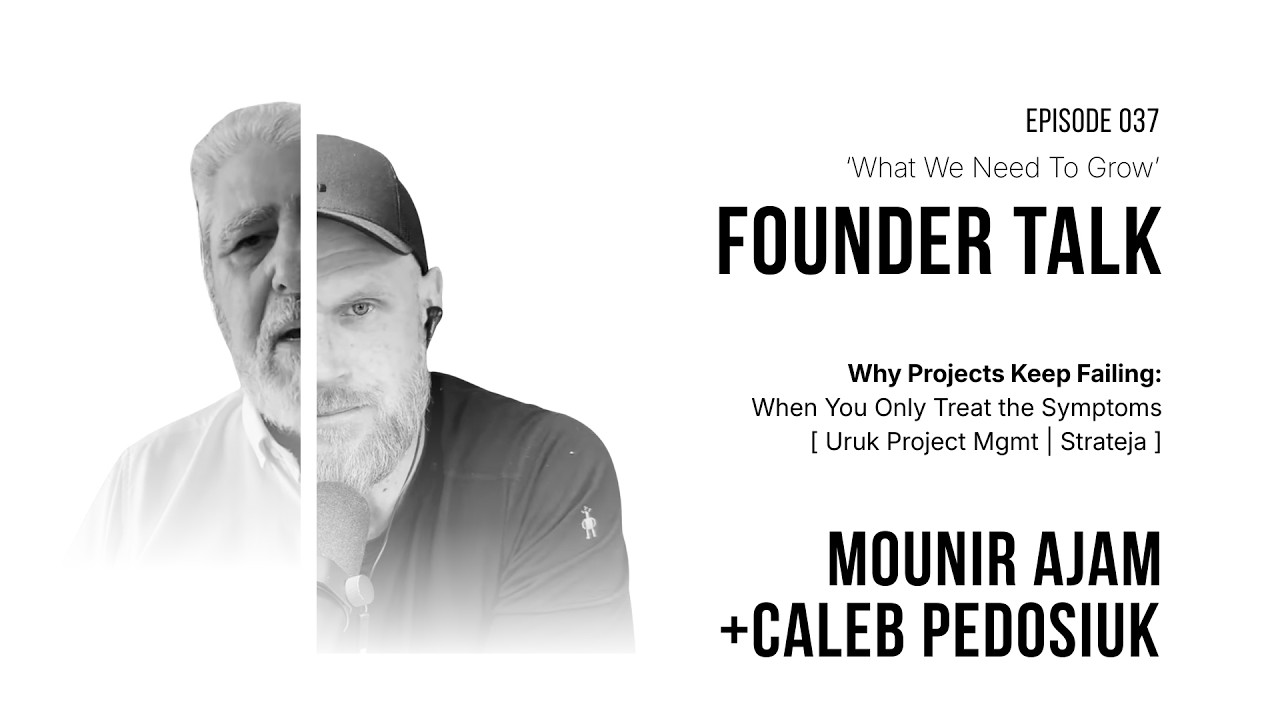
Mounir Ajam is the founder and CEO of Uruk Project Management in Houston, Texas, with over 35 years on projects worth billions of dollars, split between capital projects in oil, gas and petrochemicals and consultancy work with governments across the Gulf and Southeast Asia. His argument is that after forty years of certification culture the project failure rate has not moved, and that every reason people give for it is a symptom. The cause he names is structural: companies have a finance department and a chief marketing officer and no project management department and no chief project officer, and a function organized as an office never gets the authority to be strategic. The most transferable idea in the conversation is about AI, and it is not about project management at all. Generic models are trained on the content that exists today, the content in his field carries the same gaps he has spent thirty years documenting, and a junior practitioner has no way to tell where the answer is wrong, so the gaps get repeated back as fact. He puts AI implementation failure at eighty percent or higher and traces it to organizations moving before their data is ready. The detail worth sitting with is how the company started: readers of his books offered to fund it, ten and twenty thousand dollars at a time. That is the throughline 79 Development keeps coming back to. Expertise that stays in someone's head is indistinguishable from no expertise at all, and an honest, structured account of the work is what makes a brand understood, trusted, and findable by the systems people now ask for answers.
KEY TAKEAWAYS
- The root cause is not on the list of fifty reasons. Forty years of certification culture, millions and billions spent on credentials and PMOs, and the failure rate has not moved. "If you ask 5 people why projects fail or why organizations do not achieve their full objective, they will give you 50 reasons. But all these 50 reasons are probably symptoms. We have not considered the root cause." His root cause is a single structural fact: project management is treated as tactical and operational, never as strategic, and so it is never given the authority to be either.
- An office is not a department, and the word itself is the diagnosis. Walk into any company and you find an HR department, an IT department, a finance department, a marketing department, a chief marketing officer, a chief people officer. "But you don't find project management department, with some exception, you don't find chief project officers. As a role, as at the C-suite level." Where project management is organized at all, it is organized as an office. "Psychologically speaking, there is a huge difference between what we call a project management office versus a project management business unit or a division that is led by an executive."
- Executives do not care about the technical layer, which is the only layer most of the field teaches. "Even when we focus on project management, we focus on the technical aspect, you know, scheduling, scope management, stakeholder engagement, which is for an executive, who cares? Executive want to see result. Executive want to see project performance." The correction he named for this is business integrated project management: project management joined to the business from the highest level to the lowest working level, and present at strategy formulation rather than handed a finished strategy to execute. His reason is blunt. You can write a beautiful vision, but if you cannot implement it you are only choosing how to waste resources.
- Delivering the product is not delivering the value, and the gap between them is where projects quietly fail. His example is a museum. The design, the engineering, the construction, the commissioning all produce a building. "Before you open the door, you need to make sure you have hired the people that need to operate the museum. You need to train those people. You need to develop the operating and maintenance procedure." That work is usually a separate team's problem and usually ignored. So the platform opens a second path at the point execution is approved: one path builds the product, the other gets the organization ready to operate it. Software has exactly the same shape, he notes, where the go to market preparation has to run in parallel with the build.
- More than ninety percent of projects are never assessed against the reason they were started. Most projects end when the product is finished. "In our view, no, the project doesn't end there. The project product ends there." Product leads to outcome, outcome leads to value, and value can only be measured once people are actually operating the thing. His model for this is PCA: predetermine, cultivate, assess, and achieve success. Define the criteria for success during the feasibility study, hold to them through the lifecycle, and at the end assess three separate things, the technical success, the project management success, and the business success. Did it deliver the vision? "That is today, I can assure you, probably in more than 90% of the cases around the world today, that's not even measured. It's basically left to default."
- Generic AI inherits the gaps of the field it was trained on, and project management has large ones. This is the sharpest idea in the conversation and it generalizes well past his industry. "The problem is technology, especially AI, is being trained on what content exists today. And in the project management area, the content that exists today have a lot of gaps. See, these are the gaps that I've been spending 20, 30 years of my life finding and trying to fix. So those gaps exist today, and AI, the generic AI, is speaking those gaps and keeping those gaps and becoming like fact." He can hear the weak answers because he has 35 years in the domain. "But a young professional doesn't have that expertise. So if they tend to trust AI too much, then we will start to see failure mode that come with AI."
- He puts AI implementation failure at eighty percent or higher, and money is not the protection people think it is. Smaller organizations cannot build a system trained on their own way of working. Larger ones can, "and the statistics that we've seen so far is something like 80%, or if not more, of AI implementation projects actually are failing." His read on why is preparation, and specifically data: organizations move before they are ready, "and especially when their data is all over the place." His conclusion is not that AI will not be disruptive. It is that the disruption could just as easily be negative, producing more failures than there were before.
- Tailoring is the product, not a feature of it. A small project and a mega project cannot share a lifecycle: the stages, the steps and the governance rules all change. So the platform ships with ten pre-built methods. Take the one closest to your situation, modify it within hours rather than the days and weeks it takes to build one from nothing, "and it become part of their organizational asset they use for the future."
- The company exists because his readers offered to pay for it. He did not raise a round to start. People who had read his books, taken his training or followed his writing came to him with the same idea. "Oh, Mounir, you have a great methodology, why don't we convert it into a software? And a bunch of people came up to me and said, I mean, we will fund you, you know, $10,000 here, $20,000 there." That is what started the company. Twenty years of published thinking became the distribution, the credibility and the seed capital at once, which is the clearest illustration on this show so far of what documented expertise is actually worth.
FULL TRANSCRIPT
What We Need to Grow, Episode 037: An Office, Not a Department. A Founder Talk conversation with Mounir Ajam, Founder and CEO of Uruk Project Management. Cleaned for readability; the words are the speakers' own.
Caleb Pedosiuk: All right, Mounir, very good to see you again. Since our first conversation when we first connected a couple of weeks back, I have been thinking a little bit about your background. You are someone working in the project management space, you have dealt with projects that are spanning, I mean, some of the projects from the sounds of it are dealing with billions of dollars overall, over a lifespan of about 35 years. You are still working in the space, you have been consulting, you have deep expertise in a field that requires very deep expertise, and yet you have, I do not know if it is so much of a pivot or you have expanded out to actually build software. So you have built a platform that helps project managers in this space to be able to filter their expertise, leverage other expertise, leverage expertise from yourself. So one of the things I have been wondering about is where the gap is, if there is a gap, for someone with deep consulting expertise who is used to the space. Where is that gap between where you would be if you were in a project, and where the tool you have built now steps in?
Mounir Ajam: The solution we are building aligns with our philosophy of how to manage projects. And the whole reason behind all of this is that over the years we have seen a very high rate of project failures and project management failures, where organizations are failing to deliver on their visions, to a different extent depending on which industry you are in.
Over the last 35 years I have been in this domain, I have been privileged to work in different industries and different domains. I spent about 15 years of my career in what we call the capital project, industrial, petrochemical, oil and gas. I have worked in different roles and on all types of projects, from a tiny project built inside an existing operating chemical plant all the way to building a huge mega project on an island somewhere. So I have had significant exposure, and in that period of time we have seen excellent performance and we have seen some poor performance.
Then I shifted my career into more consultancy and training. So I ended up working with a lot of government organizations, private companies, small and large, and we kept seeing the same failure mode. A lot of organizations are often failing to link strategy to results. Whether it is during the strategy formulation itself or executing the strategy, we have seen a lot of problems and weaknesses and gaps.
Part of that is that the domain of project management is often seen as a tactical role, as an operational role, as a secondary role. It is not viewed from a strategic perspective, where project management is and can be a competitive advantage and indispensable for organizational success. A lot of organizations invested millions and billions of dollars in certification and building PMOs, and we still see a lot of failures.
So as I kept digging through that and researching with my team and my previous company, why is that? And we think if you ask 5 people why projects fail or why organizations do not achieve their full objective, they will give you 50 reasons. But all these 50 reasons are probably symptoms. We have not considered the root cause, which is, in my opinion, that project management is not viewed strategically, is not considered a strategic function within an organization, is not even often enough considered a mandated or what I would call a core function.
Like for example, you go to companies, you will find an HR department, an IT department, a finance department, a marketing department. You will find a chief marketing officer, you will find a chief people officer, but you do not find a project management department. With some exceptions, you do not find chief project officers, as a role, at the C-suite level. That is a sign that even if project management is organized within a company, you see it as an office. So psychologically speaking, there is a huge difference between what we call a project management office versus a project management business unit or a division that is led by an executive. That is part of the root cause of the problem, that project management is not considered that strategic.
As a result of that, we end up not building the proper project management system and the people system. That is another huge gap that we have seen. Often enough, even when we focus on project management, we focus on the technical aspect, you know, scheduling, scope management, stakeholder engagement, which is for an executive, who cares? Executives want to see results. Executives want to see project performance. And that is where we came up with the concept of what we call business integrated project management. That basically and simply means project management must be integrated with the business, from the top highest level to the lowest working level within an organization.
Caleb: So I am curious to know how much of the execution of that integration is being disrupted or augmented by recent developments in AI. You have now built a platform and a tool that takes these observations and your hypothesis of how to fix it, and you are integrating it into a system. Is there some way to quantify the amount of disruption you see as possible here?
Mounir: Obviously there is a lot of hype. Let me start with that. If you read some of the publications that deal especially with technology and software, you hear comments like AI is going to replace 80% of the jobs. Obviously that is not the case. And a lot of organizations are jumping on AI, I think, too early. Or at least without proper preparation, let me put it that way.
What do I mean by that? If you go today and use some of the existing tools that are built outside of your company, outside of your organization, it is going to be based on generic content, not necessarily applicable exactly to the way you do business. So AI can help you improve efficiency. For example, I have used it in writing my books. I put the ideas, I put what I want, I write some text and say, okay, help me refine it. In project management we can say, okay, help me identify some of the risks here.
However, the danger in technology, and that has been the case since probably the computer came about 40, 50 years ago, is that sometimes we trust technology too much. The problem is technology, especially AI, is being trained on what content exists today. And in the project management area, the content that exists today has a lot of gaps. See, these are the gaps that I have been spending 20, 30 years of my life finding and trying to fix. So those gaps exist today, and AI, the generic AI, is speaking those gaps and keeping those gaps and becoming like fact.
So for example, when I ask AI something related to my domain, I can tell if it has good content or if it has some weaknesses, and where the weakness is and which strengths, because I have 35 years in this domain. But a young professional does not have that expertise. So if they tend to trust AI too much, then we will start to see failure modes that come with AI. That is one problem, about degree of trust.
The second problem with AI is that the smallest organizations do not have the resources and capability to build their own AI tool that is based on their system. Bigger organizations, rich organizations, they have the capability. When they have the capability, the statistics that we have seen so far are something like 80%, or if not more, of AI implementation projects actually are failing. So even when organizations are spending money on this, they are still failing. I think a lot of that is because they probably do not do enough preparation, and especially when their data is all over the place.
So AI will be disruptive for sure. However, the disruption will take time, and the disruption could be negative because of everything I just said. The disruption could be negative when we are trusting AI too much, and we end up with a lot of failures, maybe even more than we had before. That is something organizations need to be extremely careful about when they go into building an AI solution to support their project management or their business in general.
Caleb: So if we went through it step by step, let us say that this afternoon someone comes across what it is that you have been building. First of all, who is that ideal project manager or project owner? How does it work? They are going to come into it, they are going to become familiar with what you have built. Are they then bringing in contractors? Are they bringing in their own stakeholders? Are they integrating other software they are using to import data?
Mounir: Let me start by talking about the approach we followed as a business, because we have been in this domain for 35 plus years, so we have significant domain expertise. A lot of what we have been doing over the last 20 years is documenting the learning and the gaps, and that led us to develop something we call the Uruk framework. That is our framework, or our philosophy maybe, of how organizations can bridge strategy to results. So it starts at the highest level. And actually, a side note here, next Sunday I will be presenting at a conference in Saudi about the same concept, so that as a country, if you want to implement a national project authority or a national project management system based on our concept.
We started with that knowledge foundation, built on 20, 30 years of actually working on projects in addition to research and development, and then we convert all that knowledge and framework into the software. We do not call it a tool. Our software, it could be a combination of 20 or 30 tools once it is all built and done. The vision of our software that we are building, and we call it Stratija, is basically linking strategy to results.
At the strategic level, it starts with strategy formulation. If you have an organization, any type of organization, and let me sidetrack for a second here because you asked what industries, technically every organization today, whether you are a nonprofit, an NGO, a government entity or a private company, you work on projects. If you are in oil and gas, petrochemical, pharmaceutical, medical, every organization works on projects, whether they are facilities projects or technology projects or marketing or training or educational projects. They work on projects.
So if an organization accepts our solution, the vision of it, and it is not fully there yet, you start with strategy formulation. We want project management and the chief project officer to be involved at that level when you are formulating a strategy, because when you formulate a strategy you need to understand your capacity, your competition, your capability as an organization. You could come up with a very nice vision, but if you cannot implement it, you are going to waste a lot of resources.
Then, using the concept of portfolio management and strategy execution, we convert that vision or that strategy into strategic initiatives and strategic goals. You have to establish your strategic goals, and that would help us convert that into a product, program, or project. Programs and projects help us implement that. Because a strategic plan consists of initiatives and strategic goals. You need to do something to change your current reality into a desired outcome, into a brighter future. That is the strategy, that is the vision. How do you implement it? You need the mechanism. That mechanism is through program and project management. So that is at the highest level.
Now let us say an organization established a strategy, and we converted that strategy into execution, into a roadmap. Now we have a list of programs and projects. So now we need to manage each one of them. What exists today in our platform, which we have already built, that is the MVP that we built, is how you manage those initiatives one by one.
So you go in at the vision. What is the initiative, what are you going to do? Let us say we want to enter a new market. That could be a business, or we want to build a new hotel. From that point of the vision, our software starts. You go in, you put your information into the software, and that helps you formalize or prepare a proper document that we call a project brief. That is basically how you start the project.
Then we say you need to conduct a feasibility study. You must define the success criteria, because often enough we do not define success. We basically depend on, oh, the project is finished, therefore we succeeded. That is not the case. We do not succeed in project management when we deliver output. We do not do projects because we want to deliver output. A project owner organization, whether they are an NGO or government or private, they do projects because they want value. This is why we call our methodology the value delivery methodology that we are building in the platform, that starts with the vision of that initiative, whatever that initiative is, whether it is a new opportunity you want to pursue or a strategy you want to manage. You start with that vision, the what, the why, the justification.
Then that is not enough. Let us conduct a feasibility study. You need to make sure that, hey, the idea might be great, but you might not be capable of doing it now. Maybe it is something that needs to be postponed or cancelled totally. So it needs to go through proper feasibility, and that is often missed or abbreviated or accelerated. Organizations do not take enough time to do this. Once you do it right, you establish success criteria. What does success look like? This is before we start to do any real work on the project. We are still in very, very early stages, where typically today project management is not even involved. And that is when we talk about project management being at a strategic level, because it needs to be involved at that very early point.
Then of course, I can go on and on, but basically you go to the next step, which is you define the business requirement, the technical requirement, security requirement, anything depending on the nature of the project. You develop your project management plan, you develop your detailed plan, you go to execute. And in parallel to execution, we introduce change management, because now you need to prepare for what happens after execution.
Let me give you an example. A company is building a museum. Often enough the focus is on the team that is building the museum, the design, the engineering, the construction, the commissioning of that museum, but that will give us only a building. Before you open the door, you need to make sure you have hired the people that need to operate the museum. You need to train those people. You need to develop the operating and maintenance procedure, the technology system that goes with it. Usually that is done by a separate team and is often ignored in project management. We end up focusing only on building the product.
Same in software. We are building the product, but how about the marketing, the go-to-market preparation that needs to be happening in parallel? All of that for us is in the software. So after the point where management approves the project to proceed to execution, we open a parallel path, one path to build the product and another path to get ready to operate the product.
Now, most projects, when the product is finished, they end. In our view, no, the project does not end there. The project product ends there. You deliver the product, but to deliver value you need multiple things. First we need to develop the product. The product should lead to an outcome. Now we have different capabilities, we have people operating. If it is software, for example, now we have people using the new software in order to improve their performance. But usually that is not done in many organizations, because they end the project and they demobilize the team when the product is out. We say no, you need to go all the way into operation, because only then can you measure and assess the final success measure. That is when you are achieving the benefit you expected. Then value is achieved.
So we have a model we call PCA, which is predetermine, cultivate, assess, and achieve success. At the beginning, in the feasibility study, you define the criteria for success. And then throughout that lifecycle I just explained, you are making sure you are staying on track to achieve that success. And at the end you need to assess success. You assess the technical success, you assess the project management success, and you assess the business success. Did the project deliver the vision? That is today, I can assure you, probably in more than 90% of the cases around the world today, that is not even measured. It is basically left to default.
So our software allows you to do that entire value lifecycle, and the key is that lifecycle is tailored. What do I mean by that? If you are managing a small project versus managing a huge project, the process, the lifecycle, the number of stages, the number of steps, the governance rules change. It has to be adapted, or we call it tailored methods. You have to tailor it to the specific case of an organization.
Our system starts with 10 different methods. So you can go in and you can select one of the methods that is most applicable to you, and if none of them is perfect for you, you can take the one closest to what you want, and then within hours you can modify it and build your own method. So instead of an organization taking days and weeks to build a tailored method for them, we built it. It is there. They can take it and modify it within hours, and it becomes part of their organizational asset that they use for the future. So there is much more in the software than that, but that is at the strategy level and at the working level.
Caleb: You have published a fair amount of your writing, your thinking. From what I can see, you just mentioned you are consulting with the Saudi Arabian government at some level with some projects. You are, I think, based in the US and working here across multiple industries. How are you finding these conversations are happening with project owners? Is it through word of mouth? Are people finding you through your thought leadership, through some of the educational materials that are industry-specific?
Mounir: It changed, because we are new to the US. I was in the US for 20 years before I left the US for a long time. So most of our business was in what we call the Gulf Cooperation Council, Saudi. We were based in the UAE, but when we left that to come back to the US, it was primarily to build the software. Obviously we are starting from scratch in the US, because we did not have that network here. So a lot of our business is still dealing with companies, or even training, for overseas. But now we are building that practice here in the US.
So conversation, a lot of it, yes, it is about leadership. Even the whole reason the company was established is because many people have read my previous books and said, oh, Mounir, you have a great methodology, why do you not convert it into software? And a bunch of people came up to me and said, we will fund you, you know, $10,000 here, $20,000 there. We will fund you. Let us start a company to build software based on your methodology. That is how we started, based on people who have read my books, my work, or taken training with me, or have seen my posts online.
So yes, a lot of the conversation is happening right now through the network, through my online work, because I publish a lot online in addition to my books. That is the starting point. But in the US we are just starting to build that, because we have been focusing on technology. We have not been going to market, so we have not put a lot of energy into building the market yet. So now that is what we are doing.
Caleb: Well, I can certainly see the importance of what it is that you do, because as much as AI has all of this raw potential, it also has an unlimited amount of useless activity. If it is directed properly, the energy is like a laser, it can be incredibly effective. But it can also, if dispersed widely, add to confusion, add to compounding timelines of indecision or error. So in and of itself it is not a solution unless properly applied. Let us say that you have the funding equation, an unlimited amount of money. You need those resources, like banks have a river, to be able to direct that water. Otherwise you end up with a swamp, a marsh. So I can see the importance of it. What would be the best way for people to follow along? You mentioned you have a beta version of the software. Would you say just following what you are doing on LinkedIn, and that way as you are posting updates they would be able to see it, or do you have a program where people should be getting on a waitlist?
Mounir: Right now, actually, it is the first time in the public I actually named our software Stratija. Because it is not even public yet, it is not announced yet. We would expect to announce, and the website, we are finalizing the website this week. We have an MVP, so basically the MVP will be done this month. We are already using it and testing it on internal projects and doing very well. We are just right now putting the final touch on the branding and on the website.
So the best way right now for people is to reach out to me online, or our company page, Uruk Project Management, or they can go to stratija.com. But stratija.com will not be live until maybe by the time this podcast is out. It probably will be live, because it will be live this week for sure. That is one way, and they can keep up with our work. If they follow me or the company page, they can actually see the full picture of what we do, the services we offer, the learning and development, the books we are publishing. If they are only interested in the technology component, stratija.com would be the place for them to go to.
Caleb: And Stratija is spelled like strategic, but instead of the "ic" at the end it would be different. Is that correct?
Mounir: It is actually a combination of 2 words, strategy and result, but we played on Arabic actually. So Stra, S-T-R-A, ti, T-I, J-A, not G, J-A. So Stratija, S-T-R-A-T-I-J-A, stratija.com.
Caleb: Stratija. Excellent. Well, Mounir, thank you very much for sharing. We will put your LinkedIn in the show notes. We will put the link to Stratija and your work, so that people who are project owners, and I think also those who are invested in a project at a high level and are looking for another layer to add to the quality of their management, managing contractors on major projects across the board, across industries, can certainly take a look at what you are doing and reach out to you or your team to be able to understand what it could look like for them.
Mounir: Sounds good. Thank you.
What We Need to Grow is a conversation series by 79 Development, hosted by Caleb Pedosiuk. New episodes on YouTube and Spotify.