Why the STEM Talent Pipeline Starts With 8th Grade Algebra
For executives deciding where corporate giving actually moves a workforce, and for nonprofit founders who have to make their case in the language of the people funding it.
About Adrian Mims
Dr. Adrian Mims Sr. is the founder and CEO of The Calculus Project, the Massachusetts nonprofit he built out of his own doctoral dissertation, *Improving African American Achievement in Geometry Honors*, and has run since 2009. It is known for moving Black, Hispanic, Indigenous and low-income students into honours and advanced mathematics beginning in middle school, and has reached more than 10,000 students across more than 100 middle and high schools in Massachusetts and Florida. The program was inducted into the Minority Student Achievement Network's Promising Practices Clearinghouse in 2011, and The Calculus Project was one of five organizations to receive a $1 million unrestricted award through The 1954 Project, whose network lists him as a Luminary. He holds a Bachelor of Science in mathematics, a Master of Arts in teaching mathematics, a Certificate of Advanced Graduate Study in educational leadership, and a Doctor of Education in educational leadership and administration.
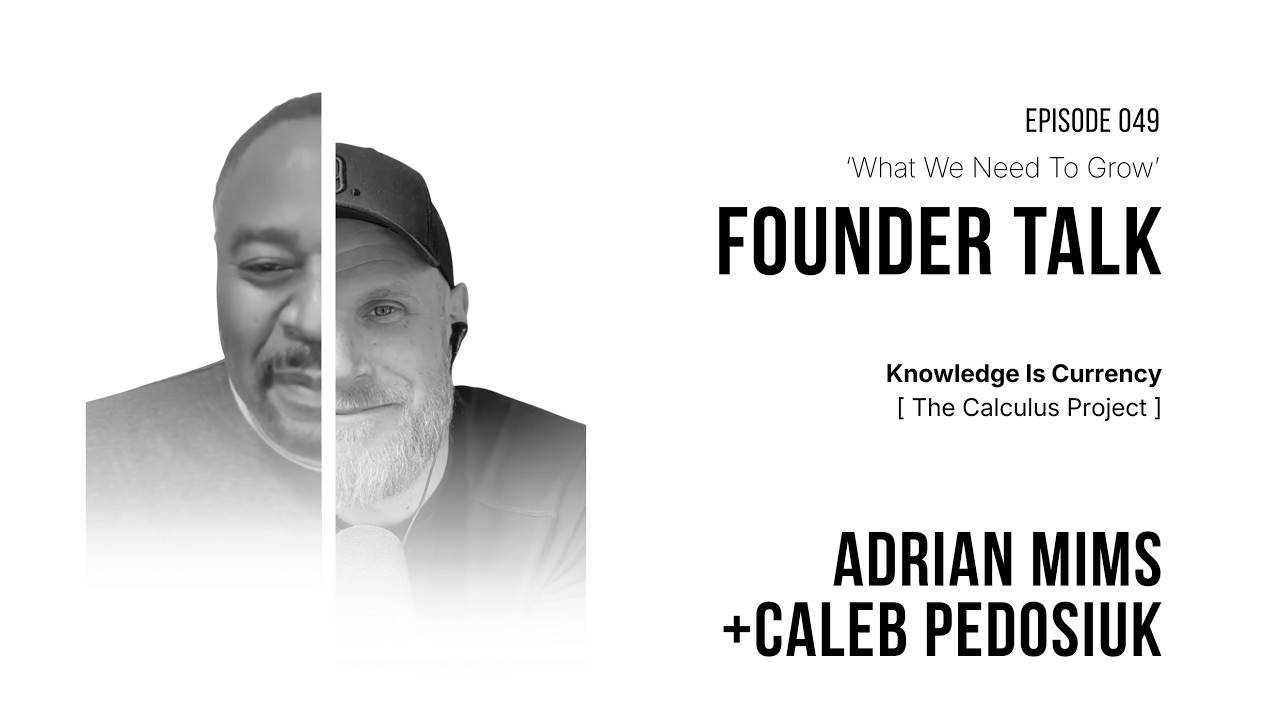
Dr. Adrian Mims Sr. turned his own doctoral dissertation into The Calculus Project, which since 2009 has moved more than 10,000 students through more than 100 middle and high schools toward honours and advanced mathematics. His framing of the problem is that the constraint is not ability, it is access: "so many students have the ability and the capability to perform at a high level in advanced mathematics, but unfortunately, due to their zip code, they just don't have that access." His argument to the private sector is made in its own language. "The only difference between for-profit and nonprofit is a tax code," both are businesses that have to be funded, and the work "directly impact everyone's bottom line and us as a nation." He traces the mechanism precisely, from algebra in eighth grade to calculus in senior year to a completed STEM degree, and then to the companies now recruiting that talent through H-1B visas because the domestic pipeline was never built. On AI he is neither evangelist nor refusenik, and the analogy he uses is a calculator and a student who thought his was broken: the tool is only as good as the understanding of what goes into it, so the goal is "to enhance learning and not replace the thinking and reasoning that students really need." Asked what he needs most to grow, he named open-minded educators ahead of money, and said he doubted anyone had given that answer before. That is the throughline 79 Development keeps coming back to. Work this substantial is worth nothing to the people who could fund it if they cannot find it or read it, and making a real record legible is what builds the kind of signal AI systems draw on.
KEY TAKEAWAYS
- The constraint is not ability, it is the postal code. His framing of the problem, and he does not soften it. "So many students have the ability and the capability to perform at a high level in advanced mathematics, but unfortunately, due to their zip code, they just don't have that access." He names the places rather than abstracting them: "whether students are living in Compton or Harlem or in rural areas in West Virginia, through no fault of their own, they're in environments and in school systems where they just don't have the opportunity to reach their highest potential." The program is delivered in five components and it is explicitly collaborative, built "very collaboratively with parents, with school districts, educators, and students."
- "The only difference between for-profit and nonprofit is a tax code." The sentence that reframes the whole funding conversation, and it is his opening move when he talks to the private sector. "You know, both are businesses. The nonprofit work that's happening across the country has to be funded." He is not asking for charity so much as arguing that the work sits inside someone else's supply chain: "the work that a lot of nonprofits do directly impact everyone's bottom line and us as a nation."
- Eighth grade algebra is where the trajectory is set. The most concrete mechanism in the episode, and the reason middle school is where the program starts. "We know that when students are taking algebra in the 8th grade, that's very important because all things considered, if they stay on that trajectory, they're taking calculus their senior year in high school." What follows from that is measurable: students who take AP Calculus AB or BC, or even a high school calculus course, "are better prepared for college completion" and better prepared to pursue two-year and four-year STEM degrees. And the requirement reaches past STEM entirely. "If you're a student and you're going to Northeastern University here in Boston, and you want to graduate with a degree in finance or some other business discipline, you have to take business calculus."
- The H-1B conversation is a symptom, and he points the argument straight at CEOs. The case he makes to the private sector, stated as economics rather than as a grievance. "We're the most technologically advanced society now than we've ever been before. You talk about AI and you talk about autonomous vehicles and you talk about space exploration. But when you look at these companies like Meta, Google, Boeing, when you look at where they're recruiting their workforce, a lot of their workforce is coming from outside the country through H-1B visas." His point is not that this is wrong, it is that it is avoidable: "we have the talent here in this country, but because our educational school system isn't working the way that it should work, making sure that all students have unfettered access to these advanced courses to prepare them, it really hurts us economically." He ties achievement and performance gaps to GDP, and then to capacity: "you can't take on additional projects and additional work if you don't have the workforce."
- "To be it, you need to see it." His grandmother's line, and the basis of what the program calls its Pride curriculum. He brings founders and executives in front of students to talk about leadership, entrepreneurship and failure, and the example he reaches for is Marcus Wilson, co-founder of NOBULL, who holds an engineering degree from Cornell. Wilson talked to the students about "how important it is to do hard things, to push yourself and to challenge yourself." Mims describes the room: "when you walked in that room, you could hear a nail drop, right? And those students were captivated." What he tells them to do with it is the part worth keeping. "Take out a pen, take out a pad, write down notes, ask questions, because knowledge is currency. And so what we want you to do is take away the knowledge so that you can build your own individual blueprint."
- Let partners decide how they want to participate, and the cash is not always the valuable part. His actual partnership method, which is closer to relationship management than to fundraising. "We just really lay out everything that we're doing, what our vision is, and let them figure out how they want to be part of this partnership." The example he gives is not a cheque: one corporate partner provides in-kind office space, "that's huge because that saves us a lot of money, it allows us to provide training seminars for math teachers," and runs career fairs where students can learn about STEM professions and work toward internships. Others "just want to just on the periphery, just observe and see what happens, and they just want to give money," which he welcomes equally. The thing he says he has learned is that the relationships compound: "once you are engaged with these supporters over time, those relationships evolve, and they identify other ways they would like to support and participate."
- On AI in the classroom, the calculator is the precedent and the student who thought his was broken is the lesson. The most useful few minutes in the episode for anyone thinking about AI and judgment. He recalls the same panic about calculators, then makes the turn: "calculators are actually pretty dumb because you have to know how to enter the information to get the right output." The story is exact. A student entered negative two squared, got negative four, and announced the calculator was broken. Asked what the answer should be, the student said four, "because it's negative 2 times negative 2." The student had meant to put the negative two in parentheses; without them, order of operations raises the two to the power first and then applies the sign. "So the reason why I'm giving you that example is AI is very much like that still. You really need to understand what data and information you're putting in, but you also need to understand some of the limitations to the data." His organization's own position is deliberate: integrate it "in a way wherein that students and teachers can leverage it as a tool to enhance learning and not replace the thinking and reasoning that students really need to thrive in this world. We don't want it to do the work for students." He notes the research they ran on this roughly four years ago produced wrong answers and nonsensical algebra problems, and that the same technology now "is conducting proofs of doing mathematical proofs and getting it right, something that it never did before." Districts, he says, split cleanly: some running toward it, some running away. And he frames resistance as a single question. "One is change means that I have something to gain, and the other is that change means I have something to lose. And the people who tend to think that change means that they have something to lose, they definitely push back against the people who think that they have something to gain."
- Asked what he needs most to grow, he named open minds before money, and said so himself. The show's standing closing question, and he flagged his own answer as unusual. "I mean, of course we need funding to grow. But I think we also, and this is, you probably never heard this answer, we need more educators to be open-minded." What he means by it is structural. "When you look at the school year, it's 180 days. It was built off of the agrarian calendar. The school year is still 180 days, and in some places in the country it's less than 180 days." He reaches for the line about the definition of insanity being doing the same thing over and over and expecting different results, and asks for willingness rather than agreement: that educators "be reasonable and open to conversations around looking at how they work with students and families and how they are teaching math, and be willing to engage in professional development." He points back to A Nation at Risk, released under the Reagan administration, which framed education as a matter of national security, and notes how little the public conversation has moved since. "You rarely hear conversations about education and its importance on the news, and you rarely hear about initiatives that are moving the needle. So that's what I hope for. I mean, I definitely need more funding, but I definitely would like to have more opportunities to have discussions."
FULL TRANSCRIPT
What We Need to Grow, Episode 049: Knowledge Is Currency. A Founder Talk conversation with Adrian Mims, founder and CEO of The Calculus Project. Cleaned for readability; the words are the speakers' own.
Caleb Pedosiuk: So Adrian, we've been talking for almost twenty minutes before we hit record. So first of all, I just really appreciate you, the bit that I understand about you. I know that we've really just met through for this purpose, but you are serving people and communities that often it's easy for them to be overlooked. And you're bringing, from what I understand, opportunity, and you're bringing something that I think is just so important. So can you share a little bit about the Calculus Project, what you're working on?
Adrian Mims: Our mission is to dramatically increase the performance and access of students who identify as Black African American, Hispanic and low-income students, Indigenous students, to prepare them for success in advanced mathematics.
And the reason why that is so important is because so many students have the ability and the capability to perform at a high level in advanced mathematics, but unfortunately, due to their zip code, they just don't have that access. So whether students are living in Compton or Harlem or in rural areas in West Virginia, through no fault of their own, they're in environments and in school systems where they just don't have the opportunity to reach their highest potential.
That's one of the reasons why I'm passionate about the work. And this work is so important because we recognize that these students have the ability, and we work very collaboratively with parents, with school districts, educators, and students to provide them with the resources so that they can access advanced mathematics. And the way they do that is through our five components that comprise the Calculus Project, which is the name of the nonprofit.
Caleb: So I'm curious to understand a little bit of how you got into this. What was the motivation for you? What was some of that story? But maybe we can come back to that. The thing that I'm curious about, we were just talking a little bit and you touched on it just in passing, but I'd like to jump to that: how do these things happen? How do these things get funded?
I've noticed that I see a lot of people that recognize there are challenges in the world and want to make a difference about it. And one of the most beautiful ways I see is when an entrepreneur goes and starts solving a problem, people want it solved, and in the exchange, in a free market, for money to solve that problem, if they do that well and they structure that business well, it'll grow and expand to be able to serve more people. But in the instance where there isn't necessarily a product that's being sold, we have nonprofits that get created.
You mentioned in passing that you listed a major franchise, very successful globally, that had set aside funding for their nonprofit, and that there were applicants and you guys were recipients of that. So can you speak to the role that the for-profit sector plays when they allocate resources to be able to fund projects like yours? What has that meant for you guys?
Adrian: It's been huge, very significant. One of the things that I talk about often is nonprofit versus for-profit. And really the only difference between for-profit and nonprofit is a tax code. You know, both are businesses. The nonprofit work that's happening across the country has to be funded.
Whether you're a venture capitalist, a CEO running a bank or whatever, the work that a lot of nonprofits do directly impact everyone's bottom line and us as a nation. And I'm just going to give you an example with us, the work that we do. So when we don't have students reaching their highest potential in mathematics, what does that do long-term?
Well, we know that when students are taking algebra in the 8th grade, that's very important, because all things considered, if they stay on that trajectory, they're taking calculus their senior year in high school. Why is that important? Well, the research and the studies show that students who are taking calculus, in particular AP Calculus AB or BC, or even a high school calculus course, are better prepared for college completion. They're also better prepared to pursue post-secondary degrees, whether two-year or four-year, in STEM-related disciplines.
And for example, if you're a student and you're going to Northeastern University here in Boston, and you want to graduate with a degree in finance or some other business discipline, you have to take business calculus. So students being introduced to those courses while they're in high school actually prepares them to complete college within six years, and those students who have those high-level courses have a higher completion percentage of college.
Now, how does that transfer into the workforce, and why is this important for CEOs? Well, we're the most technologically advanced society now than we've ever been before. You talk about AI and you talk about autonomous vehicles and you talk about space exploration. But when you look at these companies like Meta, Google, Boeing, when you look at where they're recruiting their workforce, a lot of their workforce is coming from outside the country through H-1B visas. And that's great. However, we have the talent here in this country, but because our educational school system isn't working the way that it should work, making sure that all students have unfettered access to these advanced courses to prepare them, it really hurts us economically.
There are a lot of studies and papers out there that talk about having these gaps. Achievement gaps and performance gaps, it actually hurts our gross domestic product, our GDP. And we're facing a significant deficit, so we need to make sure that all hands are on deck. When there's a pool of highly trained engineers and students with STEM degrees, that just allows companies to operate at their highest capacity. You can't take on additional projects and additional work if you don't have the workforce. So I think for us, as people who work at the Calculus Project, it's really about helping CEOs and people in the private sector understand that the educational system needs their support, needs their help.
Caleb: What role do you think it plays to have figures that students are looking up to in a certain vertical? I'm just trying to think, as a kid growing up, I remember there was an era, I think I was eleven or twelve, and I got a bunch of Sports Illustrated magazines and I cut out all the athletes and I plastered them on this wall where we had a little bit of workout equipment as a kid. And I noticed that the trajectory, it was only in my adult years that I looked and went, wow, I played basically every single sport I could at a competitive level in high school and we just won, won, won in high school. And I look at it after and I was like, wow, I had a massive vision board around me growing up.
And I kind of wondered, what if, for kids that grow up and have a different figure, whether it's music for some that they look up to, whether it's cultural icons, filmmakers. But I've wondered when it comes to entrepreneurs or people working in technology, in math, in others, if there has been a shift towards that. Social media in many ways can be interest driven nowadays, and so it can be an echo chamber of interest. So I'll see a lot of entrepreneurial content online, but I've wondered, are a lot of kids growing up in high school seeing entrepreneurs, seeing people pioneering in technology? Is this something that they're seeing and looking up to, a sort of Kobe Bryant or a Jordan in their field that they're aspiring to?
Adrian: Yeah, that's a great question. We actually do that in the Calculus Project. It's part of what we call our Pride curriculum. And it's nothing that I would say is revolutionary, because my grandmother used to say, to be it, you need to see it, right?
And so what we do, and we're very fortunate with a lot of the people who support the Calculus Project, we're able to bring entrepreneurs and CEOs in front of students so that they can learn about what it means to be a leader, to be an entrepreneur, to fail. For example, we brought in Marcus Wilson, and a lot of people don't know who he is. He's an African-American male who is the co-founder of NOBULL, which is the sports cross-trainer apparel company. So he talked about his experience being young and taking calculus. And he actually has a background, has a degree in engineering, from Cornell. And he talked about how important it is to do hard things, to push yourself and to challenge yourself.
So when you walked in that room, you could hear a nail drop, right? And those students were captivated. And they had the opportunity to ask him a lot of questions. And when we bring people such as Marcus Wilson and other people who are highly successful in front of these students, we tell them, look, take out a pen, take out a pad, write down notes, ask questions, because knowledge is currency. That's what a friend of mine would always say. And so what we want you to do is take away the knowledge so that you can build your own individual blueprint for success.
I look up to a lot of people and I admire a lot of entrepreneurs, and some of them I haven't had the pleasure of meeting, but I hope to meet someday. And for me, one of them is Robert Smith, who is a venture capitalist and he does leveraged buyouts of tech companies, highly successful billionaire, but he's also a very generous philanthropist, and he is the gentleman who paid for the tuition, I forget what graduation year, of all of these Morehouse students who just graduated. So being able to pay it forward and to have a huge impact like that, I think that's important.
And so we try to educate students about these entrepreneurs and people who may look like them and share their same language and culture, because we recognize they're not going to necessarily learn that in their schools.
Caleb: How are some of these more successful individuals that would potentially support the organization, either by showing up and doing talks or contributing in some way, or those, whether foundations or others, that have resources and are looking to financially support, what is the path? Word of mouth certainly, but is there a way where you're seeing people say, hey, they found us through alumni that came through talking about it? What would that look like?
Adrian: We've actually done a better job at our social media and our marketing. We're still a small organization, but through the generous donations and the support of foundations and small, medium, and large individual donors, we've been able to scale our work.
And so the way we engage people who want to partner in this important work, whether it's a company or an individual or a foundation, we just really lay out everything that we're doing, what our vision is, and let them figure out how they want to be part of this partnership.
And I'll give you a quick example. We have one corporate partner that they don't necessarily provide us with funding, but they provide us with office space, in-kind office space. That's huge, because that saves us a lot of money. It allows us to provide training seminars for math teachers. They also provide career fairs wherein some of our students can come and they can learn about STEM professions, with the goal that they will have these internships.
And then you have some people who just want to, on the periphery, just observe and see what happens, and they just want to give money. And we welcome that as well. So we value all of our partners and all of our donors, and we just let them figure out the best way they want to engage.
And one of the things that I've learned about this process is that over time, this is all about relationship building and building trust. And what I've learned is that once you are engaged with these supporters over time, those relationships evolve, and they identify other ways they would like to support and participate, and we always welcome that.
Caleb: How have you seen the recent technological advancement over the last few years with AI, or I guess superintelligence now is how it's been rebranded? How are you seeing AI reimagine a lot of this? When people have tools now that they can talk to to break down problems, versus a few years ago, which would have seemed like Tony Stark science fiction.
Adrian: You know what's interesting? I remember not long after ChatGPT was really big, we were very curious as an organization about, okay, well, it's a tool, but how can we leverage this tool to improve math instruction? But also, how can we use this tool to support teachers, to help them work more efficiently and smarter in the classroom? And so we were funded by a foundation to do a little research on this.
And this was about maybe four years ago. And just to give you an idea about how the technology and AI has evolved over the years, it was initially very clunky. We experimented with, well, can it do algebra? Can it create algebra problems that students can practice? And it was giving the wrong answers, and it was creating problems that just didn't make sense.
Now is an entirely different ballgame. The advancements that they've made with AI and this technology, you now have AI that is conducting proofs of, you know, doing mathematical proofs and getting it right, something that it never did before.
So what we're seeing is that some school districts are running towards it, and they're very curious about how to implement it as a tool. And then we see some districts running away from it because they just don't know what it means. The Calculus Project, our organization, we're trying to figure out how to integrate it in a way wherein that students and teachers can leverage it as a tool to enhance learning and not replace the thinking and reasoning that students really need to thrive in this world. We don't want it to do the work for students. We want to use it as a way to enhance the learning. And so we're still figuring it out, but we're getting a lot of traction with that.
Caleb: It's interesting. I was at a store near here chatting with a cashier, and we were talking about AI, and she's in a second year, I think, of a university program, and she mentioned that they're not allowed to use it for anything at all. Total black box. And I thought that was such an interesting stance. It's funny to me that I have real respect for people that would hold a hard stance. Like I have respect for Mennonites, but then you've got the Hutterites. Hutterites are like Mennonites, but Hutterites will use advanced technology for their farming, the most advanced technology. Their equipment is the best. Mennonites, not at all. I just thought that was so interesting to see.
But as you were saying that, one thing that came to mind that I certainly see, and I feel like the need is, let's picture there's brackets. There's an equation that has fifteen different parts to it. It's complex. And let's say five, ten years ago, that's what was needing to be solved in some industry, some person, some company is solving that. Let's say that AI tools would actually be able to, with observation or with supervision, be able to solve that. To me, part of it is put brackets around that.
And then look and say, if we can solve this, what is the next equation, the larger one? In a way, it's almost like, hey, let's solve this part. This issue that's been facing labour as it relates to agriculture, can we use tools to be able to address this? But if we solve this part, how do we deal with then distribution? How do we deal with the storage and processing of things, and teaching people to still apply that form of algebraic thinking?
But using it and saying, instead of being in that one bracket for a year trying to really solve this complex challenge, you're going to now use tools and those tools are going to function there, you're going to oversee it. But now you're going to get to be doing algebra at a different level, to solve bigger aspects of things. That to me, certainly in the way a lot of the stuff that we structure working heavily with the tools, is I find more and more something that would have taken me a day is now being tasked to agents under a chief of staff to work with. And that might take twenty minutes for it to do. But then outside of it, I'm like, well, once this is done, what's the next piece that is needed? And then you're overseeing agents within brackets doing algebra, sort of, but I guess in a way.
Adrian: Yeah, I mean, I think about it like this in terms of math. I remember people having conversations about the use of calculators, right? Kids were going to be, all of a sudden they're not going to be able to count and be able to do simple arithmetic with TI-85 graphing calculators or whatever. But it still required students to think.
And so I remind educators that calculators are actually pretty dumb, because you have to know how to enter the information to get the right output. And I'd give them this example. I had a student who put into the calculator negative two squared. And the student said, my calculator's broken, because it gave me the answer negative four. And I said, really? I said, so you put it into the calculator, well, what do you think negative two squared should be? And he said, it really should be four, because it's negative two times negative two.
So that kind of took us to a conversation around language, and even what I just shared with you. If I'm talking about negative two squared, really what the student should have done was put the negative two in parentheses and then raise the power to the second to get the four. That's what the student meant to do. But because they just put negative two without the parentheses, order of operations is going to raise it to the power and then look at that negative sign, and you get negative four.
So the reason why I'm giving you that example is AI is very much like that still. You really need to understand what data and information you're putting in, but you also need to understand some of the limitations to the data. And that also led to a conversation with the students around, okay, how do I say this? Quantity negative two squared, because when I say quantity, that means that there are parentheses around it.
So I think right now, anytime you introduce something new to people, you're introducing change. And for me, there are two trains of thought around that. One is change means that I have something to gain, and the other is that change means I have something to lose. And the people who tend to think that change means that they have something to lose, they definitely push back against the people who think that they have something to gain. But I think, again, knowledge is power.
It's emerging and it's growing so fast that no one has really been able to nail it down and quantify it, and educate people in a way where you can really educate them and so that they can understand it as a tool. And just like any other tool, it can be used to do some incredible things, some beautiful things, but it can also be used to cause destruction too.
Caleb: This is the last question I like to ask, and I love hearing the different answers, because for some people it's raising capital, some people it's team, some it's awareness. What is the one thing right now that you would say you need most to grow for the organization?
Adrian: Wow. That's a great question. I mean, of course we need funding to grow. But I think we also, and this is, you probably never heard this answer, we need more educators to be open-minded.
And what I mean is that when you look at the school year, it's 180 days. It was built off of the agrarian calendar. The school year is still 180 days, and in some places in the country it's less than 180 days. And you know the Einstein quote about the definition of insanity is doing the same thing over and over expecting different results. Educators will be more open-minded and be reasonable and open to conversations around looking at how they work with students and families, and how they are teaching math, and be willing to engage in professional development so that we can do a better job educating our students.
Years ago, I think maybe Ronald Reagan was president at the time, they released a report called A Nation at Risk, and I think there have been other reports that talk about it's a national security if we're not doing a great job educating all students. But you rarely hear conversations about education and its importance on the news, and you rarely hear about initiatives that are moving the needle.
So that's what I hope for. I mean, I definitely need more funding, but I definitely would like to have more opportunities to have discussions, and hope that educators, leaders, policy people are going to hopefully approach this challenge, this crisis in education, with an open mind and with good intentions to collaborate and work together.
Caleb: As you were saying that, it reminded me of something I had seen online. I think it was in China, and I know China's not a perfect country, they certainly have their challenges, some more extreme than others, but I think it was in a train station that they had lined up a wall of scientists. They had these massive mural-like banners of people that had achieved certain breakthroughs in science and math and other different breakthroughs, and were sort of, I think, attempting to iconize them a little bit more, and doing that idea of creating something for a younger generation to look up to and see. Recognizing, what quote is it, Marshall McLuhan or something that said, I don't know, that might be wrong, but beware of what you applaud, what you celebrate, you encourage. I don't know, I wrecked the quote. Sorry, whoever had that quote. But the idea, beware of what you applaud, because you're encouraging that, certainly for a younger generation.
So I think that's interesting, to be able to find a way to look at the things in life where people are solving meaningful problems, where discipline or habits actually compound over time in a positive direction as well. But I like that, educators being open-minded, considering change. Very cool.
Adrian, thank you so much. If people want to find you or see what's going on, what's the best way to follow?
Adrian: Best way to follow, we're on LinkedIn, Instagram, Facebook. You can visit our website, www.thecalculusproject.org. Just put us in Google and do a search and you'll be able to find us. So we'd love to hear from you.
Caleb: Awesome. Thanks, Adrian.
Adrian: Thank you. I appreciate you. Have a great day.
What We Need to Grow is a conversation series by 79 Development, hosted by Caleb Pedosiuk. New episodes on YouTube and Spotify.