Why This VC Runs Fourteen Small Funds Instead of One Big One
For emerging fund managers and LPs, music industry and streaming platforms, and founders raising from a fund built differently.
About Andrew Batey
Andrew Batey is the co-founder and co-CEO of Beatdapp and the founder and general partner of Side Door Ventures, known for building the fraud detection layer that traces the billions of dollars siphoned out of music streaming royalties every year. He holds more than 40 patents across seven countries in artificial intelligence, machine learning and blockchain, and has backed over 120 companies representing more than $8 billion in enterprise value, among them K2 Space and Mysten Labs. He is also a chart-topping country artist, reaching number four on the US country singles chart with Urban Outlaws, and a professional Karate Combat fighter.
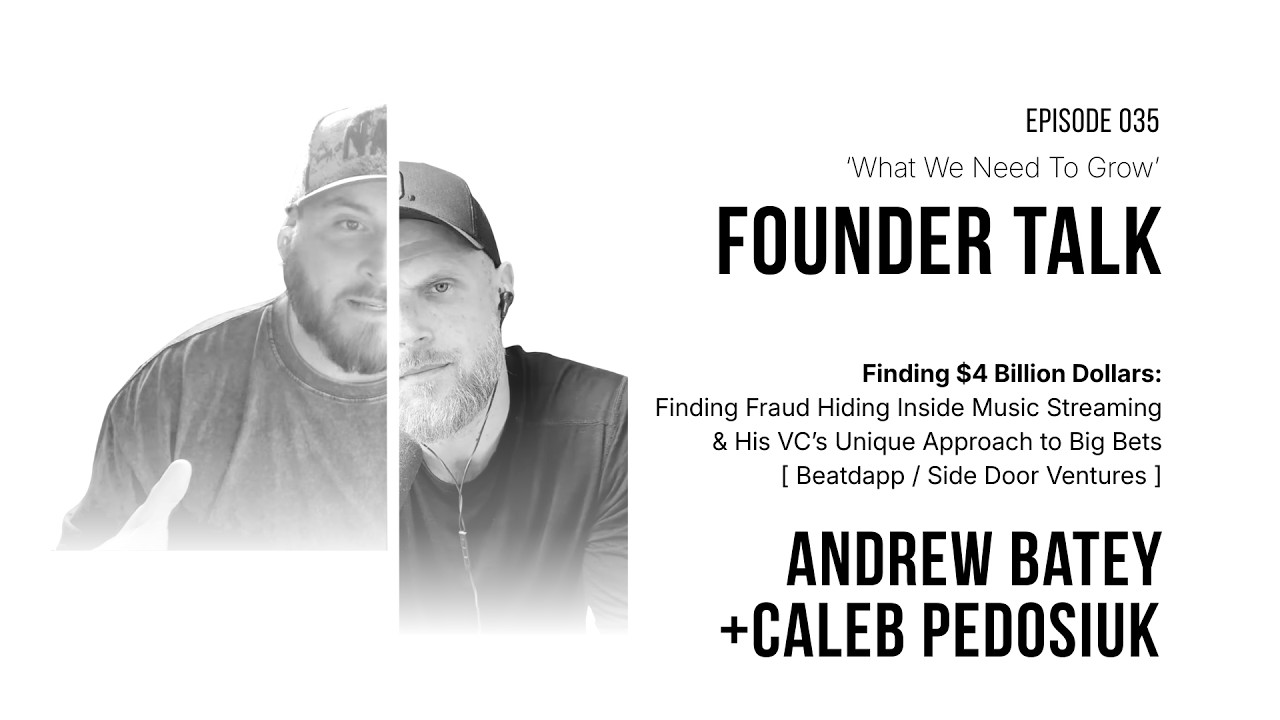
Andrew Batey is co-founder and co-CEO of Beatdapp and founder and general partner of Side Door Ventures. Beatdapp was asked to solve an accounting problem, proving how many times a song had actually been played, because an artist gets a spreadsheet saying a hundred million and, in his phrase, has no receipts. What it found instead was that streaming revenue is pooled and split by share of total plays, so nobody knows what they are owed until the month closes, and fraudsters worked out that what cannot be proven cannot be missed. Roughly four billion dollars a year leaves through that gap, mostly to organized crime, with the major labels accounting for under one percent of it. The other half of his working life is the more unusual piece of engineering. Offered a hundred million dollars to start a fund, he spent eight months asking VCs how the job works and then built close to the opposite. The conventional path raises a small fund, then a bigger one, then a bigger one, until you are forced to lead rounds, which is a different sport from the one you proved you could play. So Side Door runs fourteen small funds in parallel instead, sharing one platform layer, reaching the same assets under management without ever changing the game. Fund five should look just like fund one. The way he underwrites is the same instinct pointed outward: Side Door came into K2 Space near a twenty million dollar valuation, and the company closed a five hundred million dollar Series D at $6.8 billion in July 2026, but the reason he wrote the cheque was the moment rather than the company, that Starship collapses the cost of mass in orbit and if weight is no longer a constraint you build everything in space differently. The other half of his working life, Beatdapp, is the same problem in a different market: in a pooled royalty system nobody can prove what they are owed, and roughly four billion dollars a year leaves through the gap. Asked what he needs most to grow, he does not say deal flow or returns. He says he needs to walk into a room of people who do not know him and be believed. That is the throughline 79 Development keeps coming back to. Proof is what turns a claim into something that can be checked, and an honest, structured account of the work is what makes a brand understood, trusted, and findable by the systems people now ask for answers.
KEY TAKEAWAYS
- Beatdapp started as an accounting problem, and the phrase is the whole diagnosis. A label asked in late 2017 for real-time verification of play counts, because an artist gets a spreadsheet from a streaming service saying a hundred million and, in his words, "you have no receipts, you have no proof of how many times it was played." He describes what they built as a bouncer at a nightclub, an extra count at the door checked against the house count, and the two almost never matched, twenty to thirty percent off from data errors alone.
- Nobody gets paid per stream, and that is the vulnerability. Advertising and subscription revenue pools each month and is split by share of total plays. One stream out of ten is ten percent of the pool; one out of twenty is five. Nobody knows what they are owed until the month closes. Fraudsters worked out that if you cannot prove what you should have been paid, you cannot notice what was taken, so the attack is on the denominator: millions of songs loaded worldwide under shell companies, each played only a couple of thousand times so nothing looks worth investigating, while the pool everyone else shares quietly shrinks. He puts the theft near four billion dollars a year. "They’re basically stealing a penny from everyone at all the registers at once."
- And it is not who anyone assumed. He expected the majors to be the problem and found Warner, Sony and Universal together account for under one percent. The volume is in the unwatched independent sector, much of it organized crime, cartels and terrorist financing, with a second business in laundering rather than theft: cash to crypto at an ATM, on to a stream farm with a target list, out the other side as a clean-looking company with real revenue in another country and no traceable link between the two.
- They built a Ferrari and needed a scooter. The original brief was a blockchain audit layer, requiring a million transactions per second per region when the record was forty thousand. They got to ten million and filed patents in seven countries. Then they turned it on. "If I tell you one hundred million streams occurred, but forty million of them are fake, we have a bigger problem. None of that even mattered." Fraud had to be solved before audit could mean anything, and they never went back to audit. The pricing carries the same instinct as the fund: a flat fee, so Beatdapp is never paid more for finding more, and a deliberate preference for letting fraud through over penalising a real creative.
- The fund is where the same instinct shows up, and it is the more unusual piece of engineering. "If we’re good at playing baseball, we just keep playing baseball." This is the whole thesis and it is a structural argument, not a motivational one. The conventional path raises ten to twenty million, proves you can pick, raises fifty, proves you can scale, then raises a hundred and fifty to two hundred. The problem is that deploying two hundred million forces you to lead rounds, and leading is a different sport from the one he was winning at. "We shouldn’t be entirely changing the sport we’re playing and chasing a completely different muscle, habit, brand perception, everything." His alternative: run many small funds at once. "You can get to the same AUM as a large fund if you have smaller funds all working in parallel together, and then they’re all chipping in fees to one platform support layer." Same assets, different shape, and the shape is the point. "Fund five should look just like fund one, with small iterations based on what we’ve learned."
- Each fund is a product, and a working one gets a version two. Side Door now runs a pre-seed and seed fund on its third iteration and a digital asset fund on its second. It built a fund with the State of Michigan around a talent pool it judged underserved in mobility, manufacturing and advanced materials, and says plainly that if it works there will be a fund two that looks just like it. And it built what he says is the first vehicle of its kind in Junior Achievement’s hundred-and-seven-year history, writing college students their first cheques, mostly in Europe, sitting as the VC arm on top of an organisation that already starts three thousand companies a year there. The reasoning is the same each time: do not grow the fund, launch another one shaped like the last.
- The K2 Space bet is the clearest example of how he underwrites. Side Door was one of the first investors in K2 Space at roughly a twenty million dollar valuation. It closed a five hundred million dollar Series D at $6.8B on 2026-07-30, five weeks before this conversation. But the number is not the interesting part; the reason he wrote the cheque is. For sixty years satellites have been designed around a single scarcity, that mass in orbit is astronomically expensive, so everything gets built small, light and power-starved. Starship collapses that cost. K2 builds for the world on the other side of it: a 4.5-tonne Mega class bus with twenty-seven metres of solar array, forty of which fit in one Starship and deliver eight hundred kilowatts in a single launch. As Andrew puts it, "if weight is no longer a constraint, you will build everything differently in space. To me, that was the fundamental thesis we invested on." He is not picking a company, he is picking the moment a constraint that shaped an entire industry stops applying, and backing the people who designed for the world after it.
- The same move, applied to biology. He is now heavily into biotech on an explicitly structural read: advances in AI and protein work are compressing things that historically took fifteen years, and therefore needed an evergreen strategic investor, into a seven to eight year window. Seven to eight years is a venture fund’s life. "So we believe that a lot of biotech investments today will be really promising investments four or five years from now." The pattern in both cases is a timing argument about when a category becomes fundable, not a judgement about a founder.
- The fund is staffed with operators, and that is the deal-flow strategy. Twenty-three exits across the team as founders. One partner started at SpaceX in 2011; another has two robots on Mars and one on the moon and helped build the autonomous engineering team at Cruise. His read on why that produces deals: "It’s natural for a founder to want to talk to an operator first. Before you go formally pitch VCs, you want to go meet founders and hear what they think. So we always catch them pretty early." Current focus is robotics, space, defense and biotech, including Dominion Dynamics, which he calls the Anduril of Canada, building an Arctic mesh sensing network.
- The system he is proudest of exists to say no faster. Seeing eight to ten thousand companies a year, volume was never the constraint. He wrote forty individual notes to people he genuinely knew, asking what they had seen lately, randomized and automated them on a six-week cycle with enough memory that nobody got the same message twice, then repeated it with a new forty, and a new forty. Within months people stopped waiting for the email. On top of that sits a machine: inbound parsed into a ticket, auto-summarised into investment committee documents, a Slack channel with the right associates tagged, a fourteen-day shot clock with email and SMS escalation, and an emergency button that pulls the whole team onto a call for something that cannot wait. The goal is a single number. If a founder emails on day one, do they have an answer by day fourteen?
- And a no comes with the math. Thirty to fifty page memos, written pre-AI, when it meant actually doing the market sizing. "We are very specific in telling them why we’re passing. Here is exactly why, and if we don’t give you money, fix these things and go pitch somebody else with a better version of this." He does it because he hated generic rejections as a founder. It compounds commercially: founders he passed on send him their friends.
- The bottleneck is not deals or returns. It is being believed. He raised roughly ninety-nine percent of the money across the first fourteen funds himself, almost entirely from people who had backed his earlier companies, exited well, and known him fifteen years. That does not scale, and asking a family already in for sixty million to anchor another twenty is hard. Institutions are the obvious answer and are structurally closed to him: they want to own under ten percent of a fund, write at least ten million, and therefore need a hundred-million-dollar fourth or fifth vintage, "because if you failed, they look bad, they lose their jobs." His actual LPs run their own balance sheets and decide for themselves, typically starting at two hundred and fifty thousand and leaning in fund over fund. "It’s still hard for me to walk into a room of people who don’t know me and explain to them why they should trust me with their money. That is the single biggest thing I have to get better at." Asked what he needs most to grow, that is the answer: a way to compress ten years of earned confidence into something a stranger can evaluate.
- He is also disciplined about when to stop helping. They are deeply involved at pre-seed and seed, become an on-call soundboard once a Series A lead is setting direction, and are barely involved by Series B. Not because they cannot add value, most of them have scaled large companies, but because of the power dynamics: "we try to be there for people when they need us, but not necessarily the one beating the drum and setting the tone for everybody." They underwrite seventy percent failing, usually within eighteen to twenty-four months.
FULL TRANSCRIPT
What We Need to Grow, Episode 035: Finding Four Billion Dollars. A Founder Talk conversation with Andrew Batey, Co-Founder and Co-CEO of Beatdapp, Founder and General Partner of Side Door Ventures. Cleaned for readability; the words are the speakers' own.
Caleb Pedosiuk: All right, Andrew, Beatdapp is probably the most fascinating project you are working on, from what I understand, but you also have a VC, you have a brewery, you have been building a number of different projects. It seems like, at least from what I can see, even your background in writing music and then rising to such a level, whatever you touch has some degree of success, which is awesome. Can you tell us a bit about Beatdapp? Offline we were talking a bit. You were talking about cartels. We are talking about fraud. What is going on with this?
Andrew Batey: Yeah. So, bit of history. Back in late 2017 a label came to us and asked us to build a real-time tracking solution to tell them the number of times a song is played on a streaming service. If you think about it today, you have an artist and you just get a CSV from Spotify, Apple, whoever, that says artist A, one hundred million. You have no receipts, you have no proof of how many times it was played. You do not know anything.
So we were originally asked to build a real-time tracking tool that just verified how many times the song was played. The way I describe this to people is like a bouncer at a nightclub. We are just an extra check. As they walk through, we are checking, and then we compare numbers with what the bouncer had. Almost always there is a discrepancy, somewhere between twenty and thirty percent incorrect, from data errors or whatever.
So we build this tracking tool. That was really hard. We have like forty patents on it. It was very challenging, a lot of R and D. We go live, and we see a crazy amount of weird anomalies. Eight thousand users playing a song in the exact same sequence sixty-three times on a Sunday. Specific users that seem to all of a sudden behave out of character for themselves.
So we went back to the streaming services and the labels and we said, we think you might have a fraud problem, but we do not know how big the problem is until you give us more data, because this is not a tracking problem anymore. It is an anomaly detection problem. So instead of using blockchain or some sort of immutable source of truth, we are now doing a lot of machine learning. That is fine, a lot of us have done machine learning at a previous company, but we needed to change our stack to do that, and we needed more data inputs.
So they give us massive amounts of data. We get battery life, gyroscope, orientation of phone, what percentage your phone is at, degree angle, if you are in a car or on a bus, what you have done in app and liked. We get crazy telemetry from users. And then we analyze it and we say, this is in fact a real person, or it is not, or your account has been taken over and someone else is streaming as you. We see a massive percentage of streams these days where they just log in as Andrew or log in as Caleb and pretend to be you for ten or fifteen streams and then jump out. There are hundreds of millions of accounts that are compromised, that people just jump in and out of to create the stream.
Why that matters is that everyone assumes when an artist gets a stream, they get paid. That is not actually how it works. All the revenue goes into one pool, advertising and subscription. Let us call it a hundred million dollars comes in this month on a streaming service. Then they decide how much they are going to pay out based on play counts. So if you are an artist and you did one stream, and the platform had ten streams, you get ten percent of that hundred million, ten million bucks. If you did one stream and the platform had twenty streams, you get five percent, five million bucks. It changes every single month. So you are not really sure how much you should get paid until you know how many streams there are and how much revenue they made.
Fraudsters realize this, and they create entities all around the world and they load millions of songs onto streaming services. They then generate small numbers of streams to each song. No one notices a song with a thousand or two thousand streams. It seems irrelevant to most people, it looks like a hobby. But if you do that across ten million songs all around the world, you can make a hundred and fifty to two hundred million dollars a year that otherwise would have been paid to real artists, because that pool would have been split amongst the real artists. Now all of a sudden they are diverting that pool to themselves.
So every year over four billion dollars gets stolen this way, mostly by organized crime, cartels, a lot of terrorist organizations. It is another great way for them to move money, just moving it through the platforms. Let us say I do not care about stealing it from artists necessarily, I just need to move it from point A to point B. What we have seen in the past, as an example, is someone taking cash, converting it into crypto at crypto ATMs, sending it to their partners that are the streaming farms that generate the streams, and saying, here is a list of all the songs we need you to hit, and we need you to generate X number of streams or revenue from this.
So what ends up happening, if you are the platform, is you do not see the connection from some random artist getting streams to where the money came from to generate those streams. There is no direct link. But you can move hundreds of millions of dollars from Colombia to Doha, or Colombia to Sweden, or Hong Kong, or Canada. This money gets washed through the streaming services, through all that illicit activity, and you are moving hard physical cash into digital and then making it real. So now all of a sudden you have a tangible, real-looking company with clean money on the other end. And it is easier than shipping hundreds or thousands of pounds of cash.
So again, you can either steal money from it or you can wash money through it. In both cases it is a really big problem, and we have become the leader in fraud detection for that specific pool of money.
Caleb: So who are your customers then? Is it a pretty small base? You have the Spotify, the Apple Music. Are they all aware of you?
Andrew: Yeah. There are a hundred streaming services globally. The big ones in North America would be Spotify and Apple. But you have Amazon, Tidal, Deezer, that is really big in Europe. You have Boomplay, you have Audiomack, you have Melon, KKBOX in Japan. The biggest one is LINE. Every region has a bigger regional player, some bigger than others. But across the board you probably have thirty big players and seventy smaller players, for a total of roughly a hundred. They move eighteen to twenty billion dollars a year in payouts. So there is a massive pool of money that was unprotected before us.
Caleb: I am curious about the revenue model you have. Is it based on some degree of the insights you find, or is it some kind of flat fee that you come alongside them to process X amount of data?
Andrew: We charge a flat fee, mainly so that we are not incentivized to find more or less fraud. We are the source of truth on what the number is, and we can defend that number. We have lots of times when someone claims it is not fraud, we have gone into arbitration and proven it without a doubt. We have never lost any of those cases. When we say something is fraud, we are 99.99999 percent confident. That is intentional. We would rather let fraud go through than say something is fraud and penalize a real artist or a real creative. So we err on the side of creatives, not on the side of catching more. But even with that, we are finding just massive amounts of fraud as a whole.
Caleb: Did the industry know this was happening at this scale before you guys uncovered it?
Andrew: It is funny. There was a guy named Jay who was part of a major label group in like 2014, 2015, 2016, who had kind of raised the flag and said, we think this is a problem. I do not think anyone understood the level of the problem. And he got cancer and passed away. He was very beloved in the industry, and when he passed away, no one continued the project. It kind of just died.
So here we are a few years later. We come in, we are asked to solve a problem for accounting, basically a real-time assurance product. How many times has this been played? We then discover fraud, and we have to go back to them and say, we think you have a fraud problem. They all thought it was nothing, and they all being the big players. Because the major labels collectively, think of Warner, Sony, Universal, they make up less than one percent of fraud. They almost have no fraud. Big artists are not really moving the needle this way. They are trying to promote their art, they are selling concert tours, they have real fans.
Before we started working on this, I would have guessed the majors were out to get everybody, running the counts up, the big artist keeping the little artist down. It is actually not the case. Most of this fraud is coming from the independent sector, where no one is watching them and they are sliding in and moving small bits. They are basically stealing a penny from everyone, at all the registers at once. That is the craziest part.
And when you are a major label, you only see the data related to your artists. So to you it seems like there is no fraud. What are you talking about, there is no fraud. So it was not until we could give them a holistic view, and they saw that we were moving twenty gross market points back in their favour, that they realized they were losing billions of dollars a year. They just never saw it. They never had the data to see it. That was the big eye-opening, aha moment for the whole industry, and that is when all the dominoes started falling for us really quickly. Most of the major labels pushed the streaming services to adopt our technology, because they were losing so much money. They were like, look, we are victims, our artists are victims, we are losing a billion plus dollars because you do not have this, we need you to implement this. So we quickly were able to secure a lot of market share very fast throughout the industry. And because it is a tight group, we were able to win a lot of that market share at once.
Caleb: What a great problem to stumble upon and be able to solve. Now, you said we were approached essentially to do an accounting problem. Was there already a formed version of what the company is now?
Andrew: No. I say we because I had two co-founders I started with. So Morgan, we met in business school. We had been friends at that point for, I do not know, six, seven years. We had always talked about maybe doing a company together. My other co-founder Pouria, our CTO, he had worked at a previous company I was in that we had scaled up and were in the process of exiting on. So we had a really good relationship working together. He was a phenomenal developer, a really brilliant engineer.
And keep in mind, I was kind of everyone's weird crypto friend. I started mining bitcoin in like 2012. I kind of kept it separate from regular tech stuff. Everyone in tech at that time kind of hated crypto people. I met this kid that was writing his paper on Anonymous and had set up my first mining rig and really showed me what was going on. He actually works for the government now tracking bitcoin, which is kind of funny. But he had told me how all this worked and I got really fascinated with it. When I went into my next company after that, a lot of the guys I was working with were also into it. So we were buying mining rigs and setting up a bunch of this stuff on the side of our desk while we were building a different tech company.
Fast forward, I meet Pouria, my co-founder. We start a crypto trading club at work, we are building weird bots. Now it has gone from bitcoin to ethereum to all these ICOs. So you do not just have one or two or three coins, you can have a basket of thirty and they all have different use cases. I really started investing heavily in that space and being part of foundation teams. But I did not want it to affect my core tech identity. In tech I was a tech guy, not a crypto guy. I sort of just kept this quiet. In that era, when you went to crypto stuff it was a bit weird, it felt esoteric, like going into a dark dungeon. I remember going into one meetup and there was just ethernet cords everywhere in a dungeon, all black with screens. It felt like a true hacker den, and I remember thinking, this is not mainstream yet. And around 2018 the suits started showing up. You started seeing 2017, 2018 bankers show up, fintech, really interested in blockchain. You started seeing real enterprise value collecting on the fringes to try and figure it out. That is when I knew this was converging.
So when the label came to us, they initially asked us to build an auditing technology built on blockchain. The problem is, to audit that many transactions on streams, you need to be able to do a million transactions per second per region, and the fastest that had ever occurred before that was forty thousand transactions per second. So we had to hit a million or more. It is a huge step function. So the first year, year and a half, was really around, can we even build the technology to do this thing before we even have a business? We do not even know if we can build a vehicle to do it.
We ended up breaking that and crushing into ten million transactions per second per region. We filed patents in seven countries. I think we have forty-four issued or something. We have a lot, I feel like I get emails every day that are renewals on those.
But the hard part is building a Ferrari and realizing you need a scooter. You built this whole thing, and then you turn it on and you are like, none of that is relevant. If I tell you one hundred million streams occurred, but forty million of them are fake, we have a bigger problem. None of that even mattered. So we almost had to solve streaming fraud if audit was going to work. And it just turned out that the fraud market became so big, and there was so much to do there, that we never really went back to audit. We just continued on with fraud, and getting better and better, and becoming a trust and safety layer for the music industry.
Caleb: At what point did you look and go, we need to create a fund?
Andrew: At the same time. Before I started Beatdapp, I built and sold four other companies, all in different tech. I was one of the first people building Facebook games back in 2006 and 2007, when it was still edu based. Everyone thought I was crazy back then.
I was really well known for hacking platforms. I figured that nobody X-ed out of Facebook, so I would hide the friend request pixel on all kinds of websites, and as people were clicking, they were actually friend requesting me, or different brands, or whatever I had created. They did not have fan pages yet, that eventually came, and we could drive them to the fan pages to have five thousand people. There was a little bit of technical annoyance to make it work, but you would have all these accounts and you would create automations that would post. So to the person who did not realize they clicked, all of a sudden they see a brand with really cool content that shows up in their newsfeed, and it is like, that is a dope video, who is that? I do not remember liking that. So they almost discover you through their newsfeed. That was our goal. I would jack millions of people so I could drive millions of people towards something, show up in their feed, and slowly convert them with really high quality premium content.
And then I figured out how to hack the front page of YouTube. Back then a lot of people went to the front page of YouTube to see what music videos were trending. I could almost guarantee you the front page of YouTube. I became one of the first fifty beta advertisers at Twitter when they were starting the advertising function and just testing it out. So I hacked their platform and figured out how to drive a massive amount of fans to DJs at the time. We would get a bunch of world-known DJs listed into the top fifteen or top twenty of DJ Mag for their contest every year. And what would happen is all of these venues would be like, we need to book that DJ, they are the next hot DJ. So you might have gone from making ten grand a show to a hundred and fifty grand a show, just by us moving you up that list. So we were really quickly moving needles in the music industry that way. I met all these music people, worked a lot in music in this format.
Then fast forward, I go and build a couple of other tech companies. We all go to football games together. I ended up speaking in 2013 on a panel with the COO of the Rams, right when they were talking about moving to LA. I was talking about how it was going to be impossible to get tickets. He ended up getting us, we were the first people to buy tickets when they were playing at the Coliseum, and we got ten seats at the fifty yard line, ten rows up. We would all go as ex-music guys, we would all just go together and hang out.
It is interesting. You do not think about it in 2006 and 2007, but you fast forward ten years and a lot of those guys are executives at these companies now. So they come to you and they are like, hey, we have this problem. You are our weird crypto friend, we believe crypto is the solution, you also know tech in the music industry. Could you build this for us? We would be your first customer. So Morgan and I had that conversation, and then we went to Pouria, because Pouria is the most gifted technical engineer I have ever met, and I thought he would be the perfect person to build this with us. That is really how the whole thing starts. When I say we, it started with us three, kind of a mission to figure out, can we even build this technology or not.
What I did not see coming was the whole fraud aspect. I did not see the train hitting us from a different direction. There was a moment we sat down and I was like, screw it, I am out. I do not want to build another company. We have to restart, I do not want to do this. We had already fundraised, we had all this money, and I was like, I would rather just give it back to investors and move on.
I have the fund. I started the fund at the same time, because I did not know if we could build the technical thing. My whole thesis on the fund was that small funds return higher multiples. A family came to me and offered me a hundred million dollars to start a fund. I really was like, I do not know anything about VC. Let me go talk to a bunch of VCs. I spent six or eight months talking to VCs.
What I felt is that the traditional path most VCs take is they start a small fund of ten to twenty million. They prove they are good at picking. They raise the next fund at like fifty million. They prove that they can scale. Then they raise a hundred and fifty to two hundred million dollar fund. The problem is, when you are deploying a hundred to two hundred million dollars, you have to lead rounds. You cannot possibly write checks the same way. And my biggest strength was being collaborative, every fund wanting me to be there as an operator to help those companies grow.
So my thought was, why do not we start a bunch of small funds that are all ten to thirty million dollars each. If we are good at playing baseball, we just keep playing baseball. Fund five should look just like fund one, with small iterations based on what we have learned. We should not be entirely changing the sport we are playing and chasing a completely different muscle, habit, brand perception, everything. What I did was say, you can get to the same AUM as a large fund if you have smaller funds all working in parallel together, and then they are all chipping in fees to one platform support layer.
So we have today fourteen funds, almost three hundred investments. I think our average IRR across funds is close to fifty. It might be a little higher, like fifty-one. We have really succeeded at finding amazing companies early, leaning in, and then doing it over and over and over again. Instead of trying to grow a much larger fund, we create new products or new types, launch those, and we just have different categories.
We have a pre-seed and seed fund, it is on its third iteration. We have a digital asset fund for crypto and web3 that is on its second iteration. We have a new fund with the State of Michigan, where we felt there was an underdeveloped ecosystem around mobility, manufacturing and advanced materials that we could really lean into with the talent pool. So we created that fund specifically with the state, and if that works, we will do a fund two that looks just like it. We have a fund with the Junior Achievement organization, writing college kids their very first checks, mostly starting in Europe but eventually growing global. It is the first time JA has ever done anything like this in their hundred and seven or hundred and eight year history. They are a non-profit and they are like, let us start formalizing with the education piece we already have for all these college kids. We start three thousand companies a year in Europe alone. What if there was a VC on top, helping us filter them and give our best candidates money to get off the ground and go? So we are now that VC arm.
We have been highly interested recently in quantum computing. We believe that Chattanooga is well positioned to be the number one place for quantum computing, because they have a quantum computing lab now with an entire quantum network and lots of warehousing space, which is very well primed for space, defense, or anything that quantum can really leverage.
So our whole VC fund has just really taken off with this thesis that small funds are nimble. We can be collaborative and partner, but we do not have to be the one leading the rounds or building a brand for ourselves. We can take bits and pieces and really add value through speed and helping them grow. That is kind of what we have done over the last eight years. But I ran both at the same time. It did not get challenging until they both took off, and then I was running around with my head cut off. Someone once described it as catching a tiger by the tail, and I feel like I have just been whipped around for the last few years.
Caleb: Where does the deal flow come from? Is it word of mouth, or have you guys set something up? It seems like you are no stranger to systems. You talk about the pixel, early days, getting in front of people with a compelling message. Do you have a system in place that helps you show up on the radar of people that are maybe really brilliant in their field, whether it is quantum or web3 or whatever, but have not figured out the piece that requires capital, or coaching?
Andrew: I would say the systems I have set up have been around getting to a fast no. The thing I try really hard to do, which I would admit we are not always a hundred percent great at, is giving founders the fastest no we can. We see eight to ten thousand companies a year. So number of companies is not the problem, and adding a bunch of noise is not incredibly helpful.
A lot of our best companies come internally, from a really trusted network. We are part of a bunch of really early SpaceX alumni groups. One of the guys in our fund started at SpaceX in like 2011. One of the other guys in the fund has two robots on Mars, one on the moon, helped build the autonomous engineering team at Cruise. We have a lot of really brilliant technical guys, and at our fund we have twenty-three exits across the team as founders. So we are all operators that have done this a lot. I think it is natural for a founder to want to talk to an operator first. Before you go formally pitch VCs, you want to go meet founders and hear what they think. So we always catch them pretty early.
When you ask how I built a system around it, I built two systems. The first system was, I literally listed forty people that I thought I was close enough with that I could say casually, hey, have you seen anything cool lately? And I wrote, just like an old sales technique I remember from building sales teams, I literally wrote, hey Caleb, what is up, big dog, haven't seen you in like six weeks, I just saw this interesting company X, have you seen anything cool lately? And I wrote forty of these individual messages out, and then I basically made them work for everybody later. I put the messages down the side and then everyone's name, and I built an easy script on Google Sheets that would just automate the emails to go out. I would go into the sheet every six weeks, I set a Slack reminder for myself, and I hit launch, and it would execute all these emails. I randomized it, so no one ever got the same email twice, and added some memory in it, and I would put a new company in place of, have you seen this?
What happened was, when I did that for the first forty, they would reply back with two or three companies. Yeah, actually I have seen this, this and this. And they would send them to me. After I did that every four to six weeks for five, six, seven months, what became a problem was they did not wait until I sent them the email. I became top of mind for them to send it. And then I picked a new forty and did it again, and a new forty and did it again, and a new forty and did it again. And I trained everyone on the team to do the same thing. So we just started getting a massive amount of inbound.
Then what I did was build an entire system with JJ, one of the guys I brought in early to the fund, who is an amazing platform guy. He built a ton of automations internally with us that automatically passed the email we get into, at the time, an Airtable ticket. It would parse it all out, it would automatically summarize it, it would put the summary into IC PDFs on Pitch, so that we could discuss it in the investment committee meeting. We would be able to talk about it as it came up, twice a week. It would create a Slack channel and tag in the appropriate associates. It would set a shot clock, and then send email and SMS reminders if the record had not been updated within fourteen days. And if they were not working on it and it had gone stale, in forty-eight hours it would email remind you.
We built all these automations with the goal of, if a founder emails me on day one, do we give them an answer by day fourteen? Our value prop as a fund was speed. Some of our best investments, our highest return investments, we made the call within hours. They came in highly trusted. We have an emergency button too, that we created. If we hit it, it emails everybody with a Zoom link to jump on. It is like, let us get on right now and talk about this. And we would rush getting to an answer as fast as we could.
We write full memos that include thirty to fifty page memos. That is pre-AI, so nobody was writing, we did not have anyone to generate a bunch of crap. We actually had to do the work, market sizing, all the things. But we did that really quickly, and we got really good at saying no. That was the strength. Getting to a fast no, and then telling the founders exactly why we said no. We would be like, here, your market size does not add up, this is the math we did, we do not like this, this and this. We are very specific in telling them why we are passing. I think that was helpful, because I hate it as a founder, always getting just generic reasons. So here is exactly why, and if we do not give you money, fix these things and go pitch somebody else with a better version of this. I think that resonated really well with founders, and so they started sending us deals. Hey, I know I was not a fit, but here are six of my friends. So we got massive deal flow really quickly within two years, and then we had built this system of automation on how we handled that deal flow. I think that has sustained us a long time. We have revamped it, we have refactored a lot in the last year with a lot of AI tools, there is just a lot more you can do these days. But that was the foundation that really laid the footprint for everything we were doing.
Caleb: So today, if you had to pull all the energy from all these spots and laser beam it a little bit, where are you most focused?
Andrew: In investments, I would say we are very focused in robotics, space, defense and biotech. Those four. We have been in robotics for a while, we have a bunch of wins in space. We were one of the first investors in K2 Space, which is building mega satellites for Starship, and sort of big infrastructure in space. They are building it with the intention of riding up on a giant rocket, so the cost per kilogram goes down, and they reevaluate that if weight is no longer a constraint, you will build everything differently in space. To me that was the fundamental thesis we invested on. They are worth seven billion now. We invested at like twenty million.
There are a bunch of other space companies like Varda, TransAstra. We have a bunch of defense technologies like Dominion Dynamics, which is basically the Anduril of Canada, building their own Arctic mesh network for Arctic defense. We have a bunch of these really hard tech investments that no one wanted to make five or six years ago that all seem obvious today.
What we are now moving towards is, where does that apply later? So in robotics, we recently looked at one that does real-time surgeries inside of an MRI, so you have a real-time image while they are doing surgery at the same time. We are looking at a lot of biotech investments, because we believe, especially with the advancements of AI and proteins and everything that is happening, things that would have taken fifteen years historically, that needed more of an evergreen strategic investor type scenario, are now squeezing into that seven to eight year range. So we believe that a lot of biotech investments today will be really promising investments four or five years from now. We have heavily invested in those areas over the last year.
What we do as a fund is think around what theses make sense, and then actively pursue those theses. If other deals and categories come up that are obvious, then we make those investments too. But we are really hyper focused on space, defense, biotech and robotics right now.
Caleb: So what would you say is the number one lever to growth for you? If there is one most important variable to solve. Is it processing more macro information to understand larger trends? It sounds like deal flow is not the challenge. Is it execution to help?
Andrew: It is getting investors. The hardest part for me was I was never really great at pitching random LPs or family offices that I do not know. I raised almost all of our money for the first fourteen funds. I will call it ninety-nine percent, I raised. And it was largely because I had a track record of investors that had invested in my previous companies, exited, done well, known me for fifteen plus years, and I brought deals to them.
It gets really hard when you have sixty million from one family and fifty million from another, to go and ask them to anchor another twenty million or fifteen million into something. So where I found the biggest bottleneck is in this strategy I set up, where we have all these different funds and we rinse and repeat them. Our IRRs are insane, and on some of these I could pay back entire funds with multiples, no problem, tomorrow, on secondary. People are dying to get our deals. But the cost of it is a massive upside. Some of these companies I could return back forty-five million today, or four hundred million four years from now. What is best for the LPs is for us to wait. Maybe what is best for me personally is to take the check now. But that is not really what is best, and as long as I stay aligned with the LPs, that ultimately is what is going to matter most.
In this short-term gap we have, it is really hard to find people capable of writing two hundred and fifty thousand dollar checks, especially in this market today, where they have maybe been burned, or they are scared of venture, or a lot of these funds from 2021 when interest rates were low, a lot of people were throwing money in and they have not quite returned yet, or they have really poor metrics. So even though I think that we are a top percentile, top decile fund, and have absolutely killed it, it is still hard for me to walk into a room of people who do not know me and explain to them why they should trust me with their money. That is the single biggest thing I have to get better at and learn, because in order for us to scale, it needs a lot of gas, and getting that gas is pretty hard sometimes.
Caleb: The thing that came to mind as you were talking about that was, wind the clock back. Facebook, you got a lot of eyes that are looking, and then you put a high quality asset into their feed. I am wondering if there is a media tool that you could create. I am not saying I know what it would be, but is there something that could take eighty percent of whatever the DNA is that you need to get from your head and story over to someone else to understand? Could you do that, and use media as the message, in the way you tell it? Almost like a mini documentary maybe, but heavy on stats, speaking their language, giving them the information. So after X number of minutes of watching it, they are already a warm lead. Their interest is there, they are leaning in. They are braced and reluctant, maybe for good reason, but within that number of minutes you could get that whole download, almost like software, into their context, so that when you show up, all you have to do is go, hey, so what is going on?
Andrew: That would be amazing. I do not know the modality to do that, or what it is exactly, but I do not think it is off. It is the hardest part, explaining, especially because traditional VC just looks the same way. They all check the boxes, typically hoping to get institutional money.
We are uniquely built for high net worth individuals and families that manage money off their own balance sheets, because I believe those people care about returns. They do not care about risk profile in terms of checking boxes. A big institution does not want to own more than say ten percent of your fund. They want to write at least a ten million dollar check, or it is not worth the time and effort to diligence it. So really, they need you to be a hundred million dollar plus fund. They do not really want you to be your first fund. Maybe they will come in on your second. But ideally for them it is the fourth or fifth fund, where you have proven yourself, you have de-risked, they can look at the other ones and they go, okay, I am going to do all this evidence-based diligence, and then we are going to write this guy a check for ten or fifteen million dollars. That is what they want to do, because if you failed, they look bad, they lose their jobs.
Most people that invest with us are managing their own money, whether they are high net worth or whether they run a family business that is generating cash and they want to invest some of it. They do the diligence, they look at what we are doing, and they go, oh, that makes sense. I can invest two million here into this fund, a million here, three million here, two hundred and fifty here. And I am not only diversified in each one of those buckets, but across the entirety of the fund in these different strategies. And it makes sense.
What we often see is a slow burn, where someone puts in two hundred and fifty thousand, they see how we operate, and the next fund opens and they are like, I will take a million. The next one opens, they are like, I will take two million. We see them typically lean in. That just takes time to build that relationship and rapport. And that has been my biggest bottleneck, how to recreate that same level of confidence in a shorter window than ten years.
Caleb: The story that comes to mind, you have probably heard it, but I remember in the golf domes, they planted trees that would grow really tall and then they would just fall right over, because they did not have the root structure that had been conditioned by the wind and the rain. Over time, at a certain stage, you want incremental growth to have that resistance, to have the root structure. So that is probably some of the logic. Can you fast track that? Maybe it depends on the kind of plant it is, the kind of tree. Or could you reinforce that structure artificially? Could there be other factors around that? Could you resistance train it?
Andrew: The good news is we have had so many winners that it is really a champagne problem, because at the end of the day, in the next five to seven years, we will exit a lot of really large positions. In doing so, the carried interest alone will generate enough money for me to personally fund every fund if I wanted. So I think there is a weird situation coming where what will probably happen is all of the partners in the fund will probably just make enough money that, I do not know, I have never seen anything like it. I guess you would become a multifamily office that operates like a VC. It is just kind of interesting.
We will have really interesting returns for investors and ourselves. So again, I think it really is a short-term problem when I look at some of the companies we have. I think the probability that any one of those companies pays back the funds is high. And most of our investors are across multiple funds, so even if they win in one, and win overly, it inadvertently offsets whatever they could have lost on the other funds anyway. And then when you add our track record in successive funds, I just think it is going to be inevitable that these investors are going to want to place more money with us.
I just do not know what to do in that next three to five years, where I could go much faster, but maybe I should not. Maybe, to your point of resistance and building roots, maybe it is better that we go slow, and it is a little harder for us, and then when the money does come in, we have all the structure.
Caleb: The one thing I would say with that was, I saw some random thing where somebody had taken the stalk of, I do not know what kind of plant, but they had artificially put a robotic device around it to shake it, to give it the resistance. And the stalk on that little pepper plant or whatever was just so thick. So I think the one variable to that would be, could you artificially, using different tools, stress test your investments in a real world scenario, constantly, and put them through, so that anything coming into your system gets this stress test that would actually increase your likelihood, because you are already processing a lot of the market variables, or personnel, or technology variables.
There are so many things that you are doing that I think are interesting. I am curious also to know, I do not know if we have time to get into it, but on the back end, once you have greenlit these companies, how involved are you with operations to improve?
Andrew: In the very beginning, in the pre-seed and seed. Everyone kind of takes different companies, so they might not hear from me directly, but maybe they are working with Jordan or JJ or Drew or Jackie. Someone is working with them.
The natural cycle of companies is that not all of them make it after two years. So in a two to three year window you are going to have a couple that have really made it. We are outlier investors. We are hoping one of them is the next Uber, or in our case, K2 Space. We are underwriting that when we make the investment, we believe that can happen. But we are also aware, and we have modeled out, that seventy percent fail, and they typically fail in a cycle, in eighteen to twenty-four months.
I say that because we are very active in the first part. We are investing primarily in pre-seed and seed companies, and we try to help as much as they are willing and want our help. There comes a phase, I would say at like Series A, where the next investor is on their board setting the direction. At that point we become more of an on-call advisory slash soundboard when they need, and we are really just founder therapy slash founder help. By the time they get to Series B we are very little involved. They have their own really formalized structure with boards, a lot of different investors. If they are successful, they could have raised a couple hundred million already, and our million dollar check or two million dollars in the beginning collectively is nothing in the grand scheme of how much they have raised.
So I would say we are really helpful in the very beginning, or we try to be, and we know where we phase out. It is not that we cannot be more helpful. Most of us have scaled really large companies. I just think that there is a lot of power dynamics involved at that level, and we try to be there for people when they need us, but not necessarily be the one beating the drum and setting the tone for everybody. So we pull off a lot at that Series A level.
Caleb: Thank you so much for sharing some of this and going deep on a number of these points. Appreciate it.
Andrew: Yeah. Thanks for having me.
What We Need to Grow is a conversation series by 79 Development, hosted by Caleb Pedosiuk. New episodes on YouTube and Spotify.