Why We Should Disarm Bacteria Instead of Killing Them
For founders in deep science explaining a new category, anyone following antimicrobial resistance and what comes after antibiotics, and investors weighing preclinical biotech.
About Rory Triniman
Rory Triniman is the founder and CEO of Veirulence, a London preclinical biopharma developing first-in-class, non-antibiotic small molecules that disarm bacteria by targeting their virulence factors, an approach built on his drug discovery PhD at the University of Cambridge on *Pseudomonas aeruginosa*, a World Health Organization priority pathogen. Before founding Veirulence he was a commercial strategy consultant at Blue Matter, advising global pharmaceutical companies on launch strategy and indication prioritization. He holds a first-class degree in Medical Sciences from the University of Leeds and co-authored research in the *Journal of Biological Chemistry* on virulence and antibiotic resistance in *P. aeruginosa*.
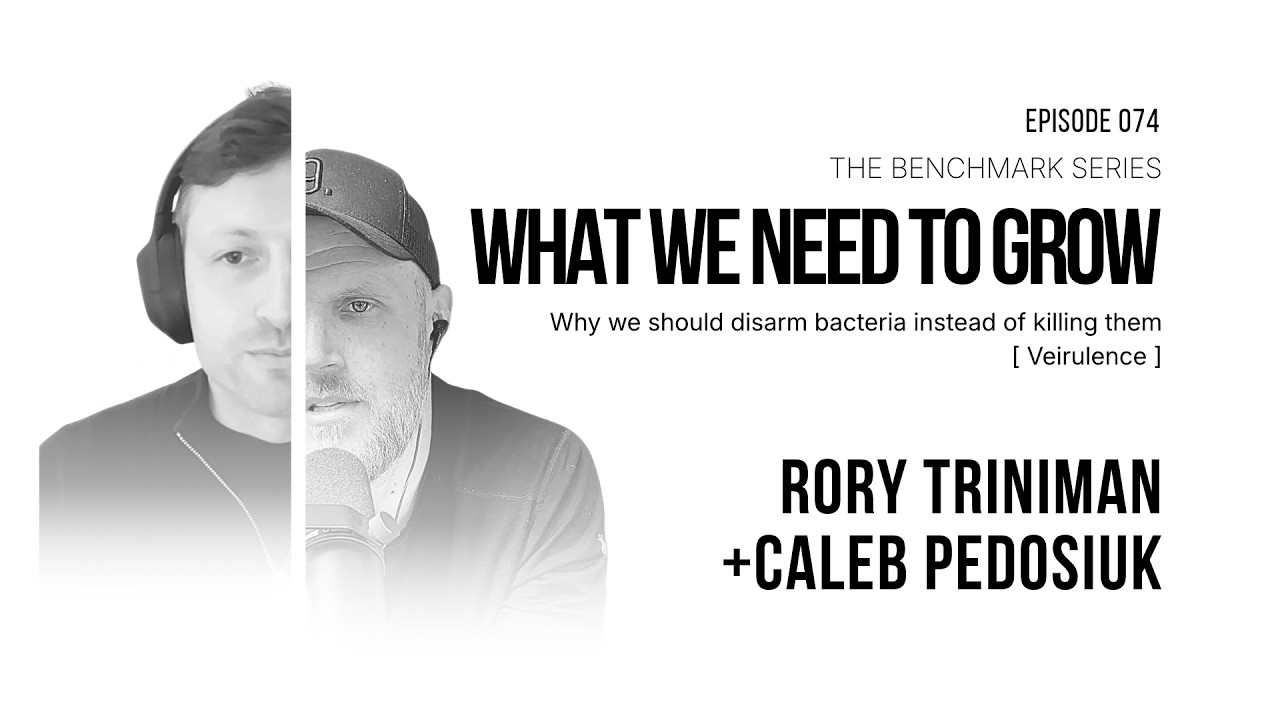
Every antibiotic ever made does the same thing, kills bacteria, and bacteria have beaten every one of them. Rory Triniman, founder and CEO of Veirulence, is building the other option: small molecules that disarm bacteria by targeting their virulence factors, working alongside the antibiotics we already have. He traces the idea from his Cambridge PhD to a London preclinical biopharma, explains how he built the team piece by piece, and why biotech raises against de-risking milestones rather than round names. That is the argument 79 Development keeps returning to. When a whole field repeats one answer, a genuinely different one has to be explained clearly enough to be understood, trusted and found.
KEY TAKEAWAYS
- Disarm the bacteria instead of killing them. "The world has only ever had antibiotics... and they all do the same thing, which is to kill bacteria." Killing selects for survivors, and "bacteria have defeated every single one we've ever made." Veirulence targets virulence factors, which Rory describes as "little weapons systems" on each bacterial cell. Take the weapons away and the infection is disarmed, without the same selection pressure, and the immune system and existing antibiotics can do their work.
- Build the team like a molecule. Rory's co-founders are a surgeon friend who covers the clinical side and a chemist he found through the Cambridge network, "one of the only people to read my thesis front to back." An industry drug developer started as a free adviser, watched them do what he suggested, and asked to join. His rule for approaching experts: "the last thing they want is someone coming to them with a half-baked idea." Caleb called it "a chemistry approach to building in business," and Rory's version is people with "a hard drive and a processor."
- Raise against milestones, not round names. In biotech the stages are de-risking steps: a disease model that shows the molecule treating infection, then the preclinical safety package that clears a first human trial. "A seed round in an AI tech startup is not the same as a seed... round in another area." He knows what he'd do with $5 million, $20 million or $150 million, and stages the milestones back from there.
- A cross-sector problem. Resistance runs through hospitals, agriculture, aquafarming, veterinary medicine, water and food safety, and every one of them still relies on the same tool. The 20 to 30-year vision is virulence factor innovation applied to any antimicrobial resistance challenge.
FULL TRANSCRIPT
What We Need to Grow, Episode 074: Disarm, Don't Kill. A Founder Talk conversation with Rory Triniman. Cleaned for readability; the words are the speakers' own.
A Conversation with Rory Triniman, Founder and CEO of Veirulence
Caleb Pedosiuk: All right, Rory, we hit record really fast because we were getting into some stuff that was really interesting. In a second I want to hear you introduce yourself, what you're working on, who it helps, why it matters. But we were talking about connecting. We were introduced through a mutual contact, Charles, and one of the things we were talking about is these introductions.
I've been trying to understand why I have this intangible sense of what connecting is, and why these conversations matter. I feel like there's an emerging exploration of what it means to connect with human beings in a sincere way in the digital ecosystem. And the digital ecosystem has this way of, maybe this isn't the best way to describe it, wrapping a digital snapshot around the molecular structure of what we bring to things. Depending on how you approach it, you can pull that out and have it live in a transcript or an article, or in something your agents can review and index next to research that could help me, my company, or someone I know who might be looking for a piece of the puzzle like that.
A second ago we were talking about how, if we were sitting in an airport, I'd have this really cool conversation and hear about what you're building, but when we walk away it almost vanishes, like a vapour. So now it's a puzzle: how can we use technology to hear about what people are doing, draw that out, find out what meaningful problems are being solved, and then find ways to repurpose that in our own lives or for those we know? So Rory, great to meet you. Let's get into it.
Rory Triniman: It's a pleasure. Thanks for having me. While I was listening to that, what I was thinking about is how, when you're young, you're always told to go speak to people, find out what they're doing, get a bit of knowledge from their experience. And as you say, when it's just you on the phone, it's such a closed-off conversation, and then you have to process it yourself. Whereas in this world it could be everywhere. You can pass it on. I think it's phenomenal.
So, my name is Rory Triniman. I'm the CEO of a company called Veirulence Limited. We're a UK company, a preclinical biopharma, and what we're trying to build is a new innovation in the way we treat bacterial infections.
The world has only ever had antibiotics to treat bacterial infections, and they all do the same thing, which is to kill bacteria. That has a big problem, because you automatically select for survivors, and it drives the resistance that bacteria develop to that antibiotic, or to all the antibiotics. Let's be clear: bacteria have defeated every single one we've ever made.
So we're in a really precarious situation globally. One in six hospital-diagnosed infections is resistant. I think one in two US patients in hospital in 2023 received an antibiotic. These are really high-volume drugs, and they're the backbone of a lot of what allows good medicine to go well without complications: surgeries, cancer patients, all these sorts of things. And they're really beginning to struggle, and they're not working.
What we're building is an entirely new way to treat these bacterial infections. We fundamentally change from killing the bacteria to disarming them, and we do that by targeting what are called virulence factors. The best way to think about them is as little weapons systems on the individual bacterial cells that they use to actually cause the disease. I like to think of bacteria as an invading army. There are loads of them, they're all together, they communicate, and they have all these different little weapons. They start attacking your cells and your tissue, damaging it and spreading around the body.
So if we wipe out those weapons, we've basically disarmed the bacteria. It's a totally different approach. You don't apply the same selection pressure that killing them does, and you can work with the antibiotics we already have. It helps your immune system clear the bacteria, and it helps antibiotics work and overcome that resistance barrier. What we want to do is use the two together, the old things we already have with the new thing, to treat patients in hospital with nasty bacterial infections.
Caleb: How did you come across this?
Rory: This is a relatively new field that was exploding when I was doing my PhD. I was at the University of Cambridge doing a drug discovery PhD, looking at these non-traditional targets in a particularly nasty bacterium. It's a priority pathogen for the World Health Organization, and it's one of the main focus bacteria for Veirulence now: Pseudomonas aeruginosa. We had a target in mind, and, as very typically happens in these discovery projects, we developed a small molecule, which is our technology now, that was working very well at protecting cells from these infections, but not through the mechanism we had originally intended.
I did a medical sciences undergraduate, then this PhD in drug discovery, and in the back of my mind I always understood that I was personally very invested in the translation of what comes out. A lot of research in academia, which is phenomenal work and absolutely essential, is very investigative. It keeps building and building and there's never an end to it. I loved the really clear translational endpoint: I'm trying to get a drug, it's going to go into these patients, and it's going to benefit this person by preventing them from dying, or from having a poor outcome, or their family from suffering a loss. That's how we got here. We took it to the end of my PhD, there was lots more work to do, so we ended up building Veirulence, got my co-founders on board, raised some money, and now we're off to the races.
Caleb: At what point in that journey did you realize you were going to step out on your own and build a company?
Rory: Good question. Quite late, I think. I didn't go straight from my PhD into founding Veirulence. I worked as a commercial strategy consultant for a company called Blue Matter, which specializes in commercial strategy for pharmaceutical companies. I was mostly working with global pharma, helping with launch strategies and indication prioritization: selecting which drugs go into which populations of patients.
That was really essential, because it gave me time to understand how pharmaceutical companies think and work, what their metrics are for taking things forward, and a more holistic picture of drug development. It's a much more complex picture than a lot of people understand. Even within pharma, people tend to get into silos as R&D people or commercial people.
We had looked at spinning it out of the university when I was finishing up, and the only reason that didn't go ahead was a health scare for the principal investigator on it. But we had gone to the university with this idea, and I think it was an earworm I had through those years of working: it had been given a green light and never got off the ground. So in the background I spent several years doing due diligence myself, asking people if it was a good idea, monitoring the space, looking at equivalent assets and competitors being developed, and watching the unmet medical need with patients in the news. Eventually we got to the point where we thought, right, this is a goer. And then we went for it.
Caleb: You mentioned you have co-founders. You mentioned research and development and the commercial approach. What are their backgrounds, and how did you set that structure up?
Rory: Two co-founders. Great question, and I'm going to add a layer to it about mentors, if you don't mind, because I think it's really interesting. Having been in this world and mixing with a lot of early-stage biotech startups, you see a lot of different structures, but they tend to fall into two kinds. There are well-established academic groups spinning out with the professor who's the expert, and maybe a young PhD student or postdoc running the commercial coalface as boots on the ground. And at the other end, there's someone with an idea who doesn't have a network and puts himself out there to find a co-founder. By definition you're not going to know them. There are great strengths there, because you find the person with the abilities and the CV you want, but you don't necessarily have the personal connection.
I was quite fortunate. I had a good friend I'd known for several years, a surgeon I'd lived with for a while, so that covered a lot of the early medical side: the prescribing side, the patient-facing side, and all the network he'd built in that world. And I knew that we needed a chemist. So I went back into the Cambridge network, looked around for people with the right skill set, and we met this phenomenal chemist. We were a Brit, a Kiwi and an Aussie. I hadn't met him before, but he's probably one of the only people to read my thesis front to back. I took him for breakfast, we went back and forth for a while, and he said, look, I was looking for a project with some purposeful meaning, and I'm very happy to help out.
So that was the core structure, three co-founders, with the work built on the back of my PhD. Then we expanded the team to a fourth: an ex-industry guy, Eddie French, a phenomenal drug developer. That came about because I constantly went out to my network and asked, does anyone know people who'd be useful to speak to? It didn't matter whether it was opportunistic, whether I sought them out, whether it came through accelerators or cold outreach. It's amazing how willing people are to help if it's an area they're interested in, they have a connection with the unmet need, or they just see what you're doing.
With Eddie, we met him through a connection and he gave us some free advice. When we came back and said, hey, we've done it, he said, oh, you have done it? Okay, well, you should look at doing this. We came back again: right, we've done that, what would you recommend now? He was an adviser for about a year, and then he asked to come on board more formally as Chief Development Officer. He's been a phenomenal mentor for me, for the company, and I know for others as well.
When you build that structure, some of it is organic and some of it is fortuitous, but all of it comes with an element of work. If you say you're going to do something, you've got to do it. You can't be half-prepared. These are people at the top of their field, and the last thing they want is someone coming to them with a half-baked idea and an aimless, rudderless conversation. So it came about by design, fortuitousness and work ethic, I'd say.
Caleb: As you're describing it, it feels a little like what I'd imagine building a molecule is like: recognizing that certain pieces are needed, and if one is missing, it's a different molecule, the structure is different until you bring in the other pieces. And in this case you're looking for mentorship to say, how do you build this kind of molecule so it's strong and capable? You're very much looking at a seat that has to be filled at a level of quality that will hold. It's almost a chemistry approach to building in business.
Rory: Absolutely. When we're young, everything is graded: what results did you get in your exams, what GCSEs, what A-levels? It's easier to say this person is smarter than that person, and you fall into the trap of thinking one has to be better than the other, or if one is good the other can't also be good. It probably came most from my commercial strategy days, realizing that you don't know what you don't know. You're constantly learning. We're in preclinical drug development, and I don't think anyone in the world can hold up their hand and say they're an expert in every aspect of preclinical development, clinical-stage development and marketing. It's unrealistic in every area.
I love to think of it as having a hard drive and a processor. You've got people with amazing memories, and people with amazing processors who can run the work with logic. When you get people who have both, who have an expertise area but are fully appreciative of other areas, that's a really exciting team. It's a very conscious thing for us internally when we think about our development. We're developing a totally new drug class, so there's so much innovation in it, and so many conversations where even the experts don't know. The regulators are still working it out. We're having conversations with them, trying to show them our evidence package for why they should accept this endpoint, or what key opinion leaders and clinicians are seeing on the front line and would like to measure as a biomarker. So we're very conscious of thinking that way when we define our strategy and development programs.
Caleb: What would you say is the next major milestone? For a lot of startups, though not all, milestones are related to financing: is it pre-seed, seed, Series A? Whether that's actually a good gauge of where things are at, I think that's a great question. But what's the next point you're setting your sights on?
Rory: Great question. An advantage of being in biotech is that there are very clear de-risking stages. The one we're looking at now is a disease model. When you have an infection in a disease model that's representative of a human having the disease, and you show your molecule treating it, that's a huge de-risking step, because you've shown in a representative model that you'll get an outcome that benefits a patient in hospital in real life. That's our near-term milestone.
But these things cost money to develop. We're raising right now, and you can break it into a bigger chunk, the preclinical chunk. Essentially you do all the work your regulators need to be happy that the drug is safe to put into humans in your Phase 1 clinical trial. That's the bigger near-term milestone: get your disease model, do your safety work, select the one molecule you want to take forward, and complete that preclinical stage. Then most people have heard of the clinical stage, Phase 1, Phase 2 and Phase 3, and then you get an approved drug.
So I don't place much emphasis on the names of rounds, pre-seed, seed, Series A. They're just sequential. A seed round in an AI tech startup is not the same as a seed or pre-seed round in another area. I like the milestone approach. And the other thing is to have conversations about what someone can do with $5 million versus $20 million. You can do different amounts with that money. I know exactly what I'd do all the way up to $150 million. So if you want to have those conversations, you can stage the milestones back. But in biotech they're based around de-risking, and for us the near term is those preclinical milestones.
Caleb: Do you have a vision, a big 20 or 30-year-out vision? What does that look like?
Rory: Absolutely, and I think it's so important. We focus on the medical, human side of infection. But bacteria infect humans, and animals, and plants. It's my belief, and Veirulence's belief, that antimicrobial resistance is one of the few truly global challenges. It's cross-sector, it's the developed world and the developing world, it's no longer confined to less economically developed countries. It's everywhere and it's spreading fast. We're talking agriculture, aquafarming, veterinary, humans, waste and water management, food safety. All of these huge industries have antimicrobial resistance challenges, because we still only have the same solution, which is antibiotics.
The innovation we have is to disarm those bacteria, either on its own or in combination with the antibiotics we have now or develop in future. There's equal opportunity and applicability for that innovation across all of those industries. Obviously I can't sit here as CEO and say we're going to do all of it at once. But the vision of virulence factor innovation applied to any antimicrobial resistance challenge is absolutely our big 20 to 30-year vision.
Caleb: What a cool vision. My wife and I have been doing this work with our company for 14 years. We come alongside founders and help them build across a bunch of different industries. And when we've talked about it, we've asked, what's the centre of it? Because at a glance we say yes to everything from regenerative agriculture to anti-human trafficking to enterprise cybersecurity. There's a real spectrum. What's the common note being played in it all? Solving not just problems, but meaningful problems.
Boredom can be a problem for someone, and there can be a very addictive game that solves it, but I wouldn't categorize that as a meaningful problem the way we look at it. When we first started this conversation series, we asked what the central point would be, and I feel like that's the goal. Some are closer to the centre than others, depending on how you look at it and what's going on in life. I've had the chance to go and help after a couple of hurricanes, and I'll tell you, a generator with some fuel solves a meaningful problem. A flashlight at the right time when the power's out. A little portable filter to clean water, a GRAYL, which, by the way, is such a great brand. You don't use it most of the time, but when you need it, it solves a meaningful problem. And the problems you're talking about really seem to hit the centre of that. Very, very cool.
So where's the best place for people to follow along if they're interested in what you're doing, or interested in reaching out and connecting about the raise that's happening?
Rory: We've got a website, veirulence.com. That's V-E-I-R-U-L-E-N-C-E. On the website there's info@veirulence.com, or reach out to me or one of the team directly on LinkedIn. We've probably not got as good a presence as we would like, so please do get in touch. One of the most exciting and also disappointing things in this area is that the pipeline of what's actually being developed to address this is too small, and there's more than one way to skin a cat. We think we've got a really exciting innovation that can be applied in really broad areas. We're raising now, as I said, so do reach out. We're always open. This is a very collaborative field, because it's such a drastic medical problem. Every day I see news articles, charities and personal stories of people recognizing it. There are documentaries out as well. So please get hold of us any way you can, but the best are the website and LinkedIn, or email us.
Caleb: Rory, thank you so very much.
Rory: No, thank you. Brilliant. Nice to speak.
What We Need to Grow is a conversation series by 79 Development, hosted by Caleb Pedosiuk. New episodes on YouTube and Spotify.