How a Physical Product Startup Gets Into Retail
For solo founders and consumer product builders trying to get a physical product onto a retail shelf.
About Sean Rana
Sean Rana is the founder of BagEZ and CEO of Green Comfort Innovations, which makes patent-pending portable steel garbage bag holders sold through Amazon and direct to customers across Canada. He is also the founder of Renocraft. He builds and sells a single physical consumer product largely on his own, which is a different discipline from software and a considerably harder one to get onto a retail shelf.
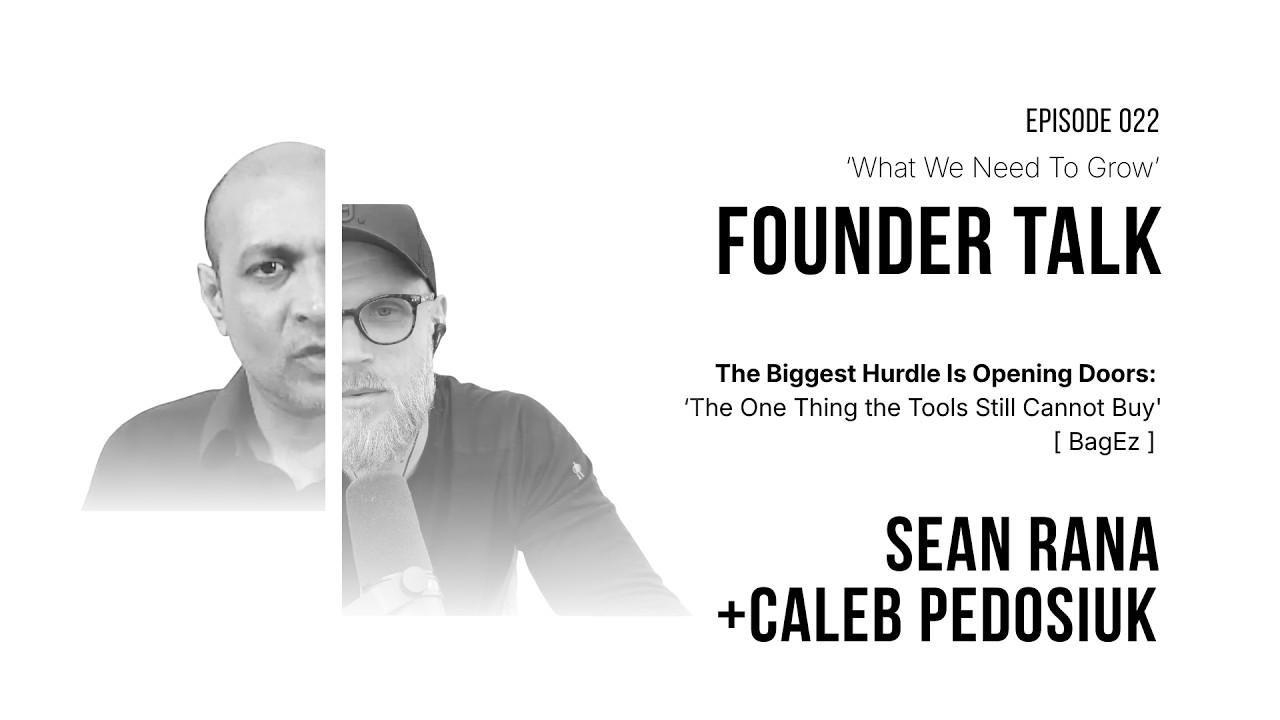
Sean Rana runs BagEz alone. It is a steel frame that holds an ordinary garbage bag open and hangs off a nail, a branch or a doorknob at 55 pounds, and it sells into warehouses, schools, campsites, municipal green bin programs and disaster shelters. The second half of the conversation is the more useful one for any founder building today: what AI tools genuinely gave him, where they quietly contradict their own instructions, and the fact that after all of it his single biggest constraint is still getting a real person on the phone. That is the throughline 79 Development keeps coming back to. A founder can now produce like a whole team and remain invisible to the people who decide, and being findable and credible is what closes that gap.
KEY TAKEAWAYS
- The moat is that it holds anything, badly on purpose. Sean's description of his own product is unusually honest: you would not say it does everything fantastically, because it is meant to work around a lot of things. A solid steel frame, three sizes, clips onto a regular bag, hangs off almost anything, holds 55 pounds. Paper bags are the one thing it will not take, and he says so, because the density is wrong for the clip and a cardboard box already does that job for twenty cents.
- Never give the AI a free hand. He is blunt about the failure mode. You can give a model perfect instructions, tell it never to say you offer the colour red, and it will still turn around and offer the colour red. It is excellent at initial outreach with the right programming, and it built him a CRM in under an hour that he would otherwise have paid someone to build and rebuild. But read every message that comes back. Tell it to act like a secretary. Do not trust it unattended.
- The thing AI cannot buy is a door. Asked what he needs most to grow, Sean does not say capital or headcount. He says opening doors. Someone hands him a card at an event and asks him to email, and two weeks later there is not even a confirmation. You call an office and every real person is unattainable. His read is that whole departments seem built to deal with lobbyists, which is a game he is not playing.
FULL TRANSCRIPT
What We Need to Grow, Episode 022: The Biggest Hurdle Is Opening Doors. A Founder Talk conversation with Sean Rana, founder of BagEz. Cleaned for readability; the words are the speakers' own.
Caleb Pedosiuk: Sean Rana, BagEz is the current product business you're working on. We chatted a little and caught up, and I got to understand more about some of what you're doing, which is servicing everything from enterprise level, multi-location facilities dealing with this. But I wonder if you can explain your product really quickly, so people get a sense of it, and then let's talk a little about how you're building, because there were some interesting things we were talking about with some of the tools you're using.
Sean Rana: Absolutely. So BagEz is what I consider to be the world's first truly universal bag holder. You wouldn't say it does everything fantastically, because it's meant to work around a lot of things. What it is, is a solid steel frame that holds the regular garbage bags we have, open. That's it.
There are three sizes. The small is usually for the indoor section where people use it. The mid-range covers just about any trash can you have. It creates your average bag open, so it creates a pocket, messy waste can go inside, and your trash can actually stays clean while you use your trash can for bulky items.
This holder is also designed so it can loop on just about a nail, a hook, a branch, a doorknob, you name it. It hangs on it. And once you hang it and shake it, it's tough to knock off, because you clip a bag on and it holds a bag up to 55 pounds, or 25 kilos. That's the benefit of it.
So people are using it in warehouses, they're using it in schools, people are using it for camping. It's even large enough that if you have to sweep or scoop leaves you can use it in your backyard, so you're not frequently bending, which can hurt your back. The application is completely all over the board. It's from city level, if you're looking at getting more people participating in green bin programs because of the yuck factor, to your regular everyday person just looking for something for his backyard because he wants to have a party and find an easy way to manage waste. That's it.
Caleb: Very cool. I'm always amazed, the right tool for the job makes all the difference. You can use the back of a screwdriver to hammer in a nail, but it's much better to have a hammer. That might be a really crude, simple analogy, but if you walk the tools section of any hardware store you see so many niche tools, and they niche down even further depending on industry and trade, and so many of these innovations have come from someone who's in there working and realizes there's a better way to do this. And then once you have that one specific tool, how much easier it is to do your job properly.
The thing I thought was interesting is the bag. When I first saw it, the bag goes around it, the frame is essentially this rectangular mouth, the bag comes up and then you have pieces that clip onto it that hold it in place. I didn't think of it for raking leaves until you mentioned it, but I wonder, have you been able to use it to fit the paper bags people use for that?
Sean: So the unfortunate part is, the paper bags, you could even put an old t-shirt or a cloth on this and clip it, because it's meant to hold. But paper creates a completely different kind of density. The amount the plastic clip would have to stretch to accommodate that would just not be enough. So paper bags unfortunately don't work. And from what I've seen already, paper bags do have some rigidity to them. So even a little cardboard box, slide it in, it's doing the job for you. If you can do something for like 20 cents, why would you spend something more?
Caleb: Either way, even us, we're camping, and I had to find some solution for our bags, because you've got a recycling bag, a big clear bag that's in there, and you've got a garbage bag, also a clear bag, that sits in it. So we have this collapsible spring bag, but it doesn't really fit to the right size, it's a little bit smaller, so it doesn't work as well. But I could see the value in it.
These niche products, I'm always interested in how you get something like that, because a little innovation, whether it's something like this or some other specific tool, a little innovation for the right person is like, oh man, this is so helpful. How many times are people pinning something they see on Instagram or TikTok or Pinterest because they see this one piece, and they think, wow, this is perfect, almost even to gift to someone, hey, this would be really helpful.
But I'm curious to know how it is that you're finding your customers for that. I think we spoke a little, you talked about retail stores. So if it was a pie, what percentage of that pie are you finding are enterprise level, or a buyer purchasing multiples for however many locations, versus individuals at a household level?
Sean: So the best way I've found so far, right now we are doing all the outreach. We are going in at distributor levels. And that may change from how we're presently working, because when distributors come in they would want a little more control.
I always look at the climate. In the climate for the last year, we've seen it's really hard for people to get jobs. So what I started to do is I've now incorporated this level where I become like the wholesaler of the item. This allows people to buy an item for really low cost, so that when they go out and make that effort, it becomes profitable for them. So they are now the ambassadors of the product and they are selling it at the same time. It's good enough that it would give them a return as if they're putting in that eight hours of a day, with way less. And since the product allows them to sell it online as well, if they have a large base or they have friends and family willing to help them share things like that, it seems to be growing.
And I've seen a different route as well, where people are buying it specifically for trade shows, where they've knocked off other items they used to carry. Because what they found was thirty vendors in the same area are all carrying the same thing, and the passersby or visitors would just walk through and say, okay, t-shirts, keychains, squeegee dolls, things like that, okay, great, great, and just walk past. And then something unique like this, some of them even had these little ultraviolet lights, so people are like, what is this? Because when you're having a party at night, you can see your bin. So these are creating conversations and creating points of stop. And since it doesn't go above a value of, oh, this is too expensive, it becomes completely a no-brainer, so people most often end up out of stock. I've got calls where a lady once told me, I don't mind paying you more, but can you give me that consignment which is meant for this other person? And I'm like, no, I can't.
So it's working out great now. I'm loving it. But I'm hating the fact that I'm doing this all alone. I hate that.
Caleb: I have two questions there. I'm curious about what you mean, all alone, if you wanted to speak to that. But just a quick question first, is it mainly farmers markets? I know when we first chatted you mentioned farmers markets or flea markets, or is this something you're finding in other ways, in that cottage industry, solopreneur, pop-up shop sort of thing?
Sean: So we are working with people in the bin cleaning industry, because a lot of people don't see the value. I'll pay you 20 dollars or something, and then it goes back to its original state. So our product helps them get over that issue. It helps them get over the seasonality, the limitations. So that's one industry.
Then we've got people who are drop sellers or affiliate marketers, in different niches. Some are in the home, some are into recycling, some are into food waste. Each one is doing it their different way, on how they sell our product.
Now, the most recent one I'm working with is the shelter systems. We are speaking with these people because what we saw was there's a gap between, if you have a flood, what you can do in your home. Most often it's sandbags to stop water coming in, a pump for water going out. And then you have every bed, every table, just stacked with items. But there are also so many items floating on the floor because there's no place to put them. So our bag holders have now become the option that takes a minute, and you can hold up to 55 pounds with those bags you have every day.
And in shelters, when you go, most people have brought a lot, but there's no place to put them. So ours, with a little nail on the wall, now you can save so much space. So a shelter has so much more room for people.
Caleb: Or running a line between trees. Just helping out at a shelter back in the day in Winnipeg, in Canada, I remember the amount of donations they had for clothing, and I remember sorting it. You're down there and volunteers are down there sorting, and you look and all of the table space is used, you're constantly at a point where you've got boxes all over. But how much more helpful it is if you could activate that upper space, or just run a line.
I had the opportunity to do some disaster response work, was in Jamaica right after the hurricane last year, and was in western North Carolina after. In both instances, and I didn't know this beforehand, when resources come in, donations come in, and sometimes one area gets flooded with so many donations, maybe because the roads are still intact, and you have so much coming in with food and water and other things, and other areas don't have any. But often organizing the amount of donations coming in, clothing, blankets, in the midst of hurricane season with rain, sometimes the places like churches were overflowing. A truck comes up, they're hired to drop all this stuff off, they just unload it, and sometimes it can be overwhelming. So it's so interesting to me to be able to find efficient ways to set that up, where you potentially even run a line and hook these on, or like you said, put a nail into something, and potentially even have them marked.
Sean: So it's designed not only for nails, because I thought about that, but you could have a pipe like this, a good inch pipe, like a steel rod, and literally put a whole bunch of them hanging through a steel rod and just hang that steel rod. It's how you would wish to incorporate it. It's made for you to use your imagination on that spot and make it hang. That's it.
Caleb: The other thing I think was really interesting is having the LED lights lit up, because so many times, if it's something outdoors at night, how do people know where recycling goes or garbage goes, and how much more helpful it is to make it easier, certainly for cleanup after, for the hosts. How efficient that must be for music festivals, outdoor concerts, other things like that, where you have well-meaning people, but if you're not seeing options, how much more helpful that could be.
So very cool. I'd love to hear a bit more. You brought up some interesting things about how you've been building. One, you mentioned being a solopreneur, you're running this solo. But you also shared a bit about how your use of different AI tools is helping you accomplish disproportionately more than you would be able to prior to these tools. So going back two, three years compared to now. How is that going? What right now is exciting to you with that, or things you're finding that may be helpful for others?
Sean: So, solopreneur, to be honest with you, without it I'd be seven months behind, and that's in a time span of, let's say, a month. So it's telling you how much accelerated you can go.
Now, the thing about these AI systems is, if you give it a free hand, even though you've given it perfect instructions earlier, there's still a chance it will come back or send the message. So while it's great at fantastic outreach, it's very good for you to constantly make sure that when you get a message coming back in, you are taking the time to look at it. Because, for example, you may tell an AI with an instruction, never say that we have the colour red. And it may suddenly turn out to say, oh yeah, and if you want even the colour red, we can do that. So never trust any AI in a lot of situations. But for initial outreach with the right programming, that's where I say it can get you moving.
Let me give you a nice idea, for example. Since I'm dealing with a lot of affiliates, a lot of wholesalers, retailers, the same CRM I would have to pay somebody for, to then modify to my situation, and then when I want to remodify or update it, it's all going to cost me time and money. With these new AI systems, in under an hour you get these things up and running. And any modifications you want, it will pre-examine and say, hey look, these are the possibilities that you may require. So do you want to pre-build them into your system, maybe use them as an option where you can tick on and off. So it's really like having an expert who's there for you, if you give it the right instructions.
Caleb: Interesting. It's funny to me how the machine layer can accelerate human connection. Whereas before, maybe if you were used to connecting with one human within an hour, if it accelerates and you have the ability to connect with ten, the adjustment that needs to be made on the physiological and psychological side is to make that adjustment. You don't just turn up the tech and then have the tech facilitating more connection without also turning up the human side, the empathy, the preparedness, that connection on this side. Otherwise, like you said, you could be missing, there could be churn, there could be missed opportunity with legitimate connections. That's one piece I think is really insightful, I appreciate you noting that.
Sean: The one suggestion I would say, because I use this all the time, is read the message. Understand the message, and tell the AI, literally, act like a secretary. Say, look, I want you to respond to them this way, make this point obvious, be friendly in the tone you're telling it.
Caleb: Is there a specific tech stack that you find you're using, or that you're leaning into? Are you mainly in Claude Code, are you dealing with OpenAI, or do you find you're going from tool to tool?
Sean: So I am right now looking at the best tool for me. Here's what I understand now. Most of these providers of AI are looking to find a way where they can give you the best model without you having those limitations. Because I did come up against those limitations, which literally for three days I couldn't do anything, because at one point I just went crazy. And that means during those three days, even those agents that are supposed to be making outreach, were down. Unless you're ready to spend that extra into it. And that's a good learning curve, it teaches you how to use models for what you want, don't go overkill on them, and control your prices as well.
But I would say right now I'm considering Kimi K2, for example, because it's got a fantastic token range and benchmark. There's also a model which incorporates all the models you have, so that it picks the best. Because what I've noticed is, Grok, for example, is great at doing math. If you want some thinking with math, Grok is the thing. If you want stats, Grok. Claude makes some mistakes sometimes, but it's good at doing a lot. Each one has got a little difference. But at the end of the day what you're looking for is those longer tokens, so that when you have the conversations you're not limited to, oh my god, I'm running out. Because quite often you're thinking something, but precisely you may not get it into words.
Now here's what I do to save money. Prior to jumping into Claude, for example, which I use presently, to set up what I want, I'll talk to a free thing like Gemini or ChatGPT. Have an entire conversation about what I want, and then tell it, okay, do you understand what I want? If you're not clear, ask. And then it'll do that. Then, okay, now perfect, now put that into a simple, understandable step, like a PRD, and then print it out. Then I put that into Claude. So I'm saving a whole bunch of tokens and time with the one that's actually doing it. So that's a nice way to save money, I think.
Caleb: And with visual tools, you mentioned Gemini. I noticed that in some of your creative you've been using video, and you also use gen AI for image generation. Do you find there's one or a couple you lean more towards than others?
Sean: So the thing about this image creation, they are all over the board. What I do now is, you have your own AI systems, where you can literally just download it onto your computer. So now you're not paying per token or limited in use. In some cases, for example, if you're trying to create a sequence where, I'll give you a nice one, a raccoon is breaking out of a trash can and it's busting loose. And, oh, we cannot do this because this shows violence. So then you pass certain things when you have your own AI system, which are much better than the others. But at the end of the day, I would say use them all. The Chinese models are fantastic, so you can't go wrong there as well.
Caleb: Very cool. Alright, my final question for you is, what is the one thing you feel like you need most right now to grow? Is there a bottleneck, is there one lever, is there one problem where you're like, man, this is the point, right now, August 2026, this is the pain point to solve?
Sean: I think for me it's opening doors. Today, I'll give you an example. I met one of the leaders, one of their staff gave me their card, oh, please email me. And two weeks ago, not even a confirmation email. I'll just look into it. Nothing. You call up an office, every real person you can really talk to is unattainable. And so that's kind of shocking. It looks like every department is only meant to deal with lobbyists and things like that, which don't really work, because then they will look at it, okay, which lobbyist is going to take me where for lunch and dinner? I find that the biggest hurdle. Opening doors.
Caleb: Well, it seems like with your affiliate program you have the opportunity to leverage other people's networks, other people's relationships. So if it's struck in a way where those affiliates could benefit from those doors opening, or those introductions being made, that could create a win, win, win scenario. A win for them, in the sense that it's an opportunity to leverage their network. A win for the person they introduce you to, if the product is actually something that helps them solve a meaningful problem. And a win for yourself, because they've been able to create that introduction for you to be able to help them.
Sean: We do have that, which we don't actually say everything online. Sometimes we do tell people, when we talk in direct DMs and stuff like that. What we do is, if you've got connections, if you've already got the FaceTime with those people, hi, how are you doing, here's what it is, it's fifteen minutes to learn it, so that you're an expert. Everything is literally in slides, everything, put forward. What we tell them is, you continue being that face. You don't need a third person coming in. You know what I mean? And once that goes through, we give you a percentage of that total order. So if you're getting a town coming in, or a city coming in, and you're that front person dealing through the entire process, that percentage of that order is a certain volume that goes towards you.
Caleb: Very cool. So for anyone interested in that, where would they find out more, or how could they get in touch with you?
Sean: So you can call me directly. We have a telephone number, a website, which is bagez.com, B A G E Z. And a telephone number, my email, everything's on our site, so there's nothing to be complicated about.
Caleb: Bagez.com. Got it. Well Sean, thank you so much. Really appreciate your time today, and thank you for sharing ways that other people can also get involved.
What We Need to Grow is a conversation series by 79 Development, hosted by Caleb Pedosiuk. New episodes on YouTube and Spotify.