How to Turn Professional Services Into a Repeatable Pipeline
For professional services and automotive retail operators, and founders turning expert work into something repeatable.
About Dave Anderson
Dave Anderson is the CEO and co-founder of EvenFlow AI, which applies airline yield management to the service departments of car dealerships. He holds a PhD in theoretical and applied mechanics and was previously a United Airlines executive re-engineering core business functions under heavy financial pressure. He founded the company in 2019 after waiting three hours for an oil change and recognizing that dealership service lanes had the same capacity problem airlines had already solved.
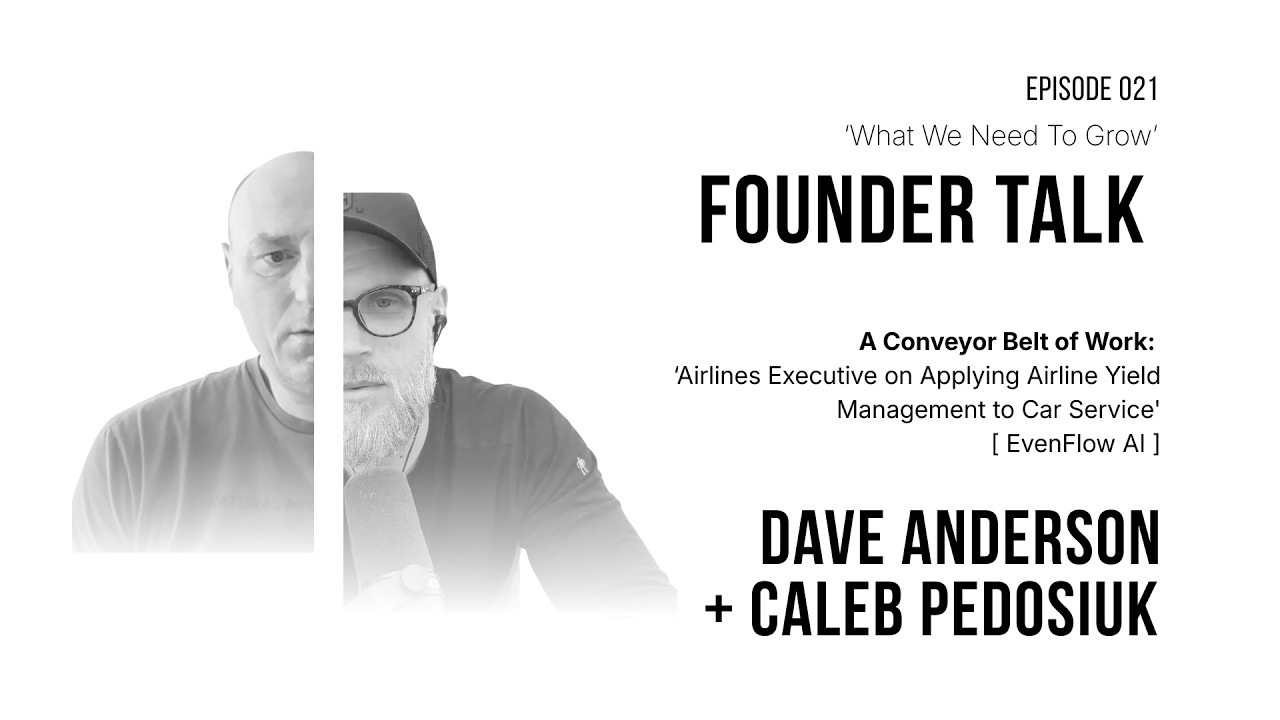
Dave Anderson earned a PhD in theoretical and applied mechanics, re-engineered operations as a United Airlines executive, and spent the years since carrying one airline discipline into other industries: sell every seat. At EvenFlow AI he applies it to the service department of a car dealership, pacing work against the real capacity of the technicians doing it. His account of the revenue a dealership loses without ever seeing it leave is the kind of hard-won explanation no competitor can fake and no generic content can produce. That is the throughline 79 Development keeps coming back to. When a business understands a problem nobody else has bothered to name, a clear account of that understanding is what makes it findable, credible, and trusted.
KEY TAKEAWAYS
- The lost revenue is invisible, which is why it survives. Dealership service advisors are measured on satisfaction surveys, and Dave says one survey can cost a store around 200,000 dollars in incentive in a month. So they move cars through. Your tread is low but you are okay, see you in six months. Your brake pads are almost ready but you are okay, see you in six months. That is lost revenue on the dealer P&L and a worse outcome for the customer, and nobody sees it happen.
- Two restaurants, the same food. In one you wait forty five minutes, everything is rushed, dishes are breaking, your server never mentions the specials and drops the check. In the other you are seated immediately, the room is full, and every part of the meal arrives paced correctly. The food is identical and the experience is not. That is the whole argument for pacing work against capacity rather than pushing more of it through.
- More demand generation is not better. Dave's system sits underneath the AI phone and chat agents dealerships are buying, directing them rather than competing with them. He calls it the puppet master. You do not want twenty seven appointments at 8 AM because you cannot handle twenty seven appointments at 8 AM, and blind demand generation without operational sense is counterproductive to whatever lift you thought you bought.
FULL TRANSCRIPT
What We Need to Grow, Episode 021: A Conveyor Belt of Work. A Founder Talk conversation with Dave Anderson, CEO of EvenFlow AI. Cleaned for readability; the words are the speakers' own.
Caleb Pedosiuk: Dave, PhD in theoretical and applied mechanics. You were running point on some really important things, running operations at United Airlines. And now, as I understand it, you're applying airline yield management principles to the automotive dealership. So something that is often understood to be entrenched, everything from behaviour at the local level with dealerships, how they deal with vehicles, how they deal with people, their staff, and you're bringing in principles that would probably seem disruptive, coming in to basically say, hey guys, you might be doing what you're doing well, but look, we can do it better. Let's hear about it.
Dave Anderson: Yeah, thanks for having me. So we're building EvenFlow AI, which, as you hit upon, is a resource optimization product for automotive dealerships. That resource optimization focuses on their fixed operations, their service department. At the end of the day, or the tip of the spear, our product is scheduled appointments. But that's the mechanism to better match the demand of customers, their vehicle service needs, with the capacity of the service center, which is anchored on the technicians who do the work. So what we're doing, as you alluded to, is bringing a little bit more rigour and intensity to the shop loading and the capacity optimization. We've got other features as well, a pricing engine, demand generation workflow. But the core is shop loading and capacity optimization.
Caleb: Share a little about the story of how you got to this point. What were the touching stones to go from one industry to the next?
Dave: Lots of different twists and turns in one's career. I can give you more of a straight line path, but in reality it's never quite so logical. About fourteen years ago, I was at United Airlines and I knew I wanted to start my own ventures. It was something I'd been thinking about for quite some time. And then I just jumped off the cliff and left United and started my own things, but worked with partners throughout. The core theme is taking some of the things airlines do really well, selling every seat on the plane, and trying to apply it in other contexts. So hotels, golf courses, doctors' offices, surgery centers. We were forecasting we were going to exit the healthcare company soon. We did exit, but it wasn't quite as soon as we thought. And we were thinking, well, what's next? It's kind of random, but we were thinking financial services, hair salons. We were all over the map. And I had just gotten out of getting my car serviced. I had a three hour oil change, and I was like, this doesn't feel all that optimal. Something here. And that, in a naive way, sparked a journey of study and investigation of the space. Eventually we cleared enough milestones that I said, yeah, let's just dive in. There's an opportunity here, and let's go for it.
Caleb: How do you feel about having that PhD background, very structured in your thinking? This isn't the way a lot of people building with different tools right now are coming at it. They pick an industry and they become experts through leveraging a second order consequence of learning. They're learning from tools that have learned from people, whereas it seems like you went through the education layer, then you were in the industry, and from there you're bringing in tools. What is that like?
Dave: I think that PhD experience was the single best training I've ever had in any context. Because at the end of the day, with your research, you're solving a problem that's never been solved before. So it's not like I can go Google something and get the answer, or go to the library to get a book. And I was heavy into the theory, so there were a lot of days I'm staring at a white piece of paper and a pencil and trying to figure something out. That process of grinding through it, working through it, getting stuck, taking another turn, getting stuck, going back, taking another turn, that mental agility and practice of just learning and trying to solve problems, that stayed with me throughout. That's probably the biggest skill I'm using all the time with startups. My wife would probably say I don't use it enough at home, but definitely in work I use it all the time.
Caleb: Fair enough, and I feel like with my wife as well, a lot of that perspective is constructive criticism in a founded way. There's room for improvement across the board. So if I understand correctly, you estimate a 10 to 25 percent lift in revenue if you're able to solve this problem well, which for some would look substantial. Can you explain it to me like I'm in grade school, at a really practical level, for someone who doesn't understand this industry aside from going in and getting something serviced? How would you explain how those pieces individually in that process become optimized?
Dave: They have big incentives on satisfaction surveys. One survey could cost them like 200,000 dollars in incentive in a month. So they're always looking at that upset customer. And the way they move them on through, when they're trying to do more cars in the same amount of time, is physically you've got to do less work. So they might say, hey Caleb, your tires, the tread's like this, but you're okay, we'll see you in six months. Or your brake pads are almost ready to be replaced, but you're okay, we'll see you in six months. They're just trying to move you on through. From the dealer P&L perspective that's lost revenue, because those services are being skipped, so it's a hidden killer to their profitability. There are things they should have pulled through that they didn't. And from the customer standpoint, you're not doing the customer any favours, because you probably should get your brake pads replaced for your own safe operation of the vehicle, and to maintain or extend the lifetime operation of your vehicle.
So all of it is a system. I say it's like a conveyor belt of work. When we get the demand equalling the capacity, it's all coming in at the right pace, and then the customers have a better experience. The dealerships say their days feel easier, but they set records.
A simple example. I sometimes think of a restaurant. Two restaurants, equally good food. In one, you go in and you've got to wait forty five minutes for a table. Everything is rushed. People are running around. They're arguing with the kitchen staff. You hear dishes breaking. Your server doesn't even tell you what the specials are, they don't offer you dessert, they just give you the check and you're out the door. In the other, you walk in and you get a table right away. The place might be full, no table is empty, but the server answers all your questions about the menu, talks about the specials, makes sure you get the dessert menu, and it all comes at the right time, when you're ready, when you've finished and you're having conversation. It's all paced out in the right way. The food's the same, but the experience is very different. That's what we're trying to do, make sure that the service advisors can really pull through the necessary services in the customer's own interest, for the operation and lifetime of their vehicle.
Caleb: What has the response been like? Depending on your marketing, are you doing outreach? Do you have outbound, versus how much of that response is people finding you online? And how does that conversation pick up with them?
Dave: We get a lot of word of mouth still today. We've also set up some partner channels. And we do some outbound outreach through social, like LinkedIn or email. Then we get inbound from our website. Usually the inbound is some form of word of mouth anyway. One of the challenges we have is that our customers generally aren't in the market looking for a better tool. They've kind of resigned themselves to, this is just how the industry is. It's like, I have a migraine, but I'll have a migraine for the rest of my life and I just have to deal with it. So they're not looking online for the pain relief medication or anything like that. They're just accepting it. So we're trying to find ways to engage them and tell them we've actually got a solution to help with their migraine.
Caleb: It seems to me that as the idea of AI permeates more and more of society at different levels of adoption, more and more people are realizing this is really disruptive. They might have seen something else totally unrelated get disrupted, and they've logically concluded that our industry is likely being disrupted too, I just might not know how yet. I feel like we've seen that in a few ways, where a receptivity opens up and a curiosity, but they may not yet know what product or service or vendor exists. As that continues to push forward, part of the behaviour I'd expect is more people reaching for whatever trusted tool they use and asking ChatGPT or Claude or even Google, saying, what AI solutions are out there, what's happening in this space, and then seeing what surfaces.
Dave: Yeah, I think with the dealerships right now it's a confusing space, and I'm trying to weather the storm of the AI confusion. The dealers know they need to adopt AI in some inherent way, almost like fear of missing out. The solution they're gravitating to is more of an AI phone agent or chat agent, which has real value in their operation, because they generally don't have enough staff to handle all the inbound and outbound contact points with customers. So it's a valuable solution for their bandwidth. But we're not that. The market is really frothy, people are adopting that because it's more intuitive, and we're more of a layer underneath it that optimizes the operation. When we integrate with those AI schedulers, we're more like the puppet master. We're directing those AI agents on how to schedule appointments and how to generate demand in a way that's going to optimize the operation.
This is generally true with demand generation and fixed capacity: more demand generation may not be better. You don't want twenty seven appointments at 8 AM, because you can't handle twenty seven appointments at 8 AM. You might want twenty seven appointments, but they have to be where the operation can handle it. We're really that intelligence to make sure things are getting loaded the way they should. Because otherwise, blind demand generation without operational sense will actually be counterproductive to whatever incremental benefit you think you got from higher repair orders.
Caleb: So do you see what you've developed becoming more of the foundational layer? Or does it soak into whatever systems already exist? Is it replacing a primary platform people are interacting with, or does it run in the background?
Dave: It's a bit of both. With scheduling the appointments, we're replacing that, and we become the booking channel that all our algorithms feed. But overall this intelligence layer gets tangled in across the other dealer management systems. In a traditional B2B vertical play, we're trying to integrate and surround the core systems to be the enabler of unlocking value, in a way that the core system in a lot of contexts is almost a fixed green screen. It's handling commodity transactions. Difficult to replicate, really hard to replace. So you don't necessarily want to be in that game, at least from my perspective. You let that be, but you surround it and become the orchestrator, the intelligence layer.
Another way of thinking about it: one dealer, I quote him all the time because I love this, they're private companies so they don't need to do all the normal employee ratings, and he's just like, Dave, I put all my employees in a two by two grid. Are they smart, are they dumb? Are they energetic, or lazy? And the dumb energetic ones drive me crazy. They're always running around messing up stuff, and I wish they were lazy. I think of that for both the humans and the AI agents within the dealerships. There are core people who really understand the operation, but it's too vast for them to make every single decision. Today, either the AI agents or the untrained employees running around like Energizer bunnies are making independent decisions based on what they think is best, but it's missing the big picture. So what we're trying to do is be that intelligence layer, taking the expertise of the dealership and making sure it's pushed down into all facets of the operation.
And my firm belief is that it can't just be this LLM probabilistic machine. It's got to be many different components, because in an operation you can't just rely on a prediction. Think of a chemical reaction. I need two parts A, one part B, in order for this thing to work. If I have two point one and one B, I get an explosion. It's the same in an operation. In some cases there's no room for chance, or for the probabilistic being slightly off. You've got to be precise, and so there's still big room for deterministic and other mathematical techniques that are the right tool for the right time.
Caleb: It sounds to me like what you're doing would be a chapter in a deeper look at something like Tesla optimizing an aspect of its entire systematic flow, and how valuable what you're building could be to a single manufacturer. So if all of their dealerships. I'm curious whether you have a plan in mind, whether your goal is to work across multiple manufacturers, or if you'd ideally find one that would say, hey, we see what you're doing, and create some sort of agreement, or potentially a partnership or acquisition, to say, look, we just want you to work exclusively with GM products across the line, or Ford. Whether that's a path you've considered or would want.
Dave: Yeah, I'd say all paths are open. I firmly believe that as a founder you can't shut down any commercial path or viability. If it's something backward looking, yeah, we're past that. But for future opportunities, you've got to evaluate all things on their own merits. There is a possibility of an OEM saying, this is our capability. There are large dealership groups, a couple of them are poking around saying, hey, this could be our secret sauce, we don't want anyone else to have it. Or it could just be that dealerships are one segment of the marketplace. In the US that's like 150 billion dollars of repair volume. That's big. And it's part of an overall 400 billion dollar repair market annually. So we could go to other segments, like the chains, like Jiffy Lube, or the hundreds of thousands of independent shops. Or go to other international markets. So there are a lot of different vectors we could go, and we're at the stage where I can't close any door down. All of these things could be pretty interesting, depending on the right context.
Caleb: Okay, the last question, and one I'm often curious about in any venture I'm looking at. What is the one thing that you would say you need most to grow right now? Is it investment you're looking for? Is there a specific bottleneck you currently have that you're looking to move the needle on?
Dave: I would say it's business intelligence and change management, all wrapped up into one. You hit upon it earlier. We're a completely new approach. People have been doing things a certain way their whole career, and change is hard in any context. A lot of people have accepted that this is the migraine they're going to live with, so they're not thinking about it elsewhere. They've also been burned by a lot of other automotive retail software vendors, so they have a low trust of anyone new. It's trying to get over the hump of awareness and willingness to try something.
Part of where I say business intelligence is that helping them get over the hump means giving them insights on how to look at the world differently. But the challenge is that this is a continuous process, and you can't set it and forget it. We might have it dialled in for your service center, and you have ten technicians, and then you call up the next day and say, hey, three guys quit, now what? So whatever the plan was, we've got to have a new plan here.
The way I always say it, it's a complex problem and we have a complex solution. So there's also a risk of it not being deployed correctly. Think of it like a hammer. I could precisely nail this nail in the wall and hang a picture. Or I could swing it around and bang some holes in a wall. Without our own intelligence layer for the users, we could end up banging holes in the wall. So this whole thing of the change management, of the awareness and willingness to try, and then supporting them as their operation is dynamic, in an efficient way and a smart way, that's a huge scalability challenge for me. Because I could get someone over the hump on maybe giving it a try, but if I can't support them efficiently as their business is ever evolving, then I can't go back to the pipeline and get the next person to try it. Because I'm still working with the latest one that I pulled through.
Caleb: And if I hear what you're saying, you need that revenue, that cash flow, to sustain it in a monthly or quarterly engagement, however you have it structured, so you can deliver a high enough quality experience that their testimonial is strong and you perpetuate the flywheel in a positive way. So what I'm hearing is that this is not a trial, try this for 30 days, you love it, and then you engage. And I'm not an expert in this, but depending on your background, you might have the ability to create certain formulas based on what you see. There might be a bit of a competitive advantage in some creativity and math, to look and see what that amount of time is. Is it 120 days to really see that traction demonstrated? And if so, what is that hard cost to you versus that revenue, in an equation where you either might fully absorb it, if you had the ability to bring on as many clients, if you had enough of a team and enough technical capability, to basically remove the cost of acquisition, or cushion the cost of acquisition, and hold your breath long enough. Because if you found that sweet spot where the cost to acquire is near zero for you, and the risk is near zero for someone to come in and say, okay, we'll do this, we've been burned before with these other quote unquote AI tools or other systems that ended up costing us time and frustration. If you could find that sweet spot, essentially you could carve out as much of the market share as you can until you have a competitor at your heels.
Dave: I think what you outlined is a lot of the dynamic I worry about, but I'd modify it slightly. A couple of years ago we worked really hard on getting implementation timelines short. The industry standard in our space is like thirty days, and we can be up and running in ten to fourteen days. So we've shrunk that considerably. Depending on the nature of the service center, we can actually show results in week two. Worst case, week four, if they have a big backlog of work. We can show benefits early on. So that part is still a bit of the change management, but where I get hit is more on month two, month three, month four, because like I said, their operations are dynamic. Things change. They get a new recall. They get new staffing. There are different consumer demand changes out in the marketplace. All of this is a dynamic thing, and being able to efficiently keep retaining and delivering value, that's a challenge. Because we are a new way, and habits are hard to form. Service managers left to their own devices will go back to their twenty year habit. They'll start unwinding things, and we've got to help keep them on the straight and narrow. And that part is a real challenge, that we do this efficiently on my end.
Caleb: That's interesting, especially if you have, let's say, a goal to exit five years out, if that was the case. I'm not saying it is, but if you did have acquisition on the timeline you wanted, then what the value would be per client that you have. What is the multiple based on the value of that? This is the size of our book of business. What that multiple might be worth in this industry, either to a competitor who is doing something similar to you or the same as you, and they're looking at it and it's actually faster to acquire and then integrate what you have, versus just compete with you. But also if you're ahead of the market, a competitor with a worse product but maybe bigger pockets or a larger book of business is looking and saying, hey, we know you've got a better thing, let's not compete, let's work something out. If acquisitions and rollups are a part of what this industry would see, which I think is rational.
Dave: It is, yep.
Caleb: It might be worth looking and saying, in a twelve month span, if I need that first thirty days to see value, I need 1.5 of my reasonable guys on it. And then for every month past, I need one to two, depending on how many. Or if you actually could find a way to budget for the two across the board, so that you have that in expectation. And then if you had a way to remove the risk for the first three months or whatever it is, to change the behaviour of that manager who might go back to his old twenty year behaviour, if you could remove that. So that could be a numbers equation. That might be venture capital. I'm not always saying to do that, we don't have backing in that, but we've certainly been the M&A partner from a marketing standpoint. We've done over 80 rebrands, and in some of these larger companies their growth strategy is acquisitions. So we've seen firsthand how they'll find smaller outfits, bring them in, merge that brand, integrate it. But because you might look at that and say, it's actually a visible number, then you can just concentrate on, I know, because we have this number, I know I'm going to need this amount of staff to grow, for the human in the loop. And then you just are focused on growth this way. We know we can acquire here because it's predictable. There's low risk, and then we're just improving the product.
Dave: Yeah, it makes a lot of sense. And part of that strategy that's always seemed to resonate with me too is the incumbents that have three, four, five thousand customers. There is definitely a segment of customers out there that are, I'll call it the happy path. They're a little bit easier for us, a well worn path. Being able to cherry pick the next 200 or the next 500 that are on the happy path accelerates growth much faster than when we're trying to drive pipeline but beggars can't be choosers, so we're taking all comers, and we get some happy path and we get some new paths with stumbling blocks that slow us down a little bit. That dynamic has definitely been top of mind here for the last twelve months.
Caleb: Well Dave, I really appreciate the talk. I know we're a couple of minutes over what you had allocated, but this has been awesome to hear. It sounds like you've built something that's got a lot of momentum and is certainly solving a really important problem. I appreciate that, and thank you.
Dave: Yeah, thanks for having me on. A lot of fun. Thanks.
What We Need to Grow is a conversation series by 79 Development, hosted by Caleb Pedosiuk. New episodes on YouTube and Spotify.