How Many Real Decisions a Leader Actually Makes in a Year
For CEOs and senior leaders who want to spend their judgment on the handful of decisions that actually carry the year.
About Derek Wilder
Derek Wilder is a CPA and the CEO of Hallmark Homes, one of the Midwest's most established homebuilders, and the author of The Butterfly in the Boardroom: Chaos Theory and the Art of Growing a Business. He is known for the argument that organizations behave like weather rather than machines, sensitive and connected and nonlinear, a conclusion he reached after more than thirty years of watching sound plans drift anyway. He now writes and speaks on applying chaos theory, systems thinking and nonlinear dynamics to the work of running a company.
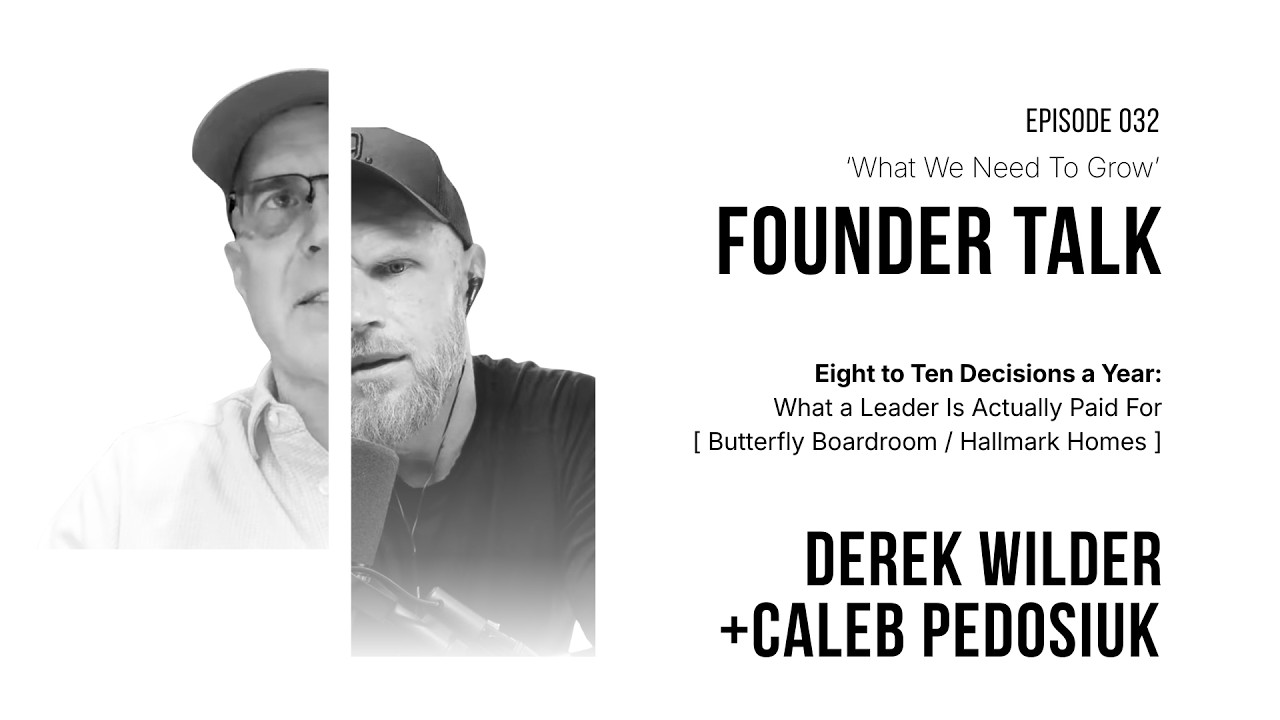
A second conversation with Derek Wilder, CPA, CEO of Hallmark Homes and author of The Butterfly in the Boardroom, following his first appearance on the series. That one established the claim that a business behaves more like weather than like a machine. This one asks the harder question that follows: if chaos is the operating condition rather than a failure state, what is a leader actually for? His answer is the line the episode is named for. He makes about eight to ten decisions a year, and that is what he is paid for. He is a systems person first, explicit that a company without systems should go build them before any of this applies, and his argument starts one layer above: you will still never get it perfect, and the weather will still rock you. The proof is a thirty million dollar project rescued not by powering through or firing anyone but by adapting the shape of the team around a manager who had outgrown his depth, and a feedback loop built so the riskiest thing on any site reaches the CEO in thirty seconds regardless of the org chart. The problem-solving app he built from the book is free to use at butterflyboardroom.app. That is the throughline 79 Development keeps coming back to. A founder who can name how they actually think has something durable to say, and an honest, legible account of that thinking is what makes a brand understood, trusted, and findable by the systems people now ask for answers.
KEY TAKEAWAYS
- "I make about eight to ten decisions a year. And that’s what I get paid for." He works plenty of hours, but the compensation is for a handful of judgment calls. It is the sharpest statement of the thesis, and it reframes the job: if chaos is the operating condition rather than a failure state, then a leader is not someone who prevents storms, they are someone who reads a small number of moments correctly. His frustration is that he does not yet know how to teach it. That is what the book and the app are an attempt at, giving the philosophical underpinnings of the call in a form somebody else can use.
- Chaos is the territory, not the thing to escape. He is blunt that the tidy version sells books and does not survive contact with a real company. "It’s not a matter of, wonder if I’ll go through a storm. It’s a matter of you’re going to go through a storm." Little ones every other day, big ones on market cycles, and no plan or strategic initiative will see them coming because none of them can predict the future. What changed for him was not a technique, it was relief. He spent his twenties and early thirties beating himself up trying to stop the chaos before realising that stopping it is not what makes a leader or grows a business. "Chaos is not the thing you’re trying to run from. Chaos is like the edge of opportunity."
- He is a systems person first, and that is what makes the argument land. Deloitte, CPA, self-described geek about elegant systems, and explicit that a small business without them should go read The E-Myth and build them before listening to any of this. His point is the layer above: once the systems and the duplication are in place, it is still true that you will never get it perfect, and the weather will still rock you. Accepting that is not an excuse to stop systemising, it is what stops a leader from treating every problem as personal failure.
- The Ohio project, and what adaptation looks like when it is expensive. Two hundred homes in eighteen months for an investor, roughly a thirty million dollar job, run by a construction manager who had been with him fifteen or twenty years. The man was managing well and was not developed enough as a leader for that scale, and it showed as a quiet disconnect with subs and suppliers rather than a crisis. The black and white options were power through or fire him, both with ripple effects. What he did instead: an honest conversation naming the challenge and the strengths together, several relational circle-backs after the man got defensive, and then moving in a younger manager with far less construction experience but real leadership instinct, while keeping the original manager in place to watch it work. The texts from suppliers turned around almost immediately. "The best plan is a plan that ultimately becomes a different plan."
- A CEO needs a feedback loop that survives the org chart. Asked how culture gets built, his first answer to a peer running a big development company was that you do not know what is being said in the field by employee number fifty, and you are disconnected from it. His fix is a standing instruction rather than a report: the most important thing every morning is to assess risk and name the riskiest thing right now. It reaches him in about thirty seconds and five minutes, through however many theoretical layers, because he has spent years teaching for it. The reason is not tidiness. He is holding several projects at once, and a single crew problem only means something inside that bigger frame. "Somebody that thinks like that is a person that doesn’t understand chaos."
- Managers and leaders, and the licence to break the rule. He reaches for the line he attributes to Warren Bennis or possibly Drucker, that managers do things right and leaders do the right things, and uses it to separate what reporting can and cannot do. Dashboards answer whether guidelines are being met. They cannot ask whether the guideline is still the right one. "We follow the rules to execute at a high level. But ultimately the great leaders know how to know when and how to break the rules and then reset the rules."
- "Butterfly for parenting." The best moment in the episode is not about business. His wife Jenny, who has never run a company, put a genuinely small problem into the app, a neighbour whose friendly texts about Amazon deliveries had started to feel like being watched, and it came back with small bets, the butterfly effect, and leaning in rather than going all in. She said she would do what it suggested, and then said this is not just butterfly for business, this could be butterfly for parenting. Derek’s read on his own tool changed on the spot: "It’s more of a world view about how we think about problem solving than it is about any specific kind of issue."
FULL TRANSCRIPT
What We Need to Grow, Episode 032: Eight to Ten Decisions a Year. A Founder Talk conversation with Derek Wilder, CPA, CEO of Hallmark Homes and author of The Butterfly in the Boardroom. Cleaned for readability; the words are the speakers' own.
Caleb Pedosiuk: All right, here we are. Derek, part two. I asked for a follow-up conversation because I really enjoyed our first one, and I mean this: anytime somebody says something and I am still thinking about it the next week and the following week. At least four or five times I found myself in regular life going through this idea of a butterfly effect. The butterfly effect is not a new concept in physics, this idea of small things creating hurricane-like conditions through a ripple effect of activity, but you have applied it specifically to business. One of the things you said was that business is more like weather than it is like a machine. I am wondering if you could share a little of your lens into what that world is like for the average person going into business, or considering building something.
Derek Wilder: So all I have done all my life is build businesses, and sell some of them. From my perspective, just in the last year or so, I have been thinking a bit more about retirement and not building businesses, but also maybe paying it forward. So I know it sounds a little odd, but lately I have been getting on things like Reddit and seeing what people are talking about. I have never been that kind of guy. I have just built the businesses. I do not know what everybody else is doing. I do not even know what they are talking about on Facebook, or X, or any of these things about business. But lately I have been trying to follow along.
There are lots of people out there trying to understand how this really works. And there is so much content of, here is how you do it, and it usually sounds sanitized, or clean. Here are your five steps and it is going to work. That is how you sell books. But almost every time I listen to or read about these things, I think, no, that is not the way it works in real life. Not to get to 100 million, not to get to 500 million in sales, and not to sell a company and make enough to retire. You might be able to put a little game plan and a strategy together for a coffee shop, but how do you duplicate it? It is much less clean. It is just messy.
So for someone to develop the skill set to make it through and grow a big business, it is incredibly important to grab the skills that let them completely recognize the storm. It is not a matter of, I wonder if I will go through a storm. It is a matter of, you are going to go through a storm. You are going to go through little storms every other day. You are going to go through a big storm during market cycles. And there is no strategy and no plan that is going to get you through that storm. Your plan is not going to know the storm is coming. Your strategic initiative is not going to know how to predict the future. It cannot possibly do that. If we could predict the future we would just buy a lottery ticket.
One of the easiest ways for people to understand this concept, because they want control, they want a plan, they want to make sure it works, and I know that is comforting: just think about five years ago in your life. Whoever is listening to what I am saying right now, think about five years ago. Ask yourself, yep, everything I had written in my little plan, that is where we are at. Almost inevitably, when I ask people to think about where they were and where they thought they were going to be, and how it lines up, there is at least a snicker, if not a laugh.
But the thing I have found so comforting in this message is that when things keep going awry and that storm keeps coming, as a businessman I do not feel nearly as bad about myself when I realize, no, this is how it works. The maze is the territory. Chaos is not the thing you are trying to run from. Chaos is like the edge of opportunity. I spent years, especially in my twenties and early thirties, beating the crap out of myself because I thought, how do I stop this chaos? And then when I realized, no, you do not stop the chaos, that is not what makes a great leader and that is not what makes a business grow, you figure out how to engage it in a way that is magical. That was such a relief to me, Caleb.
Caleb: Just for context for this conversation, building on the last one, you come from a Deloitte CPA career, you have got graduate degrees in theology and counseling, a PhD in biblical exposition, on top of 30 years of operating. I think it was the largest custom home building business in Indiana, with something like 2,000 homes built. I do not know if I have all those details right, but even roughly, the fact that you are in these industries. You have got this CPA mind, you understand numbers, you understand accounting, and you have this very practical business build where you are building very complex things across market cycles across multiple decades. And then you have this lens where you can also look at it through a philosophical and theological one that understands historic context. It is not just philosophical theory, you are looking at stories through the ages that have been recorded and have verifiable evidence in archaeology.
I had an economics professor who said a lot of the biggest breakthroughs come from individuals who have very different worldviews. You studied philosophy and biology, or physics and chemistry, and when you put those two together you see different patterns. So just for some context with what you are saying, part of what really stands out to me is that you are not looking at this from a perspective that does not understand the consulting world, where you would say, here is the framework to use, or here is how we will structure it properly and it will work out better.
Derek: I have been there, done that. Absolutely. All those things you said are true, nuanced, but true. You got the gist of it right. I was a Deloitte consultant for years. And chaos theory is interesting because it is physics, but it is also kind of a worldview, and I am leaning on the worldview of chaos theory. There is all the physics behind it, the science behind chaos theory, but when I started really more deeply understanding chaos theory I thought, no, this is kind of how life works. And again, the relief came when I realized I do not need to fight that. I do not need to feel guilty about it.
Most leaders I work with spend all their life, all their day thinking, how can I solve this problem and hopefully it will never happen again. This was a bad day because these problems happened. Now, clearly I am a big fan of modifying a system to make sure we do not duplicate mistakes, so I want to make sure that is very clear. I am a systems guy. It is hard not to be a systems guy. Deloitte, CPA, kind of a geek. We are constantly attempting to create elegant systems for our workforce to engage in and perform at a high level. Those are non-negotiables. Every business needs to have those, and if you are a small business that does not have those, you need to read The E-Myth. Start from there, create the systems, start building the systems so you can create duplication.
I am talking about the next level up from that. I am assuming you have got those bases covered. Because now that I have tried to systemize everything, now that I have tried to make everything perfect, now that I have spent these years trying to create a business that is consistently working and taking all the problems off my desk, I realized that is never going to happen. There is a point where you get the systems in place, you get the duplication in place, you grow the company, you build the business. But it is okay to then realize you are never going to get it. You are always going to have problems. The weather is still going to rock you.
Caleb: The weather is going to. Yeah. Prior to our first conversation I had always thought of businesses as a machine, as an engine. When you first mentioned weather I was tracking with you, but I did not think too much about it. Then over the summer we spent a lot of time out in nature. One of the immediate things I know to do when we come in and get settled, for our dining tent specifically, is figure out where you are going to ratchet strap that thing down. I will use blocks to hold the seams where you do not have anything to hold to. I have these leveling Lego-brick-style blocks, I will wedge them in between the fabric, put a board over it, and put rocks on it to hold it. And this thing will hold through the storm.
So storms come and I do not think about it at all the way we used to set up our outdoors. The interesting thing, as you were talking, is that it made me think it does not matter if it is sunny the whole time. Great, it is sunny. But if rain does come, or a big storm does come, I feel a certain sense of peace of mind. To me, part of that with systems is that when you talk about modifying a system, it was not until the first storm came through that you realized, oh, we need more than just pegs in the ground. And then once you realize that, you realize we need a couple of ratchet straps, and how would we do that, and you are tying to a tree or something else.
I am also thinking, as you were talking, about how you grow in business and understand things like wearing a merino wool base layer. How do you have a rain shell? What do you have in different environments, if you are hiking versus if you are stationary? And if you are going into bigger business seasons or cycles, knowing, hey, winter is coming, guys, do not be surprised. If you wake up every day during winter wondering why it is not summer, you have got to adjust that perspective and say, no, we are in a cycle right now that could be a number of weeks or a number of months. We do not know how cold or wet, or how much snow or freezing rain there will be. But we are in this for a bit. And I am thinking about market cycles right now, too.
Derek: For example, in 2008 I was already 15 years into this residential construction business. I remember during that time beating myself up because it was the first time Hallmark had ever broken even. We made money every single year I ever ran the company. But that year we basically broke even. We paid ourselves a little money, maybe a bit of a payroll, and that was pretty much it. I actually went and grabbed some consulting work on the side just to supplement my income and supplement Hallmark, because it was so rough.
In the middle of that storm I knew it was rough, but I was also frustrated and beating myself up. That was a time in our industry where there was not a sunny day for a long time. Every day was another day where somebody else canceled a contract. Another salesperson quit, because she was on commission, and how do you make a living if you are not selling houses? So I was losing some of my best salespeople because of that. Waking up on a Monday and having four contracts cancel on the same day. That is a million dollars of revenue on the same day that just goes away, back in 2008. And back then, because the market had already shifted, that seemed like a lot at the time.
My point is this. In 2010 and 2011, when we got to look in the rearview mirror, the vast majority of my competitors had gone out of business or bankrupt. And when I was talking to bankers and businessmen three years later, it was unbelievable how many times they were congratulating me. Isn't that odd? I was beating myself up thinking, this is the first year we are just breaking even, it feels like we are just getting by. And then a few years later I am getting congratulated with, I cannot believe you made it through it. So in the middle of that storm, the way I think is, if I can just help people grasp that the storm is the territory. This is how it works.
Caleb: So within the storm, practically speaking, let us assume someone is tracking with you and they can see it. You come into a week, or you are in a season like 2008. How does your lens now on a Monday morning look compared to what it might have looked like before? Part of what I am interested in is also from a faith perspective. Do you feel like, whether it is a staff member, someone in management, or an owner you are advising, you are saying, be looking for butterfly-like opportunities, or be looking for clues as to what you should be doing? In terms of battening down the hatches, or shifts and adjustments, how does it practically look to take this philosophy and use it?
Derek: So I will start with this. When we have a plan and we have something in place and we are driving towards it, one of the knock-off effects is that it is harder to shift. Because you are locked into, this is where we are going, this is where we are going. And so it causes you to not be able to adapt. In real life it is literally being able to get up in the morning, stay in the present, and then adapt to the thing that comes to you.
Let me go through a very quick story. We have a big multifamily project going on over in Ohio right now. When I say big, it is like 200 homes we have to build in a year and a half, for an investor. The construction manager out there had been working with me for a long time, but he had not worked on this big a scale. I did not realize it at the time, it seemed like a good move, but he was not ready. He was very ready as a manager. He did great managing it. But he was not developed enough as a leader to handle that big a project. So he was not getting the buy-in he needed to get.
But you have got a guy who has worked for me for 15, 20 years. He has got lots of experience and he is a great guy. And he was following up on everything. But there was a disconnect. I would talk to different people, the subs and the suppliers, and there was this disconnect between him and running this project. This is a big enough project that I have got three or four full-time guys there all the time, but he was the guy in charge.
So right then, I had a plan, I had a strategy, and now the storm comes. This is not working. So how am I going to think about this? Am I going to try to power through it, make it happen? I have seen that happen with lots of companies. You are just going to have to deal with the guy, figure it out. Am I going to fire the guy? What kind of impact could that create? And how am I going to replace him, especially out of state? That is an example of a storm. And if we have got a strategic plan and an idea and here is where we are going and we cannot vary from it, that is going to be difficult. If we try to just solve the problem immediately by firing him, that has plenty of butterfly effects, plenty of ripple effects through the organization.
But if we can stop thinking in those black and white terms, and start thinking, wait, chaos is normal, this is what happens, we need to think about adjusting and adapting, how might we be able to make this work? So I was able to talk with him and be very honest and say, look, here are the challenges we are having, here are the strengths you bring to the table. I need to be able to get you more support in this area. But that does not mean I want you to go away. He got offended at first. I then circled back with him several times relationally to explain what was causing these things. I started working with him on different resources. And I brought in another younger manager who did not have nearly the experience as a construction person, but he is a great leader.
So he went out there and immediately I started getting texts from subs and suppliers. Oh, I love this guy. I really like working with this guy. This is really working. He just understood people well enough to know how to massage that. And I thought, okay, we are going to shift the leadership stuff over to this new construction manager. The older construction manager is then going to be put back in that place as he watches this younger guy who is more of a natural leader work. And so now we are finding our way through this and things are back on track.
Here is what I am saying, Caleb. My decision making through that, my relational connections through that to keep the glue together, to make this thing happen and not blow up a 30 million dollar project, was the key. But how do I teach that?
Caleb: If you could rewind the tape and go back, when do you think it was apparent to you? When did you look at it and go, oh, actually it is not black and white here, this is normal, like you said. Was there a moment you can think of where that became apparent?
Derek: Yeah, so there are two moments. The first moment was when I realized there was a problem, and that is when I started getting some feedback from other people. But then when I would talk to, I will just call him the old construction manager, meaning he is just an older guy, he is not really old, he is my age. The older construction manager started getting a little defensive about it, which then increased the odds that this was going to be a problem. Because if he is getting defensive with me, he could be getting defensive with someone else. He could be a little stressed, a little overwhelmed. So I thought, okay, there is a problem.
And then as I was talking with him and brainstorming with other guys about it, it hit me: I could move this newer guy and replace him pretty easily in the role he has got, and put him over there to make this work.
Now, here is the thing. I do not know how to help somebody make these kinds of decisions. I like to say I make about eight to ten decisions a year. And that is what I get paid for. I work plenty of hours, but I am really getting paid for those ten decisions. So what I am trying to do with this slide book is give insight into the philosophical underpinnings, in a really relatable way, of how to think about these things. Like, oh, I am just going to fire him. Wait, think about the butterfly effect. Well, I am just going to power through this. Wait, look, chaos is normal. You do not have to constantly be on track with the plan. Sometimes the best plan is a plan that is adaptable. In other words, the best plan is a plan that ultimately becomes a different plan.
So what I am trying to do is extend those kinds of things out. When I listen to other business leaders who are highly successful, I hear these underpinnings in the way they talk. It is just so dang hard to put into words, because a lot of times it feels like, no, it was kind of my gut. Well, no, there was a pattern to it. It was not just my gut. It was a couple of texts I got. It was a little bit of a defensive conversation. It was a feeling of overwhelm from a guy. It was, no, I got this. But I got this does not mean I got this. I got this means I do not have this. And then being able to sense through that. Does that help, Caleb?
Caleb: Yeah. So there are two sides of the coin. One is recognizing the problem, and the second is navigating to a solution. When you talk about teaching this, you probably have people who have some degree of sense of the problem. For a lot of people that is the reason they are looking for something else, the reason they are coming to look for some kind of solution, because they have a problem.
But the flip side of that is you mentioned you had conversations with some people around you for suggestions. That, to me, is interesting. When you ask about how to teach this, I wonder about the tool you created based on the Butterfly in the Boardroom principles, that you have made available free of charge for people to check out. That seems like the first variable that could be advised upon: come to it, explain your problem, and use that tool as the thinking partner, where you had surrounded yourself with advisors, trusted people who have been working with you for some time, and they would give you signal back that you would then make decisions on. So in a way, what you built with this tool would give other people an opportunity to leverage some of that insight, to reflect their problem to the app and have some of those principles surface considerations. Hey, have you considered this, this, this? Does that sound like an accurate description of how you have set it up?
Derek: It does. And you have hit on something very important, which is feedback loops. The tool we have, butterflyboardroom.app, is something our team uses to assess risk and to brainstorm through this way of thinking. It does give some practical advice, but often only as a metaphor. Here is an example of what it would look like in real life. Obviously AI does not know the actual people who work for us.
But the thing you said that I think was most important, Caleb, is this idea that I do talk a lot about in the book, which is the feedback loops. You would be amazed. I literally just had lunch with a guy a couple of weeks ago who runs a big development company. He was asking me about culture, because he said, you have got a culture at your business that we do not have, and I want to know how you create that kind of environment. And the first thing I mentioned to him was, you do not know what is being said out in the field with employee number 50. You are not getting that feedback. You are disconnected from it.
So it is critically important, no matter how big the company gets, that the CEO has some way to get a trusted feedback loop from the field. I will get an update today from Anthony, and he will tell me we have been struggling with our siding crew. We lost our siding crew, a family situation came up, on this big project. So we are working on trying to hire another one. Every day, even though there are plenty of theoretical layers between me and that guy working on the siding crew, that feedback is going to come to me. Because I have spent years teaching my team that the most important thing I want you to do this morning is assess risk. Determine what is the riskiest thing right now.
The riskiest thing on that project right now is that we need a siding guy. We had been told there was going to be a guy show up on Friday and Monday, and he was not there. And then we got another crew who was supposed to show and they did not show. Okay, that is the biggest risk. So I need to know about that every day. But I do not need to tell Anthony to tell me about that. Anthony knows he has got to determine the biggest risk and report the biggest risk update to Derek. And that is five minutes. That is not five hours. But it is critical that the CEO has a way for somebody to say, for 30 seconds, here is the risk, I need you to know about it.
The reason is that the CEO can then take that risk from that project and put it in a much bigger framework, because we have got subdivisions going in Whitestown, another subdivision starting north of Whitestown, a big townhome project starting in Brownsburg, we have got these 200 units going, we have got a villa project over in Westfield. I have got to be thinking about how that all fits. And if I have no idea what those risks are because I did not ask, because I did not want to know, because I put my head in the sand, I did not get a call so hopefully everything is okay and I really do not want to open up a can of worms. Somebody that thinks like that is a person who does not understand chaos.
Caleb: Do you find that with some of the project management tools, some of them out of the box with software, some of the daily reporting, status updates, photos of the site, any problems that surface, that software is serving that initial data capture? Whether it is a 200 person company, a 2,000 person company, or a 20 person company, you are going to have a certain end-of-day status, green, yellow, red, photos, and then allowing tools like AI, set to query or synthesize information a certain way, to surface it to the next tier up, or even give you a summary that your inner circle or you could be making decisions on.
Derek: Yeah, those reporting mechanisms are in place for us and they need to be in place for everybody. And I think they do a great job in assessing management. Are we managing well? Are we hitting the mark? We have guidelines in place, are we meeting those guidelines? I think it was Warren Bennis, or maybe Drucker, who made this pretty famous, and it is this line: managers do things right, but leaders do the right things.
So those reporting mechanisms are going to help see, here is what we are doing, are we doing it? But what a leader is going to do is ask, wait, I am not sure we should be doing it that way. That is the sixth sense of pattern recognition I am talking about. Yeah, these are the rules, these are the guidelines, this is when we order the carpeting, this is when we have the Gantt chart working, this is how we pay bills. That is the system. But the leader is the one who is always assessing: we have put all these things in place and they have worked, which one now is no longer working and needs to be changed? We follow the rules to execute at a high level. But ultimately the great leaders know how to know when and how to break the rules, and then reset the rules. That is the kind of thing I am talking about here.
Caleb: Doing the right thing. I feel like butterflyboardroom.app seems like, why not use this if you are somebody in management or leadership looking to grow in this area? So to check it out and use it, is it at all technical? From the way the app works in its current version, is it something somebody could get specific about, with context for their industry, like yourself with custom home building? Or is it something more strongly suited for higher level personnel or project related questions?
Derek: It is a great question. Think about it as more of a problem solving app that is based on a way of thinking about problem solving. For instance, my wife has never worked, let alone run a business. She is an amazing mom, an amazing grandma and unbelievable support for me. But she has no idea what I even do, really. We were in the car the other day driving up to our cottage up north, and we were listening to the book in the car, because it is always good for me to get Jenny's perspective. Jenny is going to have a very different perspective. If she says this is boring, that is helpful feedback for me, because she does not know anything about business. Or if she says it is interesting, that is also good feedback.
Anyway, I said, get on the app. And she literally went in there and put in this problem. The problem was we had a neighbor who is constantly being a little too nosy. We will get a package from Amazon and she will get a text, hey, you got an Amazon package. Which is fine, and it is friendly, but Jenny thinks it is a little too much. Some days it is a little like, am I being watched? How do I address that with a neighbor? And she loves this neighbor. They go eat ice cream together.
So she put that in, and after seeing the answers and the suggestions she said to me, I am going to do what it suggested here. It was talking about small bets. It was talking about the butterfly effect. It was talking about leaning into it, not going all in with this discussion, but giving her ideas about how to do it. And then she stopped and she said, you know, really this is not just butterfly for business. This could be butterfly for parenting.
And that hit me. What it did for me was, and the last thing I need is to grow another business or make anything big, but what hit me about it was that this is really broader. It is more of a worldview about how we think about problem solving than it is about any specific kind of issue.
Caleb: So a problem solving tool that helps reframe a situation, that helps with the thinking of how you are approaching a problem.
Derek: Yeah. That is right.
Caleb: Well, Derek, thank you so much. I genuinely appreciate this follow-up conversation. I sincerely appreciate getting to talk with someone who has so much experience across so many successful endeavors. We were chatting offline beforehand, but really, whatever you put your hand to has succeeded through your lifetime, and I hope and believe that it will continue. And thank you for making this available to so many people free of charge as well.
Derek: Thank you, Caleb.
What We Need to Grow is a conversation series by 79 Development, hosted by Caleb Pedosiuk. New episodes on YouTube and Spotify.