Why Booking a Speaker Is a Behaviour Change Problem
For professional speakers, event and conference organizers, and experts building a platform around a message.
About Martin Perelmuter
Martin Perelmuter is the president and co-founder of Speakers' Spotlight, which he started in 1995 with his wife Farah Perelmuter, its chief executive, after the two married, quit their jobs and moved within about a month. A former corporate lawyer at an international firm, he is a past president of the International Association of Speakers Bureaus. He has spent three decades matching speakers to audiences, work he argues is a behaviour change problem rather than a booking problem.
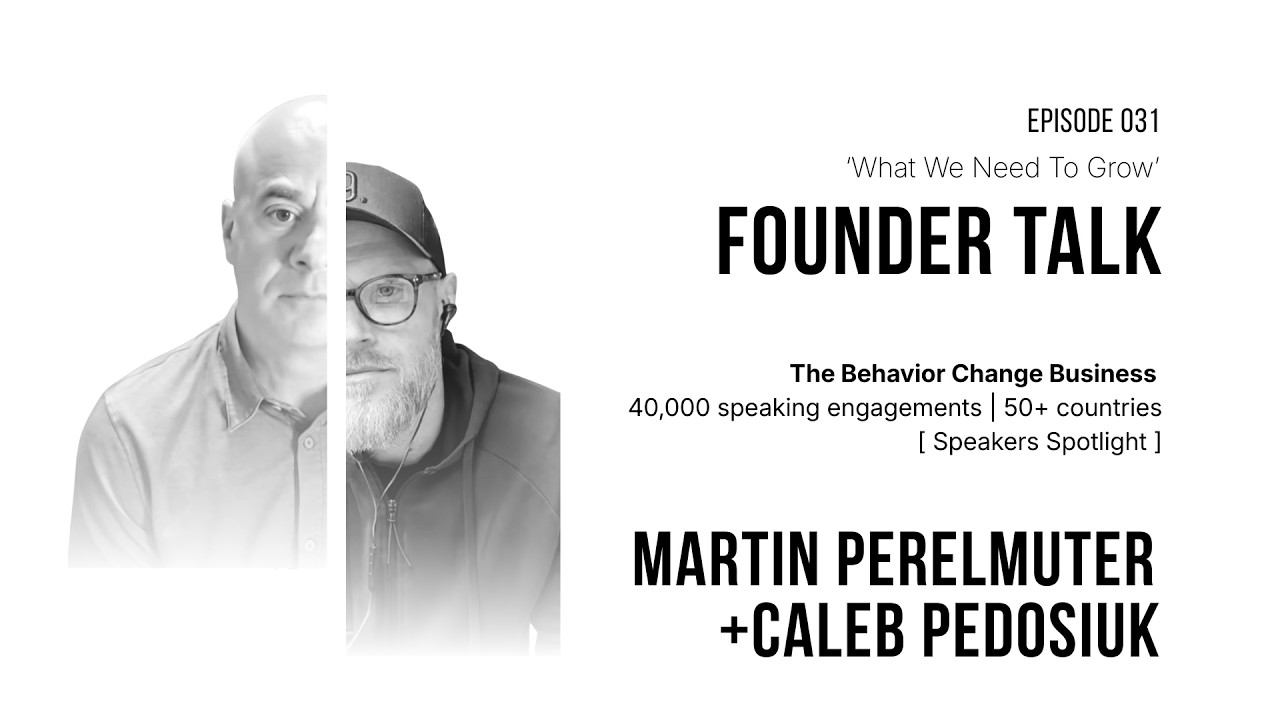
Martin Perelmuter is president and co-founder of Speakers Spotlight, which he and his wife Farah started in 1995 and which has since arranged more than 40,000 speaking engagements in over 50 countries, alongside its sister company The Spotlight Agency. His framing of the business is the reason this conversation is here: "we don’t want to be in the slot-filling business, we’re in the behavior change business." An organization booking a speaker is not filling sixty minutes, it is spending a fee and an hour of life for everyone in the room against an outcome it wants, so the deliverable is what people apply afterward. That has a consequence for anyone with something to say. A message earns its audience by being about that audience rather than about the speaker, and Martin is blunt that plenty of people can deliver a great talk without an audience taking anything from it. The part he is most animated about is finding people nobody has heard of yet, spotted in a breakout room or a podcast rather than on a main stage, and moving them to the keynote. It is the same principle 79 Development works from at the machine layer: placement follows substance, never the other way around. Authority is earned by doing work worth talking about, and an honest, legible account of that work is what makes a brand understood, trusted, and findable by the systems people now ask for answers.
KEY TAKEAWAYS
- "We don’t want to be in the slot-filling business, we’re in the behavior change business." That single line reframes what a booking is. An organization putting a speaker on stage is not filling sixty minutes, it is spending a fee and, far more expensively, an hour of life for hundreds or thousands of people, against an outcome it wants. So the deliverable is not a talk, it is what an audience member applies afterward at work, at home, or in their community. As Martin puts it, that is in some ways what they do, but it is really a lot more than filling a slot.
- Two clients, and the one people assume is the client is not. Speakers are clients in a sense, but the conference organizers and meeting professionals are the true clients, and Martin is precise about what the bureau owes them: their job is to help those clients make better buying decisions. Organizers have infinite choices and one important decision, so the work is identifying and securing the right speaker for that audience at that moment, then absorbing every logistical detail so the organizer’s job gets easier.
- The message has to be about the audience, not about the speaker. Some people arrive fully formed and just need distribution; others have something real but have not worked out what it is. The failure mode he names is a speaker talking about what interests them rather than what an audience can use. There are lots of people who can deliver a great talk, have a great message and share good stories, but the question is what the audience actually walks away with. Notably, he does not overclaim the fix: they are not speech coaches, they give tips, and they refer that work out.
- Finding the diamonds before anyone else has. The part of the job he is most animated about is not the household names, it is the people nobody has heard of yet, and clients ask him directly who is next, partly so they can book them while they are still affordable. The radar is unglamorous and human: something that jumps out on social media, a guest on a podcast, or a client who saw someone exceptional in a breakout room rather than on the main stage. Moving that person from breakout sessions to keynotes is where he thinks the real value sits.
- Asked what he needs to grow, he declined the big directional answer. After an industry that changed more in the last five or six years than in the previous twenty-five, his answer is compounding: he wants the company to be better six months or a year from now than it is today. Better at identifying talent early, better at helping clients decide, and open about where AI might augment that. No pivot, no bet, after thirty-one years of it working.
FULL TRANSCRIPT
What We Need to Grow, Episode 031: The Behavior Change Business. A Founder Talk conversation with Martin Perelmuter, President and Co-Founder of Speakers Spotlight. Cleaned for readability; the words are the speakers' own.
Caleb Pedosiuk: Okay, Martin, awesome. You are the president and co-founder of Speakers Spotlight, and if I get this right, you started back in 1995. I understand you left a career in law, and one of the things that is most fascinating to me about starting Speakers Spotlight is that this was pre-dot-com boom, or right around that time. That to me was when the internet kind of became real, like 99, 2000. I remember all this talk about brick and mortar, dot com, the world is about to change. No, it has already changed. A lot of hype around that, get on board, the technology is changing the world. And it did. There was certainly a lot of disruption. It reminds me a little bit of what is going on now. But maybe before touching on some of that, I would love to hear you introduce yourself, what you have built, and what you are building right now.
Martin Perelmuter: Yeah, thanks Caleb. So I am president and co-founder of Speakers Spotlight, and as you mentioned, we started this bureau back in 1995. It was a lifetime ago, 31 years now. My wife and I got married, we quit our jobs, we moved, and we started a business all within about a month. So if you ever look at the list of the most stressful things to do, it is change of job, change of relationship status, and moving is probably the worst. Anyone who has had to move recently knows.
So we had a lot of change back then, and we launched into this business. We did not really know what we were doing, to be completely honest. We did not have any industry experience or contacts, and very little business experience at all. So we came in as a blank slate and started to learn as much as we could about the industry. As you mentioned, it was the early days of the internet, so it was actually not even that easy to find information back then. You could not just Google something, so we had to do a lot of calling, a lot of reaching out to people, just tracking people down, trying to learn as much as we could about the industry. And thanks to a tremendous amount of hard work, lots of lucky breaks, and the kindness of many people along the way, here we are 31 years later, and the business has definitely grown beyond what we had ever envisioned in the early days.
Caleb: Very cool. So can you, in really simple terms, explain exactly what the problem is that Speakers Spotlight helps to solve? Maybe go right through from a target speaker, someone who would use your services, hearing about you, interacting with you, and take us through to the point where they are on stage or on stages.
Martin: Yeah, well, we really serve two clients in a sense. We have the speakers, who are in a sense our clients, and then we have the conference organizers, the meeting professionals who put on events and hire speakers, and those are really our true clients. So I am going to talk a little bit to each of those.
In terms of the speakers, someone has a particular expertise or experience that may make them of interest to organizations, or they just want to get their message out. Our job in that case is to help them, not just figure out what the message really is in some cases, but really more to help them connect with the right audiences. Help them get on different stages, different platforms, in front of more people so that their message can get out. Sometimes that may be someone who has written a book, maybe it is a bestselling book and they want to get out and speak about it. Maybe they have accomplished something great, they won an Olympic gold medal, or overcome some type of obstacle, or had a big success with a startup.
The meeting professionals, the conference organizers, they are putting on events. They have infinite choices in terms of who to put on that stage in front of their attendees, and it is obviously a really important decision. You want to get it right. So really, at the end of the day, our job is to help those clients make better buying decisions. Find the right speaker for that particular event, that audience, at that time. Help them identify and secure those speakers, and then manage all of the details and logistics that lead up to the event and make their job as easy as possible.
Caleb: It is interesting to me. There has got to be a gap between when someone decides, hey, I am thinking about speaking, and then they come across and say, I am interested and willing to do this. And you start to, like you mentioned, help them clarify their message, so they have a very clear signal that is being sent out, which is important to have it resonate with an audience, which would help make the flip side of the coin, the actual organizers, make it easier for them to see the value that is brought for their audience. So how do you do that? How do you help them with that? Do you point them in a direction? Do you coach them through it? Do you have a process you take them through?
Martin: Yeah, so in some cases they come to us and it is mostly, if not fully, formed. They do not need a lot of help in terms of honing the message. It is really just getting the word out. But sometimes there are people that reach out to us that we see the potential with, but they have not really figured out what exactly the message is.
One of the big things is understanding, and I think you alluded to this, that when an organization brings in a speaker, there is some type of ROI that they want. They are investing in that person. They are paying a fee to bring that person in, put them on a stage in front of their people, and there is an investment of time as well, which is probably the most valuable thing. You have got in some cases hundreds or maybe thousands of people who are going to spend an hour of their life listening to this person, so you want to make sure that they get something out of it, that the individual audience members take something away that maybe helps them do their job better, or helps them perform better at work, at home, maybe in their community, whatever the objective may be. And then for the organization hiring them, there is an objective. So that is really key as well, making sure that the speaker is going to deliver a message that is going to help move the organization forward.
Now, from the speaker's point of view, often the speaker has a message, and it may be important to them, but the question is how is this going to be of interest to organizations that might hire them? So sometimes you really have to work with them to make sure that they are not just talking about something they are interested in, but actually how their experience, their expertise, can relate to an audience. That is really one of the key things. There are lots of people who can deliver a great talk, have a great message, can share some stories, but what is the audience actually going to walk away and take from that talk? We are not really speech coaches ourselves, but sometimes we will sit down with speakers and give them some tips or some ideas on how they can make it better. And sometimes we will actually refer them to people who are professional speech coaches who can help them deliver a better presentation, if they need more work in that sense.
Caleb: The other thing that comes to mind for me, and you mentioned helping people get the message out. One of the terms that we have used over the last few years is that we help companies or brands get their message through, because that is all-encompassing, from developing a brand, messaging, whether you are building a site or a campaign or ads or whatever, all the way through. So I am curious to know, on the outskirts of some of this activity, do you feel like you have seen, or you guys have done, some of the work that goes into amplifying a message that has already gone up? So let us say you have a star speaker and they have been on a stage. Are you trusting that event to capture it properly and then have that amplification in the digital world, whether it is with Shorts or with articles, in how it shows up online? And then also the lead-up to that, being able to properly leverage, especially when there is star power in the mix, leverage that for ticket sales or to drive interest in an event?
Martin: Yeah. The industry has changed a lot, particularly in the last four or five years, I would say. So the use of video, whether it is capturing video at an event and a speaker getting these clips and sharing them afterwards on social media to help promote what they do, or creating some video in advance of the event to help generate interest and attendance if it is a ticketed or public event, that can be very helpful. Also, organizations will often use some clips after, again, if it is an event that is public-facing, they want to share some highlights from the event afterwards and keep the message going, create awareness. All those things are very helpful.
We find that video is extremely helpful. There is a speaker named Shawn Kanungo who is based here in Canada, but he speaks all over the world. He has probably done this better than anyone in terms of capturing video from his presentations and then finding usually just one or two short clips. So he is putting out content after every talk that is not just promotional, but that is actually really helpful. And that is why I think his messages have resonated so well, because it is actually useful content that he is putting out, so that not only the people in the room who happen to be at the event can hear him, but he can reach a much, much wider and broader audience.
Caleb: Yeah, I think some people refer to it as a content waterfall. Some people have systems around it. Back in 2018, we were doing some stuff where we would call it content multiplication. There was an event that we did that was focused around the Bitcoin community, back in 2017, 2018, with a series of speakers. So we captured all of that. And once you had the raw ingredients of the talk, from there the waterfall could become these pieces. You have the main piece that lives on, you have a written article that comes out of it, you have shorter segments, these Shorts, then you have stills with quotes. I cannot remember how many pieces it was for every one talk, but all of that was useful for the next conference, and it was sort of banked and then it got used that way. I remember that was so helpful. That was coming up on almost 10 years ago, so it is interesting to see how much of that is done now, and how important it is when you have a fresh, clear signal, especially if it is confirmed on a main stage that has other media around it, to take that and really let the ripples of it go out there, ideally in a permanent, lasting way across different platforms.
Martin: Yeah, no, it is super interesting. I think the value of events and meetings has changed and increased. One thing is obviously coming out of COVID, and with still a lot of people working remotely or virtually, bringing people together is a big investment and it is really important to get it right. But also, how can you amplify those messages and make the event bigger than just a couple of days at a particular location, and reach a broader audience? By sharing video pre-event and post-event, it can really help in a number of ways. Organizations have different reasons for putting on events, and being able to amplify the messages I think can really be a valuable part of it.
Caleb: One of the things that we have certainly thought a lot about over the last couple of years is, and you ask this for a brand, what is it you do? What problem do you solve? Who does it help? Who is the target audience? And then why does it matter? Why should anybody care? I like those questions, because when you zoom out and look at anything that we do in life, it is like, well, why does this matter at all? And sometimes either groupthink, or just habit or behavior that seems like it is established in a certain industry or culture, we can be doing things that maybe we do not necessarily need to be doing as much of, or need to be doing at all.
But the thing that struck me specifically looking at your website was this idea that there are people with important stories to tell. And not everybody that has a powerful story to tell, that could be very important or helpful for others, life-changing even, not everybody that has that value, that piece of the puzzle, necessarily has the other piece of the puzzle, with the resources or the connections to be able to get that message out there, to get on stages. So it is interesting to me that you guys really are a force multiplier, in the sense that you have the ability to find these either diamonds in the rough or flat-out diamonds, these stories that could have the potential to inspire transformation, inspire change in people, that has a ripple effect into culture or other areas.
Martin: Yeah, it is a really exciting part of what we do. Obviously, like you say, there are the diamonds. It is really exciting to get to work with people who are already well known and have accomplished amazing things and just help them get their message out to more people. It is equally, if not more, exciting to work with those people that nobody has ever heard of, but who we feel have an important message, and to help them tell their story, get their message out into the world, and ultimately have a positive impact.
That is a really fun part of the job for us, to try to identify who these people might be before anyone else has, and really make a difference in their lives in telling their stories, and in the lives of the people who hear them that hopefully they can really have a positive impact on. That is an exciting part of the job for us, and I think that is one of the reasons clients call on us sometimes. They want to know who do we think is the next person that might not be on people's radar just yet, but that maybe in the future will be, and they can get them while they are still affordable and really exceed audiences' expectations in terms of what they are expecting.
Caleb: That is so cool. So you are really potentially paying attention to multiple channels, like the news, cultural happenings, social media. That is interesting to think about. I would be curious to know what tools you are using for some of that, but even just the idea of keeping a finger to the pulse of what is happening seems important.
Martin: Yeah, it absolutely is. It is one of the reasons why, after 31 years, I am still doing this and doing it with as much, if not more, enthusiasm than ever. You are constantly learning and constantly trying to understand what are the forces that are impacting people's lives, people's businesses, their work, and identifying people who might have a unique voice out there that can really help, and that needs to be heard.
It is a range of ways that we find these people. Sometimes it is just on social media, hearing or seeing something that jumps out, and then doing a deeper dive into it and learning more about that person. There is a speaker I learned about a few years ago just from listening to a podcast, and they had some really interesting insights on AI and digital disruption. We reached out to them and began working with them. Sometimes it is clients telling us about people that they have seen at different events, and we have had some real great finds that way too, where someone sees a speaker and they might not be the big main keynote speaker at an event, they might be doing a breakout session in a smaller room, but they are really exceptional. And if we can help that person go from doing the breakout sessions to eventually doing the bigger keynotes, then that is a real value that we can bring to them, and obviously to the audiences that can benefit from hearing them. So yeah, it is constantly just trying to be aware of what the zeitgeist is, what we are hearing and seeing from our clients in terms of the types of topics, the types of issues that are of importance to their organizations and their people.
Caleb: Where does your positioning in the market sit compared to, let us say, corporate sponsorship or influencer sponsorship, where a company says, hey look, we know grassroots is important, we know social media really is just media. Maybe they have factored it in, or they are curious, or they have an established strategy in that space. Is there overlap with you guys on that front, where a corporation might come and say, we are looking for somebody, maybe it is a microphone brand or something that does hardware in the music industry, and they say, who do you know that has a voice that has influence, has reach, but is also a fit with our brand, in whatever those values look like?
Martin: Yeah, well, it is interesting that you mention that, because they are related and sort of complementary services, I guess. We actually, about eight years ago now, started a sister company that focuses on connecting organizations and brands with voices in the non-speaking world. So Speakers Spotlight, our core business, is essentially helping to put keynote speakers on a stage in front of an audience at a live event, and also obviously in virtual events now as well. But this other company, The Spotlight Agency, actually looks at how we can help individuals get their messages out and how we can help brands find the right spokesperson. We can find ways to help them find the right person or people to help amplify their brand in a non-speaking event. So that might be through social media posts, that might be through traditional media, that might be through a number of different ways outside of the keynote of an event.
And sometimes they overlap too. We have clients who bring someone in to speak at a conference and also do other things for them beyond that, that help them amplify their own brands. So they are complementary, I would say, and they are somewhat related, but also quite a bit different.
The focus really, I think, for conferences, for events, is learning and growth. We always say we do not want to be in the slot-filling business, we are in the behavior change business. So it is really about people coming to an event, hearing, seeing a speaker, and then hopefully taking something that they have learned and applying it to their work, to maybe their personal life, or beyond. As opposed to, oh, I have a 60-minute slot to fill at a conference, can you fill that slot? That is in some ways what we do, but it is really a lot more than filling a slot. It is about impacting behavior. And that is also what influencers to a certain degree do. They want to help brands influence the behavior of potential customers for them. So it is different, but it is kind of related as well.
Caleb: What percentage of the pie would you say is online speaking events? I know the culture has changed certainly since 2020, but do you find that 25% of what you guys are doing is someone who has got, whether it is leadership or company-wide or a mastermind group, where you are placing these people that have the ability to so impact someone's psychology that behavior can be impacted?
Martin: Yeah, it is about 10 to 15% now of what we are doing that is virtual events. Prior to 2020 it was close to zero. Everything pretty much was in person, with a couple of rare exceptions. Then obviously once the pandemic hit and everybody was stuck at home, it became 100% of our business for a while, until things started to open up again. And we are finding that it has settled in at about 10 to 15% of our business now.
It is certain types of events. If you are doing an event, for example, for International Women's Day or for Black History Month, and you want to bring in a speaker to your organization, there are challenges with that. There are space challenges. If you have got a large organization, you have got a few thousand employees, you cannot bring them all into one space. It is very expensive to do it. It is not necessarily convenient. The cost of doing that is enormous, flying people in, putting them up in a hotel, feeding them, all of these things. But you could do a virtual event, and that way it is completely inclusive. Everybody is invited to participate. You do not have to figure out who gets invited and who does not. It is an hour of someone's day. They can take a break at lunch or whatever it is, stop what they are doing and watch the talk online. So we are seeing that for events like that, that have particular themes, it is very, very effective.
I think that people miss the in-person, face-to-face of conferences, and the value of that goes well beyond what happens on the stage and in the conference room. It is those meetings outside, in the lobby, at cocktail hour or whatever it is, the networking breaks, that drive a lot of the value in events. So thankfully that is back in full swing, and that is the vast majority of our business. But again, for certain events, the virtual component is really important and is actually very, very effective, cost-effective as well as effective.
Caleb: So where do you see this going? Typically the last question I usually ask is what do you need most to grow right now. But I would pair that up with, if you were looking out five years, it is August 2030, what are you seeing three, four, five, six, ten years from now? I know that is a big spread, but do you see a direction that you are wanting to move in?
Martin: Yeah. I mean, our thing has always been that we are just trying to get better. We want to be a better company six months or a year from now than we are today, and than we were six to 12 months ago. So constantly just trying to get better, looking at getting better at what we do, improving the service that we provide, improving the way that we can help our clients make decisions. That is really key. Obviously identifying talent is incredibly important. If we can figure out, try to identify who might be someone who has a really in-demand message down the road, then that can certainly help us.
Ways of helping our clients make decisions as well is really important, and how AI can help in this. Like most industries, we are looking at different ways that that can help, and whether there are ways that it can augment what we do. I do not necessarily see a big change necessarily happening. We have had a lot of change in our industry in the last five or six years, more change in the last five or six years than in the previous 25, I would say. So I think we are now in a mode where things have settled, and certainly there is still going to be lots of change to come, and technology is going to drive some of that. But I think it is really just how do we get better at solving the problems that our clients have, and that is what we are striving to do all the time.
Caleb: Get 1% better every day, and the compounding of that. Very cool. Well, Martin, thank you so much. From what I have heard, if anyone is curious about speaking, getting onto stages, maybe wanting to branch out from the online into the real world, or they have got some degree of career or influence established in that space and they are wanting to find a way to expand that out, come and check it out, Speakers Spotlight, and the URL is speakers.ca.
Martin: Exactly. Yeah. Thank you, Caleb. Great to chat with you. Great questions. And yeah, look forward to any feedback that anybody has.
What We Need to Grow is a conversation series by 79 Development, hosted by Caleb Pedosiuk. New episodes on YouTube and Spotify.