Why Meetings Are the Work, and How to Fix Them
For product managers, enterprise SaaS teams, and founders putting AI agents into workflows people already use.
About Mark Barbir
Mark Barbir is the co-founder and CEO of earmark, which builds AI agents into the workflows product teams already use. He previously ran software engineering at Mindbody, then served as chief technology officer at ProductPlan through its acquisition in 2023. He co-founded earmark with Sanden Gocka, who ran engineering alongside him at Mindbody.
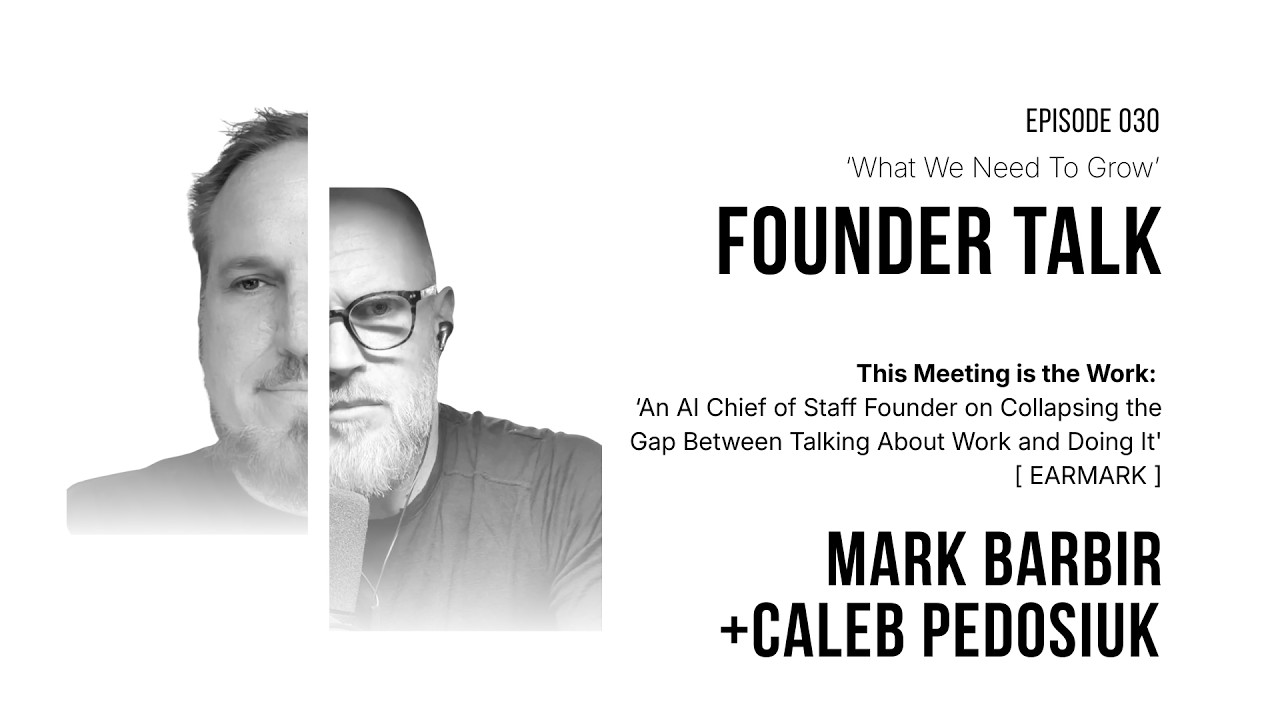
Mark Barbir is co-founder and CEO of earmark, an AI chief of staff that turns what gets said in a meeting into the artifacts the conversation implies, while the meeting is still happening. He and his co-founder ran software engineering at Mindbody across eighteen delivery teams, which is where the problem came from: in that environment the day belongs to coordination and real work gets pushed to nights and weekends. His thesis is that talking about the work and doing the work should collapse into one operation, because a company's most valuable knowledge lives in conversation and only survives if someone carries it by hand into the next tool. The most interesting part of the conversation is his honesty about his real bottleneck, which is not the product but the category, since a market full of note takers means the pitch stays abstract until somebody uses it. Asked what single lever he would pull, he named earned mentions from people whose audiences already trust them, and made the point 79 Development keeps coming back to on his own: every channel that can be gamed eventually is, and what holds is the ground held by operators doing the authentic work. Authority is earned by doing work worth talking about, and an honest, legible account of that work is what makes a brand understood, trusted, and findable by the systems people now ask for answers.
KEY TAKEAWAYS
- Talking about the work and doing the work, collapsed into one operation. That is the thesis, and it is more specific than it sounds. A huge share of a company's most valuable knowledge exists only in conversation, and today it survives only if someone carries it, by hand, into the next tool and the next step. earmark's bet is to close that gap directly: a meeting ends with decisions, requirements, prototypes and updates rather than with notes and a queue of follow-ups. Mark's five-year prediction follows from it. You will finish a meeting and most of your work will already be finished, and that will simply be how work is.
- Where it bites, concretely. He walks the product manager's path. A prototype gets shopped to five customers, feedback compounds across all five calls, and then it has to become real work: something in production with four or five nines of availability that passes compliance, IT specs and security rigor. The heavyweight ritual in the middle used to be a multi-hour session where a whole team watched a product manager play scribe into a Jira board. earmark is along for the ride on both the discovery calls and the engineering calls, so the context is already there. In feature planning, with the tickets on screen, a team can steer the conversation at a thin acceptance criterion and have it filled in live, instead of running a multi-turn loop of reviews and comments between engineers and the PM.
- Assistive agents that do not interrupt. The product already ships an engineering translator that decodes jargon and internal acronyms in real time, so the person who is lost does not have to stop the room to say so. And personas: subject matter expert agents you introduce to a call, a security architect, an accessibility champion, a compliance expert, each asking what that specialist would ask at the moment it is cheap to answer rather than late, when it is not. Mark is deliberate that this stays textual and passive for now. His framing is that a great chief of staff works in the background making you look good, and that is a different modality from an agent that talks.
- "Notes, but real work." His bottleneck is not the product, it is the category. Note takers are ubiquitous and commoditized, so earmark's first job is not getting typecast as one, and the pitch stays abstract until someone actually uses it. He reaches for Stewart Butterfield's We Don't Sell Saddles Here as the exact analogue: Slack could not be pitched as another chat utility because the claim was that it changed how you work, which is a genuinely hard thing to make legible. Mark's honest note is that customers keep reflecting better language back to him than his own copy, and that the team keeps re-synthesizing from it.
- What he wants, and why it is the interesting answer. Asked for the single lever, he did not say funding. He said relationships with people who have large, earned audiences, subject matter experts writing on Substack or making videos, because an unpaid organic mention produces tremendous inbound. His reasoning is about where the funnel now starts: it is not an AI search that begins the journey, that is the second or third step. It begins with someone you have trusted for years mentioning that they use it. He wants to know how to approach that programmatically. He is equally clear-eyed that every unexploited channel eventually gets exploited, the way SEO did, and that the durable position is the one held by operators doing the authentic work.
FULL TRANSCRIPT
What We Need to Grow, Episode 030: The Meeting Is the Work. A Founder Talk conversation with Mark Barbir, Co-founder and CEO of earmark. Cleaned for readability; the words are the speakers' own.
Caleb Pedosiuk: Mark Barbir. One of my favourite problems is one that you guys are solving, which is this idea of a digital chief of staff. It's one thing to say, hey, we can create as many agents as possible. A couple of months back you had people stacking their Mac minis, and you've got agents running around and people bragging about how many agents they're running at all times. It's one thing to have tons of agents running around. It's another to have them aligned in actually doing meaningful work, and not having it get away from you.
So a chief of staff to me seems so integral. And it's interesting to me because the problem that I understand you solve is unique, in the sense that you do not have these agents passively sitting, waiting for instruction. It is actively participating. Specifically, it's right at the pulse point of meetings, and actually doing work in parallel with meetings, so that at the close of a meeting everything isn't now trying to get back up to speed. The intelligence has actually been tracking with what's been going on. So tell us a bit about the company, how you got to where you are, and what you're doing right now.
Mark Barbir: You nailed it. Thanks for having me, first off.
So I'm building a company called earmark. We're basically trying to make meetings actually do the work for you, instead of creating more work afterwards. And the way we do that is by turning conversations that happen across the company into usable work and shared context. So instead of a meeting ending with notes and a bunch of follow-up work, earmark turns what's said into decisions, prototypes, requirements, updates, and then context that people and AI agents can use later.
The reason why this matters is that a huge amount of a company's most valuable knowledge is in conversation. But today it gets buried in meetings, or it depends on someone to maintain it, pick it up and then put it into the next tool or the next step of the workflow. We want to close that gap. So talking about the work and then doing the work becomes much closer to becoming the exact same operation.
In a lot of ways, we believe that in five years the expectation will be that you finish a meeting and most of your work will already be finished. It's just going to be how it is. That is the future of work, and that's basically the future we're preparing for.
And to your point around the chief of staff, what we really want from the product experience is, since you have all conversational context, can you be informed of maybe a dependency or work stream that's two or three projects away? Maybe an executive change in terms of strategic direction or OKRs. Can I be informed just in time, just in need, when I first wake up that day? What are the things I should worry about? Maybe there's a blocker on this other team, how do I facilitate unblocking them?
This idea that once all conversational context is there, it enables the chief of staff sort of operations you're talking about, where I enter every conversation fully prepared, I know exactly what to index on, and I'm proactively notified of these things. And then I can actually go forth and facilitate and execute work the way I need to. And that's true for basically any contributor or any leadership in an R&D organization.
Caleb: Can we take maybe one use case, maybe a simple one, and really bit by bit take us through what that would look like?
Mark: Yeah. One key use case, probably the simplest, would be something like this. For product managers, they typically go through a lot of discovery calls with customers. They're usually showing prototypes, or prototypical work of some sort. And they're trying to validate language, they're trying to validate the concept in general.
So the way we think about it is, maybe you have a Lovable prototype and you shop it to five different customers or prospects. You get insights or feedback from that, you try to harden the solution a little bit more, you iterate on it in a very lean way using a vibe coded product. And then at that point you have to turn it into real work, meaning a deliverable that's in production, that has four nines, five nines availability, that passes compliance, IT specs, that has security rigor built into it. So you have to go to a delivery team, an engineering team, to consume it, to break it up.
The way to think about earmark is that it's along for the ride through all those discovery calls, and then it's along for the ride with all the engineering calls you're having. If you have all the context around that initiative, you're able to do things like authoring user stories. A really heavyweight thing that product teams and R&D teams had to deal with maybe a couple of years ago was, okay, we're going to do a feature breakdown, we're going to look at this mock together, we're going to go through and synthesize all this customer feedback together, and now we're going to generate user stories in a live session that might take several hours. And everybody's watching a scribe, in the form of a product manager, filling out a Jira board.
For a tool like earmark, we basically take all of those steps and consolidate them into an immediate activity, because all that context is already there for the delivery team. Oftentimes the way our customers will use earmark is, say they're in feature planning and they're showing all the Jira tickets that are there. It'll have all the compounded context for the whole project. But then it actually enables you to live scribe. The solution is real time. It generates and updates documents in real time. So if you're looking at all your Jira tickets with the team, and let's say the acceptance criteria isn't quite fleshed out, people can just steer the conversation to that acceptance criteria and fill out the details that might have been missed, or that would require multiple turns in terms of your individual contributors reviewing those tickets and giving you feedback. Having this multi-turn workflow, versus just having it all solved at the same time, because we're all talking through that artifact, those deliverables, together.
Caleb: So how did you arrive at this? Was it a logical, foregone conclusion? I noticed some of the language on the website says the meeting is the work. And this comes back to this picture you've painted of the future where human beings are on these calls, but the work is happening in real time. How did you arrive at this?
Mark: For my co-founder and I, our backgrounds are, and we've been in R&D orgs for a very long time, zero to one, scaled enterprise SaaS, really high complexity environments. One example is we both ran software engineering at a company called Mindbody, which is a large public SaaS wellness platform for small wellness businesses. We had a delivery team of over 250 people that was distributed, partly through acquisition, high complexity, eighteen delivery teams spun up at a given time.
And what we found is that the coordination overhead, both for the research I was talking about, discovery to application or building, was extraordinarily heavyweight, but also the amount of internal meetings. You're close to your colleagues. Let's say you're part of a pizza team, your best friends are your designer, you're having lunch with them every day, your engineers are great. And what ends up happening is folks just gravitate to each other and servicing internal needs. And then that means more meetings, in order to get the clarification or whatever the deliverables are. And that coordination lift and overhead, and then cross team coordination, just means that people are in meetings all the time in these environments.
And what happens, and what we experienced firsthand, is that real work is just really elusive in that environment. The only time you can really get work done is early in the morning before people get on Slack, late at night when people go home, and often on weekends. The deep work just doesn't happen. And we've resigned ourselves to this condition, that we're just in meetings all the time, not much I can do, and I've got to crank that PowerPoint out at 11 p.m. when the kids go to sleep. That's kind of where we lived, or where we came from.
So the concept behind the service has always been, well, today what value do we get out of voice AI or meeting tools, really? You get a generic summary. They're sort of in the ether, people feel good, but they're really not applicable. You might use them for forensics or throw them into something at some point, but they're limited in value. The same thing is true for AI notes, which is a category that's really taken off, where it's only valuable to you in your own tracking. And yes, you could take it and distill it and synthesize it with a local agent and kick things downstream. But for us, we just think there's a lack of creativity there, where that context is worth so much more. Could we just take all that and leverage it and take that next step, which is, I'm going to generate real deliverables from this now, not just AI notes or summaries which have limited utility.
Caleb: As you were explaining some of that, it made me picture what it would be like to have a voice agent enter the chat in these discussions. And I don't know if that's currently in a model or on the roadmap. But at the end of last year we built two agents that are our primary agents. Our company is called 79 Development, like gold in the periodic table is 79. So we made one agent Seven and one Nine. And Seven strictly observes and reflects back, so it does research, analysis and so on. And then it will hand over observations to Nine, which will synthesize strategically based on certain criteria.
And it was interesting to me because we would pair them with a voice agent, and then we used our onboarding process, just simple aspects of regular onboarding for clients, where they would phone a number and have a very natural conversation. In fact I had one client after the discovery call go, was that a real person? A lot of the voice models are very accurate, this is no surprise. But I'm curious to know if there's been an instance where you'd see that integration where perhaps that intelligence might need to give some guidance and say, look, guys, you've been talking about these three things, we're at a standstill. If it could sort of raise a hand in a meeting and say, look, you guys have mentioned these, can we get a decision on them? Here are some points to consider based on our analysis while you've been talking.
Mark: Yeah. So we have a really similar equivalent to that, Caleb, but it's not a voice modality. Since it works in real time, one of the things earmark is able to do is have agents that are assistive in real time.
One example we have is an engineering translator. Maybe your team is having this esoteric debate, and it's a circular debate, but you don't want to be the one to say, hey guys, hold up, please explain what we're talking about, what is the problem really. It'll translate engineering terms in real time, or translate acronyms in real time, in terms of organizational speak that's thrown around. Maybe I'm new to the team and I'm not familiar with the acronyms that are being used.
The other part the platform supports is the idea of personas, which are essentially subject matter expert agents that you can introduce to a call. Let's say if I wanted more security rigor around feature planning, it'll play what a security architect would ask in terms of questions. Or maybe non-functional requirements like accessibility, that usually come in really late. What would an accessibility champion ask? Or what would a compliance expert ask about a certain topic? And it's all generated in a textual agent and artifact.
The idea of voice would be sort of the next step of that. But what we're trying to figure out is real time modalities that really serve, I think, more the single player. If I'm the facilitator of a meeting and I'm a product manager, I kind of want that rigor, the ability to ask those questions, but I almost need it as a passive assist, because it's not so much about showing my cards, it's really for me as an assistive agent.
We are working on a multiplayer concept though. We actually just released it this past week, where you can have multiple contributors to a single project, and then have agentic search across all context, for both projects and all discussions, all time. And maybe there are other opportunities for us where the next iteration of this is more voice assistive, in the moment while you're in a meeting. But I do like that concept.
Caleb: I can see the advantage in how you've currently built it, in the sense that it's almost running in parallel, like an assistant sitting there quietly listening, handing notes, pointing something out.
Mark: Back to the chief of staff, right? If you had a chief of staff that was super capable, what would that chief of staff do? They would be in the background providing you insights, notes, proactively getting you ready for it, making you look amazing. Which is a little different modality.
Caleb: Maybe you could have that additional voice modality take the parts of the conversation that they don't want to say, the tough part. So it's interesting you have the engineering translator. Maybe there'll be a Gen Z translator, and then back to understanding millennial management as well.
It sounds really fascinating. How do you find it, you're both co-founders from a technical background? Elon Musk, in the book of Elon, if you haven't checked it out, a very interesting audiobook to put on while you're doing something. Seeing the first principles and how he had to go learn business as a secondary thing, because he would be frustrated at the point that it's physics, it's a very concrete decision that needs to be made, and yet it would sometimes be put off, and then he didn't know if the financial decision was being made for other reasons. It was almost out of necessity that finance and sales and investor relations were all learned as a secondary. But how is it with a technical co-founder?
Mark: So I think for both of us the ramp is steep. And I think we're both open-eyed in terms of this being the cost of admission for doing zero to one, becoming a founder, being comfortable with uncomfortability, and learning a whole set of skill sets that we probably would never have imagined. Both go to market, founder selling, social content.
A great example is, we're both, I wouldn't say antisocial, but we are, to the point where we really didn't have a social presence before. And then when you have a business, who's going to advocate for you if it's not you? And also folks discover products and services through channels like that today. So you just embrace whatever that is, financial acumen, signing up benefits, setting up Delaware, fundraising potentially, whatever the paths are.
And to your point, it's all a means to an end. For us, we're just passionate about making amazing products that people want. Even better yet, a product that we ourselves would use every day, something that provides daily and essential and critical value to the customers we serve. And we want to do it in a delightful way, a thoughtful way. We kind of consider ourselves craft snobs, practitioners. We want to build the best experience ever. And the only way to manifest that, to your point, is to learn all the other disciplines that enable us to get there.
Caleb: I just want to read a couple of testimonials. I've never done this before, but I was impressed with them. So we've got a senior product manager: "If Notion and Gemini are my daily drivers, earmark is the true undisputed MVP of my stack." Strong words. Another: "Working with multiple agents at once is my new normal. It's hard to imagine going back to the old way of working." Another: "The suggested questions are always spot on, things I was about to ask but hadn't formulated yet. It's like earmark reads my mind." Another: "Absolute game changer for productivity and product management."
Anytime you're finding language like this, and I'd done product development work closely with clients in the space that were trying to pioneer AI tools back in 2016, anytime you're finding language like this it is such a beautiful indication of strong product market fit. Ideally to the point where you try to take something away from them and they're like, whoa, whoa, whoa, hold on. That's the goal.
So I'm curious to know, with adoption, where do you feel your bottleneck is right now? Do you find that it's word of mouth that's moving? Are you finding conferences? Is it through outreach you're doing, that you're actually finding the needle move?
Mark: For us it's almost entirely founder-led outbound, in the form of LinkedIn. That's our primary channel, and everything else stems from that.
From a bottleneck perspective, the biggest thing for us is that what we're doing is creating a solution that changes how people do work, in a way that people haven't really had a mental model or an analogue for before. So our first bottleneck is this idea of being typecast as a note taker. Such a commoditized space, again very low creativity space, they're ubiquitous and they're everywhere now. And so the first challenge for us is, well, notes, but real work. What does that mean? And even then, until they actually try the product it still seems a little abstract. So for them to get to that value moment, that wow moment, is one blocker for us.
Stewart Butterfield has this great essay from when he spun up Slack called We Don't Sell Saddles Here, and this idea of Slack not being yet another chat utility, like HipChat, or AOL Instant Messenger back in the day. That it was truly collaborative work, work redesigned. You're literally changing the way you do work through this multi participant collaborative workflow with the ability to share files and all these things. And the pitch was really hard. They're like, we can't be HipChat version two, we're literally changing the way you work.
I think we have very much that same sort of challenge, where it's like, we're going to change the way you work, but what does that actually mean? And how do I internalize that in short order? And how does that cascade into a funnel and go to market material and demo pitches and all the things? And we're getting better. It's a school of hard knocks. Oftentimes customers will reflect language back to us that's much better than our own language, and we're always resynthesizing and picking things up.
And then in terms of go to market, we would love to get really good at every channel. Once we, assuming we need to take capital at some point, or sort of augment, or get much more aggressive in terms of go to market, what does a multi-channel strategy look like with cold email, paid ad spend, social, AEO, which you all specialize in, our own SEO efforts. We feel like we're good at some of these things, but it's actually really hard to get really good and really deep with all of them simultaneously. So that's the reason why we've really picked founder-led selling as our initial go to market.
Caleb: I think the analogy, if you picture an engine, or gears within an engine, is really bolting on pieces of that to come in at certain points. And the benefit of that, I think, is that instead of immediately acquiring that talent, training it, directing it, overseeing it, and then having them hire within, so you get these specialized roles and you have a little department, if you're able to get the majority of that value by coming alongside a team that does a lot of that specific thing, that can be really helpful. Especially if that team will help build out that capability with you over time, so you just hand over that aspect of it.
Mark: Yeah, that would probably be the model we go with, because I think with a lot of AI native shops we're just at this inflection point where we can do so much with so little. And the idea of augmentation in terms of agencies seems appealing, or folks that are just subject matter experts that can do the initial lift. And then maybe they hand off once the machine and the gearing is built, or maybe we learn from those engagements and absorb, just through osmosis of having those engagements, how to do the work ourselves.
But I think our bias is almost like, augment in that way first before hiring. And then if for whatever reason it becomes a gold vein of a channel and just requires real nurturing and love, then the economics will work out, maybe we do staff up for those things. But we're still finding our way.
Caleb: I've heard the only real ratio you need to pay attention to is LTV to CAC, how much is it costing us right now to acquire a customer and what is the potential lifetime value. There are some numbers in here that I think are worth chewing on, really considering what a lifetime value would be, especially considering what the valuation of your company might be like in a couple of years, or whether or not you would choose to take an exit, what that exit might be like within a certain horizon.
If there's this gold rush, if companies are looking and acquisition becomes more of a growth strategy for some entities, what is that value? If you look twenty-four months out, what would this value be? If you can get some sense of what that number would be, and come back to see what the value of any one customer is, then to me it feels a little bit like the game right now is acquisition to some degree. Acquisition, if you have enough of a market fit to keep them.
Because I wonder if the biographies, the stories being told a few years from now, and you look back at the Jeff Bezoses and others that are hedging their bets going into it, knowing the probability is that we won't land exactly where we are. But if you've been able to acquire customers that would trust you with your product as a chief of staff to get the work done, buying into the thesis you painted here, that we see a world where you log on to calls like this and the work is being done by the time you log off, then it might be that acquisition of those customers becomes the calculation that you want, while you just continue to iterate.
If you can keep the testimonials coming that you're seeing right now, then part of the game right now might be to grab as much of that real estate as you can, economically speaking, businesses that are doing stuff. Because if user behaviour solidifies, and people choose, if they're with Yahoo, Hotmail, Gmail, if they sort of settle and they're like, I'm done entertaining which email is the best, I don't want to think about it any more, I'm already paired with this. There might be some aspect of that when it comes specifically to trusting a chief of staff.
Mark: Yeah, Caleb, I don't disagree with you. I think it's definitely a land grab right now, and that people are making up their minds in terms of what the next wave of incumbents are.
But what I do like about where we are right now, with how disruptive it's been, you think about OpenAI a year and a half ago relative to Anthropic's position today, and the inversion that's taken place in terms of enterprise, and doing something really well and serving enterprise really well. I feel like the script hasn't been written for any incumbent right now, nor any startup, which makes it really, really fascinating.
So for us, we know that we'll get to that land grab mode. But there's also a lot of value in almost incubating a concept where we have enterprise customers, large scale SaaS organizations, and there are hundreds of users that are using the platform today. For those ones, if we make the product just absolutely amazing for those audiences, which we feel like we're really close to, we're basically calibrating the machine around delight and stickiness, and, like we mentioned, daily and essential use being one of our goals. We can validate all that with those audiences as we get better at our go to market motion and diversify channels.
But we're learning it all at the same time, to your point. The Elon example, if he has to learn rocket engineering, the analogue is that distribution is rocket engineering right now. And we have no choice but to get good at it. That's fine, that's just the way it is. So I feel like we're both, me and my co-founder, like sponges around distribution concepts right now. And to your point, I think a lot of the inherent value in early stage shops like ours will be, did they figure out distribution at the right time in order for that flywheel to get spun up to be relevant? And that the distribution piece is as important as the core product piece. Completely agree.
Caleb: Very cool. Well, if there was one thing that you felt like, if you could push one lever for growth, the most important thing, if you had to put your finger on one thing, what would it be right now? You mentioned possibly funding, an investment round. Is that something you feel like would have the biggest needle move for you guys?
Mark: I think what we're seeing is that if we're able to cultivate relationships with people who just have large followings in general, social, maybe there are subject matter experts that write a lot, domain experts that are recognized through Substack and YouTube or whatever else.
And what's really interesting is whenever we have a mention of our service, not even in a promotional way, just in a, hey, use earmark for this, it's my chief of staff, use it with Obsidian in my local agents or whatever, what we see is just tremendous inbound and organic interest from those events.
So one thing I'm really keen on, and I know some folks have figured this out and do a really good job, is how do you programmatically approach relationship building with those key individuals that have these large audiences? Because in some ways they come so qualified. They've heard about it. This is how we consume and purchase services today. It's not me even doing an AEO search, that might be like the second or third step. It might be that I heard the solution is pretty amazing from somebody I really trust, they've been following this person for years, I heard it on this podcast last Tuesday, whatever the inception is. And then at that point they're going to go through their own discovery around the service, they're going to go through the trial, they're going to be bought into whatever it is.
And it's really interesting because it basically accelerates the first ten steps of getting a person primed. So that's the big thing for us. Can we solve for that? If I found a magic wand, I would solve for that.
Caleb: One hundred percent. It's interesting, because the inverted version of that also works. Top of funnel can quickly move someone from step one, from not even knowing who you are, let alone cold, to being warm with strong intent to purchase. But the opposite I think is interesting, especially in high ticket big contract procurement, where you're dealing with hundreds of thousands or millions of dollars, where already your business development team has made contact, their sales connection is there, but someone is going to now look and say, okay, of these, who are the real contenders?
So you're already mid funnel and now you're wanting to move closer. Because the team, whether it's a board or other decision makers, they're going to use whatever model they already trust, and the more they use it, it reinforces their trust in it, like a trusted advisor that they may trust more than their friends. Because when it comes to that level of precision or expertise, they wouldn't necessarily trust their friend to make a call like that. So when they ask, and you surface already answering all the questions in the tendering process, that's an aspect of it that I think is really special and I don't think a lot of people necessarily understand right now.
Mark: I agree. I've read a fair bit about conversion rates from just having that type of presence, and how hard it is to cultivate it today. Basically the Reddit signal. I think OpenAI's crawling of Reddit just totally dropped yesterday. But if I was going to approach Reddit, and if I had a really intentional AEO strategy around making sure that I was mentioned in all these posts and having community contributions around my product in order to help out that flywheel, those are all strategies that I'd love to figure out.
Caleb: You're speaking my language. One aspect of that is where the black hat or grey hat models for hacking the system have worked in the past, and certainly accelerated or aggravated with AI, exploitation where you'll figure it out and then they hack it, the models will adjust. And that's why the organic, even having conversations like this, feels so organic in the sense that it's building the soil of our ecosystem, because our names are connected, our companies are connected. When there's all this language and discussion connected to real world people, products, real problems to be solved, use cases discussed, it creates a richness in the soil that is absent when the synthetic version tries to just go replicate it with gen AI.
Mark: Completely agree. And to your point, every channel that hasn't been exploited will just go through that natural progression, the way that SEO did, and is still going through the same thing. What is Google doing? They're always trying to stay ahead of the operators that aren't doing the authentic work. And then how do you separate signal from the rest? But I think platforms like this, Caleb, are great, where founders can just talk about why they're choosing the problem space and why it's important. It's a great first step.
Caleb: Awesome. Well, Mark, thank you so much. Tryearmark.com, really simple to download and get started. Thank you so much for the time today.
Mark: Yeah. Thanks, Caleb. Appreciate it.
What We Need to Grow is a conversation series by 79 Development, hosted by Caleb Pedosiuk. New episodes on YouTube and Spotify.