Why Your Organization Behaves Like Weather, Not a Machine
For CEOs and senior leaders running complex organizations, and family businesses working through succession.
About Derek Wilder
Derek Wilder is a CPA and the CEO of Hallmark Homes, one of the Midwest's most established homebuilders, and the author of The Butterfly in the Boardroom: Chaos Theory and the Art of Growing a Business. He is known for the argument that organizations behave like weather rather than machines, sensitive and connected and nonlinear, a conclusion he reached after more than thirty years of watching sound plans drift anyway. He now writes and speaks on applying chaos theory, systems thinking and nonlinear dynamics to the work of running a company.
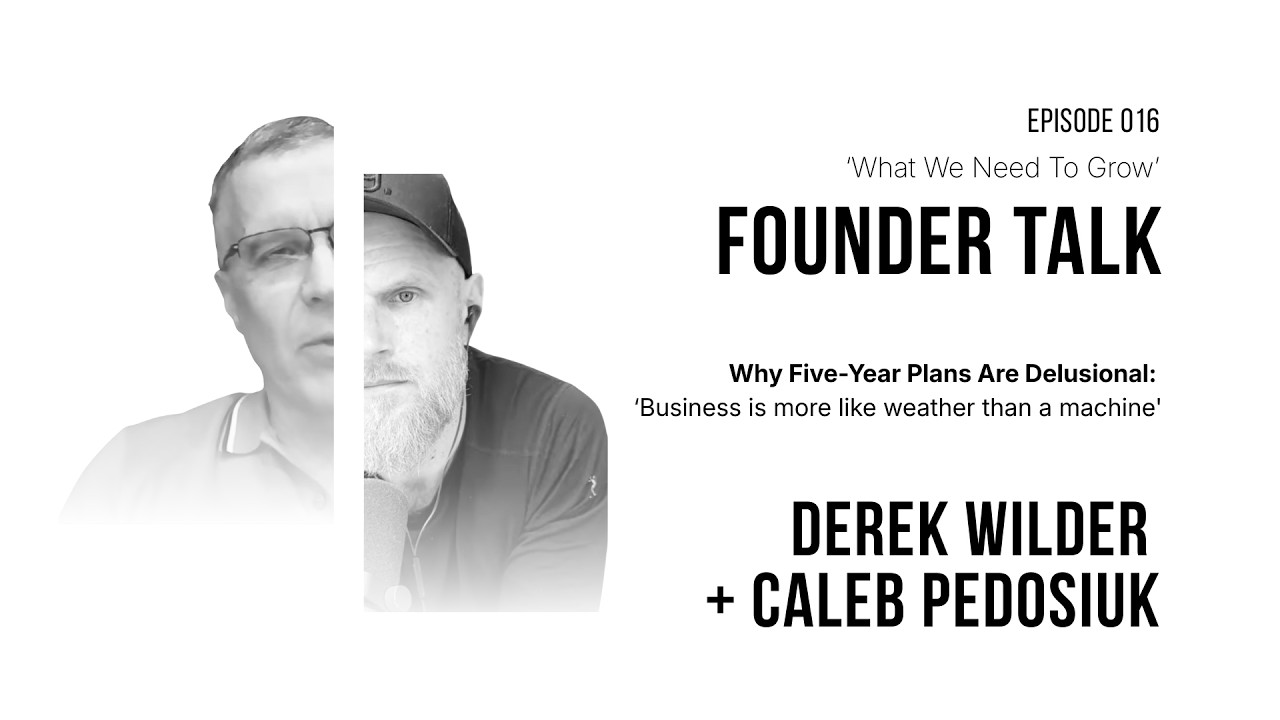
Derek Wilder is a CPA who built a residential construction company, sold it to a large Midwest developer, and stayed on as CEO of Hallmark Homes, now tracking 50 to 100 million dollars in annual sales and named the 15th fastest growing business in Indiana in 2025. Out of training the executives who will take the company over, he wrote The Butterfly in the Boardroom and turned it into a leadership app. His argument, that a business behaves like a weather pattern rather than a machine, is the kind of hard-won operating thesis that no competitor can copy and no generic content can fake. That is the throughline 79 Development keeps coming back to. Founders earn lasting authority by naming how they actually think, and a clear account of that thinking is what makes them findable, understood, and trusted.
KEY TAKEAWAYS
- Business is not a machine, it is a weather pattern. Most leaders assume that if they get all the parts and pieces right, the thing runs like a machine. Derek's read after three decades is the opposite: it is chaotic, far less controllable than it looks, and the job is riding the wave rather than assembling it. Chaos theory did not change how he thought, it gave him the language to communicate how he already thought.
- "Five-year plans are delusional." He tests it by narrating his own last five years as a plan: get bought out for millions, have the buyer die of cancer three months later, take his family under your wing, land a 30 million dollar multifamily deal because of one round of golf, and become the 15th fastest growing business in the state. Nobody would have believed it. Growth moves in S curves, not straight lines, so stop planning a straight line.
- The butterfly effect is a management discipline, not a metaphor. When his team brings him a small idea, his first question is what happens if it works. Small initial conditions produce disproportionate consequences in both directions, and the 30 million dollar project would not exist if one person had skipped a golf game. The companion test is fractals: you say you believe in clarifying expectations up front, but how do you know it reached your 57th employee?
FULL TRANSCRIPT
What We Need to Grow, Episode 016: A Weather Pattern, Not a Machine. A Founder Talk conversation with Derek Wilder, CEO of Hallmark Homes and author of The Butterfly in the Boardroom. Cleaned for readability; the words are the speakers' own.
Caleb Pedosiuk: Derek, thank you so much for the time. There are multiple things I'm really looking forward to chatting about today. You've got a background in building. From what I understand, you were the leading home builder in Indiana. But you're not just building physical structures in the real world, you've also taken a lot of that expertise and trained a coaching tool using more advanced AI tools, to make the skills, the knowledge, the wisdom you've built over the years available to others, well beyond what you could ever humanly do one on one. Which I think is fascinating. So I don't know exactly where you want to go between those two, but I'd love to hear about both, because the digital space and the physical space feel to me like a left foot and a right foot. It's almost the left brain, right brain hemispheres of what a society, a country, a community needs to thrive. I know with our kids we've really been trying to teach them to be digitally proficient but also to understand things like growing food, building, renovating. So Derek, if you want to share a little about your background and bring us up to speed with where you're focused, that would be great.
Derek Wilder: Briefly about my background. Early on I got an accounting degree and went to work for a very big consulting firm, and was with them for several years. I'm a CPA by trade. But I started my own residential building company back in the nineties. From there I went in a few different directions. I've got a couple of master's degrees and a PhD, as I continued on the education side. About four years ago I sold the company to a relatively big developer here in the Midwest, and I'm on a five-year contract as the CEO for Hallmark Homes. I'm four years into that.
The reason I bring that up is because as I'm training and developing and mentoring these young executives to take over a company that is probably going to do 50 to 100 million dollars in sales this year, it's been causing me to think about how I think about business. We're one of the few local companies that has made it through this many decades. Most companies were taken out in 2008, and COVID clearly did its own job of taking companies out in different ways. So it's been fascinating to think about how I think about business. I believe they call that metacognition.
As I'm thinking about that, and about a way of communicating it to this team so we can duplicate the way we think about business, one of the things that has really connected with me is that a lot of people believe a business is like a machine. If you get all the parts and pieces right, it's going to continue to build in a way that's machine-like. For me, it's not like that at all. It's much more like a weather pattern. It's much more like a chaotic weather pattern, and it's something far less controllable than you think you have control over. Which is why chaos theory has really informed my way of communicating the way I think. It didn't inform the way I thought, it informs the way I communicate about it.
Over the last year or so I've been digging into not just how the physics of chaos theory work but how the philosophy of it indwells a worldview, and it really has been fascinating. Take the butterfly effect. These are the initial conditions we set as business founders and leaders. They're pretty small at the time, so we don't give them a lot of credence. We have an idea, let's try a little thing, let's see if it might work. There's nothing wrong with that. But we don't necessarily think deeply about what happens if it does work. What decision are we making today that will have a disproportionate consequence in the future?
I found myself thinking a lot like that. So when my team would come to me with an idea, I'd say, wait a second, we have to think deeply about that. And they'd say, it's not a big deal, we're just trying this thing out. And I would realize, no, I spend a lot of time thinking about those initial conditions, because I have seen something very, very small become very, very big, in both a positive and a negative way. If you don't set the expectations right, it can spiral into arguments and frustration with staff, because they thought it was one thing and it wasn't. But one of the biggest jobs we've ever done is a 30 million dollar multifamily project that frankly would never have happened if Scott had not gone golfing one day. If he hadn't been on the golf course that day, it never would have happened. That one little thing.
Another example is what I call S curves. Most people try to look at a graph as linear when they're thinking about growing their business, but it never happens that way. Not with individuals, and not with organizations. Think about Apple. The undulations over many decades, of Apple doing its thing and reinventing itself and trying to find itself again, look much more like a weather pattern than a machine.
Somebody asked me the other day, what are your goals, what's your five-year plan? I really believe five-year plans are delusional. Imagine five years ago I had said this to you, Caleb. Here's my plan. My plan is for somebody to buy me out for millions of dollars, and for the person who bought me to die of cancer three months later, and for his family to then be under my tutelage. And because of a meeting on a golf course, we're going to land a 30 million dollar multifamily deal that diversifies us into another product line, while simultaneously building out more and more subdivisions on the property this developer already had, and becoming the 15th fastest growing business in the state of Indiana according to the Indianapolis Business Journal in 2025. If I'd said that five years ago, you would have thought I'd lost my mind. But if you understand that growth is more like an S curve than a straight line, you can stop planning for a straight line.
Another piece of chaos theory is fractals. A big fern and a little fern replicate each other. One of the things I love to do most when I'm talking to business owners and founders is ask them to tell me about their company, and they'll tell me about the core values, the things that are important to them. And then I just ask, how do you know it gets to everyone? You really believe in something like clarifying expectations up front. In our business it might be that we never do anything without a written change order, because that clarifies what we're doing. No surprises at the end. Bad news gets talked about up front, we don't hide it. Those are all very important things to us. But how do I know it's getting to my 57th employee? How do we know we have a healthy fractal?
All of these things are difficult to put into words. They're not things I hear and read about in business books. I have read hundreds and hundreds of business books on leadership and management over the years, and I don't hear people saying, no, it's actually a chaotic system, it's about riding this wave that's sometimes a disaster, because it's a storm on the ocean.
Caleb: Can I ask a quick question there. I had an economics professor who said you get a disproportionate amount of breakthrough from people who have a hybrid of training. Someone studying economics who had also studied biology, or physics. Those worldviews give you a whole different lens, because you're seeing patterns in a different way. So I'm curious, theologically, when you're searching for language, do you find there are principles that were helpful for you to understand this metaphorically or proverbially?
Derek: Absolutely. Let's think about chaos theory in slightly broader terms. Chaos theory is in a sense saying the world is not deterministic, it's more chaotic. But if you think about S curves and fractals, you realize there's an order to the chaos. So you start bringing in things like Genesis 1, and the original Hebrew of the first two verses, and how there's an order out of chaos.
One of the first stories I tell in The Butterfly in the Boardroom is my father asking why me, when he was dealing with my mother going through a very rough bout of pancreatic cancer. It's recognizing that maybe every decision we make doesn't have a linear outcome. Even as we think theologically about the problem of evil, maybe this life we live in is not as deterministic as we think, but maybe there's some order in that determinism. Maybe we can't go so far as to say we're fully Calvinistic in our understanding, because there's just too much chaos in the world. But we also can't get too far into an Arminian worldview when we recognize there is some order to the process.
From a philosophical perspective, it's freeing for me to recognize that I don't have control over nearly as much as I thought I had control over. It's more about riding those waves in life than it is about controlling them and being mad when they don't line up with what I want them to be.
Caleb: I think it's so interesting that when Jesus puts the disciples in the boat and sends them across, he calms the sea for them. He's literally walking across it while it's wild and crazy. That to me is an indicator that God is not afraid of the wild. The fact that Jesus many times would go up the mountain to pray by himself and be up all night. If you picture that, with the crickets and the stars and the way the garden comes alive at night, under the heavens, or sitting by a fire, or just walking on a sea that's stormy, and he doesn't even calm it for himself. He's not afraid of the chaos.
Derek: No. That's a fabulous example. There's no reason to be afraid of the chaos. The chaos is the opportunity. The maze isn't the problem, the maze is the territory. Chaos isn't something to be feared, chaos is something to use as the opportunity.
Caleb: Something I've been thinking about recently, I think it's in Proverbs, it says it is to the glory of God to conceal a matter and the glory of kings to seek it out. It doesn't say the glory of man or of humanity to seek it out. It's the glory of kings. If I look at someone at the peak of their domain, someone on the forefront of leading whatever realm they're in, it's the glory of kings to seek it out. Look at the earth, the minerals, the fact that all of this has either been mined or grown. The wood, the glass, the quartz, the silicon. All of it. These possibilities were really hidden or concealed in creation.
It's made me wonder if the way we look at challenges and problems should be more like puzzles. And if a worldview that sees things as an obstacle or a battle is a little off. Even Jesus wasn't looking at that storm thinking, I do need to walk across the sea but I should probably calm it first. He's going right through it. I've wondered whether in some of the chaos of the challenges we face, there are actually keys concealed in it. Keys for problems to solve, keys for new ways of doing things, keys for people to meet, connections being made. But if we're too focused on the wind and the waves, you stop walking and you end up faltering.
Derek: Yes, and to play off that a little, I would take it one step further and suggest that the first chapter of James tells us those difficulties and challenges are actually gifts. They're like presents on Christmas morning.
Caleb: Consider it pure joy. Yes.
Derek: Absolutely. And when we start looking at those challenges as gifts, one of the things that's so frustrating to me is listening to people talk about how successful they are and how blessed they are by God, and I have to listen to how much money they've made. For every ten people like that, there are a hundred people it didn't quite work out like that for. But that doesn't mean those challenges weren't also gifts, and that God isn't blessing them. It's a little bit like the football game. Hey, we won the Super Bowl, all glory be to God. God didn't dislike the other team. Maybe God liked the other team too.
We get into this mindset that if I'd just done everything like Caleb, I'd have been a millionaire. Or if I'd just done everything like so and so, I could have sold my business and had all that success. But if we understand the world as more like a weather pattern, and recognize we don't have nearly as much control, I think there was just as much chance that I would have ended up being worth 10,000 as 10 million. Or 50,000 as 30 million. 2008 could have taken me out. One little decision could have modified that. So you can start seeing where there's some freedom in this kind of worldview.
Caleb: I feel like that should be a strong signal from the rooftops. Here's a couple of ways it resonates with me. One is back to the butterfly effect, this idea of daily bread. For the longest time when I thought of the Lord's Prayer, I'd get to the part about give us this day our daily bread and think, that seems like a pretty low bar. Jesus, you multiplied the bread, you're talking about moving mountains. And the more I've thought about it, the more I think, actually, we only ever need this bread. Of course he's talking about himself being the bread, but the idea is that your daily bread might be to go golfing that day. It could be that the golf day is just a time of peace on the course, or a time of connection with someone. Or it could be the meeting with someone who becomes a client you serve, and in that process you build homes for people and build wealth, but you're creating wealth in it.
So the mustard seed idea, or the butterfly effect idea, is almost in that daily bread. It's what I've found myself praying more with my wife: what assignments do you have for us today, who are we to help and show up for, what is our daily bread. And at the end of the day, like in Genesis 1, looking at the day, and instead of stressing and feeling like you're supposed to grind more, looking at it with gratitude and seeing what was done and saying, it was good.
Derek: It's amazing what would happen if we recognized that there is no other thing that exists except this moment. C.S. Lewis spends some time talking about the closest thing to hell being the past and the future. And they don't even exist. So there are things that don't exist that we attempt to live in, to put ourselves through hell. But the thing that is most like heaven is this present moment.
Caleb: Be still and know that I am God. Recently I was in Ottawa, our capital, and there was a gathering of leaders to pray. It was really neat to be in that room. I met a gentleman from Quebec and we were speaking afterward. He mentioned that culturally, the prayer meeting the night before had been really different for him, pretty loud. I wasn't at that one. He said he was glad he stayed, it was interesting, it was just different. He had trained in a monastic order, and he mentioned that someone had said to him that God is a gentleman, and if you're speaking, he's not going to speak. That idea of being still, being quiet, taking the moment in to be able to really hear, to have ears to hear what the Spirit is saying.
Well, Derek, I'm going to shift it. You had one other thought.
Derek: No, go ahead, we can shift. Did you want to talk about the digital space a little before we finish?
Caleb: Yes, I was hoping for maybe the last five minutes. If you want to share what you're building, a really clear signal. Who is this for? Is it just for your team? Do you have a vision of making it available to more people in the industry? And if there's a way people can connect with you to do that.
Derek: Who this is for is anybody who is a leader, a manager, or a founder. What I have found is that the biggest challenge for leaders and managers and founders is that they end up solving all the problems, or they feel like they do. If I could just get my team to solve the problems. It seems like all the problems end up on my desk. But if we could develop teams to solve those problems before they hit our desk. I don't know that I've ever talked with a leader or founder or manager of any significant size, let's say three or four people up to 500 people reporting to them, who wouldn't say, my gosh, if we could just have that happen. If I could have a team that could really problem solve.
So what I've done is create an app, butterflyboardroom.app. It takes these concepts from chaos theory, whether that's feedback loops, planning horizons, reversible moves, and integrates them into an AI-generated problem-solving response. You go into a Coach Me section, you literally put in the challenge and the problem you're facing, and it provides feedback based on understanding business as a weather pattern rather than as a machine. We use this all the time. It's a free app, anybody can go to it, and we have several teams using it right now.
We also have a risk simulator. This is critically important when we're thinking about growing a business. We have to take risk, we have to innovate and try new things. But learning how to innovate in a way that creates a portfolio of small bets, rather than going all in, is something AI is doing a wonderful job at. It gives you the ability to prototype things without spending 700 hours to figure out that it didn't work. We're in a time right now where making a portfolio of small bets is easier than ever, with vibe coding and the like, just trying different ideas out within your business.
The app is a problem-solving tool based on the manuscript, The Butterfly in the Boardroom, a book I wrote asking, if I were going to help a team problem solve after 30 years the way I problem solve, what would that be like. Then we took the manuscript and built the app out of it. The beautiful thing is that even if at the end of the day it doesn't tell you exactly what to do, it gives you a way of thinking about things from a worldview that can successfully navigate a storm, rather than trying to get everything to line up like Lego. It also allows your team to use that language back with leaders and managers so that the team can problem solve together, rather than not being on the same page at all. Sometimes people bring ideas to me and I think, what are you thinking, that wouldn't work in any business, let alone ours. But this helps people think about problem solving like a founder, like a leader, so there can be connection and communication that's more open and effective.
Caleb: That was so helpful. I've never thought of it with the weather pattern. I've thought of things from an ecosystem standpoint in business, but weather. If someone's not used to being out in the sun all day, thinking of kids, it's so helpful to know you're going to need shade or sun protection of some kind, or you'll get burned. Or storms. We spend a lot of time by the lake, and for the temporary structures people set up, your kitchen tent, your dining tent, we found ratchet straps work really well, because of the wind coming up off the lake. That one tip alone, having lived through one storm, you just ratchet strap it when you set up and it's sunny, and you don't have to worry about it when weather comes through. Those little tips. But in a practical business sense, how much more so when you're dealing with tens of thousands or millions of dollars in some of these decisions that could easily be avoided with practical guidance.
Well Derek, really appreciate it. Butterflyboardroom.app, definitely worth checking out. And thank you so much for this time.
Derek: Absolutely. I think that sums it up very well. So it's butterflyboardroom.com for the website, and butterflyboardroom.app is the actual leadership app.
Caleb: Awesome. Well, thank you so much, Derek.
Derek: Thank you very much, Caleb.
What We Need to Grow is a conversation series by 79 Development, hosted by Caleb Pedosiuk. New episodes on YouTube and Spotify.