Why AI Has Not Reduced Misdiagnosis in Primary Care
For founders building AI into a regulated or clinical process, and for benefits and HR leaders at self-insured employers weighing preventive health tools.
About Paul Battle
Paul Battle is the co-founder and President of Medome, an AI-powered personal health record platform built on five years of research at Stanford and Harvard and designed to prevent misdiagnosis in primary care rather than document it afterwards. He is known for the argument that applying artificial intelligence to the existing diagnostic interview only reaches a wrong answer faster, which is why Medome patented a replacement for the interview itself rather than automating the one clinicians already use. He spent more than two decades in the technology industry at IBM and then Lenovo, where he rose to run healthcare as one of Lenovo's verticals, and he vetted 25 AI healthcare companies before co-founding Medome with Dr. Steven Charlap, MD, MBA. Neither founder takes a salary from the company.
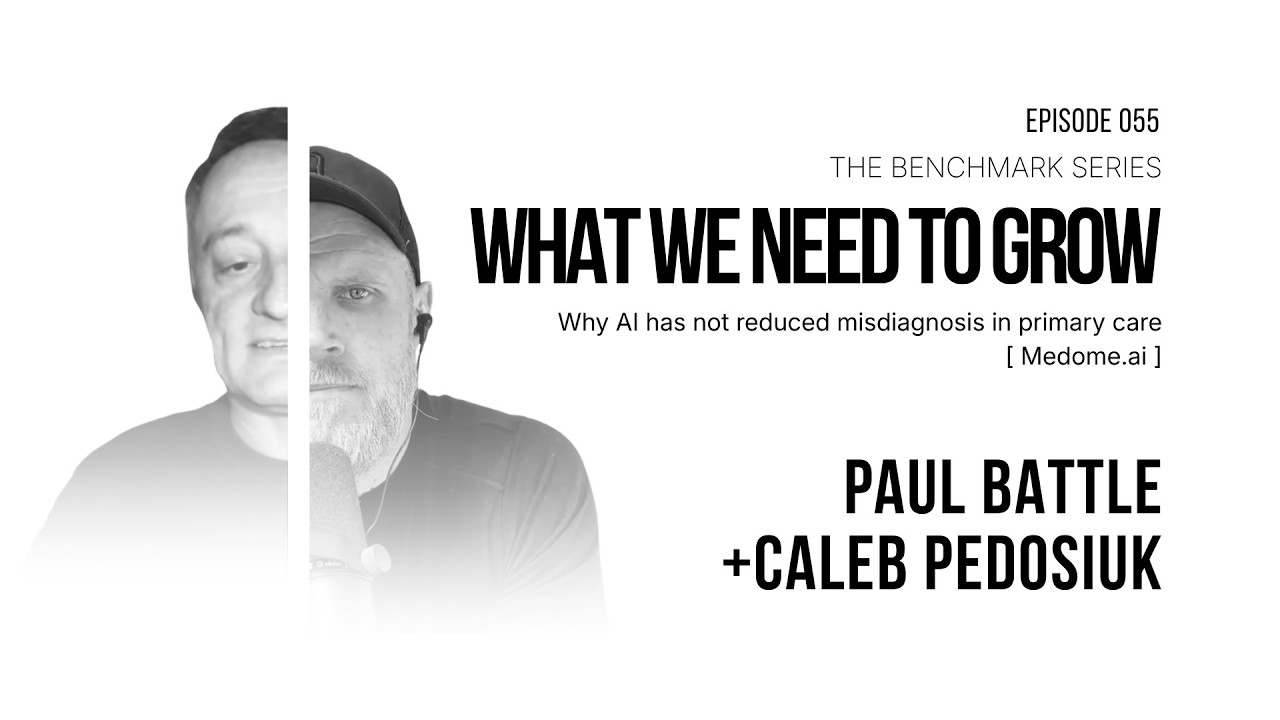
Paul Battle co-founded Medome with Dr. Steven Charlap, MD, MBA, after each of them lost someone to a misdiagnosis, and his objection to the rest of his industry is a sentence worth borrowing well outside healthcare: artificial intelligence applied to a broken process "is just going to, quite frankly, get to the wrong answer quicker." Most AI healthcare companies he vetted were automating the paperwork around the diagnostic interview. Medome rebuilt the interview. He makes the case as arithmetic rather than blame, setting 28,000 possible diagnoses against the roughly 1,000 a primary care physician may see in a whole career, and he is unusually honest about what it cost him commercially: physicians told him they do not make mistakes, so consumers became the customer. He is just as honest that his worst conversion problem is his own 30 to 45 minute intake, and he will not shorten it, because the length is what makes the output personal. Then he names the clean data as the most valuable asset he owns and refuses to sell it. That is the throughline 79 Development keeps coming back to. Authority is built by doing the harder, more honest version of the work and then saying plainly what it is, and a clear public account of that reasoning is what builds the kind of signal AI systems draw on.
KEY TAKEAWAYS
- AI on a broken process just gets to the wrong answer quicker. This is the spine of the episode and the reason Medome exists. "Their AI is really good at taking a process that is done properly and making it a lot better, more efficient and effective. But if there's a broken process, then it's not going to do anything. It's just going to, quite frankly, get to the wrong answer quicker." The companies he vetted were giving physicians fewer things to do inside the appointment, scribing the notes digitally instead of by hand. His objection is that the constraint was never the note taking: "The problem is the doctors still don't have that much time, and subsequently you're still asking the wrong questions." So rather than accelerate the existing diagnostic interview, Medome rebuilt the interview itself, and patented it.
- No primary care physician can hold the problem space, and that is arithmetic, not criticism. Battle's framing is the most quotable thing on the tape: "There are 28,000 different diagnoses. In a career, a primary care physician might see 1,000. A career, not a year. Which means they're seeing less than 4% of diagnoses. We can't expect them to know everything." He puts the misdiagnosis rate at a minimum of 15%, which he translates into something a listener cannot file away as somebody else's problem: "That means you and I will see a misdiagnosis in our lifetime, at least one, probably two."
- They tried to sell to doctors first. The doctors said they do not make mistakes. This is the pivot that set the whole company's route to market, and he is blunt about it. "We tried this with physicians, and for two reasons they said they ultimately weren't going to use it. One, they don't think they make mistakes. They're not one of the people that make mistakes." So the customer became the consumer, and the physician became a reader rather than a buyer. The product now emits a second version of its output in medical terminology, summarized to be read in "maybe two to three minutes tops," which the patient brings in, emails through the portal, or shows on a phone. A founder lesson sits underneath it: when the obvious buyer will not acknowledge the problem, the obvious buyer is not the buyer.
- The friction is the product, and he will not design it away. The upfront interview runs 30 to 45 minutes against an expectation set at 5 to 10, and he names that as his single biggest conversion problem rather than explaining it away. The reason he holds the line is what the length buys: "once they see the output, then they're hooked, and they realize the true value in this, because it becomes their personalized large language model." His distinction between generic and personal health intelligence is the spinach example. Spinach is healthy, recommended by most nutritionists, and gives him kidney stones, because he is predisposed to them and his mother has them. A wearable "has no idea who you are. It doesn't know about your upbringing, your family history."
- Two outputs, and the second one is the whole bet. A differential diagnosis is "essentially a top 10 list of diagnoses, number one being highly probable and number 10 being least probable," and it describes what you have now. A risk assessment describes what you are predisposed to. "So for me, 20 years ago it would have listed gout and kidney stones. I wouldn't have had them yet. It would have told me I probably am going to get this in the future." He made both changes only after being diagnosed, despite his father having gout and his grandfather having gout. The product is continuous rather than a one-time intake: wearable data daily, recorded appointments, lab work, genetic tests, and a re-run of the model when the underlying genetic science moves.
- He named the most valuable thing he could sell and then refused to sell it. Asked directly how he handles data and privacy, he says Medome is HIPAA compliant and SOC 2 Type 2 certified, and notes it adheres to regulations it is not formally bound by because it is not an FDA approved healthcare product. Then the part worth keeping: "You will never see this data being sold anywhere, period. That is our stance. I could see this being incredibly valuable to, say, insurance companies, for example. No, sorry, that is not our model. We are here to save lives." He will contribute anonymized data to disease research on confidentiality terms. He will not build the insurance business, and when asked what he needs to grow he rules it out again as a growth path.
- Asked what he needs most to grow, he said capital and a partner who will not take the shortcut. Medome is raising between $2.5 and $3 million and is mid-raise. Beyond the money he wants "somebody in this world that would partner with us, open doors, and has a similar mission," and he frames it against the fast option he has already declined: "I suppose we could probably go to insurance companies and quickly grow this, but that's not our mission."
FULL TRANSCRIPT
What We Need to Grow, Episode 055: The Wrong Answer Quicker. A Founder Talk conversation with Paul Battle, Co-Founder and President of Medome. Cleaned for readability; the words are the speakers' own.
```
```
Caleb Pedosiuk: All right, Paul, let's do it. So a bit of background. You co-founded Medome, an AI-powered personal health record platform built on five years of Stanford and Harvard research, designed to prevent primary care misdiagnosis by consolidating a patient's full medical history into one AI-analyzed record. There's a little bit of a personal story that, from what I understand, drove you to this. I would love for you to pick up with, or spring off, some of what I've said and share a little bit of what you're building.
Paul Battle: Yeah, absolutely. From a personal perspective, I came from a healthcare background. I did cancer research and was going to medical school, then decided to switch careers and go into technology. I went to IBM and then Lenovo, and rose through the ranks during that time.
I'd lost somebody to a misdiagnosis, and ultimately I looked at my career. I was running healthcare as one of the verticals at Lenovo, and I thought, all right, let's try and do more within the healthcare vertical. Lenovo's a great company, an amazing place, but it wasn't the right place for me to find this passion project, if you will.
So I looked on the outside and vetted 25 different AI healthcare companies, most of which, quite frankly, were focused on the ops side of things, the administrative side of things, not really the diagnostic. And I found one my co-founder had started many years ago. He also lost his brother, a trained cardiologist, to a misdiagnosis. We came together and ultimately co-founded Medome. Both of us are incredibly passionate. Neither of us takes a salary in this. We both work basically on the equity. We have a mission to save lives. That's literally our purpose for this, and why we designed it and launched it.
Caleb: In developing a product in a space where there's sensitive information, with HIPAA and other things, and very scientifically and medically specific information, there's a level of expertise that you had some background going into. I can see there are a few thresholds that might be hindrances for just an average AI startup to get into the space. So I'm curious to know about what you found once you did recognize the opportunity or the need for this. Have you found others trying to solve it?
Paul: A lot of AI companies and healthcare companies are trying to solve this. Their AI is really good at taking a process that is done properly and making it a lot better, more efficient and effective. But if there's a broken process, then it's not going to do anything. It's just going to, quite frankly, get to the wrong answer quicker. That's all it's really doing.
What I mean by that is there are a lot of companies out there that are trying to solve this, but they're using an antiquated process of diagnosis that quite frankly is what's leading to the misdiagnoses that are happening in the US. And the numbers are staggering: 400,000 deaths, 400,000 disabilities, every year in the United States alone. It's the third leading cause of death in the United States, and most people don't even know it's a problem.
And it's a cause because physicians really don't have enough time with the patient. They're not asking the right questions. They're biased. There are so many reasons for this. So that's what led to this. And yes, there are companies that are trying to tackle it by giving doctors fewer things to do while they're in an appointment, like taking notes. Let's not have you take notes, let's digitally take them. The problem is the doctors still don't have that much time, and subsequently you're still asking the wrong questions.
That's kind of what we did. We saw that as the reason for the issue. So Dr. Charlap, my co-founder, studied diagnosis and made the realization that the process is broken and was always going to lead to the wrong answers. And so hence, we have a proprietary patented upfront interview, and a proprietary patented way in which we do a differential diagnosis and a risk assessment. That's what's led to the success of this solution.
Caleb: So personal health intelligence, would that be an accurate way to describe it?
Paul: It's groundbreaking, quite frankly. There's nothing like it that exists. And there's a reason why that's an important statement. Your medical records, that are kept with whoever your medical record company is, whether it's Epic and MyChart, or athenahealth, or Oracle, are incorrect. Forty percent of it, based upon studies that have been done, is incorrect information.
So this is building a personal health record from the ground up that is as close to perfect as it's going to get, with the right information. And if we don't think it's right, we'll question you and say, hey, we're seeing a little bit of a difference here. You said this before, and you're saying this now. Those don't match up.
So fundamentally it's a near-perfect medical record, and that's why it's truly personal health intelligence. And the reason we also use the word personal is because there's a lot of health intelligence out there. I have a wearable, I'm sure you probably have something on you. I have a Fitbit, you might have a Garmin. Those all give you fantastic information, but it's incredibly generic. It has no idea really who you are. It doesn't know about your upbringing, your family history. It doesn't know anything about that.
I'll give you a good example. Spinach is healthy. I'm sure it's really good for you, you probably eat it all the time. I can't eat it. I'm not allergic to it, but it ultimately gives me kidney stones. I'm predisposed to kidney stones. I've had two of them already. My mom has kidney stones. And so therefore, something that's incredibly healthy, that's recommended by most nutritionists and doctors, is not good for me. It will cause an issue. And that's just how health information needs to be truly personalized to who you are and what's right for you.
And imagine if you could do this risk assessment in advance of getting something, versus after the fact. I changed to not eating spinach after I got a kidney stone. I changed to not eating red meat all the time, which you should anyway, but I digress, because of gout. I made those changes because I was diagnosed with something. But my dad has gout. My grandfather had gout. I of course should have been doing this well in advance. And this is what we're bringing to the table. This intelligence is personalized from that perspective.
Caleb: So who is the person, the avatar, if you will, that you're talking with? Are you primarily dealing with physicians as the ones to say yes, or is it also consumers that you're communicating with?
Paul: My customers are consumers, and there are two routes to market. We have direct-to-consumer, and we also are going to small and medium businesses that are self-insured. The reason it's really important to mention those sorts of companies is, of course, they're funding their own healthcare plans, and this will save them 5 to 10% ultimately on their yearly health bills, as a result of reducing ER visits, reducing unnecessary appointments, and reducing high-cost claimants. Because we're getting in front of individuals who may be pre-diabetic, or pre some sort of heart disease or something to that effect. When you get in front of it, it's a lot more effective to treat it, versus on the end, where it becomes incredibly expensive. And by the way, the person, when they're less healthy, is less productive. A company wants somebody who's healthy and valuable. So it's kind of a win-win for both sides.
Caleb: So I'm curious, from the vantage point of growing the company, how are you having these conversations, say, with companies?
Paul: On the B2B side, I ran a campaign with two different groups. One is a cold email campaign, and ultimately that company does the first email plus the follow-up email when there's a response, and sets up the call. And the same thing, I'm doing a LinkedIn campaign, somebody's taken over my LinkedIn. They've been able to set up a number of meetings. I probably get about one to two a day on average, meetings with self-insured companies. But as you can understand, you're not just covering the employee, you're covering the employee and their family. So we actually have a family version of the solution, whereby you don't have to fill in your kids and all your kids' information, because they're genetically predisposed to whatever you have, again assuming it's biological. So that's something we've created, and that's ultimately the campaign we've done to get clients.
Caleb: And where would you say the friction is? Is it that people just don't have an understanding of this category, personal health intelligence?
Paul: It's a good question. So the friction in the grand scheme of things comes from the upfront interview. It's taxing, and a little bit exhausting. It's 30 to 45 minutes. Most people are used to 5 to 10 minutes, and that kind of annoys them.
And candidly, I get it. I've been to a doctor's office recently and had to fill out the form, and it took me 5 to 10 minutes. And it's questions, by the way, two things. One, they're kind of irrelevant, most of them. They're not really good questions to ask. And two, the doctor doesn't even know your answers. They literally ask you some of the same questions over again. I've questioned mine and said, did you not read what I filled out?
So that's a little bit of that annoyance. The person's thinking to themselves, my doctor knows most of this, they don't take my word for it. And the friction is ultimately coming from the length and exhaustion of the overall initial stage. But once they see the output, then they're hooked, and they realize the true value in this, because it becomes their personalized large language model. It has their information. So when I'm typing my symptoms in, it's running those symptoms against my health records, not some generic record that exists in name your large language model, like ChatGPT. It actually is personalized to you. So that's the biggest friction point at the moment, people understanding why they have to fill out all this information.
Caleb: Could you, in layman's terms, or in a simple enough way that I could explain it to my teenage son, touch on the touchpoints? Let's say someone from a business just found out their employer has made this available as part of their benefits plan, and they get an email. Could you pick it up from there, what they would expect?
Paul: Sure. So first things first, you dive in. You can learn a little bit about it and what's expected of you. It'll tell you about the process, which includes the upfront interview, and then what the output is from that interview, which includes what's called a differential diagnosis. So in layman's terms, that's essentially a top 10 list of diagnoses, number one being highly probable and number 10 being least probable. It also does a risk assessment. And the difference there is that a differential diagnosis, that top 10 list, is what you have today. You're being diagnosed with that. The risk assessment is something you might be predisposed to. So for me, 20 years ago, it would list gout and kidney stones. I wouldn't have had them yet. It would have told me I probably am going to get this in the future. That's the output. In addition, it gives you questions.
So the first step is understanding what you're actually going to get from this. The second then is, okay, what's going to bring me back? Why am I going to keep doing this? Well, you can attach your wearable. That's the first thing. So now I can get an understanding in the model of what your sleep habits are, what your exercise regimen is, all those sorts of things that are generically relevant to you, because you're wearing a Garmin and I'm wearing a Fitbit. But how are they relevant when you measure them against your entire health record information? That's the connection point, and that goes in on a daily basis.
In addition, transactionally, any time you go and do any sort of exam. So for example, if you're going to your standard visit once a year with your doctor, you can bring a device with you to record them. You just bring your phone with you, open the application, and you can actually record the entire conversation. The purpose of this is not to get the doctor in trouble. It's to feed that back into the model. And then finally, any lab tests, any genetic testing you can actually have done, all that can be fed ultimately into the model to help.
And again, in layman's terms: it's continuous. It's not a one-time thing. It's not like fill it out, do it, and then you're done. No, it continually becomes your 24/7 accessible doctor, if you will, but in this particular case it's advocating on your behalf, giving you that information for you to say, hey, I need to go to a doctor, I'm at risk of this, or I need to go to a doctor, I might actually have this right now.
Caleb: So where a consumer is using this, let's say they've connected their Fitbit, they've gone through thoroughly, they use it regularly. What added advantages, or limitations, are there if the physician is or is not involved? And is there some encouragement you give them, to say, hey, this is how to present it to the physician, not to come across as though you've learned something on the internet or found some trendy thing? Is there a major bottleneck if a physician is saying, I don't need that, I'm busy enough, I have my clipboard, and it's all up here?
Paul: It's a good question. All right, so let me start with this, because this information is relevant. There are 28,000 different diagnoses. In a career, a primary care might see 1,000. A career, not a year. Which means they're seeing less than 4% of diagnoses. We can't expect them to know everything.
We tried this with physicians. And for two reasons, they said they ultimately weren't going to use it. One, they don't think they make mistakes. They're not one of the people that make mistakes. By the way, 15% minimum is what the average we're seeing, minimum. Misdiagnosis. That means you and I will see a misdiagnosis in our lifetime, at least one, probably two. And these doctors are indicating they're not the ones doing it. So we tried to give this to the doctors and not involve the patients, but they were unwilling, quite frankly.
So what we're saying to you is, you bring in the information. You can actually connect it directly to the physician by emailing it through the portal, or you can of course print it out and hand it to them, or you can bring your phone and just show them. There's a version that is in medical terminology that they can read and understand very quickly, and it's summarized. It takes them maybe two to three minutes tops. They can read through it and quickly understand that this is relevant.
Caleb: Amazing. That was the next question, like, hey, can you do this in doctor speak at an exec level? That's perfect. So another question, I guess, is that this data is incredibly valuable. Like, so valuable. And there are two sides to this coin. You've got the one side of the coin where there's HIPAA and there's privacy, and a lot of people that are like, hey, why are people profiting or selling, harvesting data, if it's my data? So there's an aspect of that that I think has a very valid case to it. There's the flip side of that that's like, hey, do you know how valuable this data could be to show correlation, causation of things in the macro, for companies to have access to this? How do you deal with data and privacy?
Paul: Good question. First of all, we're HIPAA compliant and SOC 2 Type 2 certified. So we adhere to the regulations. Even, by the way, we don't officially have to, because we're not officially a healthcare company. We're not FDA approved from that perspective. We don't need to be, but we are again still HIPAA compliant and SOC 2 Type 2, and knock on wood, nothing's happened. We have a cybersecurity policy in place as well. All of that to protect ourselves.
Now, to the value of the data from, I guess if you will say, a clinical side of things or a research side of things, absolutely it's incredibly valuable. And it's more valuable because our data is what we would call clean. Back to my 40% being wrong in medical records comment, this is not that. This is the antithesis. This is near perfect, as I mentioned, and it's incredibly valuable.
You will never see this data being sold anywhere, period. Like, that is our stance. I could see this being incredibly valuable to, say, insurance companies, for example. No, sorry, that is not our model. We are here to save lives. Not create anybody more profit, or whatever it is. That is not our purpose. Our purpose is to save lives. So if there's a chance for us to anonymize the data for research reasons, name your chronic disease, then of course we would be willing to take part in that, as long as the data again stays confidential. But other than that, not a lot of interest in anybody else seeing this.
Caleb: Yeah, I think there's something beautiful to that. What came to mind as you were saying that was the idea that sometimes people will donate a kidney, or they'll donate blood, and some people may be organ donors at the time of passing. Many people wanting to help others, in a way opting in to sharing your data for research purposes only, with a really clear disclaimer, I think, that you'd put there, that it would not be weaponized against people to squeeze out profit or take advantage of people. Who knows, maybe people would want to participate in being able to solve more problems, and feel like, hey, it's as simple as clicking a button to say, please, by all means, help others.
Paul: Exactly. And that's one of the things. Just as you're going down that path, if you do a genetic test and you upload it into the model, it will give you feedback based upon today's information that we know about genetics and what you're predisposed to. But if something's found out tomorrow, that a specific area of the chromosome means this or that, it will come back and re-go through the model and say, hey, by the way, we just learned this today, you might have a risk of this. It will come back and redo that, knowing that there are changes being made. So it's constantly searching, it's constantly updating, rather than a single point in time.
Caleb: Oh wow. So is it just the US, or are you in other countries?
Paul: We can, it's anywhere. In the US, we have partnerships with several different companies that do genetic testing, other sorts of at-home testing, and telehealth. But outside of it, we don't have any of those partnerships set up yet. But there's nothing stopping you from using the base level version, which has, of course, the upfront interview, the connections to wearables, the ability to upload things into it. We just don't have the electronic connection between an at-home testing service and us. So that's the difference.
Caleb: Yeah, I'm located in Canada and I'm just seeing the benefit of things like this. What would pricing look like, say, for an individual or for a family?
Paul: Right now it's $14.50 a month, and I think it's like $172 for a year, which is kind of discounted. So it's completely affordable, quite frankly, in the grand scheme of things, considering what it does. We're working on a family version. The family version that we're doing for the B2B side, we tend to just, any kids under 18 are free, is kind of how we're doing it. So the adults pay and the kids are free is how we've set it up. The standard go-to-market consumer version as well, a family version where the kids would be free.
Caleb: Very cool. Well, Paul, the last question I like to ask guests is, what do you need most to grow right now? I know some people are fundraising, some people are...
Paul: We are fundraising, so it's a great question and a very timely one. We're raising between $2.5 and $3 million. Pre-money valuation for us at the moment is $12.5 million. So that's our raise. Right in the midst of it, so we're looking for any and all kind of opportunities, but we're also looking for somebody in this world that would partner with us, open doors, and has also a similar mission. So as we talked about before, I suppose we could probably go to insurance companies and quickly grow this, but that's not our mission. That's not what we want to do. So we want somebody who's like-minded in that mission.
Caleb: Very cool, Paul. Thank you. I love the problem you are solving. I think it is so important.
Paul: Thank you. All right, great talking to you.
What We Need to Grow is a conversation series by 79 Development, hosted by Caleb Pedosiuk. New episodes on YouTube and Spotify.